

What sustainable business growth means and how to achieve it

Most business owners are chasing the wrong version of growth. You hit a revenue milestone, hire more people, expand your services, and then wonder why everything still feels unstable. The truth is that growing fast and growing sustainably are two very different things. Sustainable business growth means building a company that increases revenue and capacity over time without burning out your team, depleting your resources, or sacrificing the systems that keep you operational. This article breaks down exactly what that means, why it matters, and how you can start applying it through smarter operations and outsourcing.
Table of Contents
Key Takeaways
Point | Details |
Sustainable growth defined | It’s about growing profits and influence while maintaining environmental and social responsibility. |
Beyond short-term gains | True sustainability requires business-wide strategic changes, not just quick wins or greenwashing. |
Transformative approach needed | Leaders must align their business model and operations with long-term sustainable objectives. |
Outsourcing supports sustainability | Remote professionals and targeted outsourcing can drive scalable, sustainable business model improvements. |
Defining sustainable business growth
Growth, on its own, is just a number. Revenue goes up, client counts increase, your team expands. But without the right foundation, that growth can collapse under its own weight. Sustainable business growth is something more intentional and more durable.
“Sustained growth is described as continuous, long-term expansion of an organization’s revenue, market share, and profitability, achieved without compromising environmental or social resources necessary for future operation.” Sustainability Directory
That definition matters because it directly challenges the “growth at all costs” mindset. You are not just trying to get bigger. You are trying to build something that continues to function, contribute, and generate value over years and decades, not just quarters.
One framework that helps clarify this is the triple bottom line, which measures success across three areas:
Profit: Financial performance and long-term revenue health
People: The wellbeing of your employees, contractors, and communities
Planet: The environmental impact of your business operations
When you focus only on profit, the other two dimensions tend to suffer. That creates fragility. A business that grows its revenue while exhausting its team or ignoring operational efficiency is not sustainable. It is just fast.
If you want to understand how business growth with outsourcing fits into this picture, the connection becomes clear quickly. Efficient, scalable support systems allow you to grow without stretching your core team past its limits. And for businesses serious about remote staff for scaling, the triple bottom line becomes a powerful planning tool rather than just a corporate buzzword.

Why sustainability is more than financial performance
Financial performance is important. But if it is the only lens you use to measure growth, you will miss the risks that build up quietly in the background. True sustainability requires that you also consider environmental, social, and governance factors, commonly referred to as ESG.
ESG is not just for large corporations. Small and mid-sized business owners need to think about it too, because the decisions you make today about your team structure, your supply chain, and your vendor relationships will shape your ability to grow five years from now.
According to EY’s analysis, CEOs must integrate ESG strategies into their core business planning, using sustainability as a lens in both big-picture decisions and day-to-day operations. That means sustainability is not a separate initiative. It is woven into how you run your business.
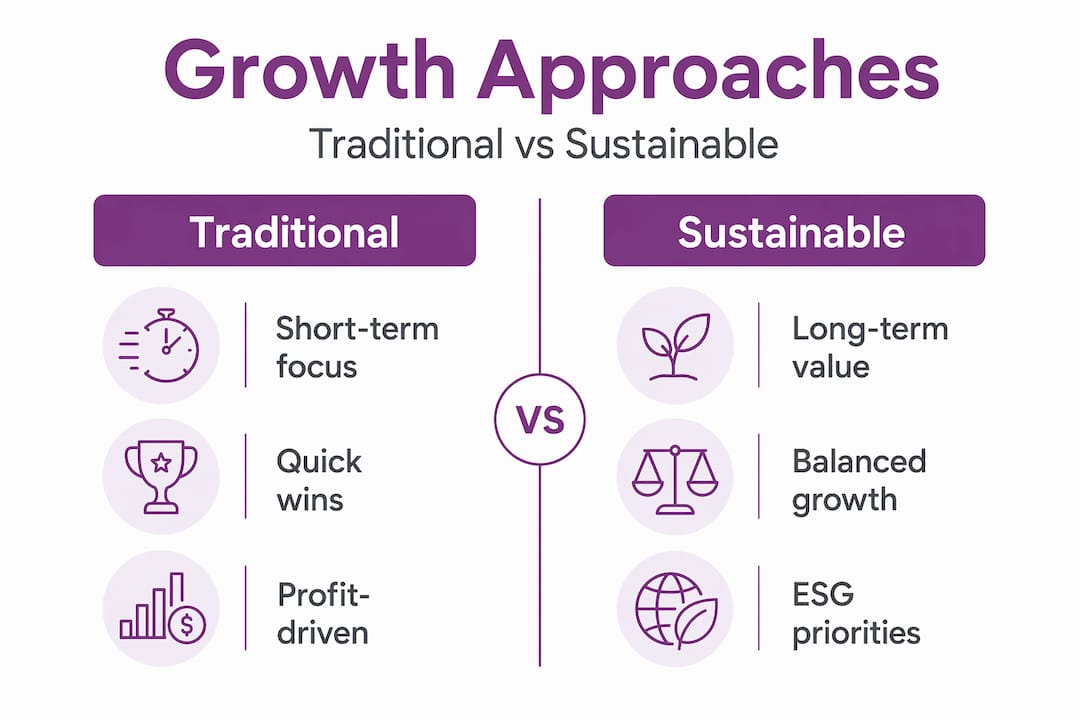
Here is how traditional and sustainable growth strategies differ across key areas:
Area | Traditional growth | Sustainable growth |
Revenue focus | Short-term revenue spikes | Long-term revenue stability |
Team structure | Rapid hiring and frequent turnover | Steady, invested team members |
Operations | Reactive and ad hoc | Systematized and proactive |
Vendor relationships | Transactional and interchangeable | Long-term, values-aligned partners |
Environmental impact | Often unconsidered | Built into decision-making |
Customer relationships | Volume driven | Loyalty and lifetime value focused |
The differences are significant. Sustainable growth requires you to think about the quality of your decisions, not just the speed of your expansion. It requires you to ask whether your team has the capacity to support new clients, whether your systems can handle increased demand, and whether your operational model is built to last.
Pro Tip: When evaluating a new growth initiative, run it through all three ESG dimensions. Ask: Does this strain our team? Does it conflict with our values? Does it create long-term risk? If the answer to any of those is yes, redesign before you launch.
Thinking about purposeful business growth means you are not just reacting to market opportunities. You are actively designing your expansion around what your business can actually sustain.
Transforming your business model for sustainable growth
Here is the hard truth that most growth guides skip over. Sustainable business growth is not something you add on top of your current model. It requires transforming the model itself.
Research from Harvard Business Review confirms that meeting sustainability targets requires transforming business models and organizational architectures to a degree matching or surpassing the transformation triggered by digital and AI technologies. That is a significant statement. It means treating sustainability as a fundamental redesign, not a checklist.
What does that look like in practice? Here is a data table showing where transformation typically happens:
Business area | Old approach | Transformed approach |
Workflow management | Manual, owner-dependent tasks | Delegated, systematized processes |
Customer support | Owner or single team member | Dedicated remote support team |
Lead generation | Inconsistent and reactive | Structured and outsourced pipeline |
Administrative tasks | In-house and time-consuming | Handled by trained virtual assistants |
Reporting and CRM | Irregular and manual | Automated with remote CRM management |
Each of these shifts reduces your personal dependency on the business and creates room for genuine scale. When you are not the bottleneck for every decision, your business can grow without growing your stress level proportionally.
Here are practical steps to begin transforming your business model:
Audit your time to identify the tasks you handle personally that could be delegated to a trained remote professional
Document your core processes so they can be handed off without losing quality or consistency
Start with one outsourced role such as a virtual assistant or customer support rep, and measure the impact before expanding
Align your outsourced roles to your growth goals, not just your to-do list
Build accountability systems using project management tools and regular check-ins so remote team members stay integrated and effective
Track capacity metrics so you can anticipate growth bottlenecks before they become crises
Pro Tip: When you bring on a remote professional, do not just hand them tasks. Share your business goals, your values, and your long-term vision. Professionals who understand the bigger picture contribute more strategically and stay longer, which is exactly the kind of team stability sustainable growth requires.
If you are serious about building something durable, the goal is to create a self-sustaining business where operations continue to function and grow even when you step back from the day-to-day.
Pitfalls to avoid: What sustainable growth is NOT
With the right mindset and tools in place, the next step is making sure you do not fall into the traps that derail well-intentioned growth strategies. There are several common misconceptions that can lead you in the wrong direction.
“Sustainable growth is not just about higher revenue; it requires discipline and often means accepting constraints to ensure long-term viability.” Harvard Business Review
That word, constraints, is worth sitting with. Many business owners resist the idea that growth should have limits. But accepting constraints is not about playing small. It is about choosing where to grow strategically so you do not dilute your quality, exhaust your team, or outpace your systems.
Here are the most common pitfalls to watch for:
Mistaking revenue growth for sustainable growth. A spike in revenue is not proof that your business is healthy. If you cannot maintain that revenue without burning through your team or cutting corners, it is not sustainable.
Greenwashing and surface-level initiatives. Adding a recycling bin or posting about company values on social media does not make a business sustainable. Real sustainability requires operational change, not optics.
Ignoring team wellbeing. If your growth strategy depends on employees and contractors working at unsustainable capacity, you are building on a fragile foundation. Turnover is expensive. Burnout is costly. Stability is a competitive advantage.
Scaling before systematizing. Trying to grow without documented processes and reliable support systems leads to chaos. Before you can scale, your operations need to be repeatable and transferable.
Measuring only short-term performance. Monthly revenue reports matter, but they do not tell the full story. Sustainable growth requires tracking customer retention, team performance, operational efficiency, and long-term client satisfaction as well.
If you want to understand what scaling with remote support looks like when done thoughtfully, the answer starts with avoiding these pitfalls. Scaling is not about doing more of the same faster. It is about building smarter systems that hold their value as volume increases.
One more common mistake worth calling out is the assumption that sustainability is something you address later, once you have reached a certain size or revenue threshold. That thinking gets it backwards. The earlier you build sustainable practices into your model, the easier it is to maintain them as you grow. Retrofitting sustainability onto a broken system is always harder than building it in from the start.
Our perspective: Why sustainable business growth demands a new mindset
We work closely with business owners who are determined to grow, and what we see most often is not a lack of ambition. It is a lack of infrastructure. People are working harder than ever, carrying more responsibility than their business structure was ever designed to support, and still wondering why growth feels so out of reach.
Here is what we believe, based on real experience: lasting growth does not come from doing more. It comes from doing the right things consistently, with the right support in place.
The businesses that grow sustainably are not the ones chasing every opportunity. They are the ones who have built a reliable foundation, delegated intelligently, and created operational systems that free them to focus on high-value work. They are adaptable because their operations do not depend entirely on any one person. They are resilient because they have built teams and processes that can absorb change without collapsing.
Remote professionals are a critical part of this equation. When a business owner partners with a trained virtual assistant or a dedicated remote team member, they are not just checking tasks off a list. They are building institutional capacity. They are creating a support system that allows the business to serve more clients, respond faster, and operate more efficiently without proportionally increasing overhead.
We also believe that the social dimension of sustainability matters more than most business guides acknowledge. The people on your team, whether they are in your office or working remotely from the Philippines, deserve to be part of a workplace that respects their contribution and supports their growth. When you invest in your team’s stability and development, you build the kind of loyalty that translates directly into business performance.
The growth mindset insights we share consistently come back to one central idea: sustainable growth is a choice. It is not something that happens by accident. You have to decide to build thoughtfully, delegate strategically, and resist the pressure to grow at a pace your business cannot actually support.
Take the next step toward sustainable growth
Building a business that lasts takes more than ambition. It takes the right people, the right processes, and a support system designed to grow with you. That is exactly what R3source provides.
R3source connects U.S. business owners with highly trained virtual assistants and remote professionals from the Philippines who integrate directly into your operations. Whether you need help with administrative tasks, customer service, lead generation, CRM management, or appointment setting, our team is built for long-term partnership, not short-term task work. If you are ready to put sustainable growth into action, explore our virtual assistant services or learn more about how to build your remote team with R3source. Take the step that moves you from overwhelmed to operational.
Frequently asked questions
What is the main difference between business growth and sustainable business growth?
Sustainable business growth means expanding revenue and profitability over the long term while also protecting the environmental and social resources your business depends on, rather than pursuing short-term gains that may undermine future stability.
Why is business-model transformation important for sustainability?
Because meeting sustainability targets requires fundamental changes to how a business creates and delivers value, affecting everything from workflows and team structures to vendor relationships and operational systems.
How can outsourcing help achieve sustainable business growth?
Outsourcing allows you to scale your capacity efficiently, reduce fixed overhead costs, and build operational flexibility without overextending your core team or compromising the quality of your service delivery.
What are common mistakes when pursuing sustainable growth?
Many leaders confuse sustainable growth with simply achieving higher revenue, or they focus on surface-level initiatives without making the real operational changes that create long-term viability and resilience across their business.
Recommended
Comments