

How to Manage a Business Remotely as a Founder


The fastest way to manage your business remotely as a founder is to stop managing presence and start managing outcomes. That means shifting to an async-first operating model where decisions live in writing, work gets measured by results, and your team can act without waiting on you. Founders who run seven-figure businesses remotely consistently point to the same habits: documentation, selective sync time, and trust over surveillance.
Here’s the execution order that actually works:
Document your top five recurring decisions and processes first
Set an async communication default, reserving live calls for real problem-solving
Hire or assign owners who can run those processes without you
Instrument a few key metrics and follow a 30/60/90 day rollout
Pro Tip: If you can’t explain a decision in a written paragraph, it’s not ready to hand off yet. Write it first, then delegate it.
Key Takeaways
Managing a business remotely as a founder works best when you replace presence-based oversight with documented systems, autonomous hires, and outcome-based tracking.
Point | Details |
Go async-first | Default every decision to writing; reserve live calls for relationship-building and complex problems. |
Document before delegating | Write SOPs for customer handoffs, billing, and hiring before removing yourself from the loop. |
Standardize your tool stack | Use Slack, Zoom, Dropbox, and DocuSign as your core, integrated remote operations toolkit. |
Hire for autonomy | Screen for written communication and self-direction, not just skills, during remote hiring. |
Track outputs, not hours | Use OKRs and simple dashboards to build trust and reduce the need for monitoring. |
Use a dedicated staffing partner when scaling | R3source provides long-term, integrated remote professionals for founders who want consistency over rotating freelancers. |
Table of Contents
How Do You Set Communication Norms for a Remote Business?
Predictability beats speed. Your team needs to know exactly where information lives and how fast to expect a response, not guess at it every time something comes up.
Start by giving every channel a defined purpose and a response window. Announcements might go in a dedicated Slack channel with no expected reply. Async decisions get logged in a shared doc with a 24-hour comment window. Handoffs between shifts or roles get a short recorded video brief instead of a meeting. Batko’s guide for founders recommends defaulting every decision to writing and reserving live conversations for relationship-building or genuinely complex problems.
A simple channel policy looks like this:
Slack: daily coordination, quick questions, status updates
Email: external communication and formal records
Recorded video brief: context that’s hard to type out, like walking through a dashboard
Shared doc: decisions, SOPs, and anything that needs a permanent home
For founders specifically, accessibility without bottlenecking matters most. Publish your own office hours, respond to non-urgent items on a set cadence rather than immediately, and make clear which situations warrant an interruption.
Pro Tip: Set an explicit “urgent means X” definition for your team. Without it, everything feels urgent, and you’ll never get out of firefighting mode.
What Should You Document First to Reduce Founder Dependence?
A remote team that runs without constant founder input is built on structure, not just good people. BOSS Publishing’s guide for founders frames this clearly: SOPs, role clarity, and delegated ownership come before scale, not after.
Document these first, in this order:
Customer handoffs (what happens when a lead becomes a client)
Billing and invoicing steps
Hiring and onboarding sequences
Incident triage (what to do when something breaks)
Each SOP needs five fields: purpose, numbered steps, an owner, acceptance criteria, and links to related templates. Skip any of these and the document becomes decoration instead of a tool people actually use.
Store everything in one place. A structured Notion workspace or a shared Google Drive with a clear folder hierarchy works. The goal is a single source of truth, echoing the remote-first operating principle that every process should be designed as if nobody will ever be in the same room.
Run this quick audit on any recurring decision:
Can someone else execute it without asking you a clarifying question?
Does it have a written acceptance standard, not just a vague goal?
Is it stored somewhere your team checks by default?
If any answer is no, it’s not ready to leave your desk yet.
Which Tools Do You Actually Need to Run Remote Operations?
You don’t need twenty tools. You need five or six that cover the essentials without creating a maze of logins and notifications.
Standardize around these categories: team chat, video conferencing, cloud file storage, e-signature, project tracking, and a documentation handbook. Slack handles day-to-day coordination and channel-based communication. Zoom covers structured, scheduled sync sessions where video actually adds value. Dropbox keeps files centralized and accessible without version-control chaos. DocuSign handles contracts, offer letters, and vendor agreements without printing anything.
Before adding a new tool, run it through this checklist:
Does it integrate with what you already use, or does it create a new silo?
Does it support single sign-on so you’re not managing five sets of credentials?
Can you set role-based access instead of giving everyone admin rights?
Does it back up data automatically and retain it long enough to matter?
Distributed teams that skip access controls create real exposure. Rotate credentials when someone leaves a role, apply least-privilege access by default, and audit who has access to financial and customer systems at least quarterly. A five-person team with admin rights for everyone is a liability waiting to surface, usually at the worst possible time.
How Do You Delegate and Hire for Remote Autonomy?
Hiring for a remote team is different from hiring for an office. You’re screening for people who can operate without a hallway conversation to fall back on. Nomadic founders interviewed by Inc. emphasize hiring for autonomy and strong written communication above almost everything else, since those two traits predict how little direction someone will need.
Build your hiring process around these steps:
Write a role brief with specific outcomes, not just duties
Run a skills-based assessment tied to real work
Give a paid trial project that mirrors an actual task
Interview specifically for judgment and self-direction
Ask questions like “Tell me about a time you made a decision without checking with anyone” or “Walk me through how you’d handle an unclear instruction.” Vague answers here predict future rework for you.
Delegation itself needs structure too:
Assign clear decision rights (what they can decide alone vs. what needs sign-off)
Define acceptance criteria before the work starts, not after
Set an escalation path for when something falls outside their authority
Use a hand-off template that captures context, deadline, and definition of done
For founders who want long-term integration rather than task-based freelancing, a model like R3source’s dedicated remote staffing fits better than rotating contractors, since the same person learns your business over time instead of restarting the learning curve every project.
How Do You Track Performance Without Micromanaging?
Outcome frameworks solve the “are they actually working” anxiety better than any monitoring software. Adopt OKRs or simple weekly deliverables, then translate them into owner-level metrics: revenue per employee, average customer response time, weekly throughput per role.
Build a lightweight dashboard, not a data warehouse. One shared doc or simple tracker updated weekly beats a complex analytics setup nobody checks.
Weekly: tactical check on numbers and blockers
Monthly: review trends and adjust priorities
Quarterly: revisit strategy and OKRs themselves
Founders who track outputs instead of hours report far less need to monitor day-to-day activity, because the numbers themselves answer the question surveillance was trying to solve.
How Do You Keep Team Culture Alive When Everyone Is Remote?
Cohesion doesn’t happen by accident once people stop sharing an office. It happens through a few deliberate, recurring rituals that don’t eat the whole week. Batko’s remote management framework suggests a rhythm most teams can sustain: a 30-minute weekly all-hands, short team tactical meetings, recurring one-on-ones, and quarterly offsites.
Structure your 1:1s around four things every time: a personal check-in, the employee’s own agenda items, current blockers, and development notes saved in a shared doc so nothing gets lost between sessions.
Pair new hires with a peer for their first two weeks
Run a low-effort async social thread (weekend photos, wins, random questions)
Recognize good work publicly in a shared channel, not just privately
Watch for “us versus them” splits between in-house and remote staff and address them directly
Pro Tip: Rotate who runs the weekly all-hands. It breaks the founder-as-only-voice pattern and surfaces leadership from people you might not have noticed otherwise.
What Should You Automate to Cut Coordination Time?
Every manual handoff is a place where work stalls waiting for someone to notice it. Automate the predictable ones first.
Common wins: a form submission that auto-creates a task, an invoice that triggers an approval flow, a completed customer step that pings the next owner automatically. Low-code connectors and native integrations handle most of this without a developer.
Scheduling links that remove back-and-forth email
Automated invoice reminders instead of manual follow-up
Weekly reporting that pulls from your dashboard automatically
Build a custom integration only when an off-the-shelf connector genuinely can’t handle your workflow. Most founders reach for custom code far sooner than they need to.
What Does a 30/60/90 Day Remote Management Plan Look Like?
Your first week matters more than it feels like it should. Cancel any recurring meeting that could be a written update, and write down the five decisions your team asks you about most.
Days 1 to 30:
Document your top five recurring decisions
Set and publish your channel policy
Run a hiring trial for one autonomous role
Days 31 to 60:
Finish SOPs for your core processes (handoffs, billing, incident triage)
Stand up a basic weekly dashboard
Delegate at least two recurring decisions permanently
Days 61 to 90:
Replace one recurring status meeting with an async written report
Hire or integrate at least one dedicated remote team member
Run a short team alignment session or informal offsite
Startup Wren’s founder playbook makes a similar point: outcome-driven structure and deliberate rituals matter more early than headcount does.
When Should Founders Use a Dedicated Remote Staffing Partner?
DIY hiring works when you have time to source, vet, train, and manage someone yourself. Most founders don’t, especially in the first year of shifting to remote operations.
A managed provider like R3source fits when you need someone trained and integrated fast, with payroll, HR, and onboarding already handled. Features worth checking for in any provider:
Dedicated long-term staff, not rotating task freelancers
Managed payroll and HR so you’re not the employer of record
Structured onboarding support built for your specific workflows
Ongoing management and accountability, not a one-time placement
Before choosing, run this evaluation: How fast can they fill the role? Is onboarding actually structured or improvised? Do they support integration into your existing tools and SOPs? Is there ongoing management after placement, or are you on your own once the contract is signed?
Pro Tip: If you’re rewriting the same onboarding instructions for every new hire, that’s the clearest sign you need a partner with a repeatable onboarding system already built.

How Do You Handle a Crisis When Your Team Is Remote?
Problems don’t wait for business hours, and a distributed team without a crisis protocol tends to freeze at exactly the wrong moment. The fix isn’t more meetings. It’s a pre-written decision tree that tells people what to do before the crisis happens.
Start with a simple severity scale. A level one issue (a customer complaint, a minor bug) gets handled by the role owner with no escalation. A level two issue (a payment failure, a service outage affecting multiple customers) triggers an immediate written alert in a dedicated crisis channel and pulls in a specific backup decision-maker. A level three issue (data breach, major client loss, legal exposure) triggers an immediate call, not a Slack message, with the founder looped in within minutes.
Write down who owns each severity level before you need it, not during the incident. Confusion about ownership is what turns a manageable problem into a slow-moving one. Assign a single point person per crisis type: technical incidents to whoever owns your stack, customer-facing crises to whoever owns support, financial issues to whoever owns billing.
After the fire is out, run a short async retrospective. What broke, why, and what changes in the SOP so it doesn’t happen the same way twice. Skip this step and you’ll relearn the same lesson every few months, just with a different name attached to the incident report.
The teams that recover fastest from remote crises are the ones who already knew, in writing, exactly who does what before anything went wrong.
What Actually Motivates a Remote Team Long-Term?
Motivation in a distributed team rarely comes from perks. It comes from clarity, autonomy, and knowing your work actually matters to something specific.

Give people ownership over an outcome, not just a task list. Someone who owns “reduce customer response time” behaves differently than someone who’s told “answer these tickets.” The first person will suggest process improvements. The second will just work through the queue.
Recognition needs to be specific and visible. “Great work this week” says nothing. “Your fix on the onboarding flow cut signup drop-off noticeably, and the numbers show it” tells someone their work had a traceable impact. Time Craft Advisory’s research on remote leadership points to outcome-focused frameworks as the antidote to founders who unconsciously try to replicate office-style oversight online, which tends to demotivate autonomous workers fast.
Protect boundaries deliberately. A founder who answers messages at midnight trains the whole team to feel obligated to do the same. Model the hours you want people to actually keep.
Finally, revisit growth paths even in a small remote team. People stay motivated longer when they can see where a role leads, whether that’s more ownership, a new skill area, or eventually managing someone else. Silence on that front reads as a dead end, even when it isn’t one.
Author Perspective: The First Changes Founders Actually Make
Most founders don’t start with tools. They start by documenting the five decisions eating their week, then hiring one person who can own a whole process without hand-holding. Tools come third, not first.
The most common mistake: replacing physical presence with digital surveillance, tracking screen time instead of results. That erodes trust faster than remote work itself ever could. Async-first operating models work because they force clarity that surveillance never produces.
How R3source Helps Founders Build a Remote Operation That Doesn’t Depend on Them
The gap most founders hit isn’t strategy. It’s finding someone reliable enough to actually own the work once you’ve written the SOP. R3source fills that gap with dedicated, long-term remote professionals from the Philippines, not task-based freelancers who disappear between projects. Each team member trains directly on your workflows, from CRM management to appointment setting to customer support, so the handoff you documented in section three actually gets used.
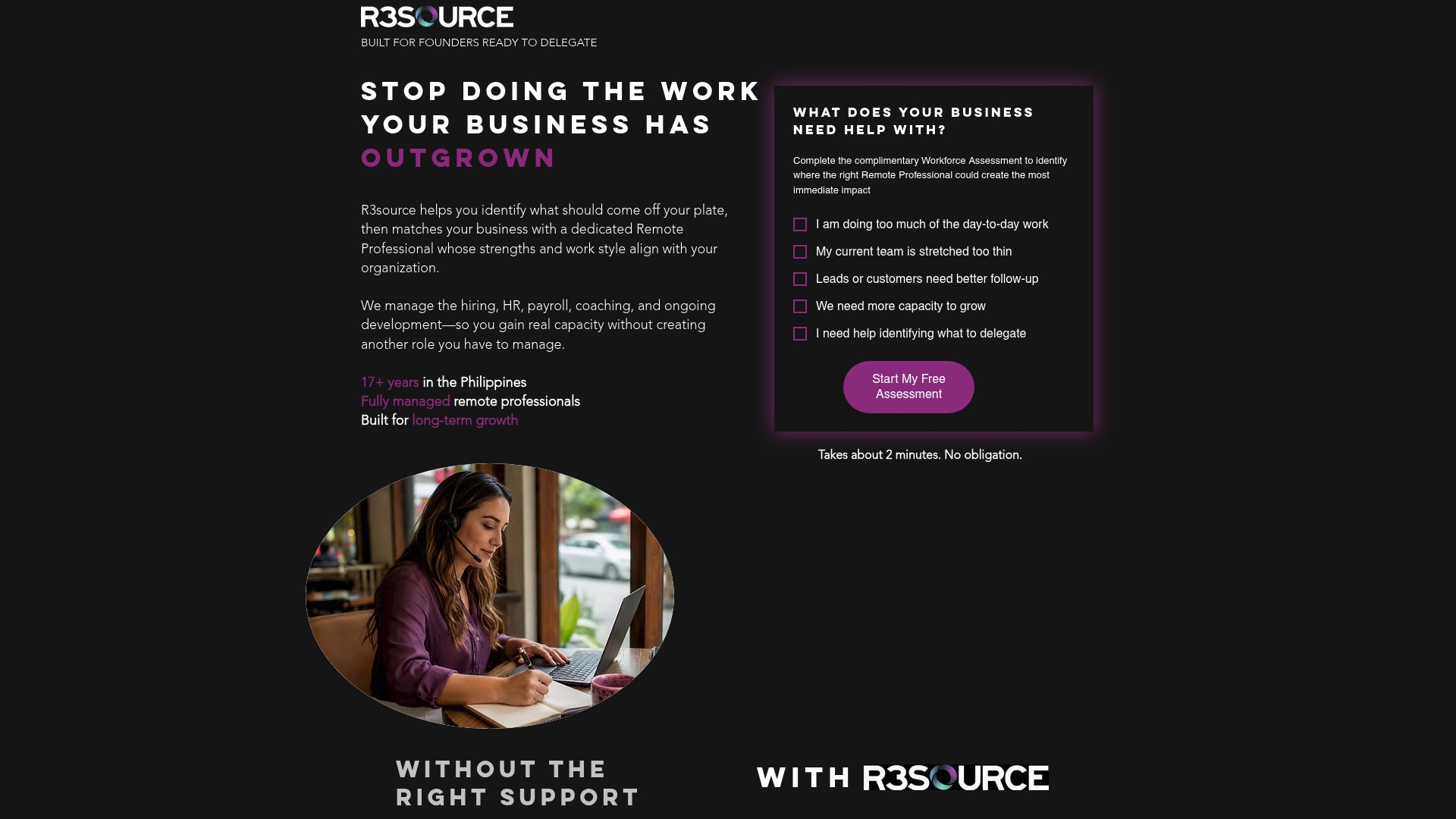
That means less time rewriting instructions for a new contractor every few months, and more time on the work that actually grows your business. If you’re ready to see where a dedicated remote hire fits into your operation, explore R3source’s offshore virtual assistant services or book a free strategy call to map out your first hire together.
Sources
For deeper templates and cadence examples, Batko’s practical guide for founders covers meeting rhythms in more detail. Startup Wren’s founder playbook expands on hiring and compliance across locations. For R3source’s own resources:
Recommended
Comments