

Virtual Assistants: What Founders Delegate and Why It Works


Yes, a virtual assistant can give you back real hours every week, and for most solo founders that time is worth more spent closing deals than answering email. The mechanics are simple: you hand off repeatable, non-founder work to someone trained to do it well, and you keep the tasks that actually require your judgment.
Here’s what to do about it this week:
Audit your calendar for five days. Track everything you do in 15-minute blocks. Anything that isn’t sales, strategy, or product is a delegation candidate.
Pick three tasks to hand off first. Inbox triage, calendar scheduling, and research are usually the safest starting points because mistakes are low stakes and easy to catch.
Book a discovery call with a staffing partner like R3source to see what a matched offshore virtual assistant would look like for your specific workload.
Pro Tip: Don’t hand over your whole operation on day one. Start with a single, time-boxed trial task, something like “clear my inbox to zero for one week”, and use it to see how the person communicates and follows instructions before expanding their scope.
Key Takeaways
Virtual assistants work because they convert a founder’s scattered operational hours into recovered time that can be redirected toward revenue-generating work.
Point | Details |
Start with high-frequency tasks | Delegate inbox management, scheduling, and research first since they’re low-risk and easy to evaluate. |
Document before you delegate | A written SOP produces fewer errors than a verbal explanation and speeds up onboarding. |
Run the ROI math | Compare hours recovered times your hourly value against the VA’s cost before committing. |
Readiness has clear signals | Repeated tasks over 5 to 8 hours weekly and missed opportunities mean it’s time to hire. |
R3source offers a managed path | Its Discover, Align, Integrate process matches vetted offshore virtual assistants for long-term roles. |
Table of Contents
What Is a Virtual Assistant for Entrepreneurs, and What Do They Do?
A virtual assistant is a remote worker who handles administrative, technical, or creative tasks so you don’t have to, and specialized VAs command higher rates because they bring skills beyond general admin, according to the Small Business Administration. That’s the whole concept in one sentence. The part that trips people up is figuring out where the line falls between “generalist” and “specialist,” and which one solves your particular bottleneck.
Generalist VAs handle the broad, recurring work every business generates:
Inbox management and calendar scheduling
Customer support (email, chat, basic phone coverage)
Data entry and CRM updates
Social media posting and light community management
Bookkeeping basics like invoice tracking and expense categorization
Online research (competitor analysis, vendor comparisons, lead lists)
Lead follow-up and appointment setting
Specialist VAs go narrower and deeper: bookkeeping with actual accounting software fluency, medical billing, e-commerce listing optimization, or paid ad management. You pay more per hour, but you skip the ramp-up time a generalist would need to learn a technical system from scratch.
Statistic callout: The US Chamber of Commerce reports that A significant portion of small business owners had already used a virtual assistant by 2021, and cites efficiency gains across both administrative and specialized task categories. That’s not a fringe tactic. It’s closer to standard operating procedure for businesses that plan to grow.
The decision rule is straightforward: if the task is repeatable and doesn’t require industry-specific knowledge, start with a generalist. If it requires a credential, a specific software stack, or regulatory knowledge (medical billing, bookkeeping compliance, legal intake), hire a specialist from the start. Guessing wrong here just costs you a training cycle, not a disaster, so don’t overthink the first hire.
Why Do Virtual Assistants Actually Work for Small Businesses?
The benefit isn’t just “less work for you.” It’s a structural shift in how your time and money get spent. Four mechanisms explain why delegating to a VA produces results that feel disproportionate to the cost.
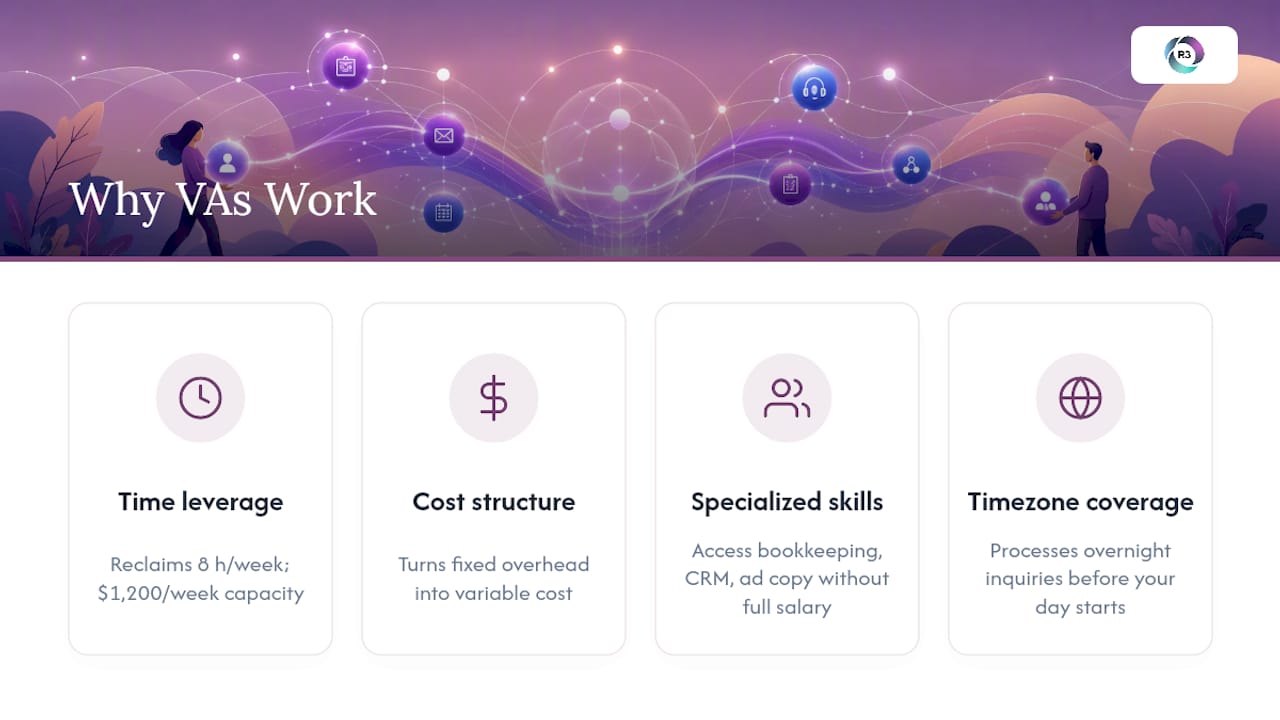
Time leverage. Every hour a VA spends on inbox triage or scheduling is an hour you get back for sales calls, product decisions, or the strategic thinking that only you can do. The SBA points out that VAs are particularly effective at absorbing communication-heavy work like customer support and social media response, precisely the tasks that eat a founder’s day in small, constant interruptions rather than big visible blocks.
Cost structure. A full-time employee comes with fixed overhead: payroll taxes, benefits, office space, equipment. A VA, especially through a managed staffing arrangement, converts that fixed cost into a variable one you can scale up or down with revenue.
Specialization without a full-time hire. You get access to skills, bookkeeping, CRM management, ad copywriting, without committing to a full salary for a role you only need part-time. Upwork’s research frames this as one of the clearest advantages of remote staffing: specialized talent on demand, not on payroll.
Timezone coverage. A VA working Philippine hours can process your overnight customer inquiries and have them handled before you open your laptop, effectively extending your operating hours without extending your own.
Here’s a mini case that shows how this compounds. Say a founder spends 8 hours a week on inbox management and appointment scheduling. A VA absorbs that work. If the founder’s hourly value, what an hour of their direct attention is worth in closed revenue, is $150, that’s $1,200 a week in reclaimed capacity. Even a portion of that redirected into sales calls or partnership outreach can pay for the VA’s cost several times over within the first month.

Pro Tip: The impact multiplies once you document your processes. Write a simple SOP (standard operating procedure) for each task before you hand it off, even a five-step bullet list in a Google Doc. A VA working from a documented process makes far fewer errors than one working from a verbal explanation you gave once on a call.
Burnout is also a real, recognized cost of running everything yourself. The World Health Organization classifies burnout as an occupational phenomenon tied to chronic, unmanaged workplace stress, and offloading repetitive operational tasks is one of the few concrete levers a founder has to reduce that load before it becomes a health problem, not just a productivity one.
How Much Does a Virtual Assistant Cost, and What’s the ROI?
Pricing shapes vary more than most first-time hirers expect. You’ll typically encounter three structures: hourly freelance rates, part-time retainers, and dedicated managed-staff arrangements where a staffing company handles recruiting, payroll, and management on your behalf.
What moves the price:
Skill level and specialization. Bookkeeping and technical support cost more per hour than general admin.
Country and timezone. Offshore staffing, particularly from the Philippines, tends to offer lower rates than domestic freelance markets for comparable skill levels.
Freelance vs. managed. A freelance marketplace hire is usually cheaper hourly but leaves you responsible for vetting, backup coverage, and management. A managed arrangement costs more but includes replacement guarantees and oversight.
Full-time vs. part-time. Dedicated full-time staff typically comes at a lower effective hourly rate than part-time or hourly arrangements, but requires a steadier volume of work to justify.
Engagement Type | Typical Structure | Best For |
Hourly freelance | Pay per hour, task-based | Occasional or one-off projects |
Part-time retainer | Fixed weekly hours, recurring | Steady but limited workload (several hours/week) |
Dedicated managed staff | Full-time, employer-managed | Ongoing operational roles integrated into the business |
Run the math before you commit. A simple ROI calculation looks like this: multiply the hours you expect to recover per week by your own hourly value (revenue-generating work you’d otherwise be doing), then subtract the VA’s weekly cost. If the result is positive, and it usually is once you’ve picked the right tasks, you’ve got your payback case. CPB Bank’s guidance on virtual assistants notes that the flexibility of hourly, project, or retainer pricing lets founders test this calculation at low risk before scaling up.
Most founders see measurable payback within the first four to eight weeks, once the VA is past the initial training period and working independently on the delegated tasks.
Who Should Hire a Virtual Assistant, and When?
Not every founder is ready, and that’s fine. Readiness usually shows up as a specific pattern of symptoms rather than a single trigger.
Watch for these signals:
You’re spending more than 5 to 8 hours a week on repeatable admin, scheduling, or inbox work.
You’ve missed a lead, a follow-up, or an opportunity because you were buried in operational tasks.
You feel constantly behind, and it’s affecting decision quality, not just your mood.
Your calendar has no dedicated blocks for strategic or revenue-generating work.
You’re the bottleneck for approvals, replies, or updates that don’t actually require your judgment.
If two or more of these describe your week, you’re past the point where doing it all yourself makes sense.
For a first hire, start with a generalist covering inbox, calendar, and light admin. It’s the lowest-risk starting point and gives you a feel for delegation before you commit to something specialized. If your bottleneck is technical (bookkeeping backlog, CRM chaos, e-commerce listings), skip straight to a specialist, since a generalist would need training you don’t have time to give.
Timezone matters more than most founders initially think. A VA in the Philippines typically works hours that overlap partially with U.S. business hours and extend into your evening, which means overnight customer questions and next-morning prep get handled before your day even starts.

How Do You Hire, Onboard, and Manage a Virtual Assistant?
Getting this right is less about finding the perfect candidate and more about running a clean process. Here’s a version that works for a first hire:
Define the role in writing. List the specific tasks, expected hours, and what success looks like after 30 days. Vague job descriptions produce vague results.
Source candidates or work with a managed provider. You can post on freelance marketplaces or work with a staffing partner that handles sourcing and vetting for you.
Run a paid trial task. Give a real, bounded task, like clearing a backlog of 50 emails, and evaluate the output, not just the interview answers.
Hire and set a 30-day onboarding plan. Don’t skip this step even if the trial went well; the first month determines whether the relationship sticks.
A sample 30-day onboarding plan might look like this: week one covers tool access and shadowing your current process, week two hands over one task fully with daily check-ins, week three adds a second task and moves check-ins to every other day, and week four operates at full delegated scope with a weekly review. If you want a more detailed version of this framework, R3source’s hiring guide walks through each stage with sample trial tasks.
Tools that make this collaboration work: project management platforms like Asana or Trello, communication tools like Slack, time tracking through Hubstaff or Time Doctor, and secure password sharing via a manager like 1Password or LastPass rather than sending credentials over email. Microsoft’s own Work Trend Index research points to AI-assisted tools increasingly augmenting this kind of remote collaboration, from automated scheduling to AI-drafted first-pass email replies a VA can then refine.
Once the VA is running independently, manage by outcomes, not activity. Set two or three clear KPIs (inbox response time, tasks completed per week, lead follow-up rate), hold a short weekly check-in, and keep your SOPs updated as processes evolve.
Pro Tip: Treat the first two weeks as a paid trial even after you’ve technically hired someone. It costs you a small amount of money to confirm fit, and it’s far cheaper than realizing three months in that the working relationship isn’t clicking.
What Mistakes Do Entrepreneurs Make When Hiring a VA?
Most failed VA relationships trace back to the founder’s process, not the assistant’s ability. Here are the recurring ones, and the fix for each.
Vague briefs. “Help with my inbox” isn’t a task. Fix: write a specific brief with examples of what a completed task looks like.
No documented SOPs. Without a written process, every task lives only in your head, and it dies there too if you’re unavailable. Fix: document each recurring task the first time you do it, before you hand it off.
Micromanagement. Checking in hourly defeats the purpose of delegation and signals distrust. Fix: set clear milestones and check in on outcomes at agreed intervals, not constantly.
Unrealistic expectations for month one. Expecting a new VA to operate at full speed immediately ignores the learning curve. Fix: budget two to four weeks for ramp-up before judging performance.
Skipping the trial task. Hiring straight off an interview, without seeing actual work output, is how mismatches happen. Fix: always run a small paid trial before a longer commitment.
Security deserves its own checklist, since a VA often touches sensitive systems:
Sign a nondisclosure agreement before sharing any confidential business information.
Grant least-privilege access, only the systems and data the role actually requires.
Use a password manager instead of sharing credentials directly.
Run a periodic access audit, especially after any role change or offboarding.
Pro Tip: Revoke access immediately when a contract ends, not “sometime this week.” Old logins left active are one of the most common, and easily preventable, security gaps in small business outsourcing.
How Does R3source Vet, Match, and Integrate a Virtual Assistant?
R3source runs a three-phase process built specifically to reduce the risk a first-time hirer feels most acutely, that the person on the other end of the hire won’t actually work out.
Discover. R3source starts with a detailed needs analysis, mapping your actual workload and pain points rather than matching you to a generic job template.
Align. Candidates go through skills testing, structured interviews, and background checks before they’re presented as a match, so you’re evaluating a pre-vetted shortlist, not sorting through a public freelance marketplace yourself.
Integrate. Once hired, the assistant goes through a structured 30-day onboarding with SOP transfer and weekly check-ins, mirroring the kind of onboarding rigor you’d expect from an in-house hire.
A founder who hands off a poorly defined task to an unvetted freelancer and one who hands off a documented process to a screened, managed hire are running two completely different experiments, even though both technically “hired a VA.” The difference in outcome usually comes down entirely to the process behind the match.
R3source’s model centers on placing dedicated, long-term remote staff from the Philippines, not task-based freelancers who rotate in and out. That distinction matters for founders building repeatable operations rather than one-off projects. The company works across real estate, e-commerce, and service-based businesses, which means the matching process accounts for industry-specific workflows rather than treating every hire as interchangeable admin support.
If you want to see the full model, including role types and how the offshore staffing structure works, R3source’s offshore virtual assistant page lays out the specifics. Booking a discovery call is the natural next step once you’ve identified the tasks you want to hand off.
What Legal and Contractual Details Matter Beyond an NDA?
An NDA protects your confidential information, but it’s only one piece of a properly structured VA arrangement. Three other areas deserve attention before you sign anything.
Work agreements. A written agreement should specify scope of work, hours, payment terms, and termination conditions. This matters whether you’re hiring independently or through a managed staffing arrangement, because verbal understandings tend to fall apart the moment a dispute arises.
Intellectual property rights. Any content, code, designs, or materials a VA produces for your business should explicitly belong to you under the agreement. This is a detail freelancers and founders alike frequently skip, and it can create real complications later if you ever plan to sell the business or license the work product.
Data protection compliance. If your VA handles customer data, especially in regulated industries like healthcare billing or financial services, your agreement needs to address how that data is stored, accessed, and secured, and who’s responsible if something goes wrong. This is a genuine legal and compliance question, and the right approach depends on your industry and the jurisdictions involved, so it’s worth a conversation with a qualified attorney rather than relying on a template you found online. This article offers general information, not legal advice specific to your situation.
An Editorial Take on Why Founders Hesitate Longer Than They Should
The founders who wait the longest to hire a VA usually aren’t the ones with the least work to delegate. They’re the ones who’ve convinced themselves that no one else can do it “their way.” That instinct feels like quality control. In practice, it’s usually just an unwillingness to spend an hour writing down a process you already know how to do.
The fix isn’t complicated, and it isn’t about finding the perfect candidate first. It’s about running one small experiment before you convince yourself you need a bigger plan. Pick one task you dread doing every week, write down the steps exactly as you’d explain them out loud, and hand that document to someone else for seven days. You’ll learn more from that single week than from another month of research into hiring platforms.
I’d also push back gently on the idea that delegation is only for businesses that have “made it.” The LinkedIn perspective on delegation and balance makes a point worth sitting with: waiting until you’re overwhelmed to delegate means you’re solving a problem that’s already cost you months of missed opportunity. The better time to start was usually before you felt the need.
Ready to Hand Off the Work That’s Slowing You Down?
If you’ve read this far, you’ve probably already identified two or three tasks eating your week that don’t need your specific judgment. R3source exists for exactly that moment: a managed, offshore staffing model that gives you a dedicated remote professional from the Philippines, not a rotating freelancer, at a fraction of what a full-time domestic hire would cost you in salary and overhead.
Here’s what that looks like in practice: lower fixed overhead than a local employee, a vetted match through R3source’s Discover, Align, Integrate process, and a managed onboarding that handles the training curve for you instead of leaving you to figure it out alone. You bring the tasks and the SOPs; R3source brings a screened professional and the oversight to keep the relationship on track.
The next step is simple. Book a free strategy call and walk through your workload with R3source’s team. You’ll leave the call with a clear picture of which tasks to delegate first and what a matched virtual assistant would look like for your specific business.
Frequently Asked Questions
What tasks should I delegate to a virtual assistant first? Start with inbox management, calendar scheduling, and basic research. These are repeatable, low-risk to hand off, and free up the most time relative to how quickly a new VA can learn them.
How much does a virtual assistant typically cost? Costs vary by structure: hourly freelance rates, part-time retainers, and dedicated managed-staff arrangements all price differently, with offshore staffing generally offering lower rates than domestic hires for comparable skill levels.
How do I know if I’m ready to hire a VA? If you’re spending more than 5 to 8 hours a week on repeatable admin, or you’ve missed opportunities because you’re buried in operational tasks, that’s a strong signal it’s time.
Is it safe to give a virtual assistant access to sensitive business systems? It’s safe when handled properly, with a signed NDA, least-privilege access limits, a password manager instead of shared credentials, and periodic access audits.
What makes R3source different from a freelance marketplace hire? R3source places dedicated, long-term remote staff through a structured Discover, Align, Integrate process, rather than task-based freelancers you source and vet yourself.
Sources
Recommended
Comments