

13th Month Pay Outsourcing: A Guide for US Employers


Yes. If you hire staff based in the Philippines, whether directly or through a service provider, someone in that chain must pay 13th month pay. It is not optional, and it is not a bonus you can skip in a slow year. P.D. No. 851 made it mandatory in 1975, and the deadline every employer works against is December 24. The real question for a US business isn’t whether the obligation exists. It’s who carries it.
If you hire an employee directly (through your own Philippine entity or a payroll provider acting as employer of record), you are responsible.
If you use a managed staffing partner like R3source, that responsibility typically sits with the partner as part of the service.
If you misclassify someone as a contractor to avoid this, you’re taking on real risk with the Department of Labor and Employment (DOLE) and the Bureau of Internal Revenue (BIR).
Pro Tip: Before you sign anything, confirm in writing whether your staffing arrangement makes you the legal employer or not. If you’re not sure, ask an EOR or managed-staffing provider to spell it out before payday, not after.
Key Takeaways
Whoever legally employs your Philippine-based staff, whether that’s you directly or a staffing partner, must pay 13th month pay on or before December 24 under Philippine law.
Point | Details |
Legal basis is clear | P.D. No. 851 mandates 13th month pay equal to 1/12 of annual basic salary for covered employees. |
Formula is simple | Total basic salary earned during the year, divided by 12, with pro-rating for partial-year staff. |
Deadline is fixed | Full payment is due on or before December 24, with an optional mid-year split payment. |
Tax exemption caps at ₱90,000 | Amounts above ₱90,000 get added to taxable income and withheld at standard rates. |
R3source absorbs the compliance work | Dedicated staffing through R3source builds 13th month calculation, withholding, and reporting into the placement itself. |
Table of Contents
What Is 13th Month Pay Outsourcing and Who Qualifies?
13th month pay is one-twelfth (1/12) of an employee’s total basic salary earned during the calendar year, paid as a mandatory statutory benefit under P.D. No. 851. It isn’t a discretionary Christmas bonus. It’s law, and it applies regardless of how the business itself is doing that year.
Coverage is broad by design. Rank-and-file private-sector employees qualify as long as they’ve worked at least one month during the year, according to Labor Law PH. That includes regular, probationary, and contractual staff, and piece-rate workers when their basic pay can be calculated.
Covered: regular employees, probationary hires, contractual staff, most piece-rate workers.
Generally excluded: managerial employees, government workers, and employees paid purely on commission with no fixed basic salary.
Employers also carry a reporting duty. DOLE expects an annual compliance report confirming the benefit was paid, filed through its Establishment Report portal.
The law’s intent is simple: every qualifying worker gets a guaranteed year-end payment tied to what they actually earned, not to how generous or cash-strapped the employer feels in December.
How Do You Calculate 13th Month Pay?
The formula is short: total basic salary earned during the year ÷ 12, according to TalinoHR’s payroll guidance. “Basic salary” means regular pay for work performed. It excludes overtime, holiday premiums, allowances, and anything already paid out as a prior 13th month benefit.
Add up basic salary paid from January through December.
Divide that total by 12.
For mid-year hires or employees who separated before year-end, use only the months actually worked, then still divide by 12.
Commissions or variable pay only count toward the calculation when they function as guaranteed basic salary rather than incentive pay, a distinction worth confirming with your payroll provider before finalizing figures.
When Must 13th Month Pay Be Paid and Is It Taxed?
The deadline for payment is set on or before the 24th day of December every year. Employers can split the payment, covering half mid-year and the other half by the December deadline, which helps smooth out cash flow according to First Circle’s employer guidance.
The ₱90,000 threshold: 13th month pay is tax-exempt up to ₱90,000. Anything above that amount gets folded into the employee’s taxable income for the year and taxed at standard graduated rates, per LegalClarity’s tax breakdown.
Employers must withhold tax correctly on any amount exceeding the exemption.
Year-end compensation and withholding details get reported on BIR Form 2316, issued to each employee.
Missing the exemption calculation is a common error that triggers under-withholding penalties later.
Who’s Responsible When a US Company Hires Philippine Staff?
The legal employer depends entirely on your hiring model. Hire someone directly through your own entity, and you carry every obligation yourself. Use an EOR, PEO, or managed-staffing arrangement, and that responsibility usually transfers to your partner, provided it’s spelled out in the contract.
Whoever holds employer status has to manage a full stack of requirements: 13th month pay, contributions to SSS, PhilHealth, and Pag-IBIG where applicable, correct tax withholding, the annual DOLE compliance report, and issuance of Form 2316 at year-end.
Most compliance failures trace back to a handful of avoidable mistakes:
Classifying someone as an independent contractor when they function as a regular employee.
Failing to pro-rate 13th month pay correctly for staff who separated mid-year.
Missing the DOLE Establishment Report deadline, typically due in mid-January for the prior year.
Assuming a staffing vendor handles statutory pay without confirming it contractually.
The financial risk is real. DOLE can pursue administrative action for non-payment, and BIR withholding errors create tax liabilities that surface months later. Pro Tip: If you’re not 100% certain who’s the legal employer in your current setup, that uncertainty is itself the red flag. Get it in writing from an EOR or managed-staffing partner before your next payroll cycle.
What Outsourcing Options Handle 13th Month Pay for You?
Four common paths exist, and each shifts responsibility differently:
Payroll provider only handles calculations and disbursement but usually leaves you as the legal employer of record.
EOR or PEO becomes the legal employer, absorbing 13th month pay, contributions, and tax filings.
Independent contractor model avoids employer status entirely, but only works if the relationship genuinely meets contractor criteria, not disguised employment.
Managed staffing / dedicated remote staff, R3source’s model, bundles compliance into the service so you get a working team member without carrying statutory obligations yourself.
Before signing with any provider, ask directly:
Who is legally the employer of record for this arrangement?
Who calculates and pays 13th month pay, and can you show me a sample compliance report?
Do you handle SSS, PhilHealth, and Pag-IBIG contributions, and can you prove current registration?
Can you produce Form 2316 evidence for existing staff?
Watch for red flags: vague answers about who owns statutory benefits, no documented reporting process, or an inability to show proof of local tax registration.
Beyond compliance, outsourcing frees up real operational bandwidth. Small businesses commonly hand off:
Email management
Calendar and appointment scheduling
Data entry
Customer service and support tickets
Social media posting
Bookkeeping support
Market and competitor research
Lead generation
CRM management and updates
Marketing support (content, email campaigns)
IT helpdesk basics
Project coordination
E-commerce order and listing support
Follow-up calls and client check-ins
If any of these are eating your week, outsourcing a virtual assistant covers the work without adding a full-time hire to your own payroll headaches.
How R3source Manages 13th Month Pay for Your Philippine Staff
R3source builds compliance into the staffing relationship instead of leaving it as your problem to solve later. When you bring on a dedicated remote team member through R3source, here’s what happens behind the scenes:
Onboarding includes payroll setup aligned to Philippine labor requirements from day one.
Monthly payroll aggregation tracks basic salary earned, so the year-end number is never a scramble.
A dedicated 13th month payroll run calculates the benefit using day-level precision, which matters most for mid-year hires or staff transitions.
Tax withholding coordination applies the ₱90,000 exemption correctly.
Compliance reporting support keeps DOLE filings on schedule.
Relevant documentation, including year-end tax records, gets issued to both you and your staff member.
Pro Tip: Run 13th month pay as its own separate payroll cycle instead of folding it into a regular monthly run. It’s a smaller step that prevents most of the pro-rating errors we see from businesses managing this in-house for the first time.
This is what dedicated long-term staffing looks like at R3source: your team member integrates into your daily operations while the statutory groundwork runs quietly in the background.

A Practical Take on Compliance-First Staffing
Too many US businesses treat 13th month pay as a footnote until it’s overdue. It’s not a footnote. It’s the difference between a staffing partnership that actually protects you and one that quietly transfers risk back onto your business without you noticing until the free consultation conversation happens too late.
Ready to Hire Without the Compliance Guesswork?
Running payroll compliance for Philippine staff on your own means tracking DOLE deadlines, BIR withholding rules, and SSS contributions on top of everything else on your plate. R3source’s offshore virtual assistant services build 13th month pay, tax withholding, and statutory contributions into the placement itself, so your dedicated staff member shows up ready to work without a compliance question mark hanging over their first December.
If you’re evaluating whether to hire directly or bring on managed staff, book a free strategy call and walk through your specific hiring situation with someone who handles this daily. You’ll leave the call knowing exactly who’s responsible for what, and whether your current setup needs a fix before your next payroll cycle.
Frequently Asked Questions
Does 13th month pay outsourcing apply if I hire a Philippine contractor instead of an employee? Generally no, but only if the contractor relationship is genuine. If the person works fixed hours under your direction like an employee, misclassifying them to avoid 13th month pay creates real legal exposure.
Can a US company pay 13th month pay directly without a local entity? It’s difficult without a compliant payment structure. Most US businesses use an EOR, payroll provider, or managed-staffing partner specifically because they can’t easily set up local tax withholding and DOLE reporting on their own.
What happens if 13th month pay is paid late? Late payment exposes the employer to DOLE administrative action and employee complaints. The December 24 deadline isn’t a suggestion, and habitual delays draw regulatory attention faster than a single missed year.
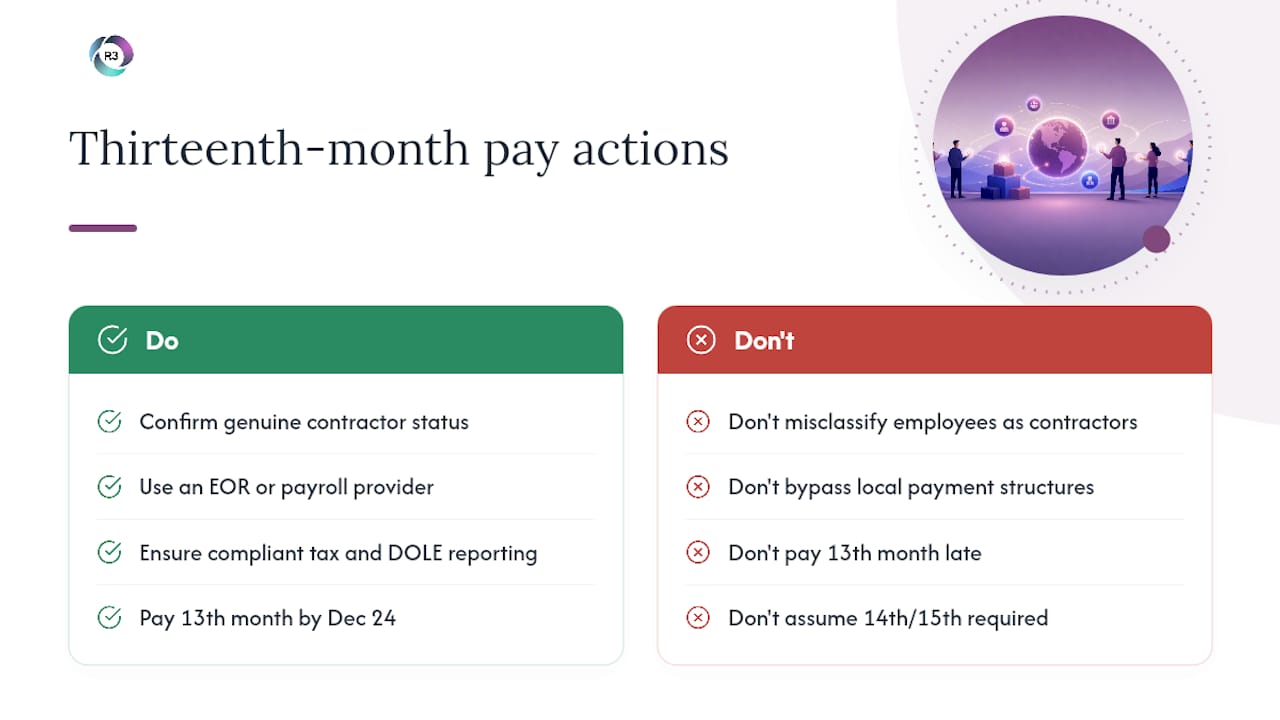
Does 15th month pay exist too? Some Philippine employers voluntarily offer a 14th or 15th month pay as an additional bonus, but only the 13th month pay is legally required under P.D. No. 851. Anything beyond that is discretionary.
Sources
Recommended
Comments