

What Does Virtual Receptionist Mean for Your Business?
- Ellis Jackson
- 10 hours ago
- 8 min read

A virtual receptionist is a remote service that answers calls, schedules appointments, and manages front desk communication without being physically present in your office. The service runs through human agents, AI, or a combination of both. Business owners across real estate, health services, and e-commerce use virtual receptionist services to maintain a professional presence without the cost of full-time on-site staff. If you have ever wondered what does virtual receptionist mean in practical terms, the short answer is this: it is your front desk, just not in your building.
What does a virtual receptionist do?
A virtual receptionist handles far more than a basic answering service. Virtual receptionists qualify leads, book appointments, answer FAQs, and integrate with calendars and CRMs, while a standard answering service simply takes a message and passes it along. That distinction matters because it determines whether your callers get real help or just a callback promise.
The core tasks a virtual receptionist covers include:
Call answering and routing: Every inbound call is answered with a professional greeting and directed to the right person or department.
Appointment scheduling: The receptionist books, confirms, reschedules, and cancels appointments directly inside your calendar system.
Message taking and follow-up: Detailed messages are logged and sent to you by email or text.
Lead qualification: Callers are screened with preset questions so your sales team only speaks with qualified prospects.
FAQ handling: Common questions about your hours, services, or pricing are answered without pulling you away from your work.
After-hours coverage: AI-powered options provide 24/7 support, while human services extend coverage beyond standard business hours.
Virtual receptionists manage appointment booking, confirmations, rescheduling, and cancellations directly inside client calendar systems. That means fewer scheduling errors and less time spent on back-and-forth calls.
Pro Tip: Track your missed call rate for two weeks before hiring a virtual receptionist. That number becomes your baseline for measuring how much new business the service captures.

How does a virtual receptionist work?
The definition of virtual receptionist covers three distinct service models, and each one operates differently. Understanding the differences helps you choose the right fit for your business.
Model | Availability | Best for | Typical monthly cost |
Human remote receptionist | Business hours, some extended | Complex calls, empathy-driven industries | $235–$1,640 |
AI virtual receptionist | 24/7 | High call volume, simple inquiries | $25–$99 |
Hybrid model | 24/7 with human escalation | Businesses needing both speed and nuance | Varies |
Human remote receptionists work from a remote location and handle calls in real time. They bring empathy, judgment, and the ability to manage complex conversations. A law firm or medical practice, for example, benefits from a human who can read tone and respond with care.
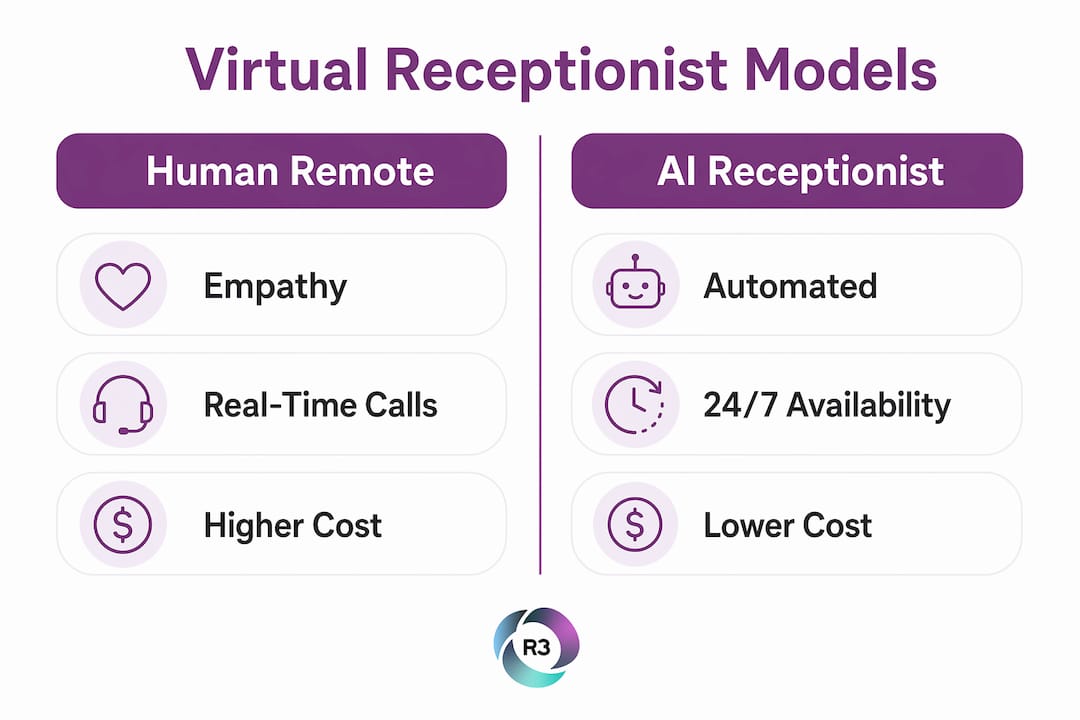
AI virtual receptionists use voice recognition and natural language processing to handle calls automatically. AI options provide 24/7 coverage handling 100% of inbound call traffic remotely, which makes them practical for businesses that receive calls outside normal hours. The trade-off is that AI struggles with nuanced or emotionally sensitive conversations.
Hybrid models combine both. AI handles routine calls and after-hours volume, while a human agent steps in for complex situations or escalations. Choosing between human, AI, or hybrid models requires considering whether your customers value empathy or speed most. A hybrid approach gives you both without paying for full-time staff.
What are the cost benefits of virtual receptionists?
The financial case for virtual receptionist services is direct. Hiring an in-house receptionist costs $52,900–$75,000 annually including salary and benefits. Virtual receptionist services range from $300 to $24,000 per year depending on the model you choose. That gap represents real money you can redirect toward growth.
Beyond salary, an in-house receptionist carries additional overhead: office space, equipment, training, paid time off, and health benefits. A remote service eliminates all of those line items. Virtual receptionists reduce total reception overhead by up to 30% compared to traditional staffing. For a small business watching every dollar, that reduction is significant.
The impact on appointment management is equally strong. Automated SMS confirmations and calendar integration decrease appointment no-shows by up to 70%. No-shows cost service businesses real revenue, and reducing them by that margin can pay for the service several times over. You can read more about how this works in the context of reducing business overhead.
For a detailed breakdown of what remote staffing costs at different service levels, the virtual assistant cost guide covers current pricing across models.
Pro Tip: Calculate your average revenue per appointment, then multiply it by your monthly no-show count. That number tells you exactly how much a virtual receptionist could recover for your business each month.
How do virtual receptionists integrate with your existing systems?
Integration is where virtual receptionist services either pay off or fall short. Failure to integrate with existing CRM and calendar software can negate the time-saving benefits entirely. Before you sign a contract, confirm that the service connects directly with the tools you already use.
The key integration points to verify include:
Calendar software: The receptionist should book and update appointments in real time inside your existing calendar, whether that is Google Calendar, Outlook, or a practice management system.
CRM synchronization: Every new lead or caller should be logged automatically in your CRM so your sales team has accurate, up-to-date records without manual entry.
Communication platforms: Confirm that messages and call summaries route to your preferred channel, whether that is email, Slack, or a ticketing system.
Industry-specific software: Real estate agents may need integration with tools like Follow Up Boss; health practices may require compatibility with their scheduling platform.
Two-way automatic integration is critical to realizing full operational efficiency. One-way data flow, where the receptionist logs information but your system does not update back, creates duplicate work and errors. Always request a live integration demo before committing to a service. The virtual assistant integration best practices guide walks through what to check before you go live.
What are the practical benefits of using a virtual receptionist?
The roles of a virtual receptionist extend well beyond answering phones. For solo professionals and home-based business owners, one of the most underappreciated benefits is privacy. Virtual receptionists protect solo professionals by preventing exposure of personal phone numbers to spam and solicitors. Your personal number stays private, and every caller reaches a professional front desk instead.
The benefits of virtual receptionists also show up directly in customer experience. Callers are greeted immediately with a consistent, professional message rather than voicemail. Shorter wait times and accurate information on the first call build trust faster than any marketing campaign.
Scalability is another practical advantage that business owners often overlook. A growing business can increase call volume without adding office space or hiring additional staff. The service scales with your needs, whether you are handling 50 calls a month or 500. Industries that see the strongest results include:
Real estate: Agents capture leads from listing inquiries around the clock without interrupting showings.
Health and wellness: Clinics reduce front desk workload and keep appointment books full.
Legal services: Firms screen potential clients before committing attorney time to intake calls.
E-commerce: Online sellers manage customer service calls without building an in-house team.
You can explore the full range of advantages for business owners to see how these benefits apply across different industries and business sizes.
Key Takeaways
A virtual receptionist is the most cost-effective way to maintain a professional front desk without the overhead of full-time in-house staff, provided you choose the right model and integrate it properly with your existing systems.
Point | Details |
Definition is broader than most expect | Virtual receptionists qualify leads, book appointments, and handle FAQs, not just take messages. |
Three service models exist | Human, AI, and hybrid options each suit different business needs and budgets. |
Cost savings are significant | Annual costs range from $300 to $24,000 versus $52,900–$75,000 for in-house staff. |
Integration determines success | Two-way CRM and calendar sync is required to realize full time and cost savings. |
No-show reduction drives ROI | Automated confirmations can decrease appointment no-shows by up to 70%. |
What I have learned about virtual receptionists after years of watching businesses use them
Most business owners come to virtual receptionists looking for a cheaper phone answerer. That framing leads them to underuse the service and then wonder why it did not move the needle. The businesses that get the most out of a virtual receptionist treat it as a front-line business function, not a cost-cutting shortcut.
The mistake I see most often is skipping the integration setup. Owners sign up, hand over a call script, and assume the service will figure out the rest. When the receptionist cannot update the CRM or book into the live calendar, the whole system breaks down within weeks. The technology is only as useful as the workflow behind it.
The human versus AI debate is also more nuanced than most articles admit. AI is fast and available at 3:00 AM, but it cannot read hesitation in a caller’s voice or adjust tone when someone is frustrated. For businesses where the first call sets the relationship, a human receptionist is worth the higher cost. For high-volume, transactional businesses, AI handles the load without complaint.
What I find genuinely exciting about 2026 is how hybrid models have matured. The best services now route calls intelligently, with AI handling the routine and humans stepping in only when the conversation requires real judgment. That combination gives small businesses a front desk that would have cost a full-time salary just a few years ago.
Treat your virtual receptionist as a business partner with a defined role, clear scripts, and regular performance reviews. The businesses that do that consistently report better customer satisfaction and more appointments booked. The ones that set it and forget it get what they paid for, which is not much.
— Ellis
How R3source supports your front desk operations
R3source provides dedicated remote professionals from the Philippines who integrate directly into your business operations, including front desk and administrative support. Every team member is trained to work inside your existing systems, from calendar management to CRM updates, so nothing falls through the cracks. If you are ready to build a reliable support system without the overhead of in-house staffing, explore virtual assistant outsourcing with R3source. The team works with businesses across real estate, e-commerce, and service industries to deliver consistent, professional support that scales with your growth.
FAQ
What does virtual receptionist mean in simple terms?
A virtual receptionist is a remote service that answers your business calls, schedules appointments, and handles front desk tasks without being physically in your office. The service can be staffed by humans, AI, or a combination of both.
What is a virtual receptionist job?
A virtual receptionist job involves answering inbound calls, routing inquiries, booking appointments, qualifying leads, and managing customer communications remotely. The role functions as a professional front desk representative working from an off-site location.
How much does a virtual receptionist service cost?
Virtual receptionist services range from $300 to $24,000 per year depending on the model, compared to $52,900–$75,000 annually for an in-house receptionist including salary and benefits.
Can a virtual receptionist integrate with my calendar and CRM?
Yes, and two-way integration is critical to getting full value from the service. The receptionist should book appointments directly into your live calendar and log caller information automatically into your CRM without manual input.
What is the difference between a virtual receptionist and an answering service?
An answering service takes messages and passes them along. A virtual receptionist qualifies leads, books appointments, answers FAQs, and acts as a full front desk extension for your business.
Recommended