

Why Entrepreneurs Hire Before They Are Ready
- Ellis Jackson

- Jul 13
- 7 min read

Author: Ellis Jackson
Premature hiring is one of the most common and costly mistakes entrepreneurs make, often triggered by capacity overwhelm rather than genuine operational readiness. The industry term for this pattern is “desperation hiring,” and it describes the moment a founder brings someone on board to escape workload pressure rather than to fulfill a defined role. Understanding why entrepreneurs hire before they are ready is the first step toward making smarter decisions that actually support growth. A single bad early hire can cost an estimated $48,000 in salary, recovery time, and stalled revenue. That number should stop any founder in their tracks.
Why entrepreneurs hire before they are ready
Hiring is often an emotional decision. When you are buried in tasks, the instinct is to find someone, anyone, to share the load. Researchers and experienced founders call this the “psychology tax” of entrepreneurial hiring. It describes how emotional exhaustion distorts judgment, pushing founders toward poor leadership choices and micromanagement patterns that undermine the very hire they just made.
Several forces drive early hiring decisions:
Fear of missing growth opportunities. You see demand building and assume a new hire will capture it.
Workload pressure. You are working 60-hour weeks and believe another person will cut that in half.
Social proof. Peers are hiring, and you feel behind if you are not.
Misreading busyness as a bottleneck. Being busy and having a structural capacity constraint are two different problems. Only the latter justifies a full-time hire.
“Hiring out of desperation skips strategic workforce planning, resulting in poor role definition and costly hires that drain resources instead of building them.”
The distinction between being busy and having a true structural bottleneck is critical. A busy founder may need automation or a contractor first. A founder with a genuine bottleneck, one where a repeatable, documented function cannot be handled without another person, is the one who is actually ready to hire. Desperation hiring bypasses this analysis entirely.
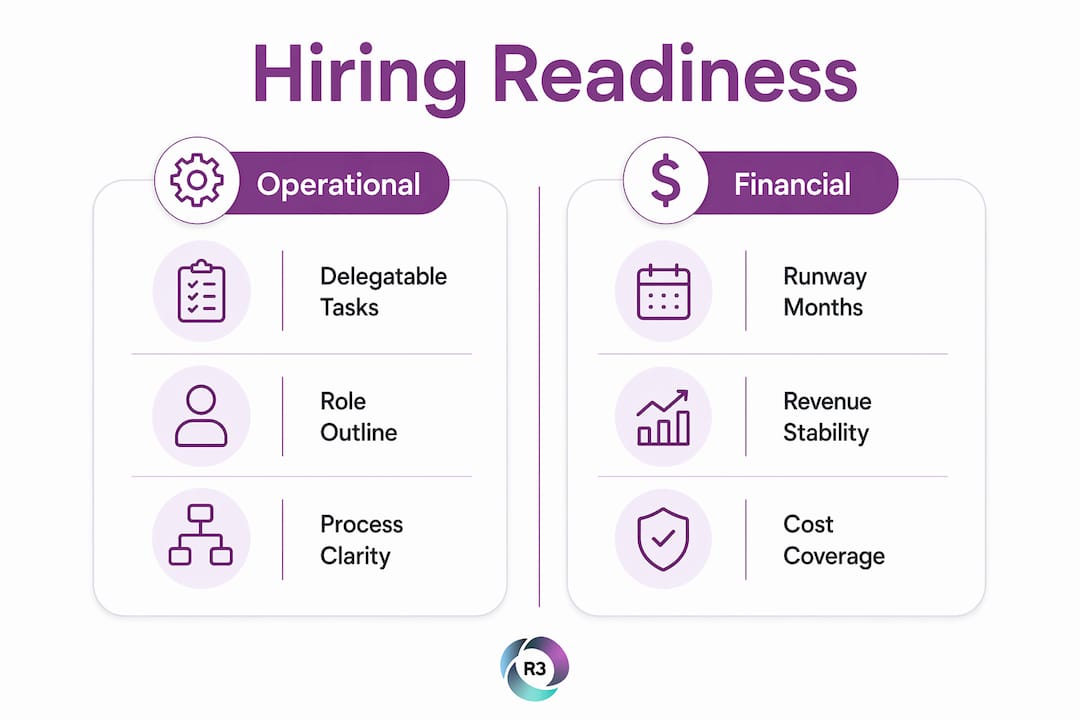
What does operational and financial readiness actually mean?

Readiness is not a feeling. It is a set of measurable conditions your business must meet before a new hire makes sense.
Financial readiness
The best financial practice is to have 12–18 months of runway for a new hire’s fully loaded cost. That cost is typically 110–125% of base salary when you factor in taxes, benefits, equipment, and onboarding time. If you cannot sustain that runway, you are not financially ready, regardless of how overwhelmed you feel.
Readiness Indicator | What to Measure |
Revenue stability | Consistent monthly revenue for at least 3 consecutive months |
Financial runway | 12–18 months of fully loaded hire cost in reserve |
Delegatable tasks | 20+ hours per week of repeatable, documented work |
Role clarity | Written job description with defined success metrics |
Operational readiness
Clear delegation of 20+ hours per week of repeatable, delegatable work is a key sign that you are ready to hire. If you cannot identify those tasks clearly, you are not ready. Documented processes matter just as much. Without them, a new hire depends entirely on you for every decision, which increases your workload rather than reducing it.
Pro Tip: If you cannot outline the role, its tasks, and its success measures in writing within two hours, systematize first before you hire anyone.
What are the real risks of hiring too soon?
The consequences of premature hiring go far beyond a bad month. A 91% failure rate occurs within 12 months for hires made out of exhaustion without documented processes. That is not a typo. Nine out of ten desperation hires fail within a year.
The financial damage compounds quickly. The $48,000 loss per premature hire includes direct salary, the cost of replacing the person, and up to nine months of stalled revenue growth. That growth delay is often the most damaging part because it sets your entire business timeline back.
Cost Category | Impact |
Direct salary loss | Wages paid for underperforming or departed hire |
Replacement cost | Recruiting, interviewing, and onboarding a second hire |
Morale damage | Remaining team members absorb confusion and instability |
Revenue delay | Growth stalls for up to 9 months post bad hire |
Skipping onboarding makes every outcome worse. Without a structured onboarding plan, 20% of new hires leave within the first 45 days. That means you pay to recruit, you pay to train, and then the person walks out the door before they have contributed anything meaningful.
Hiring also does not fix product-market fit problems. If your business has unresolved strategic issues, adding headcount drains capital without solving the underlying problem. A new hire cannot replace a clear value proposition.
How do you decide when and how to hire your first employee?
The goal is to hire from a position of preparation, not panic. These steps give you a practical framework to get there.
Conduct a readiness assessment. Write down every task you do in a week. Identify which ones are repeatable, teachable, and do not require your direct judgment. If that list adds up to 20+ hours, you have a case for hiring.
Systematize before you hire. Remove low-leverage work from your plate through automation or documented processes first. Tools like project management software and standard operating procedures reduce dependency on any single person, including you.
Write a job scorecard. Define the role’s top three outcomes, the skills required, and how you will measure success in 30, 60, and 90 days. Structured interviews and job scorecards increase hiring precision and reduce the bias that founders commonly bring to early-stage hiring decisions.
Build a 90-day onboarding plan. A structured 90-day onboarding plan improves retention by 82% and cuts early turnover significantly. This is not optional. It is the difference between a hire who sticks and one who leaves within six weeks.
Test the role before committing. Use a contractor or outsourcing arrangement to validate whether the role actually solves your bottleneck. If a part-time contractor handles the work well, you have confirmed the need and can hire with confidence.
Pro Tip: Experienced founders say first hires should subtract low-leverage tasks from your plate, not add complexity. Hire to free your time for high-impact work, not to feel less alone.
Hiring ahead of growth works only when the hire creates margin. If the hire adds stress and creates dependency instead of relieving it, you hired too soon. The margin test is simple: will this person free up your capacity for higher-value work within 90 days? If you cannot answer yes with confidence, wait.
Key takeaways
Premature hiring fails at a 91% rate within 12 months, costs an average of $48,000 per bad hire, and stalls growth for up to nine months. Preparation, not urgency, is what makes a first hire succeed.
Point | Details |
Readiness is measurable | Confirm 20+ hours of delegatable tasks and 12–18 months of financial runway before hiring. |
Desperation hiring is costly | A premature hire costs an average of $48,000 in salary, replacement, and lost revenue. |
Onboarding drives retention | A structured 90-day onboarding plan improves new hire retention by 82%. |
Systematize before you scale | Document processes and remove low-leverage tasks before adding headcount. |
Test roles before committing | Use contractors or outsourced support to validate a role before making a full-time hire. |
The urge to hire too soon is real. Here is what I have learned.
Every founder I have spoken with describes the same moment. Revenue is growing, the inbox is overflowing, and the thought arrives: “I just need to hire someone.” That feeling is real. The pressure behind it is real. But the decision it leads to is often wrong.
The founders who build strong teams do not hire to escape overwhelm. They hire to extend their capacity after they have already built the foundation. They document their processes first. They identify the specific bottleneck. They write the job scorecard before they post the listing. That preparation is not bureaucracy. It is what separates a hire that works from one that costs you nine months of progress.
The hardest part is sitting with the discomfort of being stretched thin while you do the preparation work. Rapid markets compress timelines, and the pressure to move fast is real. But hiring without readiness compounds the problem. You go from being stretched to being stretched and managing someone who cannot help you yet.
My honest recommendation: before you post a job listing, ask yourself whether a contractor or a virtual assistant for startup operations could test the role first. If the answer is yes, start there. You will learn what the role actually needs, and you will hire your first full-time employee with far more clarity and confidence.
— Ellis
R3source helps you build capacity before you are ready to hire full-time
Building your business does not have to mean rushing into a full-time hire before you have the foundation in place.

R3source provides offshore virtual assistant services that let you delegate administrative work, customer service, lead generation, and CRM management without the financial risk of a full-time employee. You get a trained, dedicated remote professional who integrates directly into your operations. That means you can test delegation, build your processes, and confirm your bottlenecks before you commit to a full-time hire. R3source works with entrepreneurs across real estate, e-commerce, and service-based businesses. If you are ready to reclaim your time and grow with less risk, learn how to hire your first virtual assistant and take the first step today.
FAQ
Why do entrepreneurs hire before they are ready?
Entrepreneurs hire early primarily due to capacity overwhelm and the fear of missing growth opportunities. This pattern, known as desperation hiring, is driven by emotional pressure rather than operational readiness.
What is the cost of hiring too early?
A premature hire costs an estimated $48,000 on average, including salary, replacement costs, and up to nine months of stalled revenue growth.
How do I know when I am ready to hire my first employee?
You are ready when you have 20+ hours per week of documented, delegatable tasks, at least 12–18 months of financial runway for the hire’s fully loaded cost, and a written job description with clear success metrics.
Does hiring early help startups grow faster?
Hiring early helps only when the hire creates margin for the founder to do higher-value work. Without documented processes and a clear role, early hiring adds dependency and stress rather than accelerating growth.
What is a good alternative to hiring full-time too soon?
Using a contractor or outsourced remote professional lets you test a role before committing to a full-time hire. This approach validates the need, builds your processes, and reduces financial risk significantly.
Recommended
Comments