

How Entrepreneurs Scale Without Employees in 2026
- Ellis Jackson

- Jul 13
- 7 min read

Author: Ellis Jackson
Scaling without employees is defined as growing revenue and operational capacity by replacing fixed payroll with automation systems, specialized contractors, and process design. How entrepreneurs scale without employees has become one of the most studied questions in modern business, and the answer is clear: AI operational capacity costs $9,000–$30,000 annually versus $60,000–$90,000 for a full-time administrative hire. That gap is the entire argument. Companies like Medvi proved the model works at scale, growing from 300 to 250,000 customers in a single year with just two full-time employees by automating marketing, support, and content. The playbook is not theoretical. It is repeatable, and this guide shows you exactly how to run it.
How entrepreneurs scale without employees: the automation-first framework
The first question every founder must answer is: which tasks should a machine handle? The answer follows a simple rule. Pattern-based, repeatable, rules-driven tasks are ideal automation candidates. If a task follows the same steps every time and does not require judgment, a human should not be doing it.
Automation works best across four operational categories:
Marketing: Email sequences, social media scheduling, ad reporting, and lead nurturing flows
Customer support: AI platforms handle 60–80% of inbound support tickets, covering FAQs, order status, and onboarding steps
Billing and finance: Automated invoicing, payment reminders, and subscription management
Reporting: CRM dashboards, sales pipeline updates, and weekly performance summaries
The economic case is straightforward. Automation tools handle volume at a fraction of human cost. The real skill is identifying which tasks in your business meet the threshold for automation. Volume matters here. A task you perform twice a month does not justify an automation build. A task that happens 50 times a week does.
Pro Tip: Run an Operations Audit before buying any tool. List every task you or your team performs weekly, note the frequency, and mark each one as “rules-based” or “judgment-based.” Automate the rules-based column first.

The audit approach prevents the most common founder mistake: buying automation tools before knowing what to automate. Start with your highest-volume, lowest-judgment tasks. Build from there.
How do you outsource effectively without hiring full-time staff?
Outsourcing is the bridge between full automation and a full-time team. It gives you access to specialized skills without the fixed cost of a salary. A freelance developer at $45 per hour costs far less than a full-time developer at $10,000 per month for equivalent hours. That flexibility is the point.
The most effective outsourcing follows a phased approach:
Automate first. Cover as much operational volume as possible with tools before bringing in any contractor. This reduces the scope of what you need to outsource and makes contractor work cleaner.
Add 3–5 specialized freelancers. Bring in contractors for content creation, graphic design, web development, bookkeeping, and customer support. Each contractor handles a defined scope with clear deliverables.
Add a project manager. Once your contractor network grows, a part-time project manager frees you from coordination and returns your focus to revenue-generating work.
Contractor relationships typically stabilize after six months. Before that point, expect some turnover and adjustment. The key is building systems that make onboarding fast. Document every process before you hand it off. Contractors need repeatable, systematized workflows. Ad-hoc directions create confusion and rework.
The roles most commonly outsourced by solo founders include content writers, social media managers, graphic designers, web developers, bookkeepers, and customer support agents. Each of these roles has a well-established freelance market with predictable quality tiers.
Pro Tip: Always run a paid trial project before committing to a long-term contractor relationship. A two-week paid trial reveals communication style, quality, and reliability faster than any interview.
One mindset shift that compounds results: billing outcomes instead of time. When you productize your services and charge for results rather than hours, you decouple revenue from labor. That is when outsourcing stops being a cost-saving tactic and becomes a growth engine.
When does hiring an employee actually make sense?
Hiring a full-time employee is justified in specific, identifiable situations. It is not the default next step after growth. Founders who automate task coverage to 85–90% before hiring avoid the margin compression that kills early-stage businesses.
The roles that genuinely require a full-time employee share three characteristics:
Deep institutional knowledge: The role requires understanding your business history, client relationships, and internal context that cannot be documented into a contractor brief
Continuous availability: The function requires someone present and responsive across your full operating hours, every day
Strategic decision-making: The role involves judgment calls that affect the direction of the business, not just execution of defined tasks
The coordination cost principle is the clearest hiring signal. When the time you spend managing contractors exceeds the cost savings those contractors provide, hiring a dedicated employee becomes the more efficient choice. That tipping point is measurable. Track the hours you spend on contractor management each week. When it consistently exceeds eight to ten hours, the math has shifted.
Premature hiring is the most common and most damaging founder mistake. Fixed payroll raises your break-even point immediately. It reduces your runway. It creates pressure to generate revenue before your systems are ready. Hiring out of anxiety rather than operational necessity is a trap. The question to ask is not “Am I busy?” but “Is there a defined, recurring role that automation and outsourcing cannot fill?”
For more context on when outsourcing stops being enough, the reasons to outsource before hiring are worth reviewing before you make that call.
What tech stack do solo founders use to scale in 2026?
The modern solo founder’s operational stack costs under $300 per month and replaces what would otherwise require a team costing $345,000 per year in human labor equivalents. That is not an exaggeration. It is the documented reality of what automation platforms now deliver.
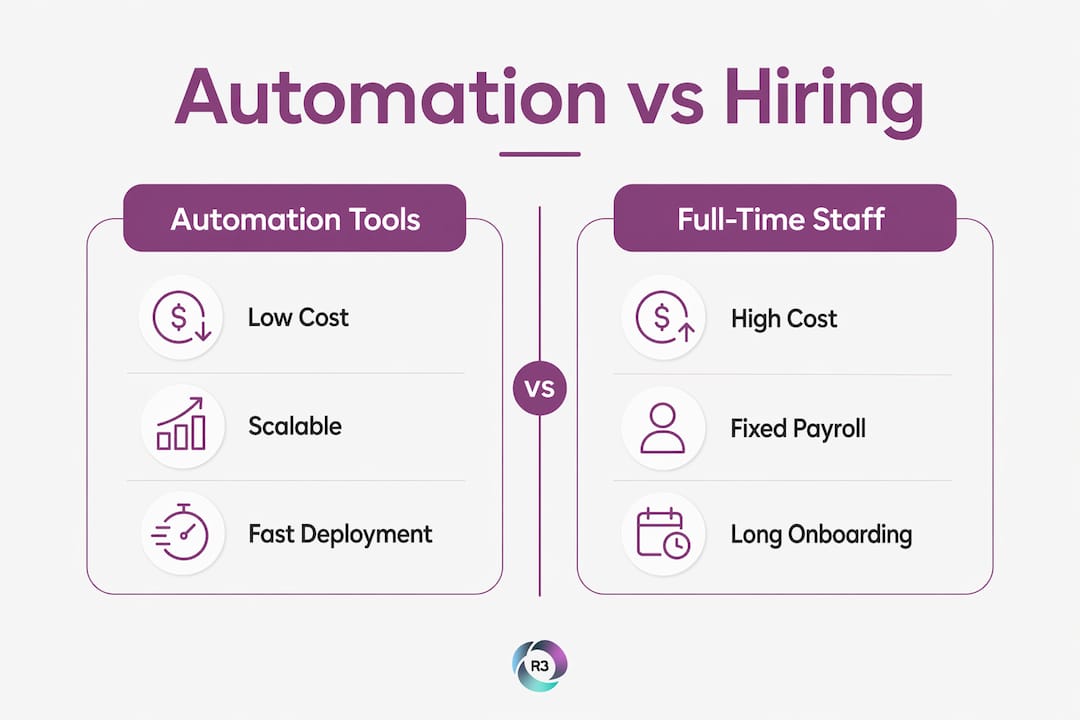
The core stack covers four operational layers:
Workflow automation: Tools like n8n and Make.com connect your apps and trigger actions automatically. CRM updates, lead routing, follow-up emails, and task creation all run without human input.
Customer support: AI chatbots handle the first line of inbound support. They resolve common questions, collect information, and escalate only the cases that require human judgment.
Content and marketing: AI writing and social media platforms produce drafts, schedule posts, and generate reports. A solo founder using these tools produces agency-level content volume.
Finance and reporting: Automated invoicing, expense tracking, and dashboard reporting keep your numbers current without a bookkeeper touching them daily.
Function | Traditional hire cost (annual) | Automation tool cost (annual) |
Administrative support | $60,000–$90,000 | $9,000–$30,000 |
Customer support (tier 1) | $45,000–$55,000 | Under $3,600 |
Content and social media | $50,000–$70,000 | Under $3,600 |
Workflow and CRM management | $55,000–$75,000 | Under $3,600 |
Pro Tip: Build your automation stack in layers. Start with one workflow tool, connect your most-used apps, and run it for 30 days before adding the next layer. Stacking too many tools at once creates fragile systems that break in ways that are hard to diagnose.
The role of virtual assistants in this stack is to handle the tasks that fall between automation and full-time hiring. They cover judgment-light but human-required work: inbox management, scheduling, research, and client communication. That combination of automation plus a skilled virtual assistant covers most of what a small team of employees would otherwise handle.
Key takeaways
Entrepreneurs who automate first, outsource second, and hire last build the most durable and profitable businesses without proportional headcount growth.
Point | Details |
Automate rules-based tasks first | Pattern-driven, high-volume tasks belong to automation tools, not human labor. |
Outsource before you hire | Freelancers give you specialized skills at a fraction of full-time cost with full flexibility. |
Hire only when coordination costs spike | Track contractor management hours; hire when they consistently exceed the cost savings. |
Build a lean tech stack | Tools like n8n and Make.com replace entire operational functions for under $300 per month. |
Document every process | Contractors and automation both require systematized workflows to perform reliably. |
The uncomfortable truth about scaling solo
I have watched founders make the same mistake for years. They hit a growth moment, feel the pressure, and hire someone. Not because the role is defined. Not because automation has been exhausted. Because hiring feels like doing something. It feels decisive. It feels like leadership.
It is usually neither.
The founders who build the most efficient businesses treat leverage as the product itself. They ask: “How do I make this output happen without adding a fixed cost?” before they ever ask “Who should I hire?” That sequence matters more than any specific tool or tactic.
The bus factor risk is real and underappreciated. When your business runs on complex automation workflows that only you understand, a single point of failure can shut down operations. I have seen this happen. The fix is documentation. Every workflow, every trigger, every exception path needs to be written down as if you are handing it to someone who has never seen your business. That discipline protects you and makes your business genuinely transferable.
The phased approach works because it matches your cost structure to your revenue reality. You do not take on fixed costs until the revenue justifies them. You build outsourcing capacity incrementally. You hire only when the math is undeniable. That is not timidity. That is how you stay in business long enough to build something meaningful.
— Ellis
R3source: virtual support that fits your scaling strategy
Growing without a full-time team does not mean going it alone.
R3source provides pre-trained offshore virtual assistants from the Philippines who integrate directly into your existing workflows. They handle the human-required tasks that automation cannot cover: inbox management, CRM updates, appointment setting, lead follow-up, and customer communication. Every R3source team member is trained before they start, which means no long onboarding curve and no wasted time. If you are ready to add reliable, consistent support without the overhead of a full-time hire, offshore virtual assistant services from R3source give you exactly that. You can also book a free consultation to find the right fit for your operations.
FAQ
How do entrepreneurs scale without employees?
Entrepreneurs scale without employees by automating rules-based tasks, outsourcing specialized work to freelancers, and reserving full-time hiring for roles that require continuous presence and strategic judgment. This approach keeps fixed costs low while expanding operational capacity.
What tasks can be automated to avoid hiring?
AI platforms handle 60–80% of inbound support tickets and can automate billing, CRM updates, email sequences, and reporting. High-volume, pattern-based tasks are the best candidates for automation.
When should a solo founder hire their first employee?
Hire when managing contractors consistently takes more time than the cost savings they provide, a threshold known as the coordination cost tipping point. Founders who automate 85–90% of task coverage before hiring avoid unnecessary margin compression.
How much does automation cost compared to hiring?
AI operational tools cost $9,000–$30,000 per year versus $60,000–$90,000 for a single full-time administrative hire. A full automation stack replacing multiple roles typically runs under $300 per month.
What is the best outsourcing strategy for a solo founder?
The most effective approach is phased: automate first, then add 3–5 specialized freelancers, then bring in a part-time project manager as volume grows. Contractor relationships stabilize after roughly six months, so start with clear deliverables and a paid trial project.
Recommended
Comments