

The Role of Delegation in Startup Growth


Delegation is defined as transferring ownership and decision-making authority to capable team members so founders can focus on high-impact leadership. The role of delegation in startup growth goes far beyond handing off tasks. It is the mechanism that removes you as the bottleneck and lets your business scale past what one person can manage. High-delegating CEOs generate 33% more revenue and achieve a 1,751% average three-year growth rate, 112 percentage points higher than low-delegating peers. That gap is not a coincidence. It is the direct result of distributed leadership replacing founder-centered control.
What evidence supports delegation’s impact on startup growth?
The data on delegation is clear and consistent. Founders who distribute decision-making authority grow faster, enter markets sooner, and acquire customers at a higher rate than those who keep control centralized.
Companies with centralized, founder-led decision-making are 20% slower to enter new markets and have a 10% lower customer acquisition rate than those with distributed leadership. Slower market entry means competitors capture customers you should have won. Lower acquisition rates mean your growth ceiling drops before you ever reach it.

The bottleneck effect is measurable at the individual level too. Closing the delegation gap reduces a founder’s daily decisions from 67 to 19 and work hours from 70 to 41 per week, leading to a 34% revenue increase in six months. That is not a marginal improvement. It is a structural shift in how a business operates.
Three specific growth outcomes follow when founders delegate effectively:
Faster decisions at the front line. Team members with clear authority respond to customers and opportunities without waiting for founder approval.
Higher throughput. Delivery capacity grows because execution is no longer limited to what one person can oversee.
Better strategic focus. Founders redirect their time toward partnerships, fundraising, and product direction instead of daily operations.
The contrast between centralized and distributed leadership is not about founder capability. It is about organizational design. A founder who handles 67 decisions a day cannot also build the relationships and strategy that drive long-term growth.
What barriers prevent effective delegation in startups?
Most founders know they should delegate more. The reason they do not comes down to psychology and structure, not workload.
Founder identity tied to “being the smartest person” and “being needed” creates psychological barriers to effective delegation. When your identity is wrapped up in being the one who solves every problem, handing off a task feels like giving up relevance. That feeling is real, and it is one of the most common reasons delegation stalls.
“Most founders underestimate the emotional challenge of letting go. Embracing the CEO role requires overcoming identity attachments to operational work. The dopamine of being needed is a powerful force that keeps founders trapped in execution instead of leadership.”
The structural side is equally damaging. 75% of entrepreneurs struggle to delegate effectively, and 58% bottleneck their own startups due to poor delegation caused by lack of clarity, trust, and communication. These are not personality flaws. They are governance failures.
The “delegation gap” describes the space between what founders say they want to hand off and what actually gets transferred with real authority. Common signs of the delegation gap include:
Tasks get reassigned but decisions still route back to the founder.
Team members complete work but lack authority to act on outcomes.
Founders re-do or heavily revise delegated work, signaling distrust.
No documented criteria exist for how decisions should be made.
Delegation without governance leads to delegation failures and the founder becoming the bottleneck again due to inconsistent decisions. The fix is not trying harder to let go. The fix is building the systems that make letting go safe.
What is the right sequence for delegating in a startup?
Delegation sequence matters more than most founders realize. Delegating in the wrong order creates worse bottlenecks, not fewer.
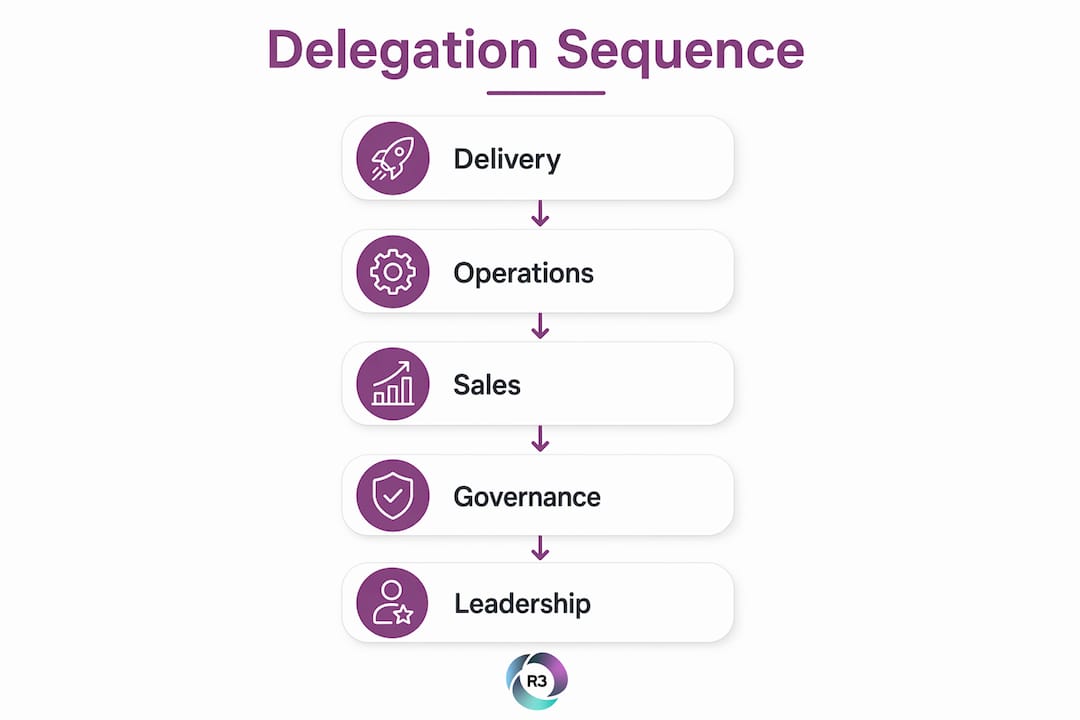
The recommended order for service startups is to delegate delivery first, then operations, and finally sales. Each stage removes a specific type of bottleneck.
Delegate delivery first. Delivery is the capacity bottleneck. When the founder is the primary person doing client work or fulfilling orders, growth is physically capped. Hiring capable people for delivery roles unlocks the ability to take on more clients without the founder working more hours.
Delegate operations second. Once delivery runs without you, operations become the time bottleneck. Administrative tasks, scheduling, reporting, and process management consume founder hours that should go toward strategy. Delegating operations frees that time.
Delegate sales last. Sales is the growth bottleneck. Systematizing sales requires documented processes, clear messaging, and trained team members who can represent the brand. Attempting to delegate sales before delivery and operations are stable typically fails because the business cannot handle the new volume.
Delegation stage | Bottleneck removed | What the founder gains |
Delivery | Capacity ceiling | Ability to serve more clients |
Operations | Time drain | Hours for strategy and leadership |
Sales | Growth ceiling | Repeatable revenue without founder involvement |
Governance documentation is what makes each stage stick. Governance frameworks should target 85–90% decision alignment with founder judgment. Targeting 100% alignment creates a brittle script that undermines team autonomy. The goal is a team that thinks like you, not one that waits for you.
Pro Tip: Document your top 10 recurring decisions before you delegate a role. Write down the criteria you use to make each one. That document becomes the governance framework your team member needs to act without asking.
How can founders delegate effectively and close the delegation gap?
Closing the delegation gap requires a repeatable system, not a one-time handoff. The most effective approach combines clear outcome definition, a quality threshold, and consistent feedback.
The 70% quality rule is the most practical standard for startup delegation. If a team member can complete a task at 70% of your quality level, delegate it. Quality improves over time with feedback. Holding out for 100% before delegating means the task never leaves your plate.
Training takes time upfront, but the math works in your favor. Teaching a task initially takes longer, but founders break even after about 6 repetitions. Founders who stop training after one or two attempts stay trapped in operational roles permanently.
Practical steps to close the delegation gap:
Define outcomes, not methods. Tell your team member what success looks like, not exactly how to achieve it. This builds judgment and reduces dependency.
Set authority levels explicitly. Clarify which decisions they can make alone, which need a check-in, and which require your approval. Ambiguity creates unnecessary escalations.
Use project management tools and dashboards. Project management tools and routine documentation transform delegation from micromanagement into scalable ownership. Tools like Asana, ClickUp, or Notion give you visibility without requiring you to be in every conversation.
Schedule feedback loops, not check-ins. Weekly reviews focused on outcomes and blockers are more effective than daily status updates that signal distrust.
Avoid abdication. Delegation is not disappearing. You stay accountable for results while your team owns execution.
You can find real delegation examples for entrepreneurs that show how this plays out across different business types and task categories.
Pro Tip: Build a “delegation log” where you track every task you hand off, the outcome standard you set, and the feedback you gave. After 90 days, you will see patterns in what works and where your governance gaps are.
Key Takeaways
Delegation is the single most measurable driver of startup revenue growth, and founders who build governance frameworks around it outperform those who rely on effort alone.
Point | Details |
Delegation drives revenue | High-delegating founders achieve a 1,751% three-year growth rate, far above low-delegating peers. |
Sequence determines success | Delegate delivery first, then operations, then sales to remove bottlenecks in the right order. |
Governance makes it stick | Document decision criteria targeting 85–90% alignment so teams act without constant founder input. |
The 70% rule unlocks progress | Delegate tasks at 70% quality and improve through feedback rather than waiting for perfection. |
Psychology is the real barrier | Founder identity and the need to be needed are the most common reasons delegation stalls. |
Why letting go is the hardest and most important thing you will do as a founder
I have worked with enough founders to know that the delegation conversation almost always starts the same way. They say they want to delegate. They mean it. Then three weeks later, they are back in the weeds, re-doing work their team already completed.
The problem is not capability. The problem is that most founders built their business by being the most capable person in the room. That identity served them well in the early days. It becomes a liability the moment the business needs to grow past what one person can carry.
The research confirms what I have seen firsthand. Closing the delegation gap cuts founder work hours nearly in half and produces a 34% revenue increase in six months. Those numbers are not from a perfect scenario. They come from real founders who made the uncomfortable decision to stop being the answer to every question.
The shift from operator to CEO is not a title change. It is a complete rewiring of how you measure your own contribution. Your value is no longer in what you personally produce. It is in the quality of the team you build and the systems you put in place. That transition is hard, and it takes longer than most people expect.
What I have found works is starting with governance before you delegate anything significant. Write down how you make decisions. Build the framework first, then hand off the role. Founders who skip that step end up pulling work back within weeks. Founders who do it right find that their team makes better decisions than they expected, and they finally have time to think.
Explore consistent support staff strategies if you want to understand how ongoing delegated support changes founder bandwidth over time.
— Ellis
How R3source helps startup founders put delegation into practice
Knowing the theory of delegation and actually building a team that executes without you are two different challenges.

R3source provides dedicated virtual assistants and remote professionals from the Philippines who integrate directly into your operations. They handle administrative support, customer service, CRM management, appointment setting, and marketing support so you can focus on the decisions that actually move your business forward. These are not task-based freelancers. They are long-term team members trained to take ownership of their roles. If you are ready to hire offshore virtual assistants who reduce your workload from day one, R3source is built for exactly that. You can also book a free consultation to talk through which tasks to delegate first and how to build the governance structure around them.
FAQ
What is the role of delegation in startup growth?
Delegation transfers decision-making authority and task ownership to team members, freeing founders to focus on strategy and high-impact leadership. High-delegating founders achieve significantly faster revenue growth and market entry than those who centralize control.
How do I know which tasks to delegate first?
Delegate delivery roles first to remove the capacity bottleneck, then operations to free founder time, and finally sales to build repeatable revenue. Starting with tasks suited for virtual assistants is a practical entry point for most startups.
What is the delegation gap and why does it cause burnout?
The delegation gap is the difference between tasks founders intend to hand off and those they actually transfer with real authority. Without closing this gap, founders continue making 67 or more decisions per day, which leads directly to burnout and stalled growth.
Why do founders struggle to delegate effectively?
75% of entrepreneurs struggle to delegate because of unclear communication, lack of trust, and founder identity issues tied to being needed. Governance frameworks that document decision criteria are the most reliable fix.
What is the 70% quality rule in delegation?
The 70% quality rule states that if a team member can perform a task at 70% of the founder’s quality level, the task should be delegated immediately. Quality improves through feedback over time, and waiting for perfection keeps founders stuck in execution.
Recommended
Comments