

Philippines English Proficiency: 2026 EF EPI Score and Rank


The Philippines ranked 28th globally in the 2025 EF English Proficiency Index, scoring 569 out of a possible 800. That places the country squarely in EF’s “high proficiency” band, well above the global average of 488 and second in Asia behind only Malaysia. If you manage teams, hire remote staff, or study workforce readiness, that number tells you something concrete: the average English speaker here can handle detailed presentations, dense written material, and unscripted business conversation without much friction.
Here is what the score practically supports:
Reading technical documents and contracts with minimal misinterpretation
Delivering presentations and leading meetings in English
Writing professional emails, reports, and client communication
Following spoken instructions and participating in live customer conversations
Statistic: Philippines EF EPI 2025 score: 569 (rank 28 of countries assessed, “high proficiency” band, versus a global average of 488).
Key Takeaways
The Philippines holds “high proficiency” status in the 2025 EF EPI at 569 points, but its weakest skill, speaking, is exactly the one most customer-facing jobs require most.
Point | Details |
High proficiency, slipping rank | Philippines scored 569 in the 2025 EF EPI, ranked 28th globally, second in Asia behind Malaysia. |
Speaking is the weak link | Speaking scored 539, well below Writing’s 603, signaling a classroom-to-workplace English gap. |
Job function matters more than the average | Scores range from 508 (Technicians) to 621 (Strategy & Project Management) within one country. |
Use EF EPI for trends, not hiring decisions | Self-selection and access bias mean role-specific testing should guide actual staffing choices. |
BPO demand keeps pressure on standards | Industry analysis links sustained call center growth to both language gains and skill strain. |
Table of Contents
How Proficient Is English in the Philippines by Skill?
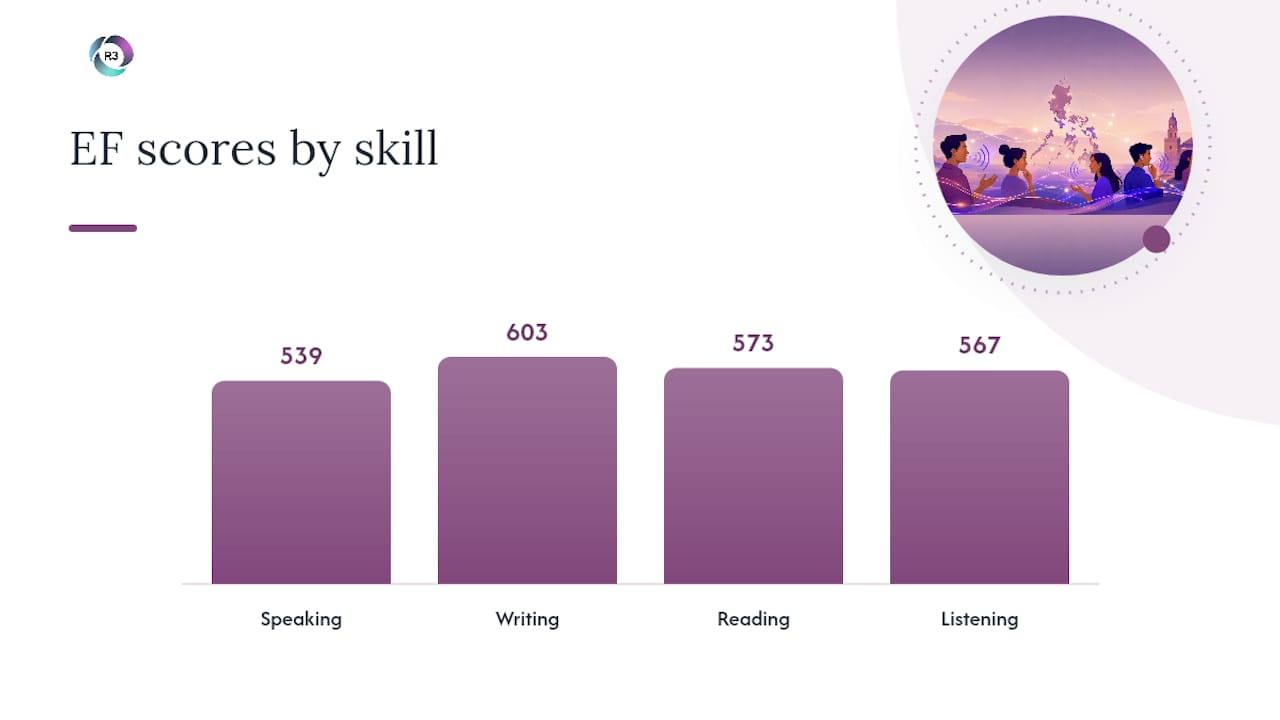
The 569 headline score breaks into four components, and the spread matters more than the average suggests. EF’s 2025 data puts Writing at 603, the strongest of the four, followed by Reading at 573, Listening at 567, and Speaking at 539, the weakest skill by a clear margin.
That gap between writing and speaking is not a rounding error. It suggests Filipino English learners are more comfortable producing structured, edited text than handling live, spontaneous verbal exchange, a pattern consistent with an education system that historically emphasizes grammar instruction and reading comprehension over conversational practice.
Writing: 603
Reading: 573
Listening: 567
Speaking: 539
Global average across all four skills: 488
EF’s 2025 edition draws on test results from millions of participants worldwide who took the organization’s free online English assessment during the reporting period. That scale gives the Philippine figures statistical weight, even with the sampling caveats covered next.
How Reliable Is the EF EPI Methodology?
EF builds its country scores from a free, publicly available online English test, not a randomized national survey. Anyone can take it, and millions do each year, which gives EF a massive dataset but not a demographically balanced one.
That distinction matters for how you use the number. People who seek out a free English test online tend to be younger, more urban, more connected to the internet, and often already motivated to demonstrate or improve their English, a self-selection pattern that skews the sample toward higher performers.
Self-selection bias: test takers are not randomly drawn from the population
Access gaps: rural and lower-income Filipinos are underrepresented due to uneven internet access
Demographic skew: students and young professionals likely dominate the sample over older workers
Point-in-time snapshot: annual scores reflect that year’s test-taker pool, not a fixed cohort tracked over time
Pro Tip: Treat the EF EPI as a directional signal, not a precision instrument. It’s excellent for spotting multi-year trends and comparing countries, but a hiring decision for a single candidate should always rest on a targeted, role-specific language assessment rather than a national average.
Why Did the Philippines’ Rank Slip in 2026?

The Philippines dropped six places to land at 28th in the 2025 edition, according to BusinessWorld’s coverage of the EF results, even while holding onto second place in Asia. A rank slide like that can mean the country’s actual proficiency declined, or it can mean peer countries improved faster. The evidence points more toward the latter: Malaysia’s 2025 score of 581 pulled ahead in the regional rankings EF published in its full report, a gap of just 12 points separating first and second in the region.
Several structural forces shape where the Philippines sits on this index year over year:
Uneven rollout of English instruction quality between urban school districts and rural provinces
Teacher training pipelines that vary widely in resourcing and access to modern ESL methods
Sustained demand from the BPO sector, which keeps functional English skills economically valuable and practiced daily
Growing use of AI-assisted communication tools, which may reduce some workers’ need to produce polished English independently
Academic analysis of the call center industry has long identified the BPO sector as both a beneficiary and a pressure point for national English standards. One frequently cited academic review of Philippine call center operations frames the dynamic this way:
The BPO industry has created sustained economic incentive for English fluency, but it has also exposed a widening gap between the formal English taught in schools and the idiomatic, customer-facing English that international clients expect on the phone.
That gap between classroom English and workplace English is the throughline connecting the rank slip, the sector’s hiring challenges, and the skill-level breakdown covered above.
What Do These Scores Mean for Hiring and Managing Remote Staff?
A national score of 569 is a useful benchmark, but hiring decisions live at the job-function level. Roles built around live, unscripted verbal exchange, like customer support, appointment setting, or sales, demand stronger speaking and listening skills than the country average implies, since speaking is the weakest of the four measured skills. Roles centered on writing, documentation, or backend coordination tend to align more comfortably with the stronger written-English scores EF reports.
Employers serious about closing that gap tend to follow a similar sequence:
Screen for the specific skill the role needs. A bookkeeping hire and a live phone-support hire should never take the same generic language test.
Run near-hire language coaching before day one. Short, targeted bootcamps focused on the exact customer scenarios a role will face close gaps faster than generic ESL courses, a pattern documented in academic reviews of BPO training practices.
Continue coaching after placement. Ongoing, in-role feedback on client calls and written communication keeps skills sharp rather than assuming a one-time test result holds indefinitely.
Build a long-term development plan per role. Speaking and listening improve with structured practice, not incidental exposure.
R3source builds this sequencing directly into how it places and supports remote professionals from the Philippines, pairing role-specific assessment with ongoing coaching so a client’s customer-facing hire is vetted differently than their data-entry hire.
Pro Tip: Ask any staffing partner exactly how they test speaking skills, not just written English. A candidate who scores well on a text-based quiz can still struggle on a live client call, and that mismatch is the single most common surprise employers report after onboarding.

Which Roles and Regions Show the Widest Proficiency Gaps?
National averages flatten out differences that matter enormously for targeted hiring and policy design. EF’s 2025 job-function breakdown shows Strategy & Project Management roles scoring 621, well above the country average, while Operations roles sit at 610. Technicians & Maintenance roles score 508, a full 113 points below Strategy & Project Management and barely above the global average of 488.
Statistic: Job-function spread in the Philippines ranges from 508 (Technicians & Maintenance) to 621 (Strategy & Project Management), a 113-point gap within the same national workforce.
Strategy & Project Management: 621
Operations: 610
Technicians & Maintenance: 508
That spread carries direct implications for sampling and policy design: a national average pulls those extremes toward the middle, hiding pockets of both strength and risk. Major urban centers, where corporate and BPO employment concentrates, tend to post stronger scores than more rural provinces with less exposure to English-heavy white-collar work. EF’s data also points to generational variation, with younger cohorts entering the workforce showing different proficiency profiles than older workers, often reflecting shifts in how English is taught across school generations. Researchers and employers who rely solely on the national 569 figure risk missing both the outperforming clusters and the roles that need the most investment.
Primary Sources and Further Reading
BusinessWorld coverage of the 2025 EF EPI results
Ready to see how role-specific English screening applies to your own hiring needs? Book a free consultation with R3source and we’ll walk through exactly how we assess and place remote professionals matched to your customer-facing or back-office roles.
What the Data Actually Tells Employers
The headline number gets all the attention, but it’s the weakest link, speaking at 539 against writing at 603, that should drive real hiring decisions. Most employers I’ve seen make the mistake of treating a country’s EF score like a single quality stamp, when the more useful read is the internal spread: a 113-point gap between Technicians and Strategy roles inside one national workforce.
The conventional advice, “the Philippines has strong English proficiency, so hiring is low-risk,” undersells the actual work required. Strong proficiency at the national level coexists with real variation by job function, region, and even generation. Skipping role-specific screening because the country-level score looks reassuring is how mismatches happen after onboarding, not before.
If you take one thing from this data, prioritize testing the specific skill your role demands, live speaking for client-facing work, precise writing for documentation, over trusting a national average to do that job for you. The score tells you the talent pool is deep. It does not tell you who in that pool fits your particular seat.
Frequently Asked Questions
How proficient is English in the Philippines compared to other countries? The Philippines scored 569 in the 2025 EF EPI, ranking 28th globally and second in Asia behind Malaysia’s 581, well above the global average of 488.
What English skill do Filipino professionals score lowest on? Speaking, at 539, is the weakest of the four EF-measured skills, trailing Writing (603), Reading (573), and Listening (567).
Is the EF English Proficiency Index reliable for hiring decisions? It’s a strong tool for spotting trends and comparing countries, but its self-selected online test sample means employers should pair it with role-specific language assessments before hiring.
Why did the Philippines’ English proficiency ranking fall in 2025? The six-place drop reported by BusinessWorld likely reflects faster gains among regional peers like Malaysia more than a decline in Philippine proficiency itself.
How does English proficiency vary by job function in the Philippines? Strategy & Project Management roles score 621, while Technicians & Maintenance roles score 508, a spread that shows why national averages can mislead role-specific hiring decisions.
Sources
Recommended
Comments