

Does Outsourcing Really Save Money? What the Data Shows


Yes. Outsourcing typically lowers operating costs, and the ISG Market Lens BPO study puts the average savings around 15%, based on responses from a large survey of business leaders [15% savings]. Some companies report far more, especially on labor-heavy support roles where offshore staffing can cut costs by significantly once you account for the full cost of a domestic hire. The catch: your actual number depends heavily on which role you outsource, how well you manage the transition, and whether hidden costs eat into the math. A managed staffing partner like R3source exists specifically to close that gap between projected and realized savings.
Key Takeaways
Outsourcing cuts operating costs primarily by converting fixed labor and overhead expenses into variable costs tied to actual workload.
Point | Details |
Expect a 15% baseline | Use the ISG study’s average as your floor, not your ceiling, for planning purposes. |
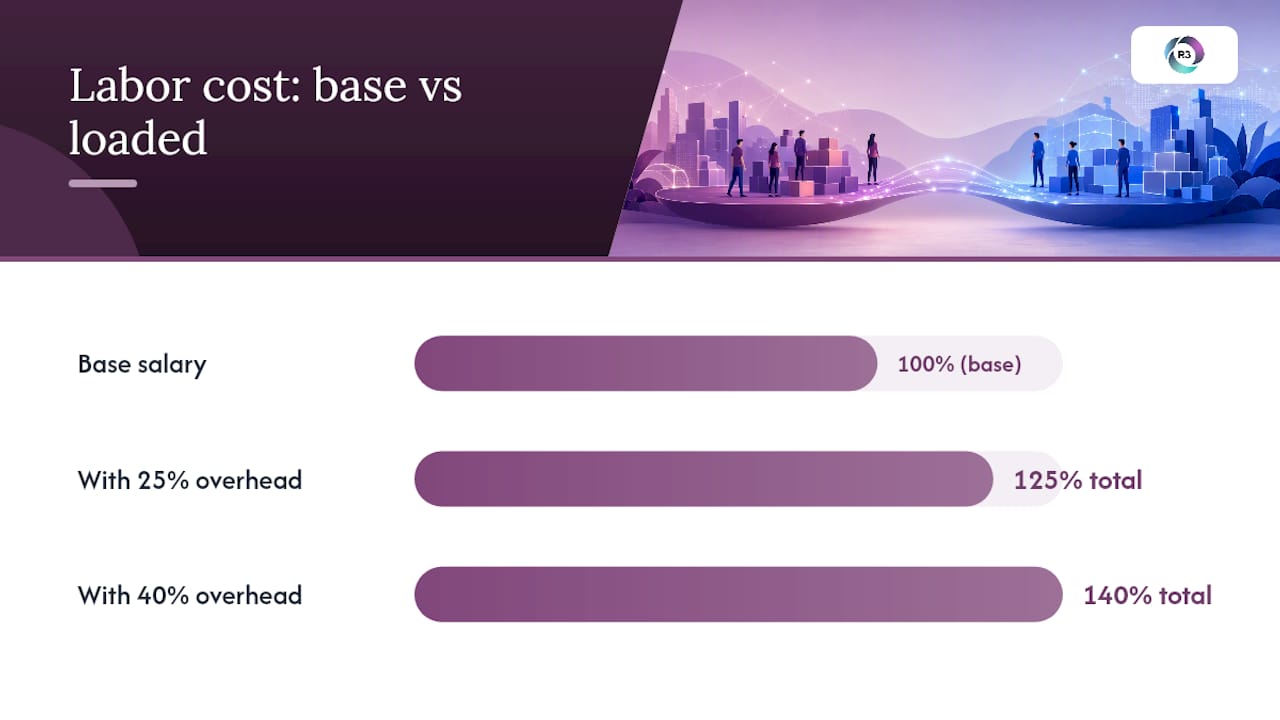
Calculate true cost first | Multiply domestic salary by 1.25 to 1.4x before comparing it to any outsourcing quote. |
Budget for management time | Unaccounted coordination hours are the most common reason savings projections fall short. |
Prioritize repeatable roles | Virtual assistants, customer service, and bookkeeping deliver savings fastest and most reliably. |
Pair savings with support | R3source provides dedicated, managed remote staff with onboarding structure built to protect quality while cutting costs. |
Table of Contents
How Outsourcing Reduces Costs: The Core Cost Drivers
Outsourcing works because it removes three categories of expense that quietly balloon when you hire in house.
Labor costs top the list. The total cost of a full-time domestic employee exceeds their base salary after adding benefits and overhead. Payroll taxes, health insurance, retirement contributions, and paid leave typically add 25% to 40% on top of base salary, a multiplier the Small Business Administration recommends factoring into any hiring decision.
Workspace costs disappear next. No added desk, no extra square footage, no share of the electric bill or the office coffee budget.
Equipment and software costs shrink too, since a managed remote staffing arrangement typically includes the tools and infrastructure your outsourced team needs to work.
The bigger shift is structural: outsourcing turns fixed costs into variable ones.
You pay for capacity you actually use, not a headcount sized for your busiest month.
Scaling up or down happens without severance, recruiting cycles, or vacant desks.
Budget predictability improves because staffing costs track your workload instead of a fixed payroll commitment.
That flexibility, more than the line-item discount, is what makes outsourcing cost savings compound over a full year rather than showing up once and fading.
What Do Outsourcing Studies Say About Typical Savings?
The ISG study remains the most current large-scale benchmark: enterprises using business process outsourcing saved an average of around 15%, based on a substantial survey of BPO decision-makers [ISG study]. That’s a useful anchor number, but it’s an average across a wide mix of functions and company sizes, not a guarantee.
Look at role-specific data and the range widens considerably.
Broader industry surveys report a range of savings reported, from low to moderate double digits, depending on the function outsourced.
Offshore staffing case studies focused on support and administrative roles show labor-cost reductions ranging broadly, often over half compared to full U.S. employment cost, according to Konnect.ph’s ROI framework.
Older academic reviews found savings ranging from 0% to 40%, with many studies clustering closer to 10% to 15%.
Why the spread? Role type matters most. Highly repetitive, well-documented work outsources cleanly; judgment-heavy work does not. Vendor model and measurement approach matter too. Companies that track true total cost of outsourcing, rather than comparing sticker prices, tend to report savings on the higher end because they’re capturing benefits and overhead in their baseline.
Why Doesn’t Outsourcing Always Save Money?
Plenty of companies outsource and still don’t see the savings they expected. The gap usually comes down to costs nobody budgeted for.
Management overhead. Someone on your team has to onboard, train, and check in on outsourced staff. If that time isn’t counted, your “savings” are overstated.
Upfront ramp-up costs. Recruiting, onboarding, and initial training take real hours before a new hire becomes productive.
Vendor and compliance fees. Employer-of-record charges, duplicated software licenses, and occasional travel or compliance costs add up fast.
Attrition and scope creep. Losing a trained remote employee means starting over, and an undefined job description invites work to pile up beyond what was priced in.
Poor integration. Staff who never get folded into your actual workflows produce work that needs redoing, which erases the labor-cost advantage entirely.
MIT Sloan’s research on IT outsourcing found something worth remembering here: companies that kept an internal liaison to coordinate with their outsourced vendor saw larger cost reductions than those who handed off work and walked away. Coordination isn’t overhead you eliminate. It’s overhead you shrink and redirect.
Pro Tip: Before you sign anything, write down every hour you expect to spend managing the new hire in month one. If that number embarrasses you, your savings projection is probably too optimistic.
How Do You Calculate the Real ROI of Outsourcing?
Run the math before you commit, not after. The formula is simple:
ROI = (Net savings / Total investment) × 100
Net savings is your domestic cost minus your total outsourcing cost. Total investment includes everything you’re spending to make the outsourcing arrangement work, not just the invoice.
Calculate your domestic total cost. Multiply base salary by 1.25 to 1.4, the range the SBA suggests for capturing benefits, payroll taxes, and overhead.
Calculate your total remote-staff cost. Add the staffing partner’s fee, any tools or software, and a realistic estimate of your own management time.
Subtract the two to get net savings, then divide by total investment and multiply by 100.
Check the payback period. Konnect.ph’s ROI examples show many well-chosen remote roles pay back their setup costs within two to four months.
Say a domestic hire costs you $52,000 fully loaded and a remote equivalent costs $22,000 including fees and management time. Positive ROI becomes realistic once the role has enough repeatable hours per week to justify the setup time and your management cost stays modest relative to the labor savings.
Which Roles Save You the Most When Outsourced?
Not every job outsources equally well, and prioritizing correctly determines how fast you see returns.
Start here for the fastest wins:
Virtual assistants handling scheduling, inbox management, and data entry
Customer service representatives fielding routine inquiries
Bookkeeping and data-entry roles with clear, repeatable processes
These roles save the most because the work is well defined, easy to measure, and doesn’t require deep institutional knowledge on day one.
Good secondary candidates include marketing support tasks like content scheduling, lead qualification for your sales pipeline, and tier-1 IT helpdesk tickets. These take slightly longer to ramp up but still show strong outsourcing cost savings once integrated.

Hold off on outsourcing strategic planning, high-IP product decisions, or any function requiring deep, day-to-day integration with leadership. Use a simple decision rule: if a role involves more than a few hours a week of repeatable, measurable output, it’s a strong outsourcing candidate.
How Do You Actually Capture These Savings?
A good hire on paper doesn’t guarantee a good outcome. Follow this sequence to protect the numbers you calculated:
Run a pre-hire cost audit. Set a specific savings target and the KPIs you’ll use to measure it, before you post the job.
Write a clear job spec and SLA. Vague expectations are the top reason outsourced work needs rework.
Build an onboarding playbook. Document your tools, processes, and communication norms once, and reuse it for every new hire.
Set a measurement cadence. Decide who owns quality checks and how often you’ll review performance against your original targets.
Invest in retention. Ongoing training, feedback loops, and small incentives cost less than replacing a trained employee.
Pro Tip: Review your outsourcing ROI at the 90-day mark, not the 12-month mark. Problems with integration or scope show up early, and catching them early is what keeps your projected savings intact.
Our guide on virtual assistant integration best practices walks through onboarding in more depth if you want a longer playbook to work from.
Ellis’s Perspective: Outsourcing as Strategy, Not Just a Cost Cut
The businesses that get outsourcing right treat it as a capability decision first and a cost decision second. Savings follow when the fit is right. At R3source, we build that discipline into how we place and manage remote staff, pairing every hire with onboarding structure and ongoing oversight so quality doesn’t erode the cost advantage you’re counting on. Cheap and unreliable isn’t a savings strategy. It’s a delayed cost.
Turn Outsourcing Cost Savings Into a Reliable Line Item
R3source gives you a shortcut past the trial and error most business owners go through when outsourcing for the first time. Instead of piecing together a remote hire on your own and hoping the onboarding sticks, you get a dedicated professional matched to your role, already trained to integrate into your existing workflows and accountable to the KPIs you set.
Businesses working with R3source commonly see meaningful reductions in payroll overhead and administrative time within the first few months, without the recruiting cycle or management guesswork that usually comes with a first outsourcing attempt. Our offshore virtual assistant services cover the roles most likely to deliver quick, measurable savings: administrative support, customer service, bookkeeping, and lead generation.
If you want a clear picture of what outsourcing could save you before committing to anything, start with a free work assessment and we’ll map out where a dedicated remote hire fits your operation.
Sources
Recommended
Comments