

When Is a Entrepreneur Ready to Hire a Virtual Assistant?


Yes, hire a virtual assistant once repetitive work is quietly eating more than five hours of your week. That is the verdict, and it holds whether you are running a solo real estate practice or scaling a ten-person e-commerce brand. The fastest way to test it: run one trial task with a virtual assistant this week, not a full-time contract, just one recurring job you already hate doing.
You do not need a perfect org chart to know you’re ready. You need two signals.
A task you repeat weekly (or daily) that never changes in structure, like email triage, appointment confirmations, or lead follow-up.
A workflow you could write down in ten steps, because if you can document it, someone else can run it.
Pro Tip: Before hiring anything long-term, hand one task to a trial VA or book a free work assessment and measure how many hours it actually returns to you in a week. The data will make the decision for you.
Key Takeaways
A virtual assistant entrepreneur scales fastest by delegating documented, repeatable tasks first and choosing a managed staffing model once reliability matters more than rock-bottom cost.
Point | Details |
Test before you commit | Run one trial task over one to two weeks before signing any monthly contract. |
Delegate leaky tasks first | Start with email, calendar, and client onboarding since they drain the most founder hours. |
Protect your legal position | Use a signed SOW, W-8BEN, and IP clause, and avoid employee-level control over contractors. |
Set a daily overlap window | Two to four hours of shared working time prevents blockers on time-sensitive decisions. |
Choose stability when it matters | R3source offers dedicated, long-term remote staff for founders who want consistency over a rotating cast of freelancers. |
Table of Contents
What High-Value Tasks Do Virtual Assistant Entrepreneurs Delegate First?
What Does a Virtual Assistant Cost, and What’s the Real ROI?
What Skills Separate Successful Virtual Assistant Entrepreneurs?
What Challenges Do Virtual Assistant Entrepreneurs Run Into, and How Do You Fix Them?
How Should Virtual Assistant Entrepreneurs Approach Branding and Marketing?
What High-Value Tasks Do Virtual Assistant Entrepreneurs Delegate First?
The tasks that free up the most founder time aren’t glamorous. They’re the ones sitting between you and the work that actually grows revenue.
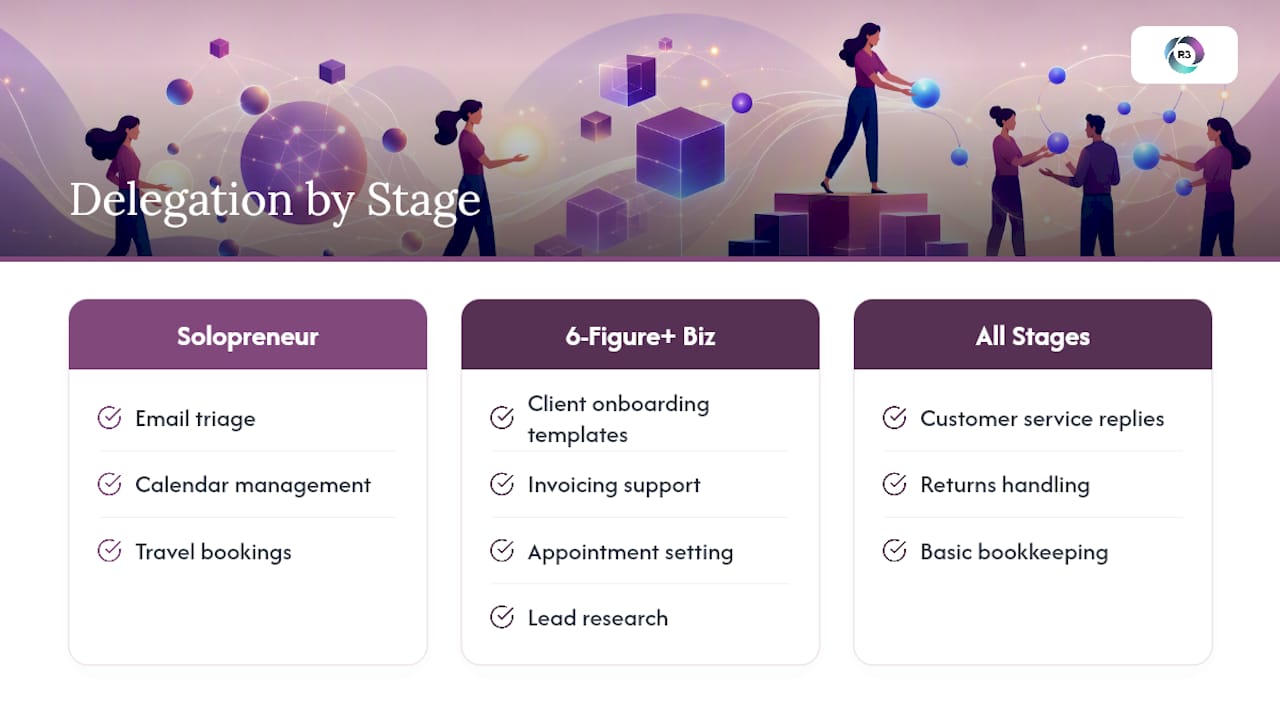
Admin and calendar work eats hours nobody notices until they’re gone: email triage, calendar management, and travel bookings. A founder who fields 40 emails a day loses close to an hour just deciding what matters.
Client operations is next. Onboarding templates, invoicing support, and appointment setting are repeatable by nature, which makes them ideal starter tasks for a new VA relationship. Get these wrong and clients notice immediately; get them right and clients never think about them at all.
Growth operations covers lead research, CRM updates, content repurposing, and social scheduling. These tasks compound. A VA who spends three hours a week updating your CRM with fresh lead data is quietly building a pipeline you’d otherwise let go cold.
Support functions round it out: customer service replies, returns handling, and basic bookkeeping tasks like reconciling receipts or categorizing expenses.
Stage matters here. A solopreneur should delegate admin and calendar first, since that’s the leakiest bucket relative to available hours. A business past the six-figure mark should shift focus to growth ops and client operations, where a VA’s output starts touching revenue directly rather than just protecting time. Our guide on tasks to outsource to a virtual assistant breaks this down by business size if you want the fuller list.
How Do You Hire or Start Working With a Virtual Assistant?
You have three real engagement models, and each carries a different risk profile.
Freelancers cost the least upfront but churn the most. You’re often one Upwork message away from losing your VA to a higher bidder, and there’s no backup if they disappear mid-project.
Agencies add a vetting layer and some accountability, but service quality varies widely depending on who gets assigned to your account.
Managed dedicated staff, the model R3source operates in, gives you a single long-term professional integrated into your operations, backed by a company that handles recruiting, replacement, and accountability if something goes wrong. This trades a bit of flexibility for real stability, which matters most once a task becomes mission-critical rather than nice-to-have.
Here’s a hiring flow you can copy directly:
Define the scope in one sentence: “Manage inbox triage and calendar scheduling for 10 hours a week.”
Write a one-page statement of work covering tasks, tools, and expected turnaround.
Set a one to two week trial task before committing to a monthly plan.
Evaluate against a simple checklist: did they hit deadlines, ask smart questions, and follow instructions without hand-holding?
Formalize the contract and payment terms once the trial clears.
Before signing anyone, screen for four things:
Time zone overlap of at least a few hours during your working day.
A writing or communication sample that matches your brand’s tone.
References or prior client feedback you can actually verify.
A portfolio showing similar task types, not just a general resume.
Pro Tip: Watch for red flags before you get attached to a candidate: reluctance to sign an SOW or IP assignment, payment requests through untraceable channels, or promises of “24/7 availability” that no real person can sustain. The Free Virtual Assistant Business Start-Up Plan walks through scope-setting language you can borrow directly for your own SOW.
What Does a Virtual Assistant Cost, and What’s the Real ROI?
Pricing varies a lot depending on the model, and treating any single number as gospel will mislead you. ZipRecruiter’s wage data shows U.S.-facing virtual assistant pay spans a wide range depending on skill level and task complexity, and that spread should set your expectations before you start negotiating.
Freelance hourly rates run lowest but fluctuate with demand and platform fees.
Agency-managed rates sit in the middle, with support and vetting baked in.
Dedicated managed staffing, R3source’s model, runs as a predictable monthly rate that includes recruiting, replacement, and oversight.
Hidden costs catch new hirers off guard: training hours in the first few weeks, the overlap window you pay for even when it’s not billable output, tool subscriptions, payment processing fees, and contractor paperwork like 1099s or W-8BENs.
Statistic Callout: A rough ROI test cuts through the guesswork: (hours saved × your hourly value) minus (VA cost + onboarding cost) = net benefit. If you value your time at $75/hour and a VA saves you 10 hours a week for a monthly cost well under that math, the payback is immediate. If the sums come out negative in month one, wait, tighten your task scope, and retest.
The math tells you when to hire now versus when to wait: hire when the task is already costing you provable hours; wait when the task is too undefined to hand off cleanly yet.
What Tools Do Productive Virtual Assistants Actually Use?
You don’t need a sprawling software stack. You need seven categories covered well.
Project management: a Trello or Asana style board so tasks don’t live in someone’s inbox.
CRM basics: even a simple system to track leads and follow-up dates.
Calendar and scheduling: shared calendars with clear booking rules.
Chat and email: one primary channel for quick questions, separate from formal email.
Password manager: shared credential access without ever texting a password.
Cloud storage: a single source of truth for documents and templates.
Time tracking: especially useful in the first 90 days to validate hours against output.
For a recurring content or admin task, a simple three-step workflow works well: the VA creates a draft or completes the task, you review and leave notes in one shared thread, then the VA publishes or finalizes it and logs the handoff. Keep handoff notes short and specific so nothing gets lost between shifts.
Pro Tip: Set a daily overlap window of two to four hours where you and your VA are both online. Remote team communication research shows this window prevents 24-hour blockers on decisions that need a quick yes or no. Everything else, status updates, drafts, routine questions, can run asynchronously.
What Legal and Tax Steps Matter When Hiring Offshore VAs?
Engagement model isn’t just a pricing decision, it’s a legal one. Treating an offshore contractor like a full employee, setting fixed hours, supplying equipment, controlling their schedule minute by minute, can create obligations under local labor law that most U.S. founders never anticipate. Legal guidance on hiring Philippine staff explains that direct control of this kind can blur the line between contractor and employee, exposing the hiring business to compliance risk it didn’t sign up for.
An Employer of Record, or a managed staffing partner operating under a similar structure, absorbs that risk by handling local payroll, statutory remittances, and compliance on your behalf while you keep operational control of the day-to-day work.
Before you engage anyone offshore, get four documents in order:
A signed statement of work defining scope and deliverables.
A W-8BEN form for U.S. tax reporting on payments to a foreign contractor.
An IP assignment clause so work product is unambiguously yours.
An invoice and accounting trail for every payment made.
Operationally, keep a few safeguards in place: avoid dictating exact hours or supplying equipment if you want to preserve contractor status, use a local EOR or managed partner for payroll and benefits, and store every W-8BEN and receipt in one place.
Statistic Callout: SCORE’s free mentoring and templates can help you draft SOWs and basic hiring paperwork, but if you plan to set strict hours, supply equipment, or exercise employee-level control, talk to a business attorney before signing anything. The line between contractor and employee has real financial consequences on the wrong side of it.
How Do You Onboard and Manage a Virtual Assistant Well?
The first 90 days decide whether a VA relationship becomes a long-term asset or a slow-motion disappointment. Build a checklist before day one: a welcome packet covering your business basics, written SOPs for the first three training tasks, clear KPIs, full access and credentials handed over on schedule, and a check-in cadence that doesn’t rely on memory.
Week one: welcome packet, tool access, and the first training task with a written SOP.
Weeks two through four: two more training tasks, daily async check-ins, one live overlap call weekly.
Days 60 to 90: shift from training mode to ownership, with KPIs reviewed monthly against outcomes, not hours logged.
A simple cadence keeps this sustainable: asynchronous updates most days, one live overlap meeting weekly for anything that needs real conversation, and a monthly performance review tied to outcomes rather than activity.
For retention and scaling, cross-train your VA into adjacent tasks once the first role is solid, and give them a path toward more complexity, more ownership, more trust. Document every new SOP as you go; it’s the difference between a business that can add a second VA smoothly and one that has to relearn everything from scratch.
Pro Tip: Designate one person on your side as the VA’s single point of contact for the first 90 days. Mixed signals from multiple managers are the fastest way to slow down a new hire’s ramp.
What Skills Separate Successful Virtual Assistant Entrepreneurs?
The best virtual assistants share a specific mix of traits, and it’s rarely about typing speed or software fluency alone. Communication clarity tops the list: a VA who asks the right clarifying question before starting saves you three rounds of rework later.
Self-management matters just as much. Nobody is standing over their shoulder, so the ability to prioritize, flag blockers early, and follow a SOP without constant hand-holding separates a reliable hire from a liability. Discretion counts too, especially for anyone touching client data, financial records, or inbox access.
Technical range helps but isn’t the whole picture. A VA who can move between a CRM, a scheduling tool, and a project board without friction is worth more than one who knows a single platform deeply but freezes outside it. Adaptability rounds it out: your business will change shape over the next year, and the VA who grows with those changes becomes far more valuable than one locked into a single task forever.
For founders vetting candidates, look past the resume. Ask for a short writing sample, a quick scenario response (“a client emails angry about a delayed order, what do you say?”), and evidence of past accountability, references, portfolio work, or a documented track record.
What Challenges Do Virtual Assistant Entrepreneurs Run Into, and How Do You Fix Them?
Communication gaps are the most common failure point, usually caused by time zone mismatches or unclear instructions rather than skill gaps. The fix is structural: set a daily overlap window and write instructions as if the reader has zero context, because often they do.

Quality drift is the second challenge. Work that starts strong can slip once a VA gets comfortable and starts improvising past the SOP. Weekly QA reviews, even fifteen minutes, catch this before it compounds into client-facing mistakes.
Trust building takes longer than most founders expect, especially around sensitive access like email or financial tools. Start with lower-stakes tasks and expand access as a track record builds rather than handing over everything on day one.
Turnover risk hits freelance and informal hires hardest, since there’s no institutional backstop if someone leaves. A managed staffing model reduces this specific risk by keeping recruiting and replacement in someone else’s hands instead of yours.
Finally, scope creep quietly kills VA relationships. A ten-hour-a-week role drifts to twenty without a pay conversation, breeding resentment on both sides. Revisit scope and compensation every quarter, not just when something breaks.
How Do You Scale a Virtual Assistant Business or Team?
Growth in this space rarely comes from adding headcount blindly. It comes from documenting what already works, then repeating it.
Start by converting every recurring task into a written SOP before you add a second VA. Without that documentation, each new hire relearns your business from scratch instead of stepping into a system.
Specialization is the next lever. A generalist VA covering ten different tasks caps out quickly, while a small team split by function, one focused on client operations, one on lead generation, one on support, scales further because each person deepens expertise instead of spreading thin.
Layering in management structure matters once you pass three or four VAs. At that point, a lead VA or team coordinator absorbs day-to-day oversight, freeing you from managing every individual directly.
Growth opportunities extend beyond your own business too. Founders who master this playbook internally sometimes pivot into building a VA agency themselves, packaging the systems they built for their own operations and offering them to other entrepreneurs. Whether you’re scaling your own support team or exploring virtual assistant entrepreneur opportunities as a service provider, the underlying principle is the same: systems scale, individual effort does not.
How Should Virtual Assistant Entrepreneurs Approach Branding and Marketing?
Positioning matters more than most new VA entrepreneurs expect. A generalist offering “everything” competes on price against thousands of similar listings. A specialist offering “inbox and calendar management for busy real estate agents” competes on almost nothing, because the audience is narrow enough to feel spoken to directly.
Before naming a business or service, run a quick USPTO trademark search to confirm the name isn’t already claimed. It takes minutes and avoids a costly rebrand down the line.
A simple portfolio beats a polished website every time in the early stages. Screenshots of completed work, a short case study describing a specific problem solved, and two or three testimonials carry more weight with prospective clients than generic service pages ever will.
Referrals remain the strongest channel for VA entrepreneurs specifically, since trust is the entire product being sold. Asking every satisfied client for one introduction compounds faster than most paid marketing channels at this stage of the business.
Where Should Virtual Assistant Entrepreneurs Specialize?
Broad “general VA” services face the most competition and the thinnest margins. Niche specialization changes that math entirely.
Legal support, appointment scheduling and intake for small law firms, commands premium rates because the margin for error is low and few VAs understand legal workflows well enough to be trusted with them. Medical billing follows a similar pattern: specialized knowledge of insurance codes and claims processes turns a commodity service into a scarce skill.
E-commerce operations is another strong lane, covering inventory updates, customer service, and returns handling for online stores that live and die by response speed. Real estate transaction coordination is booming too, since agents need someone who understands contracts, deadlines, and client communication in a fast-moving deal cycle.
Bookkeeping-adjacent support, reconciling receipts, prepping reports for an accountant, sits well alongside broader financial workflows; if this interests you, virtual finance support can extend well beyond basic bookkeeping into a genuine cost-saving function for a growing business.
Pick a niche where you already understand the workflow, then go deep rather than wide. Depth is what clients pay premium rates for.
Why Managed Remote Staff Changes the Math for Founders
Every founder I’ve talked to underestimates how much of their week disappears into tasks that feel urgent but never move the business forward. The gap isn’t effort, it’s structure. A managed placement works because someone else owns recruiting, backup coverage, and accountability, so a founder gets a working operational layer instead of one fragile freelance relationship that could vanish with a single unanswered message. R3source builds around that stability: dedicated remote staff from the Philippines, trained to integrate directly into a client’s daily operations rather than bounce between gigs. The founders who benefit most aren’t the ones chasing the cheapest hourly rate. They’re the ones who’ve already felt what it costs to lose a good hire with no backup plan in place.
— Ellis
How R3source Helps You Hire With Confidence
R3source is the alternative to piecing together freelancers one gig at a time, if you want a dedicated remote professional who shows up consistently, integrates into your actual workflow, and doesn’t disappear the moment a better offer lands elsewhere.

An introductory consultation walks through your specific bottlenecks, whether that’s inbox chaos, lead follow-up that’s falling through the cracks, or client onboarding that eats your Monday mornings, and matches you against the right role before any contract gets signed. Real estate teams, e-commerce brands, and service businesses all use this same process to figure out exactly what to delegate first. Most founders walk away from the call with a clear scope, a realistic price range, and a start date, not a sales pitch. If a repetitive task is already costing you provable hours every week, book your consultation and find out what a dedicated remote professional could take off your plate this month.
Sources
Recommended
Comments