

Why Solopreneurs Need Virtual Support to Grow
- Ellis Jackson

- Jul 13
- 7 min read

Author: Ellis Jackson
Virtual support is the operational system that allows solopreneurs to stop doing everything themselves and start building something that actually scales. Running a solo business means you are the CEO, the customer service rep, the marketer, and the bookkeeper, all at once. That load is unsustainable. Understanding why solopreneurs need virtual support comes down to one hard truth: your time is your most limited resource, and spending it on low-value tasks kills growth. The right remote professional, often called a virtual assistant (VA), shifts that equation entirely by handling the work that keeps the lights on while you focus on the work that moves the needle.
Why solopreneurs need virtual support to reclaim their time
Time management is the top challenge for 41% of solopreneurs. That statistic means nearly half of all solo business owners are losing their most valuable asset not to bad strategy, but to the sheer volume of daily tasks. Email triage, calendar management, research, and data entry are all necessary. None of them require you specifically to do them.
Virtual assistants take on exactly these kinds of tasks. Delegation of email, scheduling, and research frees up hours every week that you can redirect toward client work, product development, or sales. The shift is not just about hours. It is about mental energy. Every decision you make, even a small one, draws from the same cognitive pool. Offloading routine decisions to a VA reduces mental fatigue and lowers your risk of burnout.

Solopreneurs who automate and delegate tasks consistently outperform peers in revenue growth. The reason is simple: they spend more time on work only they can do.
Here are the task categories best suited for VA delegation:
Email and inbox management: sorting, flagging, drafting responses
Calendar and scheduling: booking calls, managing conflicts, sending reminders
Research: competitor analysis, lead lists, content sourcing
Social media: scheduling posts, monitoring comments, basic engagement
Data entry and CRM updates: keeping your pipeline clean and current
Pro Tip: Before handing off any task, record yourself doing it once. A short screen recording becomes the training document your VA needs to get it right from day one.
What is the real financial return on hiring a virtual assistant?
The financial case for hiring a VA goes far beyond what you pay per hour. The real question is what your hour is worth. If your billable rate is $150 per hour and you spend three hours a week on admin tasks, that is $450 in lost revenue every week. A VA handling those same tasks at a fraction of that cost turns a cost center into a profit decision.
The deeper financial argument involves business valuation. Businesses with documented workflows and support staff sell for 3x to 4x annual profit, compared to just 1x for solo founder-operated businesses. That gap is the “equity delta.” Every system you build and every task you delegate adds to the sellable value of your business.
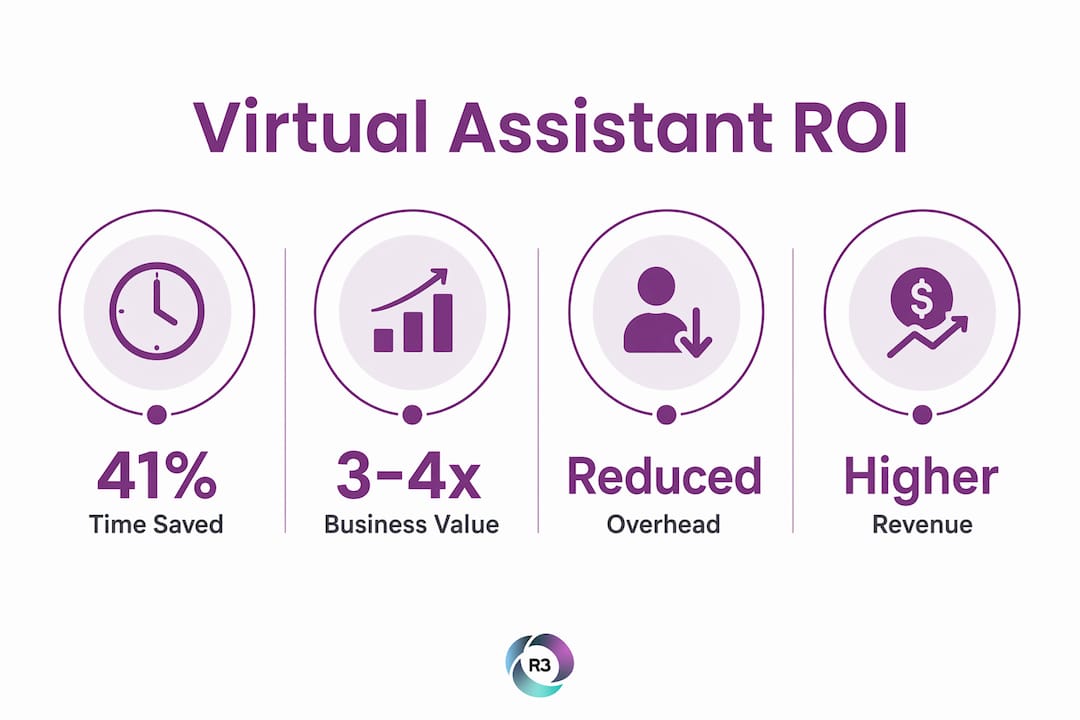
Remote virtual assistants reduce overhead costs by eliminating office space, equipment, and benefits expenses. You contract the support you need, scale it up or down, and pay only for productive time. That flexibility is something a full-time in-house hire cannot offer.
The table below shows how to think about task ownership across three categories:
Task type | Best owner | Why |
Revenue generation and strategy | Founder | Requires your expertise and relationships |
Recurring admin and operations | Virtual assistant | Repeatable, documentable, time-consuming |
Automated workflows and triggers | AI tools | Rule-based, no judgment required |
Pro Tip: Use a formal opportunity cost audit before hiring. List every task you do in a week, assign your hourly rate to each, and total the cost of tasks a VA could handle. The number usually justifies the hire immediately.
How virtual support accelerates process documentation
One underrated benefit of hiring a VA is what it forces you to do first: document how your business actually runs. Most solopreneurs carry their entire operation in their heads. That is a fragile system. A VA cannot work from memory. They need written processes, and building those processes is one of the highest-value things you can do for your business.
A VA helps document how the business actually runs and creates the foundation for every future hire. Standard operating procedures (SOPs), checklists, and workflow guides do not just help your current VA. They make onboarding the next team member faster, reduce errors, and protect the quality of your customer experience as you grow.
VAs build SOPs, checklists, and campaign workflows that protect quality as a business scales. That is the difference between a business that depends entirely on you and one that can run without your constant involvement.
The documentation benefits compound over time:
Onboarding speed: New hires ramp up in days, not weeks, when SOPs exist
Consistency: Customers get the same experience regardless of who handles their request
Error reduction: Checklists catch mistakes before they reach the client
Scalability: A documented business can grow without the founder becoming a bottleneck
Sellability: Buyers pay more for businesses with proven, repeatable systems
For a deeper look at how VAs integrate into founder workflows and daily operations, the process documentation piece is where most solopreneurs see the fastest return.
When should you hire a VA and how do you do it right?
The right time to hire a VA is before you feel desperate. Most solopreneurs wait until they are drowning, which means they onboard under pressure and set the relationship up to fail. The better signal is when recurring tasks consistently push revenue-generating work to tomorrow.
Here is a practical framework for hiring and managing your first VA:
Audit your week first. Track every task for five business days. Identify what is repeatable, what requires no specialized judgment, and what you dread doing. Those are your first delegation candidates.
Choose the right engagement model. Hourly contracts work for variable, unpredictable tasks. Retainer agreements work better when you need consistent weekly support. Project-based contracts suit one-time deliverables like a research report or a CRM cleanup.
Evaluate communication fit, not just skills. A VA who responds clearly, asks good questions, and flags issues early is more valuable than one with an impressive resume who goes silent. Test communication style during the hiring process.
Expect a short productivity dip. The first two weeks of VA onboarding typically show a temporary drop in output as the VA learns your systems. This is normal. It resolves quickly when you invest in a proper onboarding process.
Apply the 1:3:1 Rule to avoid upward delegation. This rule requires a VA to bring a problem to you only after providing context, three options, and a recommendation. It trains your VA to think independently and stops you from becoming the decision bottleneck again.
For guidance on timing your first hire, the R3source guide on when to hire a VA walks through the specific signals to watch for in 2026.
Key Takeaways
Solopreneurs who delegate low-value tasks to virtual assistants reclaim critical time, reduce burnout, and build businesses that are worth significantly more when it comes time to sell or scale.
Point | Details |
Time is the core problem | 41% of solopreneurs cite time management as their biggest challenge, making delegation urgent. |
VA ROI exceeds hourly cost | Businesses with documented systems and support staff sell for 3x to 4x more than solo-operated ones. |
Documentation is the hidden win | Hiring a VA forces you to build SOPs that protect quality and speed up every future hire. |
Hire before you are desperate | The right time to bring on a VA is when recurring tasks consistently delay revenue-generating work. |
The 1:3:1 Rule prevents bottlenecks | Requiring VAs to bring context, options, and a recommendation stops upward delegation before it starts. |
The mindset shift nobody talks about
Most solopreneurs I have worked with hit the same wall. They know they need help. They just cannot bring themselves to hand anything over. The fear is always the same: no one will do it as well as I do. That fear is understandable. It is also the exact thing keeping the business small.
The real shift is not operational. It is psychological. You have to stop seeing yourself as the person who does the work and start seeing yourself as the person who builds the system that does the work. That is a fundamentally different identity, and it takes time to settle into.
What I have seen consistently is that the solopreneurs who grow the fastest are not the most talented. They are the ones who get comfortable being imperfect delegators early. Their VA’s first month is messy. Their SOPs are rough drafts. But they iterate, and six months later they have a business that runs without them for days at a time.
The onboarding period is the hardest part. Resist the urge to take tasks back when they are done 80% as well as you would do them. That 80% frees you to do the 20% that actually drives revenue. Over time, the VA’s 80% becomes 95% as they learn your standards. Patience during that window is the most valuable thing you can invest.
Building a reliable long-term VA relationship is not about finding a perfect hire on day one. It is about committing to the process of building one.
— Ellis
R3source: virtual support built for solopreneurs
Running a solo business does not mean you have to work alone. R3source connects solopreneurs and small business owners with experienced remote professionals from the Philippines, trained to handle the daily operations that pull you away from growth.
Whether you need offshore virtual assistant services for admin, customer support, CRM management, or lead generation, R3source provides long-term dedicated staff rather than one-off freelancers. That consistency means your VA learns your business, builds your systems, and grows with you. Every engagement is designed to reduce your overhead while increasing your capacity for growth. If you are ready to reclaim your time and build a business that does not depend entirely on you, R3source is the partner to make that happen.
FAQ
Why do solopreneurs need virtual support?
Solopreneurs need virtual support because time management is the top challenge for 41% of solo business owners. Delegating low-value tasks to a VA frees up hours for revenue-generating work and reduces burnout.
What tasks should a solopreneur delegate to a virtual assistant?
Email management, calendar scheduling, research, social media posting, and CRM updates are the best starting points. These tasks are repeatable, documentable, and do not require the founder’s direct expertise.
How does hiring a VA increase business value?
Businesses with documented workflows and support staff sell for 3x to 4x annual profit, compared to 1x for solo-operated businesses. Delegation builds systems that make the business valuable beyond the founder.
When is the right time to hire a virtual assistant?
The right time is when recurring tasks consistently push revenue-generating work to the next day. Waiting until you are overwhelmed makes onboarding harder and the transition slower.
What is the 1:3:1 Rule for managing a virtual assistant?
The 1:3:1 Rule requires a VA to present one problem, three possible solutions, and one recommendation before escalating to the founder. It prevents upward delegation and builds VA independence over time.
Recommended
Comments