

Avoid TCPA and AI Voice Risk: U.S. Cold Calling Operational Checklist

Yes, you can cold call legally in the United States, but only if you satisfy TCPA and Telemarketing Sales Rule requirements at the same time. That means consent captured correctly for autodialed or prerecorded calls, a Do-Not-Call scrub inside the last 31 days, working caller ID, fast opt-out handling, and documented records for every number you touch. The single best next move: classify your calling list by number type and consent status, then run a small test batch before you scale.
Using autodialers or AI-generated voices in outbound calls to wireless numbers requires prior express written consent, verified with vendor documentation.
Lists must be scrubbed against the National Do-Not-Call Registry within 31 days and checked for company-specific do-not-call requests before dialing.
Callers must operate within hours between 8 a.m. and 9 p.m. in the recipient’s local time zone, with all restrictions enforced through dialer settings.
Outsourced vendors do not transfer compliance risks automatically; companies must maintain their own evidence trail, suppression lists, and contractual controls.
Recording consent, call activity, and opt-out requests for at least 24 months is essential for defending against enforcement actions and fines.
Table of Contents
B2B Exemptions, the National Do-Not-Call Registry, and Where They Overlap
The Operational Compliance Checklist for Every Cold-Calling Campaign
Autodialers, AI Voices, and the Technology Risks Hiding in Your Stack
Vendor Oversight: Keeping Control When You Outsource Prospecting
Penalties, Enforcement Triggers, and How Safe Harbor Actually Protects You
Primary Government Resources for TCPA and Telemarketing Rules
What TCPA Compliance for Cold Calling Actually Requires
The Telephone Consumer Protection Act doesn’t ban cold calling. It bans certain methods of cold calling without consent. That distinction trips up more sales teams than any other part of the law.
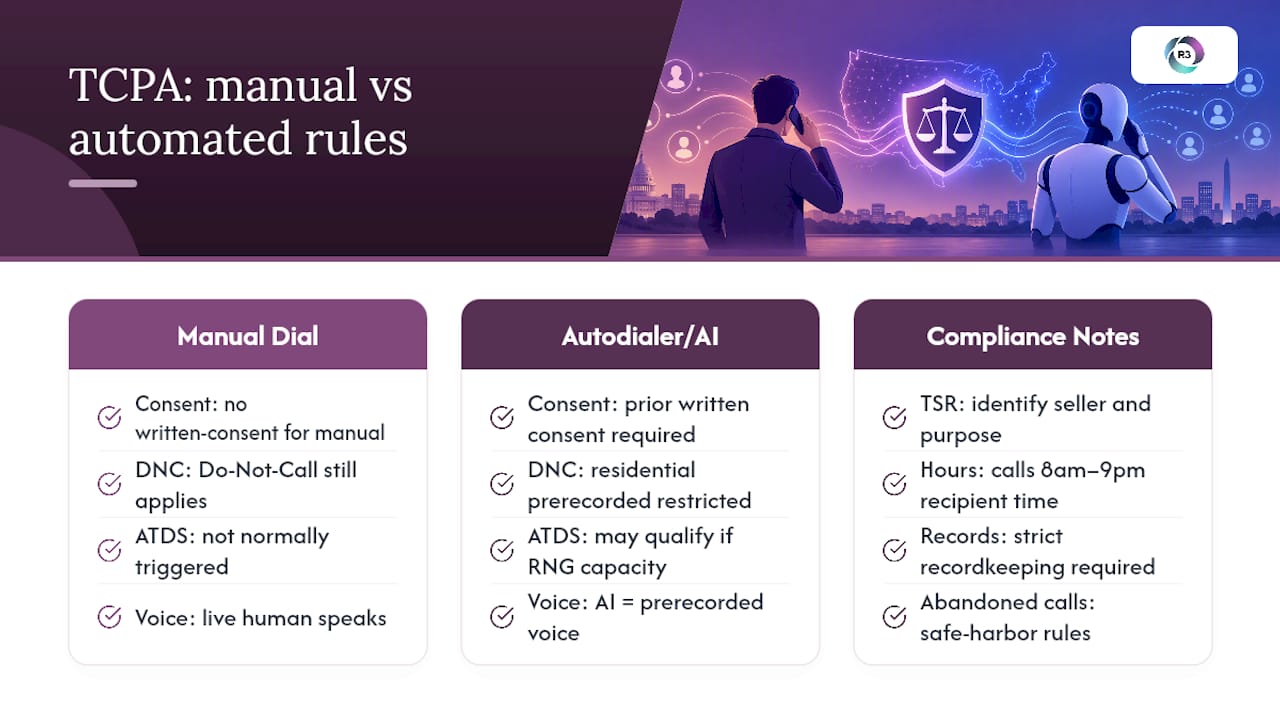
If you’re dialing manually and reading from a script, you have far more room to operate than if you’re running an autodialer or playing a recorded message. The TCPA requires prior express written consent specifically when a call to a wireless number uses an autodialer or an artificial/prerecorded voice for telemarketing purposes. Residential lines carry similar restrictions for prerecorded telemarketing calls. Manual dialing to a residential or mobile number for a sales pitch still triggers Do-Not-Call obligations, but not the written-consent requirement tied to automated technology.
Here’s where most owners get it wrong: they assume “autodialer” means whatever their vendor calls it. It doesn’t. Courts have narrowed the legal definition considerably since the Supreme Court’s Facebook v. Duguid ruling, which held that a system generally needs the capacity to store or produce numbers using a random or sequential number generator to qualify as an Automatic Telephone Dialing System (ATDS). A platform that simply dials down a fixed CRM list may fall outside that definition, but the safer approach treats any predictive or list-dialing tool as a potential ATDS until you’ve confirmed otherwise with documentation from the vendor.
Prerecorded and artificial voice calls face a separate, broader rule that doesn’t depend on the ATDS question at all. If a human isn’t speaking live, you likely need consent regardless of how the number was dialed.
That standard now explicitly covers AI. The FCC has confirmed that AI-generated or simulated human voices fall under the TCPA’s artificial or prerecorded voice rules, which means a synthetic voice assistant making sales calls needs the same prior consent and opt-out mechanism a traditional recorded message would need. Treat any AI voice tool in your stack as a prerecorded-voice trigger, not a loophole.
On the disclosure side, the Telemarketing Sales Rule layers on its own requirements independent of the TCPA. Sellers must identify themselves and the purpose of the call promptly, honor calling-hour limits (calls generally must fall between 8 a.m. and 9 p.m. in the recipient’s time zone), and follow strict recordkeeping and abandoned-call safe-harbor rules. Compliance in cold calling isn’t one rule. It’s the TCPA, the TSR, and often state law stacking on top of each other, and each one has to clear before you dial.
B2B Exemptions, the National Do-Not-Call Registry, and Where They Overlap
Business-to-business calls get real breathing room under the TSR, but the exemption is narrower than most sales teams assume. The FTC’s B2B exemption applies to calls made to businesses to sell goods or services for business use, not to any call where the person happens to answer at a company phone line. If you’re calling a small business owner to pitch something for personal use, or the number connects to a home-based sole proprietor, the exemption may not hold.
The National Do-Not-Call Registry itself only covers residential and wireless numbers used by consumers, so most legitimate B2B outreach to landlines at a business address sits outside the registry entirely. That said, the exemption doesn’t excuse you from company-specific do-not-call requests. Any business contact who asks you to stop calling must go on your internal suppression list regardless of whether the TSR’s DNC provisions technically apply.
For consumer-facing campaigns, the rules tighten considerably. Sellers must subscribe to the National Do-Not-Call Registry and scrub calling lists at least once every 31 days, and every seller has to hold its own Subscription Account Number, even when a third-party vendor performs the actual scrub. That last point catches a lot of businesses off guard. Handing your list to an outsourced calling vendor doesn’t transfer your registration duty. It just adds a second party who also needs proper access.
State law can raise the bar further. Several states run their own do-not-call registries or impose stricter consent and disclosure standards than federal law requires, so a campaign that clears TCPA and TSR review might still fail under a state statute if you’re calling numbers across state lines without checking local rules.
Practically, classify every number before it enters a campaign. Numbers tied to a business’s general line, verified for business-use purpose, and free of a personal do-not-call request typically qualify for lighter treatment. Anything ambiguous, a number that might be a home office, a personal cell used for work, a small business run out of someone’s house, should default to full consumer-level protections. That conservative call costs you a few leads. Skipping it costs a lot more.
The Operational Compliance Checklist for Every Cold-Calling Campaign
Legal theory doesn’t stop a phone from ringing at the wrong time or a suppressed number from getting redialed. That’s what operations are for. Here’s the checklist that turns TCPA and TSR requirements into something your team can actually run every day.
Before you dial:
Confirm the National DNC scrub ran within the last 31 days and covers every number in the campaign.
Verify consent status for each number: written consent on file, prior business relationship, or confirmed B2B exemption.
Check the number against your company-specific do-not-call list, not just the national registry.
Confirm your caller ID is set up to transmit an accurate, working number, not a spoofed or disconnected one.
Set calling windows to 8 a.m. to 9 p.m. in the recipient’s local time zone, and build that restriction into your dialer settings rather than trusting reps to track it manually.
While the campaign runs:
Log every call attempt with a disposition code, timestamp, and the number’s consent basis.
Capture opt-out requests immediately and push them into every connected system: CRM, dialer, exports, and any vendor list, the same day they happen.
Cap abandoned calls under the TSR’s safe-harbor threshold, and monitor abandonment rates daily rather than at the end of a campaign.
Use only approved scripts that include required identity and purpose disclosures within the opening seconds of the call.
One detail that trips up otherwise careful teams: suppression doesn’t propagate itself. A single checkbox in your CRM marking someone “do not call” means nothing if your dialer platform, your export files, and your outsourced vendor’s separate list never see that update. Suppression has to move to every system that could possibly place a call, and it needs version control so an old list doesn’t get re-imported after someone already opted out.
Recordkeeping needs to survive a legal challenge, not just satisfy an internal audit. The strongest evidence chain includes the consent text or exemption basis, a timestamp, the number’s source, recipient classification, and a full opt-out history for that specific number. The FTC’s telemarketing guidance calls for 24 months of retained records covering these details, and without that number-level chain, a compliance claim is difficult to defend in court.
Training closes the loop. Reps need to know the approved script, the escalation path for a revocation request, and what to do when a called party claims they never gave consent. The FTC’s safe-harbor provisions specifically credit written procedures, documented training, and ongoing monitoring, which means a real training program isn’t just good practice. It’s part of your legal defense.
Pro Tip: Build a single “kill switch” suppression file that every system checks against in real time, rather than relying on nightly batch updates. A number opted out at 9 a.m. should be unreachable by every channel before lunch, not by tomorrow morning.
Autodialers, AI Voices, and the Technology Risks Hiding in Your Stack
Modern dialing software makes it easy to trigger TCPA liability without anyone on your team intending to. Predictive dialers, power dialers, and AI-assisted calling tools all carry different risk profiles, and the difference often comes down to what the system is technically capable of doing, not what your team actually uses it for.
Courts increasingly focus on system capability rather than campaign intent following Duguid. If your dialing platform has the capacity to generate numbers randomly or sequentially, even if you never use that feature, you may still be exposed to ATDS classification. That means vendor documentation matters. Ask your dialer provider directly whether the platform includes random or sequential number generation capability, and keep that answer on file.
AI voice tools deserve their own line of scrutiny. The FCC’s ruling puts synthetic and AI-generated voices squarely inside the artificial voice category, which means any AI voice agent making outbound sales calls needs the same prior consent and built-in opt-out mechanism a traditional prerecorded message requires. Sales teams experimenting with AI-driven outreach, and there are more every quarter, should treat that technology as high-risk by default rather than assuming a friendly, conversational tone changes its legal status.
The risks and benefits of AI in sales technology extend well past compliance, but compliance is where the fastest legal exposure lives. A hybrid setup, live agents supported by soundboard technology that plays pre-recorded responses, occupies a gray area courts haven’t fully settled. The safer read treats any pre-recorded audio segment played during a “live” call as carrying prerecorded-voice obligations, particularly for outbound sales content.
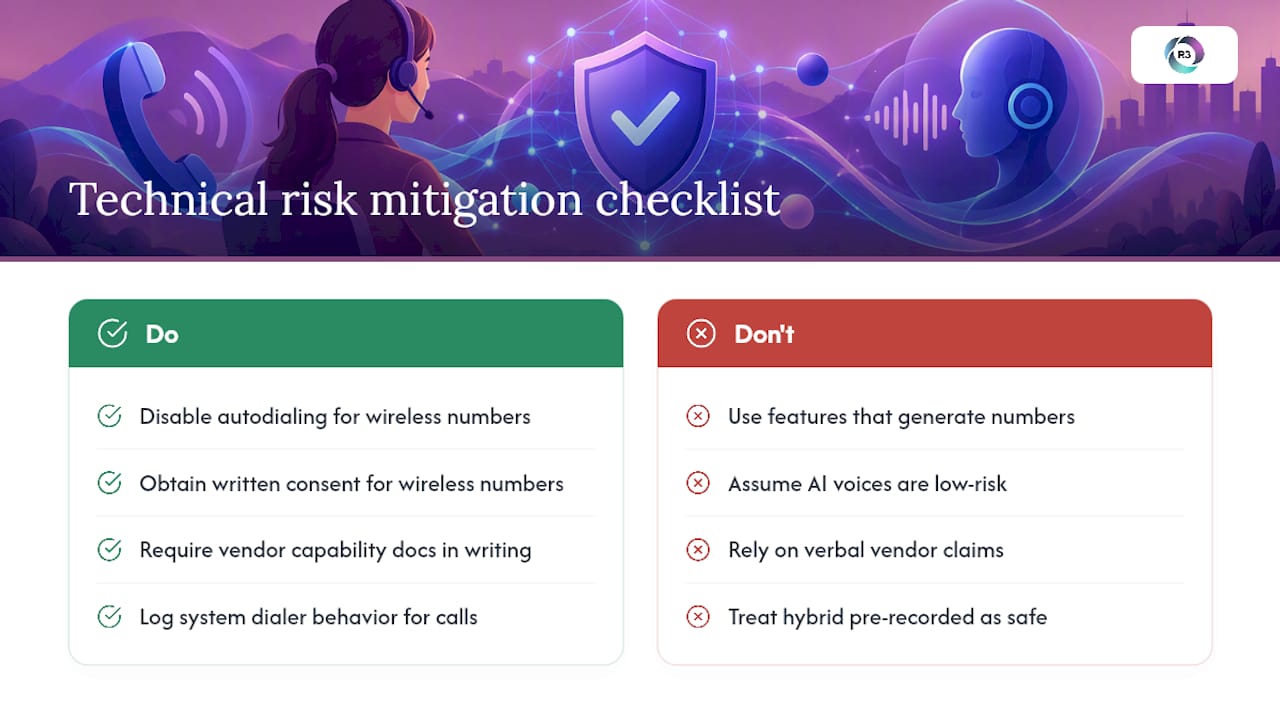
Practical mitigation looks like this: disable autodialing and prerecorded-voice features entirely for wireless numbers lacking documented written consent, require vendors to provide capability documentation in writing, and log dialer behavior at a system level so you can prove what technology actually touched each call if a dispute arises later.
Vendor Oversight: Keeping Control When You Outsource Prospecting
Outsourcing your calling function doesn’t outsource your liability. The FTC’s guidance is clear that a seller must maintain its own Subscription Account Number and its own evidence trail even when a telemarketing vendor performs the DNC scrub and dialing. If your vendor’s list gets stale or their scrub lapses, the exposure lands on you as much as on them.
That means your vendor contracts need specific, enforceable language, not a general compliance clause buried on page nine. Require:
Direct or auditable access to the suppression feed your vendor actually uses, updated in real time.
Documented, versioned list histories showing when each scrub ran and what numbers it removed.
Contractual control over caller-ID display and approved scripts, with no unilateral vendor changes.
Retention of number-level evidence (consent text, timestamp, source, disposition) for the full retention period, accessible to you on request.
Audit rights letting you review vendor records on a set schedule, plus indemnity language covering TCPA violations traced to vendor error.
Delegating registry access to a vendor without confirming they’re using your SAN, not a shared or generic one, is one of the most common gaps in outsourced calling programs. Ask for proof, not a verbal assurance.
When you’re bringing a new outsourced calling team online, vetting the team properly before granting dialer access matters as much as the contract language. Start with a small test batch, confirm every checklist item above holds up under real conditions, and only then expand volume. That sequencing catches gaps while the exposure is still small.
Penalties, Enforcement Triggers, and How Safe Harbor Actually Protects You
TCPA violations carry statutory damages per call, and because those numbers compound across a list, class-action exposure is where the real financial risk sits, not a single enforcement letter. The most common triggers behind actual enforcement actions are predictable: robocalls placed without documented consent, opt-out requests that get ignored or processed too slowly, spoofed or missing caller ID, and deceptive statements about the purpose of the call or the identity of the caller.
None of those triggers require malicious intent. Most come from operational gaps: a suppression list that didn’t sync, a script that oversold a claim, a caller ID field left blank by a vendor’s default settings.
Safe-harbor protection under the TSR exists specifically to reward the businesses doing the unglamorous work described earlier in this article. Written procedures, documented training, ongoing monitoring, and maintained suppression lists don’t just reduce risk. They form the FTC’s own recognized defense against certain violations when a call still slips through despite reasonable controls.
If a complaint or enforcement notice arrives anyway, move fast. Pull the number-level record for the call in question immediately, confirm whether your suppression and consent documentation held up, and freeze that campaign segment while you investigate. Document the corrective action you take, even if the issue turns out to be a vendor error rather than your own system. Regulators and plaintiffs’ attorneys weigh a fast, documented response very differently than a defensive one.
How to Launch a TCPA-Compliant Cold-Calling Campaign
Rolling out a new campaign without a structured test phase is how small compliance gaps turn into list-wide liability. Follow this sequence before you scale past a pilot batch.
Classify the campaign and the target numbers. Determine whether calls will use manual dialing, an autodialer, or prerecorded/AI voice, and separate your list into business-exempt numbers, consumer numbers with documented consent, and anything unclear.
Run the DNC scrub and confirm consent records on a small pilot batch. Start with a few hundred numbers, not your full list, and verify every record has a timestamp, source, and consent basis before a single call goes out.
Reconcile dialer logs against CRM dispositions and suppression feeds. Every call the dialer placed should match a corresponding CRM entry, and every opt-out captured during the pilot should already appear in the suppression file used for the next batch.
Review vendor-produced artifacts and run an internal audit before scaling. Pull a sample of number-level records from your vendor, check them against the checklist above, and only expand volume once the pilot passes review clean.
After launch, track three numbers closely: your abandoned-call rate against the TSR safe-harbor threshold, the time between an opt-out request and its suppression across all systems, and your complaint rate per thousand calls. A rising complaint rate almost always shows up before a regulatory notice does.
Pro Tip: Treat your first pilot batch as a compliance audit disguised as a sales test. If the suppression, consent, and logging systems don’t hold up at 300 calls, they definitely won’t hold up at 30,000.
How Managed Remote Teams Keep Compliance Consistent
Compliance breaks down most often when it depends on memory, not process. A rep juggling quota pressure and a dozen other tasks will eventually skip a scrub check or misfile a consent record, not out of carelessness, but because the checklist lives in their head instead of in a system.
Consistent, trained remote staff change that equation. When suppression propagation, consent logging, and vendor coordination are someone’s actual daily job rather than an afterthought squeezed between calls, those steps stop slipping. Managed teams also create the audit trail regulators and plaintiffs’ attorneys actually want to see: documented procedures, monitored execution, and a record of who did what and when.
That operational discipline is exactly what separates a campaign that survives scrutiny from one that doesn’t.
— Ellis
Where R3source Fits Into Your Compliance Operations
Some companies provide dedicated, long-term remote staff who handle the parts of TCPA compliance that fall apart when nobody owns them full time. Instead of hoping your sales team remembers to check the suppression list between calls, you get a trained professional whose actual job is running that scrub, logging consent records, updating your CRM, and coordinating with any calling vendor you use.
Our teams support lead generation and appointment setting workflows built around the checklist in this article: number classification, consent documentation, opt-out processing, and vendor audit tracking, all handled inside your existing CRM rather than a separate system nobody checks. Because dedicated remote staff can be full, integrated employees rather than task-based freelancers, you can get the same person managing your suppression files and consent logs week after week, not a rotating cast of contractors relearning your process every month.
If you’re ready to hand off the operational side of compliant outreach, take a look at our Offshore Virtual Assistant Services or book a consultation to talk through what a dedicated remote team could handle for your calling program.
Primary Government Resources for TCPA and Telemarketing Rules
Before launching or auditing a campaign, verify current requirements directly against government sources. The FTC’s Telemarketing Sales Rule compliance guide covers disclosures, recordkeeping, and abandoned-call rules in full. The FCC publishes TCPA rule updates and declaratory rulings, including AI-voice guidance. Consumers and businesses can register or check numbers at donotcall.gov, and full statutory text is available in the Telephone Consumer Protection Act, 47 U.S.C. § 227.
Sources
FAQ
Is Cold Calling Legal in the United States?
Yes. Cold calling itself is legal under federal law, but automated or prerecorded calls to wireless numbers require prior express written consent, and all consumer calls must respect Do-Not-Call registry and company-specific suppression rules. The legal risk comes from the method and technology used, not from the act of calling an unfamiliar number.
Which Calls Are Exempt From the TCPA?
Established business relationships, certain informational and emergency calls, and business-to-business calls made for a business purpose can fall outside some TCPA and TSR restrictions. The B2B exemption is narrower than most sales teams assume. It applies to the call’s business purpose, not simply to the number reaching a business line.
What Are the Federal TCPA Allowable Calling Hours?
Telemarketing calls generally must occur between 8 a.m. and 9 p.m. in the recipient’s local time zone under the Telemarketing Sales Rule. Some states impose narrower windows, so multistate campaigns should check the strictest applicable rule before setting dialer schedules.
What Is the 80/20 Rule in Cold Calling?
The 80/20 rule in cold calling generally refers to the idea that a small share of leads, calling hours, or scripts drive most conversions, though the exact proportions vary by team and industry. It’s a performance heuristic rather than a legal standard, and it has no bearing on TCPA or TSR compliance requirements.
Recommended
Comments