

Why growing businesses need remote staff to scale


Remote staffing is no longer a perk reserved for Silicon Valley tech companies. Small and medium-sized businesses across the US are discovering that hiring remote professionals delivers real productivity gains averaging 10 to 20% while cutting overhead costs that would otherwise limit growth. If you’ve been wondering whether remote staff could actually work for your business, the answer is almost certainly yes. This guide breaks down the tangible benefits, practical steps, and honest challenges so you can make a confident, informed decision about building your remote team.
Table of Contents
Key Takeaways
Point | Details |
Global talent access | Remote staffing lets SMBs hire top talent around the world, not just locally. |
Measurable productivity gains | Remote teams typically outperform in-office teams when management is structured. |
Lower hiring and office costs | Remote work reduces recruitment costs and eliminates expensive office overhead. |
Improved retention and satisfaction | Remote and hybrid teams experience less turnover and higher employee morale. |
Hybrid models maximize results | Combining remote and in-person work often delivers the best performance and satisfaction for growing businesses. |
Access to global talent: Solving hiring challenges
With the foundation set on why productivity and cost matter, let’s see how remote staff can give you global reach.
Local hiring markets are tight. Skilled professionals in accounting, digital marketing, customer service, and IT are in short supply in many US cities, and competition for them drives salaries higher every year. Remote staffing changes that equation entirely. Global talent access means you can bypass local shortages and hire specialists without geographic limits, opening your business to a much larger pool of qualified candidates.
Think about what that means in practice. A real estate company in Ohio can hire a skilled CRM specialist from the Philippines. An e-commerce brand in Texas can bring on a seasoned customer support professional who covers evening hours while the owner sleeps. Time zone differences, often seen as a drawback, can actually create near-round-the-clock coverage that would cost a fortune to replicate locally.
Here are some of the most common hiring barriers that remote staffing solves:
Talent scarcity: Specialized roles like paid media managers, bookkeepers, and appointment setters are hard to find locally but widely available in global markets.
High local salaries: Competitive wages in major US cities make hiring locally expensive, especially for support roles.
Long recruitment timelines: Local hiring often takes 6 to 12 weeks. Remote hiring platforms can reduce that to days.
Limited scalability: Adding local staff means more office space, equipment, and HR overhead. Remote staff scale without those costs.
High turnover risk: Employees hired locally often leave for better local offers. Remote professionals in countries like the Philippines tend to show stronger long-term loyalty.
The numbers back this up. Here’s a quick comparison of what hiring locally versus hiring remotely typically looks like for an SMB:
Factor | Local hire | Remote hire |
Average time to fill | 6 to 12 weeks | 1 to 3 weeks |
Average cost per hire | $4,700+ | $500 to $1,500 |
Monthly salary (support role) | $3,500 to $5,000 | $800 to $1,500 |
Office space required | Yes | No |
Benefits overhead | Yes | Minimal |
You can explore what this looks like firsthand through a free remote professional trial or read through client success stories from businesses that have already made the shift. For businesses considering technology-assisted staffing, AI solutions for staffing and 24/7 support options are also worth exploring as complementary tools.
Productivity gains and structured management for growth
Now that you can hire globally, what about getting the best work from your team? Let’s break down productivity and what makes it stick.
Remote work has a strong productivity track record, but it doesn’t happen automatically. The businesses that see the biggest gains are the ones that invest in structured management from day one. Studies consistently show productivity gains of 10 to 20% with remote teams, largely because remote professionals face fewer office distractions, have more control over their environment, and often feel a stronger sense of ownership over their work.
That said, structure matters enormously. Without clear guidelines, remote teams can drift. Communication gaps form. Accountability becomes fuzzy. The good news is that the fixes are straightforward and don’t require expensive software or complicated systems.
The top 3 productivity pitfalls and how to solve them:
No clear expectations: Remote staff need documented role descriptions, daily task priorities, and performance benchmarks. Fix this by creating a simple team charter that outlines responsibilities, communication norms, and key performance indicators before the first day.
Inconsistent check-ins: Out of sight can mean out of sync. Fix this by scheduling brief daily or weekly check-ins using video calls. Even 15 minutes a day builds alignment and catches issues early.
Tool overload: Too many platforms create confusion and slow everyone down. Fix this by standardizing on one project management tool, one communication platform, and one file-sharing system from the start.
It’s also worth thinking about which roles benefit most from remote setups. Independent roles like data entry, content writing, bookkeeping, and CRM management are naturally well-suited to remote work. Collaborative roles that require real-time brainstorming or physical presence may need a hybrid approach.
“The most productive remote teams aren’t the ones with the most tools. They’re the ones with the clearest processes.” This insight from workforce researchers reflects what high-performing remote-enabled companies consistently demonstrate: structure is the real productivity driver.
Pro Tip: During onboarding, spend the first two weeks focused entirely on process alignment rather than output. Walk your new remote staff through your systems, introduce them to your team, and set clear expectations before assigning full workloads. This investment pays off in months of smoother performance. You can find more actionable guidance on our remote productivity tips blog. For businesses looking to layer in technology support, AI productivity tools can also help streamline workflows.
Cost efficiency, reinvestment, and scalable growth
Productivity is only half the story. Next, see how remote hiring unlocks cost savings and true scalability for your business.
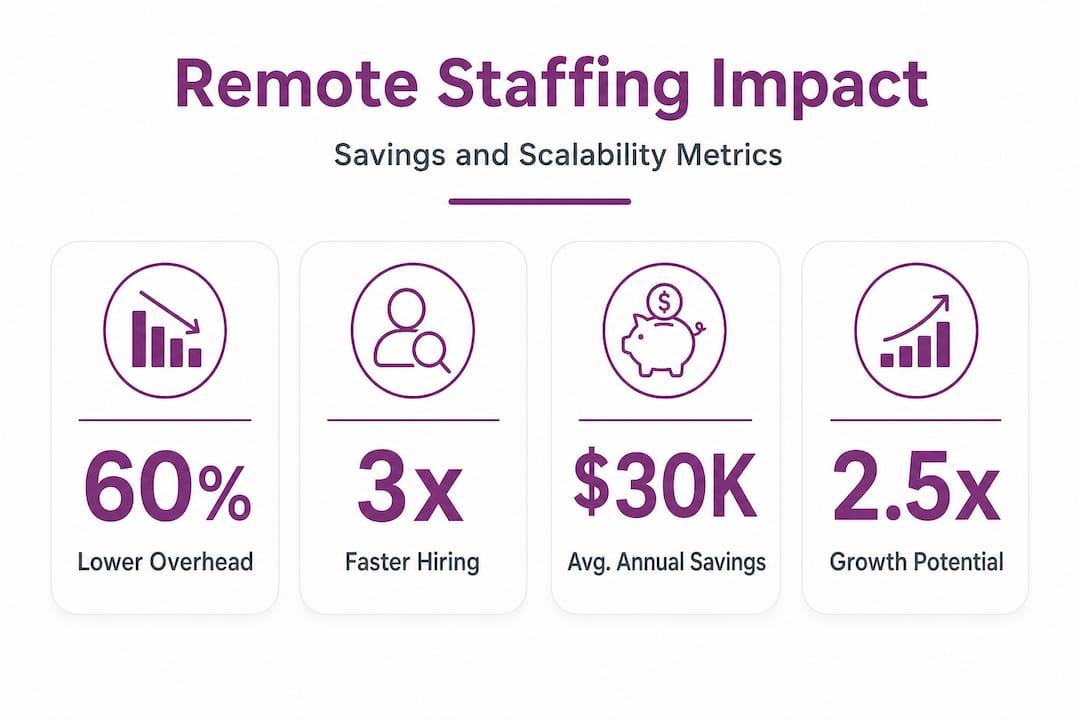
One of the most compelling reasons to hire remote staff is what it does to your cost structure. When you remove the need for physical office space, equipment, utilities, and local benefits packages, the savings add up fast. Scalable growth without fixed costs means you can add team members without expanding your office footprint or taking on relocation expenses, freeing up capital to reinvest in the parts of your business that generate revenue.

Here’s what the cost comparison looks like in real terms:
Cost category | In-office employee | Remote employee |
Monthly salary | $3,500 to $5,000 | $800 to $1,500 |
Office space per person | $500 to $1,000/month | $0 |
Equipment and setup | $1,500 to $3,000 | $0 to $500 |
Benefits and payroll taxes | 20 to 30% of salary | Minimal |
Recruitment cost | $4,700+ average | $500 to $1,500 |
The savings from even one remote hire can fund meaningful reinvestment. Here are some of the most impactful ways SMBs are redirecting those dollars:
Technology upgrades: Better CRM systems, automation tools, or e-commerce platforms that increase revenue capacity.
Marketing investment: Paid advertising, content creation, or SEO campaigns that bring in new customers.
Product development: R&D, new service lines, or inventory expansion.
Additional remote hires: Reinvesting savings into more remote staff creates a compounding growth effect.
Owner compensation: Many small business owners underpay themselves. Savings from remote staffing can correct that.
The scalability angle is particularly powerful. A traditional growth model requires more office space, more equipment, and more local hires every time revenue increases. Remote staffing breaks that pattern. You can double your support capacity without signing a new lease or buying new furniture. For more on how this works in practice, explore our posts on outsourcing for growth, scaling with remote teams, and team growth strategies. For additional perspective on cutting fixed costs, that resource offers useful frameworks applicable to US SMBs as well.
Lower attrition, employee satisfaction, and overcoming remote challenges
Cost efficiency is powerful, but success depends on keeping top talent and navigating remote challenges. Here’s how growing businesses get it right.
Turnover is one of the most expensive problems a small business can face. Replacing an employee typically costs 50 to 200% of their annual salary when you factor in recruitment, onboarding, and lost productivity. Remote work addresses this directly. Lower turnover of 33% and higher satisfaction of 35% have been documented in research, with one study reporting $2.3 million in annual savings from reduced attrition alone.
Remote professionals, particularly those working from the Philippines, often report higher job satisfaction because of the flexibility, income stability relative to local markets, and the sense of contributing to meaningful work for international clients. That satisfaction translates into loyalty, and loyalty translates into lower replacement costs for your business.
That said, remote work comes with real challenges. Here are the top four and how to address them:
Communication gaps: Without face-to-face interaction, misunderstandings multiply. Fix this with structured communication protocols, regular video check-ins, and clear written documentation for all key processes.
Tool sprawl: Teams that use too many disconnected platforms lose time and focus. Standardize your tech stack early and train everyone on it thoroughly.
Compliance complexity: Taxes, data privacy laws like GDPR and CCPA, and labor regulations vary by location and can create legal exposure if ignored. Work with an employer of record (EOR) service or legal advisor to stay compliant.
Training gaps: Remote staff need structured onboarding just as much as in-office hires, sometimes more. Invest in documented training materials and a clear learning path for the first 30 to 90 days.
“Businesses that invest in structured remote onboarding see retention rates significantly higher than those that don’t. The first 90 days define the relationship.” This reflects a consistent pattern across high-performing remote-enabled companies.
Pro Tip: Build a simple onboarding checklist that covers system access, role expectations, communication norms, and a 30-day performance review. Share it with your new remote staff on day one. It removes ambiguity and signals that you’re invested in their success. Visit our remote team FAQs for more practical guidance. For additional support on retention strategies, retention solutions and AI for team training are worth exploring.
Hybrid and full-remote models: Which is best for SMBs?
Once you appreciate the retention and financial rewards, you’ll need to decide: Which remote model best serves your company’s goals?
Not every business needs a fully remote team. Some roles benefit from occasional in-person collaboration, and some business owners prefer a mix. Understanding the differences between hybrid and full-remote models helps you choose the setup that fits your operations.
Research shows that hybrid models perform comparably to full office setups in terms of individual output, while delivering lower attrition. Full-remote teams, on the other hand, show about 10% lower performance on highly collaborative tasks but excel in independent, process-driven roles.
Model | Pros | Cons | Best for |
Full remote | Lowest cost, widest talent pool, maximum flexibility | Harder to collaborate in real time, requires strong digital processes | Support, admin, marketing, data roles |
Hybrid | Balances collaboration and flexibility, lower attrition | Requires some office infrastructure, coordination complexity | Sales teams, client-facing roles |
Traditional office | Strong real-time collaboration, easier culture building | Highest cost, limited talent pool, higher turnover | Roles requiring physical presence |
Three steps to identify the right model for your business:
Audit your roles: List every position in your business and categorize each as independent (task-driven) or collaborative (requires real-time teamwork). Independent roles are almost always better suited to full remote.
Assess your infrastructure: Do you have the digital tools and management processes to support remote staff? If not, start building them before you hire.
Start with one remote hire: Test the model with a single remote professional before committing to a full team. This gives you real experience without overextending.
If you’re ready to take that first step, build your team with support from professionals who understand what growing SMBs need.
The overlooked truth: Why remote-first only works with strategy
Most articles about remote staffing focus on the cost savings and stop there. That’s understandable, because the numbers are genuinely compelling. But in our experience working with growing US businesses, the cost savings are almost never what determines whether a remote team succeeds or fails. Strategy does.
Here’s what we’ve seen repeatedly: business owners hire remote staff, see an initial boost in output, and then watch performance plateau or decline within three to six months. The reason is almost always the same. The business didn’t invest in building a remote-ready culture. The remote staff were treated as task executors rather than team members. Communication was reactive rather than structured. And when problems emerged, there was no framework to address them.
The businesses that get lasting value from remote staffing are the ones that treat their remote professionals the same way they’d treat an in-office hire. That means real onboarding, regular feedback, clear career development, and genuine inclusion in team communications. It means building remote-ready culture intentionally, not assuming it will develop on its own.
Hybrid models tend to outperform fully remote setups for most SMBs precisely because they preserve the human connection that makes teams cohesive. If your business can support a hybrid approach, it’s usually worth the added coordination effort.
The bottom line: remote staffing is a powerful growth tool, but it’s not a passive one. The businesses that win with remote teams are the ones that lead with intention, invest in their people, and build systems that support accountability and growth.
Pro Tip: Before your first remote hire, write a one-page communication guide that covers response time expectations, preferred tools for different types of communication, and how your team handles urgent issues. Share it with every new team member. It takes 30 minutes to create and saves months of confusion.
Ready to build your remote team?
If the benefits covered in this article resonate with where your business is headed, you don’t have to figure out the next steps alone. R3source helps US business owners build reliable, high-performing remote teams with professionals from the Philippines who are trained to integrate directly into your operations.
Whether you’re looking to hire your first virtual assistant or expand an existing team, we make the process straightforward and supported. Start by exploring our remote professionals FAQ for answers to the most common questions business owners ask before hiring. You can also enter to receive a free remote professional to experience the difference firsthand. When you’re ready to take the full step, our remote staffing solutions are designed to match your business with the right people, backed by accountability and long-term partnership.
Frequently asked questions
What types of roles are best suited to remote staffing for SMBs?
Customer support, marketing, bookkeeping, and IT are among the roles most successfully filled by remote staff, since global talent access makes it easy to find specialists without geographic limits.
How do remote staff affect company culture and collaboration?
Remote work improves employee satisfaction when paired with clear communication and inclusive practices, but hybrid models perform better on highly collaborative tasks while also reducing attrition.
What are the main compliance issues when hiring remote staff?
Key concerns include taxes, labor laws, and data privacy standards such as GDPR and CCPA, which vary by location and require proactive legal guidance.
How much money can SMBs save by using remote staff?
Savings come from reduced real estate, utilities, and recruitment costs, and scalable growth without fixed costs means you can add staff without office expansion expenses.
What practical steps boost remote team productivity?
Regular check-ins, structured onboarding, and standardized digital tools are key, since productivity gains of 10 to 20% depend on structured management rather than remote work alone.
Recommended
Comments