

First 90 Days for U.S. Managers: Filipino Work Culture Playbook


Filipino work culture runs on three forces you need to plan around from day one: relationship-first collaboration, indirect communication, and deep respect for hierarchy. If you manage Filipino remote employees without adjusting for these, you’ll misread silence as agreement and directness as rudeness. The single highest-leverage move is simple: give feedback privately, build rapport before you push output, and write down every expectation you’d normally say out loud.
Private, specific feedback is essential because public correction can damage morale and trigger feelings of shame.
Building rapport early on, through relationship-focused routines, reduces silent disengagement and fosters trust over time.
Clear documentation of expectations and low-stakes, structured communication channels prevent misunderstandings in indirect communication styles.
Recognizing contributions personally, supporting career growth, and respecting hierarchical norms increase loyalty and long-term retention.
Scheduling must account for local holidays, flexible start times, and deliberate overlap hours to accommodate Filipino cultural norms and remote work rhythms.
Table of Contents
What Makes Filipino Work Culture Different From American Norms?
Filipino workplace values grew out of a mix most American managers don’t expect: centuries of Spanish and American colonial influence layered onto Southeast Asian community traditions. The result is a hybrid business culture that looks Western on the surface, in its emails, software, and often near-native English, but runs on very different social rules underneath. That blend of hierarchy, group orientation, indirect communication, and strong interpersonal ties is well documented in country-level business culture research, and it shows up daily in how your team talks to you, to each other, and about problems.
Here’s where the friction actually shows up for U.S. managers:
Directness gets softened. An American manager says “this report is wrong, fix it by Friday.” A Filipino employee is more likely to say “I noticed a few small things I wanted to check with you about” even when the errors are significant.
Deference to authority runs deep. Filipino professionals often won’t challenge a manager’s decision openly, even when they see a better path, because doing so risks appearing disrespectful.
Relationships come before tasks. Trust gets built through small talk, personal check-ins, and consistency over time, not through project velocity alone. Skip this step and you’ll get compliance, not real engagement.
Time and holidays flex around context. Meeting start times can drift a few minutes for social pleasantries, and local holidays (which include many national and regional observances) affect scheduling in ways a U.S. calendar won’t flag.
None of this means your team is less capable or less committed. It means the signals you’re used to reading in a Chicago office don’t map cleanly onto a team in Cebu.
How Do You Read Indirect Feedback From Filipino Employees?
Silence, hedging, and vague agreement are rarely what they look like on the surface. Two cultural concepts explain most of it: hiya, the discomfort or shame tied to causing embarrassment (to yourself or someone else), and pakikisama, the drive to maintain group harmony even at the cost of voicing disagreement. Together they mean an employee will almost never tell you “no” flat out, even when the honest answer is no.
Learn to translate the common phrases:
“I’ll try my best” usually means “I don’t think this deadline is realistic, but I don’t want to disappoint you.”
“That might be a bit difficult” is a polite way of flagging a real obstacle, not a minor inconvenience.
“Maybe we can look into that” often signals disagreement dressed up as openness.
Training yourself to probe these phrases with a specific follow-up question (“What would make Friday hard to hit?”) surfaces the real risk far faster than a yes/no prompt, according to research on high-context communication in the Philippines.
Feedback works the same way in reverse. Public correction, even a mildly critical comment in a group chat, can damage morale for weeks, because it triggers hiya in front of peers. Keeping corrective feedback private and specific preserves the relationship and keeps the person receptive to the correction itself, rather than just to the sting.
Pro Tip: Use the sandwich method deliberately: open with a specific, genuine positive, deliver the correction as a clear action item, then close with confidence in their ability to fix it. This isn’t a soft-skills nicety in Filipino teams. It’s the difference between an employee who absorbs feedback and one who quietly disengages.
What Do Filipino Employees Expect From a Manager?
Power distance, the gap between how much authority a boss holds versus a subordinate, runs far higher in the Philippines than in most American workplaces. Hofstede’s cultural research confirms a substantial gap between Filipino and North American norms on this dimension, and it explains behavior that can otherwise puzzle a first-time manager: employees waiting for explicit instructions instead of acting on their own judgment, or addressing you with noticeably more formality than you’re used to.
That deference isn’t passivity. It’s a learned respect for the chain of command, and you can work with it rather than against it:
Use titles or last names until an employee signals they’re comfortable with first names.
Frame decision rights explicitly (“You own this call up to $200; loop me in above that”) so initiative has a clear, safe boundary.
Invite input with specific, low-risk questions: “What’s one thing you’d change about this process?” works better than an open “Any thoughts?”
Recognize good judgment publicly and often. Praise reinforces the behavior you want far more effectively than criticism discourages the behavior you don’t.
Managers who succeed here tend to act less like a supervisor and more like a mentor, offering personal support alongside professional direction, which research on Filipino management style frames as a near-expected part of the role, not an optional extra.
How Do Filipino Team Dynamics Shape Loyalty and Motivation?
Three relational values drive daily performance more than any KPI dashboard will show you. Pakikisama means smoothing group friction and pitching in even outside your formal job description. Utang na loob describes a debt of gratitude, the sense that a manager who showed real support in a hard moment earns lasting loyalty, not just a transaction. Malasakit is a genuine concern for a coworker’s welfare that shows up as covering a shift or checking in after a rough week.
Here’s how that translates into retention:
Employers offering job stability and benefits that address real family needs, health coverage, flexible time for family obligations, see measurably higher retention, according to research on Filipino workplace priorities.
Recognition that’s personal (a specific note about someone’s contribution) outperforms generic praise.
Career pathways matter more than one-time bonuses. Show a path to more responsibility and people stay years, not months.
A manager who invests personal time, remembering a birthday, asking about a sick parent, earns discretionary effort no contract clause can buy.
What’s the Best Schedule for a Remote Filipino Team?
Punctuality in the Philippines flexes more than most U.S. managers expect, especially around meeting starts, where a few minutes of social greeting is standard before business begins. Treat that as culture, not carelessness.
Local holidays also matter more than a typical company calendar accounts for. The Philippines observes both national holidays and regional ones that shift by province, so a “business as usual” assumption on a random Tuesday can be wrong. This isn’t legal guidance, just a scheduling reality: check your team’s local calendar each quarter rather than assuming a fixed U.S. holiday list applies.
Build your rhythm around these rules:
Set a defined overlap window (even four hours) for real-time collaboration, and let the rest run asynchronously.
Record every meeting your team can’t attend live, and document decisions in writing so nothing depends on someone’s memory of a call.
Confirm holiday schedules a month ahead instead of finding out the day of.
Avoid urgent same-day asks outside the agreed overlap window whenever possible.
Your First 90 Days Managing a Filipino Remote Team
The first quarter sets the tone for everything after it. Rush the relationship-building and you’ll spend the next year fighting quiet disengagement instead of building momentum.
Week one: build rapport before assigning heavy workload. Spend real time on introductions, ask about their background, and explain your own working style plainly. This isn’t a delay, it’s the foundation Filipino employees need to feel safe raising concerns later.
Weeks two through four: document everything, using clear procedures like Scripts & SLAs for outsourcing content marketing that help operationalize your remote team efficiently. Write clear, specific expectations for every recurring task. Vague verbal instructions are the single biggest source of misunderstanding in cross-cultural remote teams.
Ongoing: run a weekly one-on-one, private, not group. This is where honest concerns actually surface. Pair it with async daily or twice-weekly check-ins through a tool like Slack or Asana so small issues don’t wait a week to be flagged.
Ongoing: set a specific feedback cadence. Address problems within days, privately, using the sandwich method. Letting issues pile up for a monthly review only makes the correction feel bigger and more personal than it needs to.
Build a simple escalation path. Give employees a clear, low-stakes way to flag a concern (a written form works better than a live confrontation) so problems surface before they become resignations.
Pro Tip: Keep your SOPs in a shared, always-current document, not buried in old email threads. A remote team management approach built on written clarity removes the guesswork that indirect communication styles can otherwise leave behind.
Combining this rhythm with the kind of relationship-building routines described in playbooks for managing Filipino remote teams is what turns a good hire into a long-term team member.
What Should You Look for When Hiring Filipino Remote Staff?
Technical skill is the easy part to screen for. What actually predicts success is whether a candidate can name problems clearly and whether they’ve worked independently before.
Ask direct scenario questions: “Tell me about a time a deadline felt unrealistic. What did you do?” This surfaces how someone handles the very indirectness this guide describes, rather than just their instinct to agree.
Probe availability honestly. Ask about their home setup, internet backup, and typical distractions rather than a simple “can you work these hours?”, which usually gets a polite yes regardless of the real answer.
Look for adaptability signals: prior remote roles, freelance history, or experience working across time zones.
Stage responsibility during onboarding. Start with clearly bounded tasks, then expand scope as trust builds, rather than handing over ambiguous ownership on day one.
How R3source Applies These Principles in Practice
Everything above is a framework. Putting it into daily practice, matching the right person to your role, training them on your specific processes, and managing the cultural handoff, is where most U.S. businesses actually get stuck.
R3source places dedicated, long-term remote professionals, not freelance task-doers, specifically so relationship continuity (the foundation of pakikisama and trust) isn’t reset every few months.
Staff are pre-vetted and coached before they ever touch your operations, reducing the ramp time tied to indirect communication misreads.
Ongoing management support means the private-feedback and structured-check-in routines described above are already built into how R3source’s teams operate day to day.
How Philippine professionals support U.S. business growth covers real examples of role fit across industries like real estate and e-commerce.
If you want a second set of eyes on how this maps to your specific role, a dedicated remote professional services consultation is a low-friction next step.
How Does Religion Shape Filipino Work Attitudes?
The Philippines is one of the most religious countries in Asia, and Catholicism in particular shapes attitudes toward work in ways that surface quietly but consistently. Concepts like acceptance of difficult circumstances, a preference for humility over self-promotion, and a strong sense of duty toward family often trace back to religious upbringing, even among employees who don’t discuss faith openly at work.
You’ll see it in specific behaviors. Employees may avoid boasting about individual achievements, deflecting credit to the team even when their own contribution was decisive. Requests for time off around religious holidays, Holy Week in particular, carry weight beyond a typical vacation day; treating these as flexible rather than negotiable builds real goodwill. Many employees also frame hard work as a form of providing for family, a duty more than a career ambition, which explains why job stability often matters more to Filipino candidates than a marginally higher salary elsewhere.
None of this means religion comes up in daily standups. It rarely does. But it quietly reinforces two traits you’ll already notice: a tendency toward patience with difficult situations rather than open frustration, and a strong pull toward group harmony over individual recognition. Managers who understand this context read “quiet endurance” correctly, as commitment, not as a lack of urgency or ambition.
How Should You Give and Receive Criticism at Work?
Criticism in Filipino work culture is a social event, not just an information exchange. How you deliver it matters as much as what you say, because getting it wrong can cost you the relationship along with the correction.
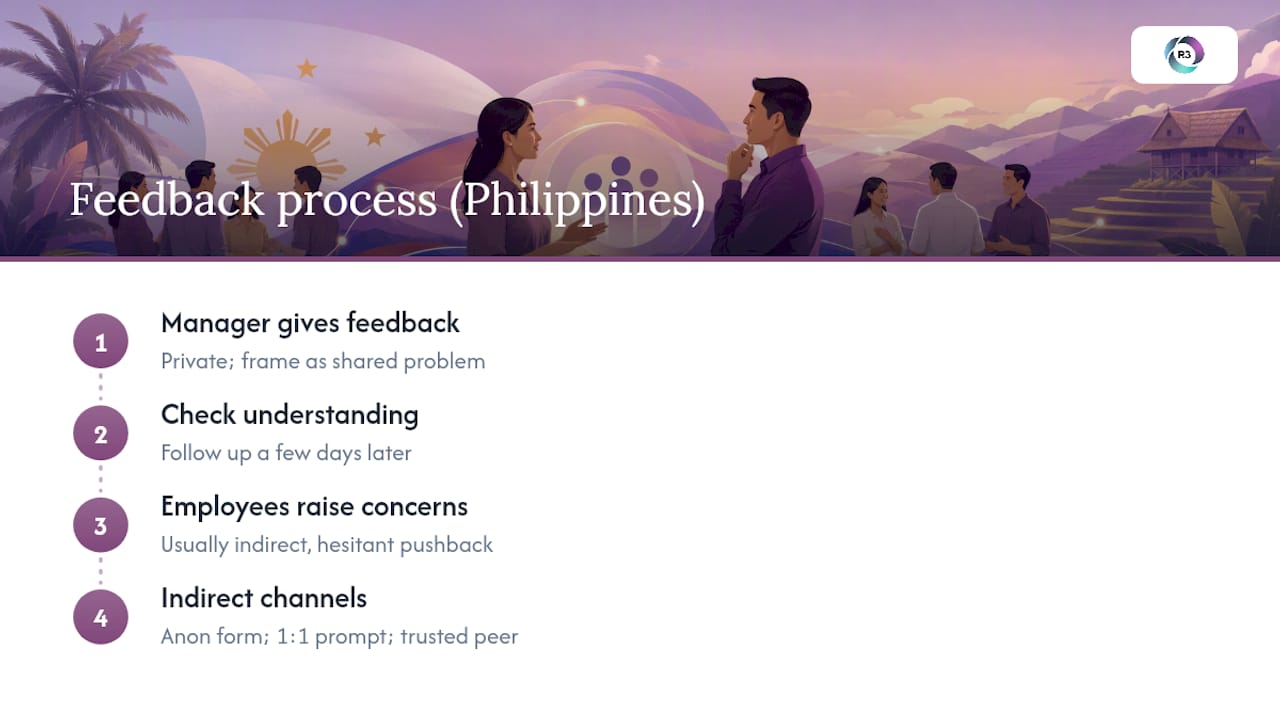
The core rule is privacy. Correcting someone in front of peers, even lightly, triggers hiya and can shut down communication for weeks rather than days. The safer default is a private message, call, or one-on-one, every time, regardless of how small the issue seems to you.
Framing matters just as much as setting. Criticism delivered as a shared problem (“How do we fix this together?”) lands far better than criticism delivered as a verdict (“This is wrong”). Filipino employees are also far less likely to push back on feedback in the moment, even when they disagree, so don’t mistake immediate agreement for genuine buy-in. Follow up a few days later to check whether the guidance actually made sense in practice.
Receiving criticism runs the same social logic in reverse. Employees are far more likely to raise concerns about your decisions indirectly, through a trusted peer, a vague comment, or a hesitant question, than to challenge you directly. Build in explicit, low-stakes channels for this: anonymous suggestion forms, a standing “anything I should know?” question in one-on-ones, or a peer they trust who can relay concerns on their behalf. Treat any hesitant pushback you do get as valuable, because it took real effort for someone to raise it at all.
What Are the Norms Around Gifts and Socializing at Work?
Hospitality is a visible, active part of Filipino office culture, and skipping it reads as coldness even when that’s not your intent. Sharing food is probably the most common form: bringing snacks to share, celebrating a birthday with the team, or acknowledging a work anniversary with a small gesture. These aren’t optional extras layered on top of “real work.” They’re part of how trust gets built day to day.

Gift-giving carries its own etiquette, particularly around the December holiday season, when many Filipino workplaces exchange small tokens or hold a modest year-end gathering. As a remote U.S. employer, you don’t need to replicate an office party. A genuine, personal note acknowledging someone’s year, paired with a modest holiday bonus where your budget allows, goes further than a generic company-wide email.
Socializing outside strict task talk also matters more than American managers often expect. A few minutes of casual conversation before diving into a meeting agenda isn’t wasted time. It’s relationship maintenance, and skipping it consistently can read as transactional or dismissive, even if you don’t mean it that way.
The practical takeaway: build small, low-cost hospitality into your routine. Open meetings with a genuine personal check-in. Acknowledge milestones specifically rather than generically. Treat socializing as part of the job, not a distraction from it, because in Filipino team dynamics, it often is the thing that makes the rest of the working relationship function.
Why Adapting Your Management Style Actually Pays Off
The businesses that struggle most with Filipino remote staff aren’t the ones with bad hires. They’re the ones applying a purely American management style to a team that runs on different social rules, then blaming the culture when engagement drops. Private feedback, documented expectations, and real relationship investment aren’t soft extras you add once the “real” management is done. They’re the mechanism that determines whether ramp time is four weeks or four months, and whether your best hire stays two years or leaves in six. Get the cultural adaptation right and retention, output, and trust follow it, not the other way around.
— Ellis
Build a Remote Team That Actually Understands Your Business
Reading a guide like this is one thing. Finding, vetting, and training people who already operate this way is another problem entirely, and it’s the one R3source exists to solve. Unlike freelance marketplaces where you inherit a stranger’s habits and hope for the best, R3source places fully managed, long-term remote professionals who are pre-vetted, coached, and matched to your role before day one, so the cultural integration work covered in this guide is already part of how your new team member operates.
Whether you need a single virtual assistant for administrative support or a full dedicated remote team covering customer service, lead generation, or CRM management, R3source handles the sourcing, onboarding, and ongoing management so you don’t have to guess at cultural fit. If a specific role, like offshore virtual assistant support, fits your immediate need better, that path is available too. The next step is simple: book a free consultation and walk through exactly which role fits your operation before you commit to anything.
Sources
FAQ
Do Filipinos Have a Good Work Ethic?
Yes. Research on Filipino workplace priorities points to strong loyalty, dedication to family stability through work, and high retention when employers offer job security and culturally relevant benefits, traits that consistently support strong, dependable performance in remote roles.
What Are Common Traits of Filipino Workers?
Common traits include strong English proficiency, respect for hierarchy, a relationship-first approach to teamwork, and indirect communication shaped by hiya (avoiding shame) and pakikisama (group harmony). Filipino professionals also tend to score well on English proficiency, which eases day-to-day collaboration with U.S. teams.
Is $1,000 a Month a Lot in the Philippines?
Remote roles with U.S. employers offer pay that is highly competitive compared to typical local salaries in most Philippine regions, attracting skilled professionals seeking stability and better compensation.
What Is the Standard Overlap Expectation for Remote Filipino Teams?
Most managers set a defined real-time overlap window, often several hours during the U.S. workday, then let the rest of the workday run asynchronously through documented tasks and async check-ins. Dedicated staffing arrangements often structure around this same overlap and documentation model.
How Should I Give Feedback to a Filipino Remote Employee?
Deliver feedback privately, never in a group setting, and frame it using the sandwich method: a genuine positive, a specific correction, then a note of confidence. This approach preserves dignity tied to hiya and keeps the employee open to future feedback.
Recommended
Comments