

3–5 Weeks to Qualified Meetings with Managed B2B Appointment Setting


For most early to growth stage B2B teams, outsourcing appointment setting through a managed partner is the fastest, lowest-risk way to fill a calendar with qualified meetings. It typically beats hiring in-house on speed and cost per meeting until you have the management bandwidth to run a full SDR team. If you go this route, start by writing down exactly what “qualified” means for your business, then book a pilot with a provider that will commit to that definition in writing.
Outsourcing appointment setting can generate qualified meetings within three to five weeks, much faster than the two to three months typically needed for in-house hires.
Costs are generally lower per qualified meeting at small scale when utilizing outsourced programs, which also eliminate hiring, onboarding, and turnover risks.
Early onboarding efforts should focus on sharing detailed ICPs, call recordings, and providing feedback, with most steady meeting volume achieved between weeks six and ten.
Pricing models vary from fixed retainer to pay-per-meeting, but combining a retainer with performance incentives offers the best balance of quality and accountability.
Maintaining a dedicated remote appointment setter with system access and ongoing training makes outsourcing more consistent and effective, closing performance gaps with in-house teams.
Table of Contents
What Is B2B Appointment Setting Outsourcing, and Why Consider It Now?
B2B appointment setting outsourcing means handing your outbound prospecting and meeting-booking work to an external team, usually a specialized agency or a dedicated remote staffing partner, instead of hiring and managing that function yourself. It sits inside the broader category of outsourced lead generation, but it’s narrower: the deliverable isn’t just interest, it’s a scheduled, qualified conversation with a decision-maker.
The reason to move now instead of building a team from scratch comes down to speed. A well-run engagement typically produces initial qualified meetings within three to five weeks, with volume stabilizing over the following month or so. Compare that to hiring, onboarding, and training an in-house SDR, which routinely eats two to three months before that person books a meeting worth showing up for.
Cost tells a similar story. Outsourced programs spread tooling, data, and management overhead across many clients, so at low seat counts they often land lower per qualified meeting than a solo in-house hire carrying a full salary, benefits, and software stack. One comparison found outsourced setups delivering first meetings in a few weeks and running significantly cheaper per qualified meeting at small scale, though results shift by market and vertical.
Beyond speed and cost, outsourcing removes a real risk: a bad SDR hire costs you months of pipeline and a salary before you even find out it isn’t working.
Faster time to first meeting, often measured in weeks, not quarters
Lower fully loaded cost per qualified meeting at small scale
No hiring, training, or turnover risk sitting on your books
Immediate access to outbound specialists who already know multi-channel sequencing
Statistic to watch: Outsourced programs report appointment-to-opportunity conversion rates around 18.2%, with show rates near 73%. Anything meaningfully below that signals a qualification or handoff problem worth investigating before you renew.
Should You Outsource, Build a Hybrid Team, or Hire In-House?
The right call depends on where your company sits on four dimensions: how much pipeline quality matters right now, your true fully loaded cost tolerance, how fast you need meetings, and how much management capacity you actually have. Comparing these four factors beats comparing a single salary number against a single retainer quote, which is the mistake most buyers make.
Score yourself honestly against each one:
Pipeline quality importance. If every meeting needs deep technical vetting before an AE will touch it, you need a partner willing to build a tight qualification standard with you, not just book volume.
Total cost, fully loaded. Add recruiting, tools, management time, and turnover risk to an in-house salary before you compare it to a retainer.
Time to pipeline. If your board wants meetings this quarter, outsourcing almost always wins on speed.
Management capacity and risk tolerance. Running an SDR team well takes coaching bandwidth. If you don’t have a sales manager who can dedicate hours weekly, outsourcing removes that burden.
Early-stage companies without a sales manager should default to outsourcing. Growth-stage teams with some management bandwidth often do best with a hybrid model, using outsourced volume outreach for broad prospecting while senior in-house reps handle strategic accounts. That combination tends to outperform either pure approach on quality and scale. Scale-stage companies with mature sales operations and dedicated management usually get more value building fully in-house.
Engagement Models and Pricing: What You’re Actually Buying
Vendor proposals usually fall into one of three commercial structures, and each shapes incentives differently.
Retainer model. You pay a fixed monthly fee for a defined amount of outreach activity and dedicated staff time. This gives you predictable budgeting and prioritizes relationship depth, but it can shift risk onto you if the provider underperforms.
Pay-per-meeting model. You pay only for booked appointments that meet an agreed definition. It feels lower risk on paper, but it can push providers toward volume over quality unless the qualification bar is airtight and enforced.
Staff augmentation or hybrid. You get a dedicated remote appointment setter or small team working inside your systems, often billed as ongoing staffing rather than a project fee, sometimes blended with a performance bonus tied to quality-verified meetings.
The best contracts combine a base retainer with a performance component tied to agreed qualified appointments, which keeps the provider financially motivated without tempting them to flood your calendar with weak leads.
What actually drives the price you’re quoted has less to do with the model and more to do with the work itself: how complex your ideal customer profile is, whether the provider has real experience in your vertical, the outreach volume you need, and whether the engagement spans just cold calling or a full multi-channel sequence across email, phone, and LinkedIn. A niche vertical like healthcare compliance software will cost more per seat than a broad SMB service, because the provider needs reps who can hold a credible conversation with a specialized buyer.
How to Evaluate a Provider Before You Sign Anything
Treat vendor selection like a hiring process, not a purchase order. Ask for documentation before the first call ends.
Request the playbook. Ask to see actual sequence examples, sample call scripts, and objection-handling frameworks. A provider with no documented process is improvising on your dime.
Ask for QA recordings and case studies. Quality varies widely across providers, so request real call recordings and referenceable case studies, not just a slide deck of logos.
Ask exactly who works your account. Get names, tenure, and whether they’re dedicated to you or split across multiple clients. Shared reps mean shared attention.
Ask how they define a qualified meeting. A vague answer here is the single biggest red flag in the entire evaluation.
Confirm the CRM integration plan. Find out how leads, call notes, and disqualification reasons sync into your system, and who owns data hygiene.
Once you’ve picked a partner, lock four things into the contract: a written qualified-appointment definition covering company, contact, and conversation criteria, service-level agreements on volume and response time, a reporting cadence in writing, and a replacement or remediation clause if a rep underperforms.
Pro Tip: Ask the provider to walk you through one real disqualified lead from a past engagement, and why it didn’t count as a meeting. Their answer tells you more about their quality bar than any case study will.
What the First 60 Days of Onboarding Should Look Like
Ramp time is where most outsourcing relationships succeed or quietly fail. The provider can only perform as well as the information you hand them.
Weeks 1 to 2: immersion. Share your ideal customer profile, top-performer call recordings, and CRM access. Providers that only get a one-page brief will write generic messaging, and it will show in your reply rates.
Weeks 2 to 3: sequence build and internal review. The provider drafts outreach sequences and scripts; you review and approve before anything goes to prospects.
Weeks 3 to 5: first outreach and early meetings. Expect the first qualified meetings to land here, consistent with the three to five week benchmark seen across well-run engagements.
Weeks 5 to 8: calibration. Volume should stabilize, and this is when weekly working sessions and closed-loop feedback start paying off.
Outsourcing only works well when you supply a documented ICP, real call access, and consistent feedback. Skip that and the vendor just amplifies unclear messaging faster.
What Metrics and Reports Should You Demand?
Ask for numbers, not adjectives. A provider telling you the campaign is “going well” is not a report.
Appointments set. The raw count, tracked weekly against target.
Show rate. The percentage of booked meetings that actually happen. Industry benchmarks put this around 73%; a rate well below that suggests weak confirmation practices.
Appointment to opportunity conversion. The share of meetings your AEs actually advance. This is the number that separates a real qualification process from volume theater.
Cost per qualified meeting. Total spend divided by meetings that met your written definition, not total meetings booked.
Pipeline influenced. Dollar value of opportunities that originated from the provider’s meetings.
Demand precision on the definitions themselves, not just the numbers. “Qualified” should specify company size, role, and a real business problem discussed, confirmed through recordings or dashboard notes you can spot check.
Benchmark to hold providers to: outsourced programs report conversion rates near 18.2% from appointment to opportunity. Set weekly working sessions for tactical issues, a monthly performance review for trend lines, and a quarterly session to revisit targeting and messaging.
What Does Outsourced Appointment Setting Really Cost?
The retainer or per-meeting rate on a proposal is rarely the full number you’ll pay. Several costs sit outside the headline pricing, and they add up fast if you don’t ask about them upfront.
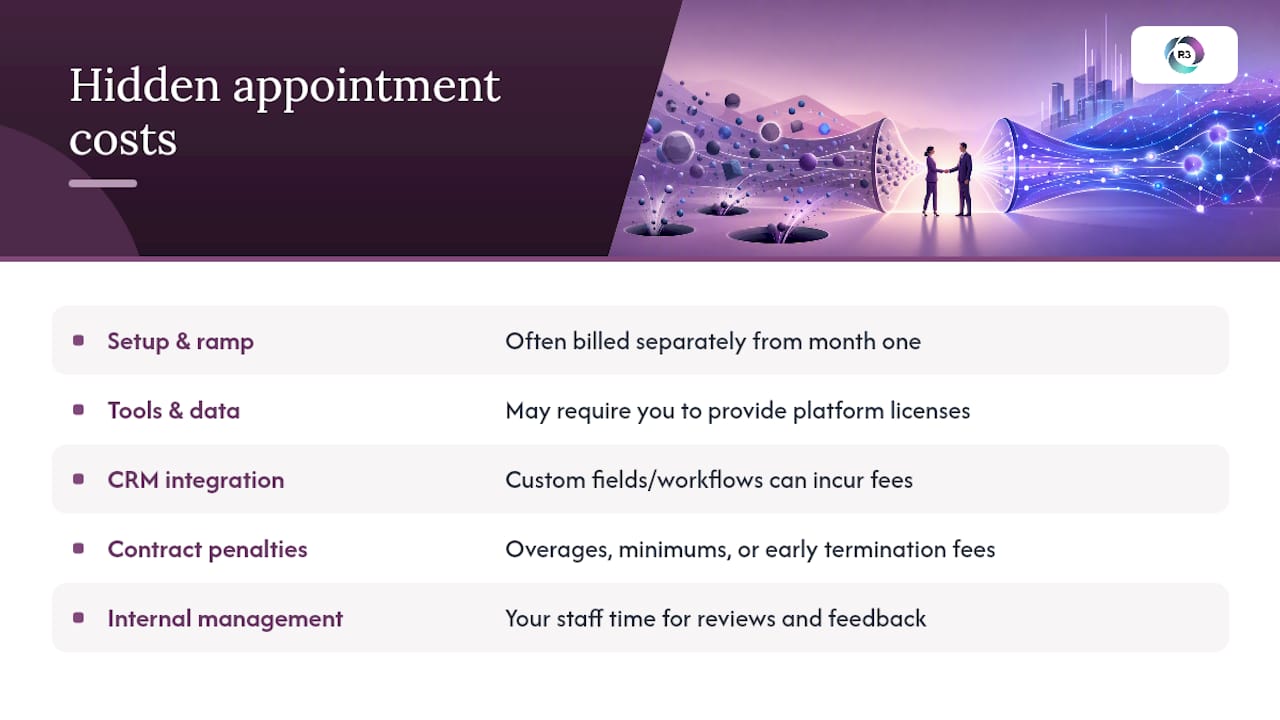
Setup and ramp fees are common, covering the time a provider spends building sequences, loading your CRM fields, and training reps on your product before any outreach goes out. Some providers bundle this into month one; others bill it separately, which can catch buyers off guard if it wasn’t in the proposal.
Tool and data costs are another gap. If the provider uses its own dialer, email infrastructure, or contact database, that’s often included. If they expect you to provide licenses to your own sales engagement platform or data provider, that’s a real line item you need to budget separately.
CRM integration work can also carry a cost, especially if your system needs custom fields or workflows to capture qualification criteria properly. A provider that treats this as an afterthought usually produces messy data that makes your metrics unreliable within a month.
Watch for volume-based overage fees on pay-per-meeting contracts, minimum monthly spend commitments that lock you in regardless of performance, and early termination penalties buried in the fine print. Ask directly: what is included in the quoted price, and what would trigger an additional invoice? A provider that hesitates on that question is one you should negotiate harder with, or walk away from.
Factor management time into your own internal cost too. Even a well-run partnership needs a point person on your side reviewing calls and giving feedback weekly. That time has a real cost, even if it never appears on an invoice.
From Signed Contract to Steady Meeting Volume: What to Expect
The timeline from signature to a predictable calendar of qualified meetings follows a fairly consistent arc across providers, even though exact pacing varies by vertical and list quality.
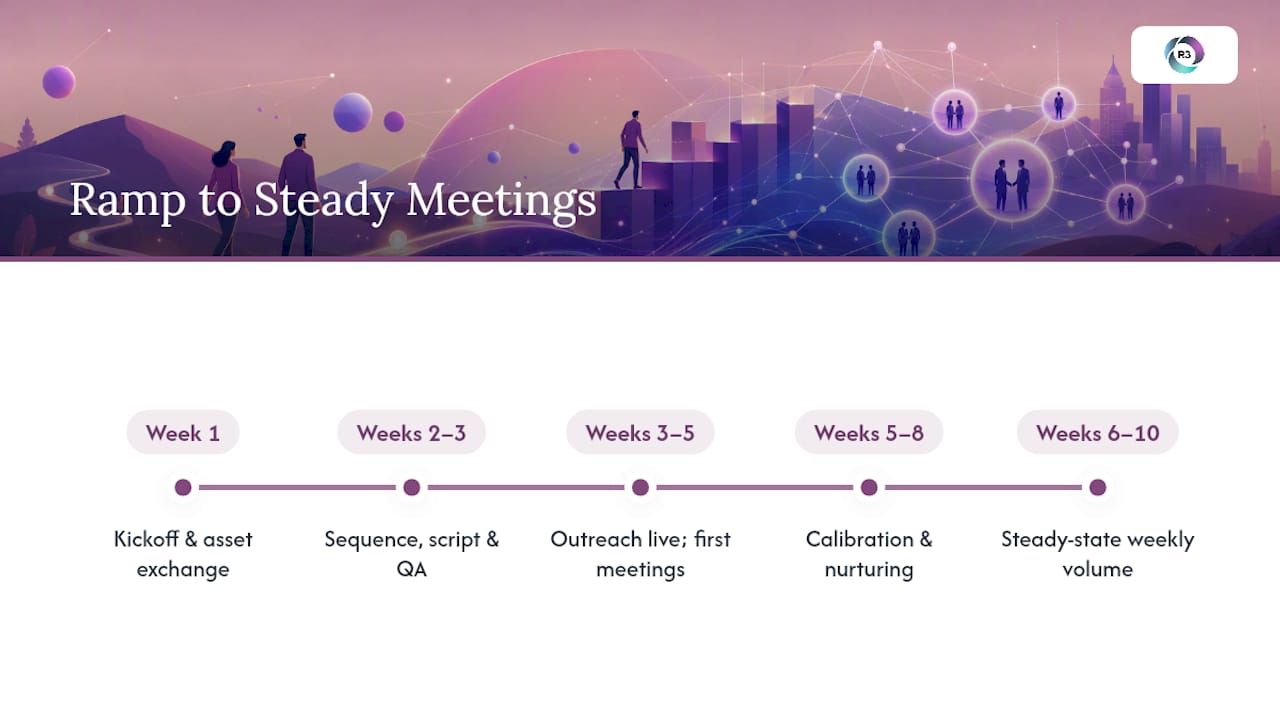
In the first week after signing, expect contract finalization, kickoff scheduling, and the exchange of core assets: your ICP documentation, messaging guidelines, and CRM access. This is also when you should confirm the qualified-appointment definition in writing if it wasn’t locked into the contract itself.
Weeks two and three cover sequence and script development, along with internal QA on the provider’s side before anything reaches a prospect. Many buyers underestimate how much back-and-forth this stage needs. Plan for at least one full review cycle where you push back on messaging that doesn’t sound like your company.
By week three or four, outreach goes live, and the first qualified meetings typically land within the three to five week window that well-run engagements tend to hit. Don’t expect full volume immediately. Early meetings are a signal the process works, not proof the pipeline is fully ramped.
Weeks five through eight bring calibration: refining targeting based on which segments convert, adjusting messaging based on objection patterns, and tightening the qualification bar based on what your AEs actually accept. This is where a partner running structured lead nurturing on non-converting prospects starts to show its value, turning near-misses into second-chance meetings instead of dead leads.
Steady-state volume, meaning a predictable number of qualified meetings hitting your calendar every week, usually arrives somewhere between week six and week ten, depending on how quickly you provided feedback during calibration. The buyers who move fastest through this window are the ones who treat weeks one through eight as a shared project, not a vendor drop-off.
A Buyer’s Week 0 to 8 Playbook
Running this well takes a little discipline on your end too, not just a signed contract. Build a weekly rhythm from day one: listen to two or three recorded outreach calls, review the quality of the prospect list against your ICP, and give your AEs a standing task to log structured feedback after every appointment, not just the ones that go badly.
Watch for warning signs early rather than waiting for a quarterly review. Catch these in week three, not week ten.
The real payoff isn’t just the meetings booked in these eight weeks. It’s the messaging insights, objection patterns, and qualification refinements you fold into your own permanent sales playbook, so the value outlasts any single vendor relationship.
— Ellis
A Managed Remote Team Built for Consistent Appointment Setting
A dedicated remote appointment setter, rather than a rotating cast of freelancers billing by the task, is key for continuity in outsourced appointment setting. That distinction matters once you’ve seen how much ramp time and qualification quality depend on continuity. Your rep learns your ICP, your CRM, and your objection patterns once, then keeps applying that knowledge week after week instead of relearning your business every time a contractor cycles out.
That consistency is exactly what closes the performance gap between outsourced and in-house teams: a dedicated person, integrated into your systems, backed by CRM management and lead generation support rather than working in isolation. Staff are trained to integrate directly into client workflows, handling tasks from list building and outreach to updating pipeline records, so AEs walk into every meeting with full context.
If you’re ready to see what a dedicated remote appointment setter looks like inside your own sales process, book an introductory consultation. Come prepared with your ideal customer profile and a rough sense of your current qualification criteria. That’s enough to start scoping a pilot and get real meetings on your calendar within weeks, not quarters.
Sources
FAQ
What Does B2B Appointment Setting Mean?
B2B appointment setting is the process of contacting potential business buyers, qualifying their fit against your ideal customer profile, and scheduling a sales conversation with your team. It’s a component of outsourced lead generation focused specifically on booking meetings rather than just generating interest.
How Much Should I Pay an Appointment Setter?
Pricing depends heavily on the engagement model, your target vertical, and outreach complexity, so there’s no single flat rate across the industry. Compare proposals on fully loaded cost per qualified meeting, not just the headline retainer or per-meeting fee, since total cost and pipeline quality matter more than the sticker price.
What Are Outsourced Appointment Setting Services?
Outsourced appointment setting services are external teams, often a specialized agency or a dedicated remote staffing provider like R3source, that handle outbound prospecting and meeting scheduling on your behalf under an agreed qualification standard. They typically integrate with your CRM and report on meetings booked, show rates, and conversion to opportunity.
Are Appointment Setting Jobs Legit?
Yes, appointment setting is a legitimate, established sales function used across B2B industries, whether performed in-house or through an outsourced provider. Legitimacy concerns usually apply to unvetted freelance marketplaces rather than established staffing providers that offer contracts, QA processes, and verifiable case studies.
Recommended
Comments