

Scale Your Business with Virtual Assistants in 2026


Virtual assistants (VAs) are remote professionals who handle defined business tasks so you can focus on growth. To scale business with virtual assistants effectively, you need more than a hired helper. You need a system. Business owners who combine clear delegation frameworks with AI tools are building real operational capacity without adding full-time overhead. The result is a leaner, faster business that grows without burning you out.
Which tasks should you delegate to scale operations with a VA?
The highest-impact delegation starts with tasks that repeat weekly and require no judgment calls from you personally. Think of these as the work that fills your calendar but never moves your business forward. Inbox management, calendar scheduling, CRM updates, data entry, and social media posting all qualify. So does research, lead list building, appointment setting, and basic customer follow-up.
A VA with inbox triage protocols can cut your email time by up to 70%. That single shift alone gives most business owners back several hours every week.
Common tasks ideal for VA delegation:
Inbox and calendar management — high volume, low judgment, immediate time savings
CRM data entry and updates — repetitive, rule-based, and critical for sales pipeline health
Content repurposing — turning one blog post or video into social posts, emails, and summaries
Lead generation and list building — time-consuming research that follows a defined process
Customer service responses — templated replies, FAQ handling, and ticket routing
Appointment setting — outbound follow-up and scheduling using your calendar rules
Reporting and analytics — pulling weekly numbers from tools you already use
The key test for any task: can you write down the steps? If yes, a VA can own it. If the task requires your personal expertise or final decision, keep it. Everything else is a delegation opportunity.
Pro Tip: Start with inbox and calendar management before anything else. These two tasks have the fastest ROI and the clearest handoff process, making them the best proof of concept for your first VA hire.
How do you audit your time before hiring a virtual assistant?
A time audit is the single most important step before you hire anyone. Without it, you will delegate the wrong tasks and wonder why nothing improves.
Spend one full week logging every task you complete, the time it takes, and whether it requires your direct expertise. Tools like Toggl Track or a simple spreadsheet work well. Most business owners are surprised by what they find.
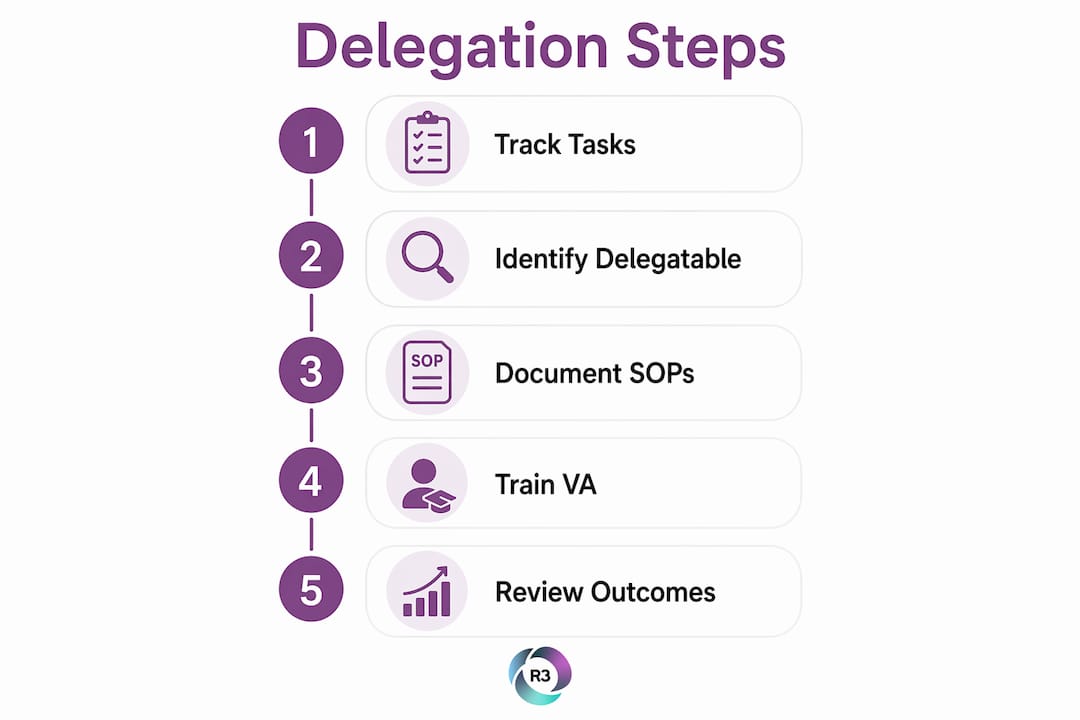
Small business owners can offload 15–25 hours of repeatable, administrative work per week after completing a proper audit. That is nearly a full-time employee’s worth of capacity sitting inside your current schedule.
Once you have your task list, sort it into three columns:
Only me — decisions, strategy, client relationships, creative direction
Trainable — tasks you currently do but could teach someone else in under an hour
Systemizable — tasks that follow a fixed process and could run from a written SOP
The second and third columns are your delegation pipeline. Start there.
After sorting, document the “Trainable” and “Systemizable” tasks before you post a job listing. Write step-by-step SOPs. Record short Loom videos walking through each process. This preparation is not optional. Businesses that invest in early documentation scale 2–3x faster than those that skip it. The reason is simple: a VA with clear instructions can work independently from day one.
Pro Tip: Record a screen-share video the next time you complete a repeatable task. You will create a training resource in real time without writing a single word.
Audit Stage | Action | Outcome |
Week 1: Track | Log every task and time spent | Full picture of your weekly workload |
Week 2: Sort | Categorize tasks by delegation potential | Clear delegation pipeline |
Week 3: Document | Write SOPs and record walkthroughs | VA-ready training library |
Week 4: Hire | Post role with documented expectations | Faster, smoother onboarding |
What are the best practices for hiring and onboarding a VA?
Sourcing the right VA starts with choosing the right channel. Recruiting agencies give you pre-vetted candidates with verified skills and experience. Freelance marketplaces offer more volume but require more screening on your end. For long-term, dedicated support, a staffing agency is the better choice. You want someone who grows with your business, not a rotating cast of task workers.
When evaluating candidates, use a paid test task that mirrors real work. Ask an inbox management candidate to sort and draft replies to a sample set of emails. Ask a CRM candidate to update a mock contact record following your SOP. This approach reveals actual skill faster than any interview.
A structured 30 to 90-day onboarding with clear phases improves both VA performance and retention. Use this framework:
Days 1–14 (Orientation) — share your tools, communication channels, brand voice, and core SOPs
Days 15–30 (Shadowing) — VA observes your current process and asks clarifying questions
Days 31–60 (Ownership transfer) — VA takes over defined tasks with your review and feedback
Days 61–90 (Independent operation) — VA runs tasks autonomously; you review outcomes, not steps
Day 90 (Formal review) — assess performance against KPIs and plan the next phase of delegation
Setting clear expectations from the start is non-negotiable. Define what “done” looks like for every task. A VA who knows the exact output you expect will deliver it consistently. One who guesses will disappoint you both.
Key onboarding principles:
Use one primary communication channel (Slack or a project management tool like Asana or ClickUp)
Set response time expectations in writing on day one
Give feedback within 24 hours during the first 30 days
Celebrate early wins to build confidence and momentum
Pro Tip: Create a simple “VA Handbook” document that covers your brand voice, preferred tools, communication rules, and task priorities. A well-prepared onboarding checklist cuts ramp-up time significantly and sets your VA up for long-term success.
How do AI tools multiply what a virtual assistant can do?
The most effective VA in 2026 is not just an admin. The right VA is a systems operator who uses AI and automation to multiply output. This shift changes the math on what one person can accomplish.

VAs who use tools like ChatGPT, Claude, or Gemini can draft emails, summarize meeting notes, and repurpose content in a fraction of the time. Automation platforms like Zapier connect your apps and trigger actions without manual input. The result is a VA who handles the volume of two or three task-based workers.
Integrating AI tools with VAs reduces time spent on daily communication by 60–70%. That is not a minor efficiency gain. It means your VA can manage your inbox, draft responses, flag priorities, and still have capacity for other work in the same day.
AI Tool Category | Example Tools | Business Benefit |
Writing and drafting | ChatGPT, Claude, Gemini | Faster emails, content, and summaries |
Automation | Zapier, Make | Connects apps and eliminates manual data entry |
Research | Perplexity, ChatGPT | Faster lead research and competitive summaries |
Scheduling | Calendly, AI scheduling assistants | Removes back-and-forth from calendar management |
Pro Tip: Ask your VA to document every AI-assisted workflow they build. Over time, this creates a library of repeatable processes that any future team member can follow, making your business less dependent on any one person.
How do you manage remote VAs to sustain business growth?
Managing a VA well means measuring outcomes, not monitoring activity. The most common mistake business owners make is micromanagement. It slows your VA down, signals distrust, and defeats the purpose of delegation.
Effective leaders set measurable expectations and run weekly check-ins of 20–30 minutes focused on priorities and blockers. That is the entire management structure you need for most VAs. Keep meetings short, outcome-focused, and consistent.
Accountability practices that work:
Time tracking tools built for remote work give you objective data without surveillance. VA time-tracking software provides productivity transparency and helps high-performing VAs prove their value.
Weekly scorecards with 3–5 KPIs per role make performance visible and remove ambiguity
Async updates via Slack or Loom replace unnecessary meetings and keep work moving across time zones
Quarterly role reviews let you expand your VA’s responsibilities as your business grows
As your business scales, your VA’s role should evolve. A VA who starts with inbox management can grow into a project coordinator, a CRM manager, or a team lead for other remote staff. Build that growth path into your relationship from the beginning.
Pro Tip: Use a shared remote management tool to track tasks, deadlines, and progress in one place. When everything is visible, you spend less time checking in and more time building.
Key Takeaways
Scaling with virtual assistants works when you combine clear delegation, documented systems, and AI-assisted workflows before you hire.
Point | Details |
Audit before hiring | Track your weekly tasks to identify 15–25 hours of delegatable work. |
Document first | Write SOPs and record walkthroughs before your VA starts to accelerate onboarding. |
Use structured onboarding | A 30 to 90-day phased onboarding improves VA performance and long-term retention. |
Combine VAs with AI | VAs using ChatGPT, Zapier, and similar tools can cut communication time by 60–70%. |
Measure outcomes | Weekly 20 to 30-minute check-ins focused on results replace micromanagement. |
The mistake I see business owners make every single time
Most business owners hire a VA because they are overwhelmed. That is understandable. But overwhelm is the worst state to hire from. When you are drowning, you hand off tasks randomly, skip documentation, and then blame the VA when things fall apart.
The real problem is not the VA. Hiring without documented SOPs leads to chaos and micromanagement every time. The VA cannot read your mind. They need a system to follow, and that system has to exist before they start.
What I have seen work consistently is this: business owners who treat their first VA hire as a systems-building exercise, not a rescue mission, get dramatically better results. They slow down for two weeks to document, then speed up for the next two years. The ones who skip that step cycle through VAs and conclude that “VAs don’t work.” They do work. The structure just has to come first.
The other thing worth saying plainly: a VA paired with AI tools is not a cost-cutting measure. It is a capacity multiplier. Effective delegation through outsourcing and systems is how businesses scale without burning out their founders. When you get that right, you stop being the bottleneck in your own company. That shift is worth every hour you spend preparing for it.
— Ellis
R3source helps you build a remote team that actually scales
Growing your business should not mean working more hours. R3source connects U.S. business owners with trained, dedicated virtual assistants from the Philippines who integrate directly into your operations.
Whether you need support with administrative tasks, CRM management, customer service, or lead generation, R3source provides long-term remote professionals, not short-term freelancers. Every placement comes with accountability built in. The offshore virtual assistant services from R3source are designed for business owners who are ready to delegate with confidence and grow without adding full-time overhead. If you want to see whether it is the right fit, you can book a free consultation and talk through your specific needs.
FAQ
What does it mean to scale a business with virtual assistants?
Scaling with virtual assistants means delegating repeatable, time-consuming tasks to remote professionals so you can focus on revenue-generating work. The goal is to grow your output without growing your overhead at the same rate.
How many hours per week can I realistically delegate to a VA?
Most business owners can offload 15–25 hours per week after completing a proper task audit. That figure covers administrative, operational, and communication tasks that follow a defined process.
Do I need to document processes before hiring a VA?
Yes. Hiring without documented SOPs leads to micromanagement and poor results. Businesses that document early scale 2–3x faster because their VA can work independently from the start.
How do virtual assistants use AI tools to improve results?
VAs use tools like ChatGPT, Claude, and Zapier to draft content, automate data entry, and manage communications faster. This combination can reduce daily communication time by 60–70%, freeing capacity for higher-value work.
What is the difference between a VA from a staffing agency and a freelance marketplace?
A staffing agency like R3source provides pre-vetted, dedicated professionals who are trained for long-term integration into your business. Freelance marketplaces offer more candidates but require more screening and typically produce higher turnover.
Recommended
Comments