

How outsourcing empowers side businesses to scale efficiently


Running a side business while managing everything yourself is one of the fastest ways to hit a ceiling. You have the vision, the drive, and the customers but not enough hours in the day. Many entrepreneurs assume that scaling means hiring full-time staff, renting office space, and taking on significant overhead before revenue justifies it. That assumption keeps a lot of promising businesses stuck. Outsourcing breaks that mold entirely. Small businesses across the US are discovering that delegating non-core tasks to specialized providers is not a shortcut but a smarter path to growth.
Table of Contents
Key Takeaways
Point | Details |
Outsourcing enables flexibility | You can scale your operations up or down without locking in costly, full-time staff. |
Focus on core growth | Delegating admin and support tasks lets you focus resources on growing your business. |
Customer experience improves | Outsourced teams provide faster, multi-channel support for happier clients. |
Manage risks proactively | Build oversight into your outsourcing plan to avoid hidden costs and pitfalls. |
Start small and iterate | Test outsourcing with simple tasks and scale up once the processes are proven. |
Understanding outsourcing for side businesses
Outsourcing means hiring external providers or remote professionals to handle specific business functions so you can focus on what matters most. For a side business, that might mean handing off bookkeeping, IT troubleshooting, scheduling, or customer support to someone who specializes in exactly that work.
This is fundamentally different from traditional staffing. You are not posting a job, running interviews, managing payroll taxes, or worrying about employee turnover. You are connecting with a provider who is already trained, already set up, and ready to plug into your operations.
A lot of entrepreneurs still carry the misconception that outsourcing non-core admin tasks is something only large corporations do. That idea belongs in the past. Today, specialized providers offer solutions designed specifically for small businesses and solo entrepreneurs. Whether you need someone to handle five hours of email management per week or a full-time remote support professional, the options exist and they are more accessible than ever.
Here are the most common tasks that side businesses successfully outsource:
Administrative support including calendar management and data entry
Customer service and phone answering
Bookkeeping and basic financial tracking
IT setup, software troubleshooting, and tech support
Lead generation and CRM updates
Social media scheduling and content coordination
Understanding what virtual admin support actually covers is the first step to identifying where it can serve your business best.
“Outsourcing helps small businesses by delegating non-core administrative work and customer support to specialized providers, freeing owners to focus on revenue-generating activities.”
With the basics established, let’s explore why outsourcing offers distinct financial advantages for entrepreneurs.
Turning fixed costs into flexible growth capacity
Traditional hiring comes with a set of financial commitments that do not flex with your revenue. A full-time employee means a salary, benefits, workspace, equipment, and onboarding time, regardless of whether your business volume supports it. For a side business operating with lean margins, those fixed costs can be suffocating.
Outsourcing flips that model. You pay for the work you actually need, when you need it. If business is slower one month, your costs reflect that. If you have a product launch or a seasonal spike, you scale support up without a lengthy hiring process. Outsourcing turns fixed staffing costs into flexible variable costs, which is one of the most powerful financial tools available to growing businesses.

Here is a straightforward comparison to illustrate the difference:
Cost category | In-house employee | Outsourced provider |
Base salary or fee | $40,000+ per year | Pay per hour or project |
Benefits and taxes | 20-30% on top of salary | Included in service rate |
Office space and equipment | Required | Not required |
Training and onboarding | Weeks to months | Minimal for specialized roles |
Scalability | Slow and costly | Fast and flexible |
Risk if volume drops | Fixed cost remains | Service scales down easily |
The numbers make a compelling case, but the real advantage goes beyond dollars. When you are not locked into fixed overhead, you have the mental freedom to make smarter decisions about growth. You can try new approaches, enter new markets, and experiment without the pressure of a large payroll commitment.
Scaling with a remote support team is increasingly how lean side businesses are building real capacity for growth without traditional risk. Entrepreneurs who have taken this approach often describe it as finally being able to breathe again.
It is also worth thinking about workspace design and productivity. As you bring in remote support, optimizing your team setup for collaboration and clarity becomes more important. The goal is making sure everyone, in-house or remote, is working effectively.
Pro Tip: Always budget for project oversight and vendor management in addition to the service fees themselves. Outsourcing is not fully hands-off. You still need a few hours per week to review output, give feedback, and keep alignment strong.
Having seen the financial structure, let’s examine which business functions are ideal for outsourcing and which ones relieve the most pressure on entrepreneurs.
Top business tasks to outsource for side business success
Not every task is equally worth outsourcing. The best candidates are repetitive, clearly defined, time-consuming, and not central to your core product or expertise. These are the tasks that keep you busy but do not move the needle on growth.
The U.S. Chamber of Commerce recommends that small businesses outsource bookkeeping, IT setup and troubleshooting, phone answering, and scheduling as early priorities. These functions tend to consume the most time relative to their complexity, making them ideal for delegation.
Here is a data-driven look at common tasks, their time impact, and their outsourcing ROI:
Task | Average weekly hours lost | Outsourcing impact |
Email management | 5 to 10 hours | Immediate time recovery |
Bookkeeping | 3 to 6 hours | Reduces costly errors |
Customer phone support | 6 to 12 hours | Improves response time |
Scheduling and calendar | 2 to 4 hours | Eliminates back-and-forth |
Lead generation | 4 to 8 hours | Consistent pipeline input |
Social media scheduling | 3 to 5 hours | Maintains consistent presence |
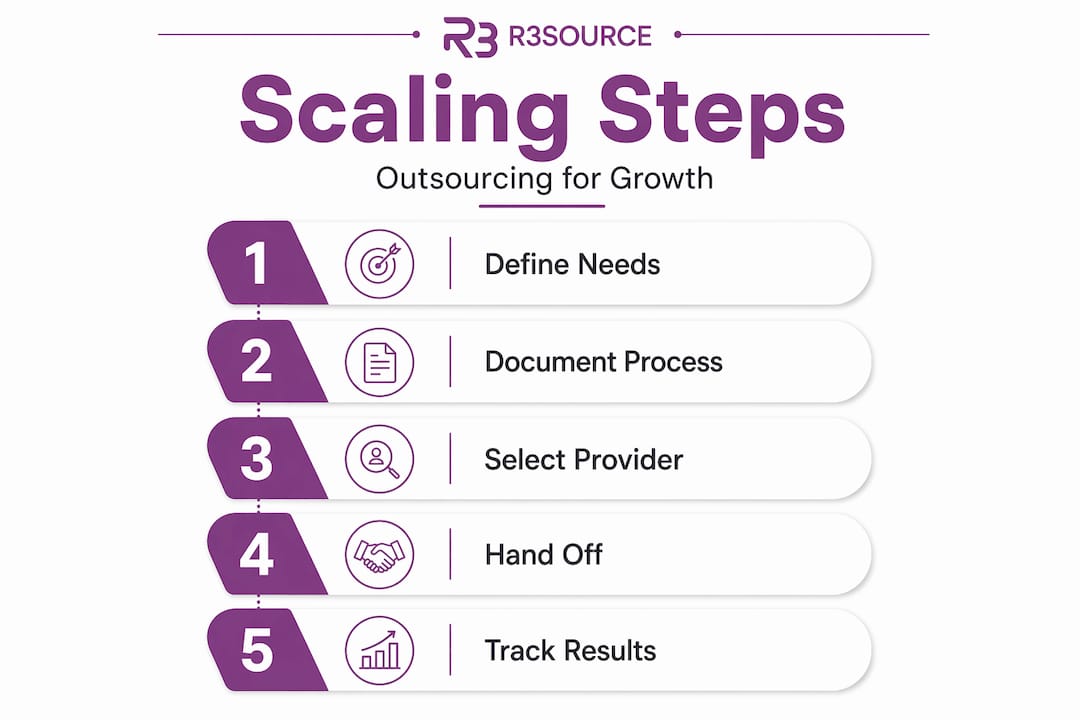
To decide where to start, follow this step-by-step process:
List every task you do in a week. Be honest and thorough. Include even the small things like responding to routine inquiries or updating spreadsheets.
Identify tasks that follow a consistent, repeatable process. These are easiest to hand off because they can be documented and trained quickly.
Rank tasks by time consumed versus strategic value. If a task takes four hours per week and does not require your specific expertise, it is an outsourcing candidate.
Start with one or two tasks, not everything at once. Pilot the outsourcing relationship and build trust before expanding scope.
Document your process before handing it off. A simple checklist or screen recording goes a long way toward ensuring quality output from day one.
Understanding why growing businesses need remote staff to scale helps frame this decision not just as cost savings but as a strategic growth move. And learning about the benefits of a dedicated remote professional shows you what a long-term outsourcing relationship can actually look like.
Pro Tip: Start with the tasks that drain your energy the most and have clear, repeatable processes. Those are the ones that will show results fastest and give you the confidence to expand your outsourcing strategy.
Now that you know which tasks deliver the highest return from outsourcing, let’s consider the impact on customer experience and scaling capacity.
Scaling customer experience through outsourcing
Customer experience is not just a nice-to-have. It is increasingly the primary battleground for small business growth. Research from Deloitte’s Shared Services Survey shows that improving customer experience is now the top priority for global business services organizations, with 50% planning to scale their footprint within three years.
That matters for you as a side business owner because your customers’ expectations do not scale down just because your team is small. They want fast responses, consistent communication, and support across multiple channels. Outsourcing gives you the infrastructure to deliver that without building it from scratch internally.
“Enhancing customer experience is becoming a top priority for organizations, and outsourcing enables businesses to scale service capacity quickly and effectively.”
Here is what outsourcing customer support actually enables for side businesses:
Faster response times because dedicated support staff are available during business hours and sometimes beyond
Multi-channel presence including phone, email, live chat, and social media without hiring separate specialists
Consistency in communication because trained professionals follow your scripts, tone guidelines, and escalation procedures
Reduced stress for you because you are not the last line of defense for every customer issue
Scalable coverage that grows with demand rather than creating bottlenecks
When you maximize your business growth through outsourcing support, you are not just solving a staffing problem. You are building the kind of reliable customer experience that turns first-time buyers into loyal repeat clients.
The goal many entrepreneurs are working toward is a business that operates smoothly even when they step back. Reaching that point requires the right support structure. Learning how to create a self-sustaining business is a process, and outsourcing is one of the most practical tools in that process.
Before wrapping up, it is essential to address potential hidden costs and risks that many entrepreneurs overlook when outsourcing.
What most guides miss: hidden overhead and risk
Most articles about outsourcing focus on the benefits and stop there. That is a disservice to you. Real-world outsourcing comes with risks and costs that you need to plan for, not ignore.
Budgeting for outsourcing should include far more than just the vendor fees. Management overhead, transition costs, communication gaps, and potential data security concerns are all real factors that affect your total cost and experience.
Common pitfalls include:
Underestimating the transition period. New providers need time to learn your systems, tone, and standards. Productivity often dips before it improves, and that is normal but worth planning for.
Assuming instant productivity. Even highly skilled outsourced professionals need context about your business, your customers, and your expectations. Onboarding matters.
Ignoring data security. When you give an external party access to customer data, financial records, or internal systems, you take on security responsibility. Always clarify who has access to what.
Skipping formal agreements. Verbal understandings are not enough. Clear contracts protect both parties.
To protect yourself and your business, build these risk controls into your outsourcing strategy:
Set clear service level agreements, known as SLAs, that define expected turnaround times, quality standards, and communication frequency
Schedule regular check-ins to review performance and address issues early
Require reporting on key metrics so you have visibility into what is happening
Define data access protocols in writing before onboarding any provider
Explore more insights on scaling through the R3source blog, where real strategies and practical guidance are shared regularly for entrepreneurs at every stage.
A fresh perspective: real-world lessons and overlooked truths
Here is something most outsourcing guides will not tell you. The vendor you choose matters far less than the clarity you bring to the relationship.
Outsourcing amplifies what already exists in your business. If your processes are clear, documented, and consistent, an outsourced professional will thrive quickly. If your operations are chaotic or undefined, no provider in the world will fix that for you. They will just execute the chaos more efficiently.
The uncomfortable truth is that many side businesses jump into outsourcing hoping it will solve problems they have not yet identified. They bring in help for customer service while the real issue is that they have no consistent follow-up process. They outsource bookkeeping while spending without tracking. The results disappoint not because outsourcing failed, but because the foundation was not ready.
Start small and be intentional. Hand off one well-documented process. Track what happens. Learn what the provider needs from you to do their best work. Then expand.
Scaling with remote support teams works best when you treat your providers as genuine partners in your business ecosystem, not distant contractors executing tasks. Check in with them. Give feedback. Celebrate wins together. That relationship investment pays dividends in consistency, loyalty, and quality over time.
The entrepreneurs we see succeed with outsourcing are the ones who approach it with patience and structure. They track every dollar and every hour. They build feedback loops. They are willing to adjust. That is where the real growth happens.
Next steps: Find outsourcing solutions that fit your side business
You have spent time understanding the real value and real challenges of outsourcing. Now comes the part that matters most: taking action.
R3source helps side business owners and entrepreneurs across the United States build dedicated remote teams that integrate directly into their daily operations. Whether you need virtual assistant services for administrative support, customer service coverage, or lead generation, we match you with trained professionals from the Philippines who are committed to your long-term success. Read what other business owners are saying through our client testimonials and see how real results look in practice. You can even win free remote support through our current giveaway. Your next chapter of growth is closer than you think.
Frequently asked questions
What are the top tasks side businesses should outsource first?
Routine tasks such as bookkeeping, IT troubleshooting, phone answering, and scheduling are usually outsourced first because they consume significant time without requiring the owner’s specific expertise.
How does outsourcing make it easier to scale a side business?
Outsourcing converts fixed staffing costs into variable expenses, enabling rapid scaling of capacity without long-term commitments or the overhead of traditional hiring.
Does outsourcing affect customer experience?
Yes, outsourcing can significantly improve responsiveness and coverage, which is why many GBS organizations now prioritize scaling through outsourced teams to meet rising customer expectations.
What hidden costs should I plan for when outsourcing?
Beyond vendor fees, plan for management overhead and risk controls, including communication time, transition periods, and data security protocols that protect your business and your customers.
Is outsourcing only practical for large companies?
No, outsourcing is increasingly tailored to small businesses and entrepreneurs, offering flexible and scalable solutions that fit the budget and operational needs of side businesses at any stage of growth.
Recommended
Comments