

Outsourcing Before Hiring Full-Time: 8 Smart Reasons


Outsourcing before hiring full-time is the most cost-efficient staffing strategy for early-stage businesses and growing entrepreneurs. Rather than locking into a full-time salary before your workload justifies it, you use external contractors or specialized firms to handle defined operational roles. This approach gives you access to skilled professionals without the overhead of benefits, recruiting fees, or office costs. The result is a leaner operation with more flexibility to grow on your own terms. If you are weighing outsourcing vs. hiring full-time staff options, the criteria are clearer than most founders realize.
1. Outsourcing before hiring full-time saves you from premature overhead
The loaded cost of a full-time employee earning $45,000–$60,000 annually runs $4,500–$6,500 monthly when you include benefits, payroll taxes, and recruiting fees. That number does not include equipment, onboarding time, or management bandwidth. Outsourced roles, by contrast, charge only for completed work. You pay for output, not availability.
Recruiting fees alone average 20% of a new hire’s annual salary. Add a 60–90 day ramp-up period where productivity is partial, and the true cost of a single hire becomes significant. Outsourcing eliminates both of those line items entirely.

2. The 30-hour threshold tells you when outsourcing makes sense
A practical rule from 2026 staffing benchmarks: roles under 30 hours per week are almost always better served by outsourcing than by a full-time hire. Paying a full-time salary for a role that only needs 20 hours of work weekly means you are funding 10 hours of unused capacity every week.
Fractional or outsourced experts also bring broader industry exposure than most single-company hires. They work across multiple clients, which means they have seen more problems and built more solutions. That experience often delivers better results than a junior full-time hire learning on the job.
Pro Tip: Track actual hours spent on each operational function for 30 days before making any staffing decision. If a role stays under 25 hours per week consistently, outsourcing is the right call.
3. Playbook-driven tasks are built for outsourcing
Full-time hires are best for ambiguous, judgment-heavy work that builds institutional knowledge over time. Outsourcing works best for tasks that follow a defined process. If you can write a standard operating procedure for it, you can outsource it.
Common functions that fit this model include:
Administrative support and calendar management
Customer service and inbox management
Lead generation and CRM data entry
Bookkeeping and accounts payable processing
Appointment setting and follow-up sequences
Social media scheduling and content formatting
HR task support such as onboarding paperwork
These are high-volume, repeatable functions. They do not require your outsourced team member to understand your company’s five-year vision. They require consistency, attention to detail, and reliable execution.
4. Outsourcing gives you access to specialized skills immediately
78% of companies prioritize specialized skills access over cost reduction when choosing to outsource. That statistic reflects a real shift in how founders think about external staffing. It is not just about saving money. It is about getting the right expertise without a six-week hiring process.
When you work with an outsourcing agency, you tap into a pre-vetted talent pool. R3source, for example, provides trained remote professionals from the Philippines who specialize in administrative support, customer service, lead generation, and marketing support. They are ready to integrate into your workflow from day one.
This matters most when you need a skill set that is too narrow to justify a full-time role. A part-time bookkeeper, a CRM specialist, or a dedicated appointment setter all fit this profile. You get the expertise without building a department around it.
5. Outsourcing lets you test roles before committing to them
One of the most underused benefits of outsourcing is its value as a pilot program for new roles. Before you hire a full-time marketing coordinator, you can outsource that function for 90 days. You learn what the role actually requires, what output looks like, and whether the workload justifies a permanent hire.
This approach removes the guesswork from hiring decisions. You are not writing a job description based on assumptions. You are writing it based on documented experience with a real workflow. That makes your eventual full-time hire far more likely to succeed.
Entrepreneurs who view outsourcing as a scaling tool rather than a cost-cutting measure get significantly more value from it. The mindset shift changes how you structure contracts, set expectations, and measure results.
6. Integration and communication determine outsourcing quality
Outsourcing fails when founders treat external team members as invisible vendors. Managing outsourced providers like internal employees, with daily check-ins and clear communication channels, produces dramatically better results. The collaboration benefit of a full-time hire is not exclusive to full-time hires. It is a product of how you manage the relationship.
Set up your outsourced team members in your project management tools. Include them in relevant team meetings. Give them access to the same documentation your internal staff uses. When they feel like part of the team, they perform like part of the team. R3source’s approach to virtual assistant integration is built around this principle.
7. Know when to transition from outsourcing to full-time hiring
Outsourcing is not a permanent state. The right time to hire full-time is when a role exceeds the 30-hour weekly threshold consistently, when the work requires deep institutional knowledge, or when your business reaches operational maturity. A widely cited benchmark is $50,000 in monthly recurring revenue or a clear 12-month operational roadmap.
The key differentiator for full-time hiring is the value of institutional knowledge and strategic judgment. When a role requires someone to make nuanced decisions based on months of company context, outsourcing cannot replicate that. That is the signal to hire internally.
When you do make the transition, do not do it abruptly. A minimum three-month overlap period with documentation and shadowing protects the knowledge your outsourced team has built. Your new full-time hire should shadow the outgoing contractor, review all process documentation, and run parallel workflows before the handoff is complete.
Pro Tip: Ask your outsourced team to document every process they own in a shared drive before you begin the transition. That documentation becomes your new hire’s onboarding manual.
8. Avoid the most common outsourcing mistakes
Most outsourcing failures come from predictable errors. Recognizing them early saves you time and money.
“The biggest mistake is outsourcing core processes without technical or operational oversight, which risks black-box results that need costly rewrites later.” — Practitioner Insights on Outsourcing
Watch for these common pitfalls:
Outsourcing without oversight. Every outsourced function needs an internal point of contact who reviews output and maintains quality standards.
Treating outsourcing as purely a cost play. When cost is your only metric, you select for price instead of fit, and quality suffers.
Skipping process documentation. If your outsourced team cannot follow a written process, the work will be inconsistent.
Hiring full-time too early. Bringing on a full-time employee before the workload justifies it creates overhead that strains early-stage cash flow.
Failing to integrate. Outsourced team members who are excluded from communication channels produce work that does not align with your actual needs.
Building offshore team productivity requires structure from the start. Set clear deliverables, establish communication rhythms, and review output regularly.
Key takeaways
Outsourcing before hiring full-time is the right default for early-stage businesses: it reduces overhead, provides immediate access to specialized skills, and lets you validate roles before committing to permanent hires.
Point | Details |
Use the 30-hour rule | Roles under 30 hours per week almost always cost less to outsource than to staff full-time. |
Outsource repeatable tasks first | Playbook-driven functions like admin, CRM, and customer service are the strongest candidates. |
Treat outsourced staff as team members | Daily communication and tool access produce far better quality and consistency. |
Transition at operational milestones | $50,000 MRR or a 12-month roadmap signals readiness for full-time internal hires. |
Overlap before handoff | A three-month shadowing and documentation period protects institutional knowledge during transitions. |
Why I think most founders outsource for the wrong reasons
Most founders I have seen approach outsourcing as a way to spend less money. That framing sets them up for disappointment. When cost is the primary filter, you end up selecting for price, not capability. The result is mediocre output, frustrating revisions, and a conclusion that “outsourcing doesn’t work.”
The founders who get the most from outsourcing treat it as a way to move faster and test more. They outsource a customer service function not because it is cheap, but because they want to learn what great customer service looks like in their business before they build a team around it. That distinction changes everything about how they set expectations, measure results, and eventually hire.
Clear role definitions matter more than most people admit. The single biggest predictor of outsourcing success is whether the founder can write down exactly what “done” looks like. If you cannot define the output, you cannot evaluate the work. That is not an outsourcing problem. It is a clarity problem.
My honest recommendation: start with one outsourced role, document the process obsessively, and treat that person like a valued team member. What you learn in 90 days will be worth more than any hiring framework you read online. And when the time comes to bring someone in-house, you will have a real job description, a real process, and a real standard to hire against.
— Ellis
How R3source supports your outsourcing strategy
Growing a business is hard enough without carrying every operational task yourself. R3source provides trained remote professionals from the Philippines who specialize in the exact functions that slow founders down: administrative support, customer service, lead generation, CRM management, and appointment setting.
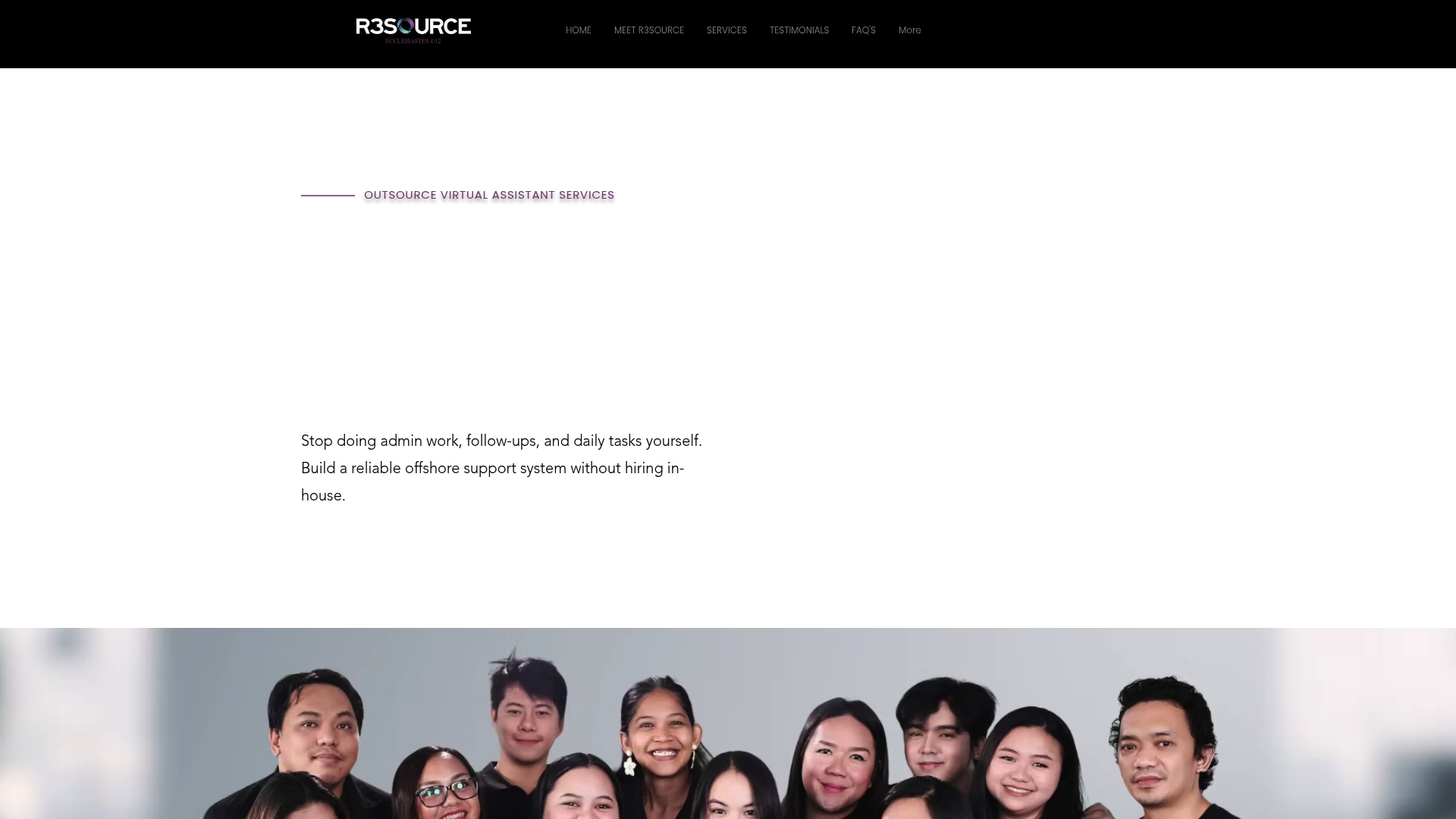
Every R3source team member integrates directly into your workflow, not as a task-based freelancer, but as a dedicated remote professional accountable to your standards. If you are ready to reclaim your time and build your capacity for growth, explore offshore virtual assistant services from R3source. You can also learn more about outsourcing for business growth to see how other entrepreneurs have used this model to scale efficiently.
FAQ
What is outsourcing before hiring full-time?
Outsourcing before hiring full-time means using external contractors or agencies to fill operational roles instead of making immediate internal hires. It reduces overhead and gives businesses flexibility to scale without committing to full-time salaries.
When should I stop outsourcing and hire full-time?
The clearest signals are when a role consistently exceeds 30 hours per week, when the work requires deep institutional knowledge, or when your business reaches $50,000 in monthly recurring revenue. A 12-month operational roadmap also indicates readiness for full-time hires.
What tasks are best suited for outsourcing?
Repeatable, process-driven tasks are the strongest candidates. These include administrative support, customer service, lead generation, CRM management, bookkeeping, and appointment setting. Any function you can document in a standard operating procedure can be outsourced effectively.
How do I maintain quality with an outsourced team?
Assign an internal point of contact to review output, include outsourced team members in your communication tools, and set clear deliverable standards from day one. Managing outsourced providers with the same structure you would apply to internal staff produces the best results.
Is outsourcing only for startups?
No. Established businesses use outsourcing to handle variable demand, access specialized skills, and avoid the overhead of full-time hires for lower-volume functions. The 30-hour workload threshold applies regardless of company size.
Recommended
Comments