

Marketing Tasks to Outsource: Your SMB Playbook
- Ellis Jackson

- Aug 10
- 14 min read

The highest-impact marketing tasks to outsource right now are content creation, paid media management, technical SEO, graphic and video design, email marketing automation, website updates, analytics and reporting, and CRM lead qualification. Start with whichever one is eating the most of your time this week, run a two-week paid trial with a vetted provider, and measure three KPIs before committing to a longer contract.
Here is what you gain immediately by offloading these functions:
Time back for revenue work. Founders who stop writing their own blog posts and managing ad accounts typically reclaim significant additional time each week for sales, partnerships, and product decisions.
Specialist skills on day one. A dedicated PPC specialist or SEO professional brings channel expertise that takes years to build in-house.
Faster campaign launches. According to MarketerHire’s outsourcing guide, paid ads can go live within a few weeks with an outsourced specialist versus months for an internal hire to ramp.
Flexible capacity. You scale up for a product launch and scale back in a slow quarter without carrying a fixed salary.
Accountability built in. A contracted provider has deliverables and deadlines baked into the agreement.
Your one action this week: Pick the single marketing task that is most behind schedule or most outside your expertise, then schedule a 30-minute vetting call with at least two providers. Ask each one for a trial deliverable before signing anything.
Pro Tip: Never evaluate a provider on their pitch deck alone. Ask for one real work sample relevant to your industry before the first call ends.
Table of Contents
1. The top marketing tasks to outsource, ranked by impact
The list below follows a priority order based on where outsourcing delivers the fastest, most measurable return for most SMBs. Each entry includes the trigger that tells you it is time to outsource, the right provider type, KPIs to track, a U.S. cost ballpark, and a trial deliverable to test vendor quality before you commit.
Content creation and SEO content
When to outsource: You have not published consistently in the past 60 days, or your team is writing content that ranks for nothing.
Best provider type: Dedicated remote content producer or a freelance SEO writer with a niche track record. For ongoing volume, a dedicated remote staff member integrated into your workflow beats a one-off freelancer every time.
KPIs: Organic sessions per published piece, keyword ranking movement (target keywords in positions 1–20), time-on-page, and leads attributed to organic content.
U.S. cost ballpark: Freelance SEO writers charge $75–$300 per article. A dedicated remote content producer through a managed staffing model runs $800–$1,500 per month for full-time output.
Time to first results: 8–12 weeks for organic traffic gains, per MarketerHire’s benchmarks.
Trial deliverable: One 1,000-word SEO article targeting a keyword you provide, delivered within five business days. Check for keyword integration, internal linking, and a clear call to action.
Paid media management (PPC and social ads)
When to outsource: Your cost per lead is rising, your ad account has not been audited in 90 days, or you are spending more than $1,500 per month on ads without a dedicated manager.
Best provider type: A fractional paid media specialist or a dedicated remote PPC support professional who works inside your ad accounts daily.
KPIs: Cost per click, cost per lead, return on ad spend (ROAS), and conversion rate by campaign.
U.S. cost ballpark: Freelance PPC managers charge $500–$2,000 per month. Agency retainers start at $1,500–$3,000 per month plus a percentage of ad spend (typically 10–15%).
Time to first results: Campaigns launch in 2–4 weeks; meaningful optimization data appears at 6–8 weeks.
Trial deliverable: A full audit of your current ad account with three specific recommendations, delivered before you sign a contract.
Technical and ongoing SEO
When to outsource: Your site has crawl errors, slow Core Web Vitals scores, or you have not built a backlink in six months.
Best provider type: A freelance technical SEO consultant for a one-time audit, then a dedicated remote SEO specialist for ongoing link building, on-page optimization, and reporting.
KPIs: Domain rating growth, crawl error count, page speed score (Google PageSpeed Insights), and organic impressions in Google Search Console.
U.S. cost ballpark: Technical SEO audits run $500–$2,500 as a one-time project. Ongoing SEO retainers cost $750–$2,500 per month depending on scope.
Time to first results: 8–12 weeks for measurable organic movement; link-building results compound over 3–6 months.
Trial deliverable: A technical SEO audit of your top five landing pages with prioritized fixes.
Graphic design and video editing
When to outsource: Your brand visuals are inconsistent, you are using Canva templates that look like everyone else’s, or video content is sitting unedited on a hard drive.

Best provider type: A dedicated remote graphic designer or video editor who learns your brand standards and works inside your tools (Adobe Creative Cloud, Figma, CapCut).
KPIs: Asset turnaround time, revision rounds per asset, social engagement rate on visual content, and brand consistency score (internal review).
U.S. cost ballpark: Freelance designers charge $25–$75 per hour. A dedicated remote designer runs $900–$1,600 per month full-time.
Time to first results: Immediate on design assets; video content impact on social engagement is visible within 30 days of consistent posting.
Trial deliverable: Three branded social graphics and one short-form video edit (60 seconds) using your brand kit.
Email marketing and automation
When to outsource: Your list is growing but open rates are flat, your welcome sequence is a single email, or you have not run a segmented campaign in the past quarter.
Best provider type: A dedicated remote email marketing specialist or a marketing VA with platform experience in Klaviyo, Mailchimp, ActiveCampaign, or HubSpot. VA-appropriate email tasks include campaign setup, list segmentation, UTM tagging, and weekly performance pulls.
KPIs: Open rate, click-through rate, unsubscribe rate, and revenue per email (for e-commerce).
U.S. cost ballpark: Email marketing freelancers charge $50–$100 per hour or $500–$1,500 per month for campaign management. A dedicated remote specialist runs $800–$1,400 per month.
Time to first results: A new welcome sequence shows open rate and click data within two weeks of launch.
Trial deliverable: One three-email welcome sequence written, built, and tested in your platform.
Website updates and landing page optimization
When to outsource: Your team is waiting weeks for simple page edits, or your landing pages have not been A/B tested in the past six months.
Best provider type: A dedicated remote web specialist with WordPress, Webflow, or Shopify experience, depending on your stack.
KPIs: Page load time, bounce rate, conversion rate per landing page, and time-to-publish for routine updates.
U.S. cost ballpark: Freelance web developers charge $50–$150 per hour. A dedicated remote web specialist runs $900–$1,600 per month for ongoing work.
Time to first results: Conversion rate improvements from landing page tests are measurable within 30 days with sufficient traffic.
Trial deliverable: One landing page update or a new section built to your spec, delivered within three business days.
Analytics and reporting
When to outsource: You are making marketing decisions based on gut feel because nobody has time to pull the data, or your reports are inconsistent week to week.
Best provider type: A dedicated remote marketing analyst or a marketing VA trained in Google Analytics 4, Google Looker Studio, and your CRM’s reporting module.
KPIs: Report delivery time (target: same day each week), data accuracy rate, and the number of decisions made from data versus intuition.
U.S. cost ballpark: Freelance analysts charge $40–$80 per hour. A dedicated remote analyst runs $800–$1,400 per month.
Time to first results: A clean weekly dashboard is deliverable within the first two weeks of onboarding.
Trial deliverable: One weekly marketing report built in Looker Studio or your preferred tool, covering traffic, leads, and top-performing channels.
CRM management and lead qualification
When to outsource: Leads are sitting in your CRM uncontacted for more than 24 hours, or your pipeline data is stale and unreliable.
Best provider type: A dedicated remote CRM specialist or lead generation VA with experience in HubSpot, Salesforce, or Pipedrive. This is one of the most effective tasks to delegate to a virtual assistant because it is high-volume, rule-based, and time-sensitive.
KPIs: Lead response time (target: under one hour), pipeline accuracy rate, lead-to-opportunity conversion rate, and CRM data completeness score.
U.S. cost ballpark: CRM management VAs run $600–$1,200 per month through a managed staffing model.
Time to first results: Lead response time improves in the first week. Pipeline accuracy improves within 30 days of consistent data hygiene.
Trial deliverable: A full audit of your CRM’s open deals with a data quality report and a recommended follow-up sequence.
Social media management
When to outsource: You are posting sporadically, engagement is declining, or your social presence does not reflect your brand quality.
Best provider type: A dedicated remote social media VA who handles scheduling, caption drafting, community management, and performance reporting. Recurring social tasks like content calendar management, publishing checks, and inbox triage are ideal for a VA.
KPIs: Posting frequency, engagement rate per post, follower growth rate, and click-through rate to your website.
U.S. cost ballpark: Social media VAs run $600–$1,200 per month. Agencies charge $1,500–$4,000 per month for full-service social management.
Time to first results: Engagement rate improvements are visible within 30–60 days of consistent, on-brand posting.
Trial deliverable: One week of scheduled posts (five posts across two platforms) with captions and hashtags, ready for your approval.
Campaign project management
When to outsource: Your marketing campaigns miss deadlines because nobody owns the timeline, or your team is spending more time coordinating than executing.
Best provider type: A dedicated remote project coordinator or marketing operations VA with experience in Asana, Monday.com, or ClickUp.
KPIs: Campaign launch on-time rate, number of missed deadlines per quarter, and team time spent on coordination versus execution.
U.S. cost ballpark: Marketing project coordinators run $700–$1,300 per month through a managed staffing model.
Time to first results: A structured project board and communication rhythm are in place within the first two weeks.
Trial deliverable: A full campaign timeline built in your project management tool for one upcoming launch.
Why outsourcing marketing works for growing businesses
The core business case is straightforward: you get specialist skills without the cost and time of a full-time hire. But the advantages go deeper than that.
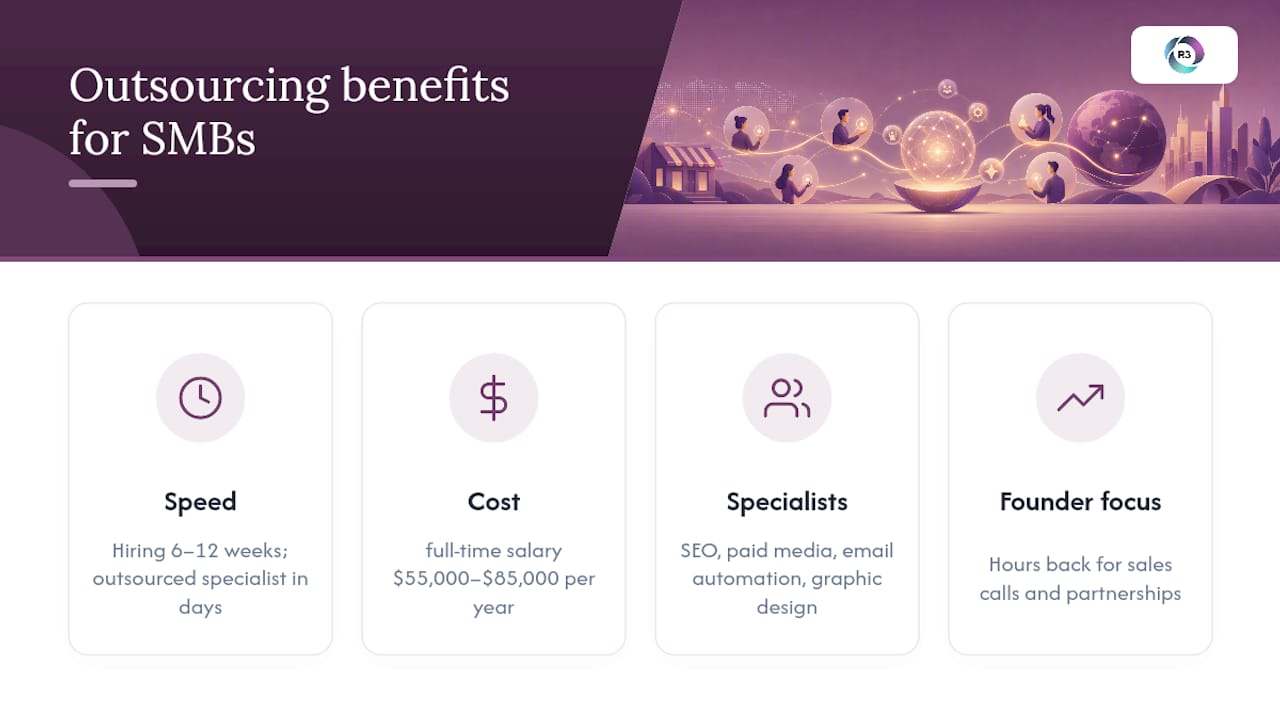
Speed to expertise. Hiring a full-time marketing manager takes 6–12 weeks from job post to productive output. An outsourced specialist or dedicated remote professional can be onboarded and producing work in days. For SMBs competing against larger brands with bigger teams, that speed is a real advantage.
Cost flexibility. A full-time marketing hire in the U.S. costs $55,000–$85,000 per year in salary alone, before benefits, tools, and management overhead. Outsourced marketing services let you pay for the specific capacity you need, scale up for a product launch, and scale back without a layoff.
Access to specialized skills. No single in-house marketer is equally strong at SEO, paid media, email automation, and graphic design. Outsourcing lets you match the right specialist to each channel. RiseOpp’s outsourcing guide notes that this channel-level specialization is one of the primary drivers of outsourcing adoption among growing businesses.
Freeing founders for revenue work. When you stop managing ad accounts and writing social captions, you get hours back for sales calls, partnerships, and strategic decisions. That reallocation compounds over time.
Statistic callout: HubSpot’s marketing statistics consistently show that companies with documented marketing strategies and dedicated execution resources outperform those without them on lead generation and revenue growth. Outsourcing the execution layer is one of the fastest ways for an SMB to build that dedicated capacity without a full hiring cycle.
For a broader look at why growing companies make this move, the 2026 guide on why small businesses outsource covers the strategic and financial case in detail.
Common outsourcing mistakes that cost you more than you save
Outsourcing fails in predictable ways. Knowing the failure modes before you start is the difference between a smooth engagement and three months of rework.
Skipping onboarding. Growth Rocket’s analysis of outsourcing failure modes identifies poor onboarding as the single biggest driver of hidden internal costs: rework, account manager burnout, and repeated corrections that eat the time outsourcing was supposed to free.
The real cost of poor outsourcing is not just the vendor fee. It is the internal hours spent on corrections, the delayed campaigns, and the team frustration that builds when the same mistakes repeat. A structured onboarding process and a clear SLA eliminate most of these problems before they start.
Pro Tip: Require a trial deliverable before signing any contract longer than 30 days. One real work sample tells you more about a provider’s quality and communication style than any proposal.
How to choose which tasks to outsource and get started this week
Vetting questions to ask in the first call
What is your process when a deliverable misses the brief?
Can you share two or three examples of work in my industry?
What tools do you work in, and do you need licenses provided?
How do you handle feedback and revision rounds?
What does your onboarding process look like for a new client?
Are you open to a two-week paid trial before a longer contract?
Check the provider’s standing with the Better Business Bureau and ask for at least two client references you can contact directly.
Your one-week starter checklist
Use this as your SMB outsourcing checklist for the first seven days:
Pick one task from the priority list above.
Write a one-page brief: goal, audience, tone, format, and three examples of work you like.
Interview two to three providers and ask for a trial deliverable.
Set three KPIs and document them in writing before work begins.
Grant tool access (ad account, CMS, CRM, analytics) with role-appropriate permissions.
Schedule a 30-minute check-in at the end of week two to review the trial deliverable against your KPIs.
Decide: extend, adjust scope, or move to the next provider.
What marketing outsourcing actually costs in the U.S.
The table below shows typical U.S. cost ranges and realistic timelines for each task. These are ballpark figures based on current market rates; actual costs vary by provider experience, scope, and engagement model.
Task | Freelancer (monthly) | Dedicated remote staff (monthly) | Agency retainer (monthly) | Time to first results |
SEO content writing | $300–$1,200 | $800–$1,500 | $1,500–$4,000 | 8–12 weeks |
Paid media management | $500–$2,000 | $900–$1,600 | $1,500–$3,000 | 2–4 weeks to launch; 6–8 to optimize |
Technical SEO | $500–$2,500 (project) | $750–$1,400 | $1,000–$3,000 | 8–12 weeks |
Graphic/video design | — | $900–$1,600 | — | Immediate on assets; 30 days on social impact |
Email marketing | $500–$1,500 | $800–$1,400 | $1,200–$3,000 | 2–4 weeks |
Website updates | $50–$150/hr | $900–$1,600 | $1,500–$4,000 | 1–2 weeks per update cycle |
Analytics/reporting | $40–$80/hr | $800–$1,400 | $1,000–$2,500 | 1–2 weeks for dashboard setup |
CRM/lead qualification | — | $600–$1,200 | $1,000–$2,500 | 1 week for response time; 30 days for pipeline quality |
Social media management | — | $600–$1,200 | $1,500–$4,000 | 30–60 days |
Campaign project management | — | $700–$1,300 | $1,200–$2,500 | 1–2 weeks |
How to manage outsourced marketing so quality stays high
Good outsourcing does not run itself. A clear communication rhythm and a quality gate process are what separate a high-performing engagement from one that slowly drifts off-brief.
Quality gate checklist (before anything goes live)
Does the deliverable match the original brief?
Are brand voice, tone, and visual standards consistent?
Are all links, UTM tags, and tracking pixels in place?
Has a second set of eyes reviewed for errors?
Is the CTA correct and functional?
Pro Tip: Build your quality gate into your project management tool as a checklist template. Every piece of content, every ad, and every email runs through it before approval. This one habit eliminates the majority of preventable errors.
Vendor scorecard (review monthly)
Score each dimension 1–5:
Dimension | What you are measuring |
Output quality | Does the work meet brief standards without heavy revision? |
Deadline adherence | Are deliverables on time, consistently? |
Responsiveness | Are questions answered within the agreed SLA? |
Revision rate | How many rounds does it take to reach an approved deliverable? |
Proactive communication | Does the vendor flag issues before they become problems? |
A score below 3 on any dimension for two consecutive months is a signal to have a direct conversation or begin a transition. For managing offshore and remote staff effectively, the offshore team productivity guide covers seven practical strategies that apply directly to marketing vendor management.
SOP and file structure
Keep all brand assets, briefs, and approved templates in a shared folder (Google Drive or Notion) that every vendor can access. Name files with a consistent convention: [YYYYMMDD]_[TaskType]_[Channel]_[Version]. This single habit cuts the time your team spends hunting for the right file by a significant margin.
Role examples R3source supplies for marketing
Integration checklist for your first remote hire
[ ] Brand context package shared (brand guide, tone of voice doc, audience personas)
[ ] Tool access granted with role-appropriate permissions
[ ] SOPs documented for the top three recurring tasks
[ ] KPIs agreed and documented in writing
[ ] Communication channel and response time SLA confirmed
[ ] First trial deliverable assigned with a clear deadline
Key Takeaways
Outsourcing the right marketing tasks to the right provider type, with clear KPIs and a structured onboarding process, is the fastest way for an SMB to build consistent marketing execution without a full-time hire.
Point | Details |
Start with your biggest time drain | Pick the one marketing task consuming the most owner time and outsource it first, this week. |
Paid ads launch fastest | Paid media campaigns can go live within a few weeks with an outsourced specialist, faster than any internal hire. |
Onboarding determines quality | Poor onboarding is the leading cause of rework and hidden costs; share a brand context package before day one. |
Dedicated staff beats one-off freelancers | For ongoing execution tasks, a dedicated remote professional builds brand familiarity that compounds over time. |
R3source for long-term marketing support | R3source provides dedicated remote marketing professionals from the Philippines, integrated directly into your U.S. business operations. |
The one outsourcing lesson that changes everything
Most business owners approach outsourcing as a cost decision. They look at the monthly fee, compare it to an in-house salary, and make a spreadsheet call. That framing misses the real variable: the quality of your onboarding determines the quality of your output, not the price you pay.
The businesses that struggle with outsourced marketing almost always share one pattern. They hand off a task with a vague brief, skip the first two weeks of structured check-ins, and then wonder why the work does not match their standards. The fix is not a better vendor. It is a better handoff.
The single most repeatable action you can take: before you hire anyone, write a one-page brief that covers your goal, your audience, your tone, three examples of work you admire, and the three KPIs you will use to measure success. Share it on day one. Review it at the end of week two. That document is worth more than any contract clause.
One more thing: always own your logins. Your ad accounts, your CMS, your CRM, your analytics. A vendor manages them; you own them. That boundary protects you if the relationship ends and keeps your data portable.
R3source makes dedicated remote marketing support straightforward
If you have read this far, you already know which marketing tasks are holding your business back. The question is whether you hire a string of one-off freelancers and manage the coordination yourself, or you bring on a dedicated remote professional who integrates directly into your team and owns their function long-term.
R3source places dedicated remote professionals from the Philippines into U.S. businesses, specifically for the ongoing marketing execution tasks covered in this article: content production, CRM management, social media, email marketing, PPC support, and analytics. These are not task-based gig workers. They are long-term team members who learn your brand, work in your tools, and report to you directly.
Onboarding takes 1–2 weeks. In the first 30 days, your remote professional is producing work. By day 60, they know your brand well enough to work with minimal supervision. The cost is a fraction of a U.S. full-time hire, with no benefits overhead and no long recruiting cycle.
Book a free strategy call to talk through which role fits your business first, or explore the virtual assistant services R3source offers to see the full range of marketing support available.
Useful sources and further reading
How to Outsource Marketing for Small Business (MarketerHire) — Covers outsourcing models, cost ranges, and ramp timelines for each marketing channel. Useful for benchmarking your budget and timeline expectations.
Outsource Marketing: A Complete Growth Guide (RiseOpp) — Explains the channel-level benefits of outsourcing and when each model makes sense for a growing business.
The Hidden Costs of Poor Outsourced Marketing (Growth Rocket) — The most practical resource on what goes wrong and how to prevent it. Read before you sign your first contract.
VA Outsourcing Tasks: 10 Marketing Jobs to Delegate (5n2 Digital) — A concrete list of recurring marketing tasks that are well-suited to a virtual assistant, with practical guidance on what to track.
How to Outsource Sales and Marketing Without Losing Control (MarketerHire) — Makes the case for the hybrid model and gives stepwise vetting guidance for each provider type.
HubSpot Marketing Statistics — Updated marketing benchmarks for traffic, leads, and conversion rates. Useful for setting realistic KPI targets.
BBB Vendor Verification — Use the BBB to check complaints, longevity, and transparency for any provider you are considering.
15 Tasks to Outsource to a Virtual Assistant Today (R3source) — Practical examples of VA-appropriate tasks with quick-start guidance.
Outsourcing Before Hiring Full-Time: 8 Smart Reasons (R3source) — The strategic and financial case for outsourcing before committing to a full-time hire.
Recommended
Comments