

Ethics First: How Law Firms Outsource Litigation Support Safely


Yes, litigation support outsourcing can cut costs and speed up case readiness without compromising your ethical duties. It works when you vet the provider properly, supervise the work like you would any junior associate’s, and get client consent when the rules call for it. Skip those safeguards and the savings turn into risk fast.
Outsourcing high-volume document review and deadline-driven discovery tasks can significantly reduce review costs and improve case turnaround times.
Legal support tasks involving data processing or scheduling are the safest to outsource first, while legal judgment calls require closer supervision and in-house oversight.
Proper vetting, supervision, and client disclosure are critical, with the need to document scope, obtain consent, and establish clear communication protocols before outsourcing.
Vendor selection should focus on staff credentials, security standards, error rates, and reporting practices, avoiding providers that lack transparency or proper security measures.
Starting with a short pilot project allows firms to test outsourcing arrangements, build oversight routines, and expand scope gradually as trust and processes mature.
Table of Contents
What Is Litigation Support Outsourcing?
Litigation support outsourcing means handing discrete, process-driven litigation tasks to a third-party provider instead of building the capacity in-house. Think document review, eDiscovery processing, trial exhibit prep, and paralegal-level administrative work. Firms use it to convert fixed staffing costs into variable ones that flex with case volume, and the commercial logic is straightforward: a firm that hires a permanent litigation support team pays for that headcount whether a case is active or dormant. Outsourced legal support flips that math, letting you pay for capacity only when a matter actually demands it.
The strongest return shows up in three situations. High-volume document review is the obvious one. Deadline-driven matters, where a discovery deadline lands regardless of your internal bandwidth, are another. The third is specialty technology access, where a provider already owns the review platform and analytics stack that would cost your firm six figures to license and staff on your own.
Managed-review case studies back this up with real numbers. One managed document review case study using technology-assisted review workflows cut the reviewed population by roughly half while still hitting the deadline. A separate predictive-coding engagement took a dataset of more than 500,000 documents down to roughly 225,000, trimming review cost by about half while meeting disclosure deadlines and keeping documented quality control in place.
Beyond the headline numbers, outsourcing changes how your team spends its time. Virtual paralegals and outsourced administrative support let firms absorb workload spikes without the overhead of a full-time hire sitting idle between matters, a point Bolster Legal’s analysis of virtual paralegal outsourcing makes directly. The practical benefits stack up:
Fixed labor costs convert to variable costs tied to actual case volume.
Deadline-driven surges get absorbed without emergency hiring.
Firms gain access to review platforms and analytics they would not otherwise license.
Senior attorneys spend less time on document triage and more on strategy.
Smaller firms can compete for document-heavy matters they’d otherwise have to decline.
None of this works without oversight, which is why the ethics and vendor-selection sections below matter just as much as the cost case.
Which Litigation Support Services Do Firms Typically Outsource?
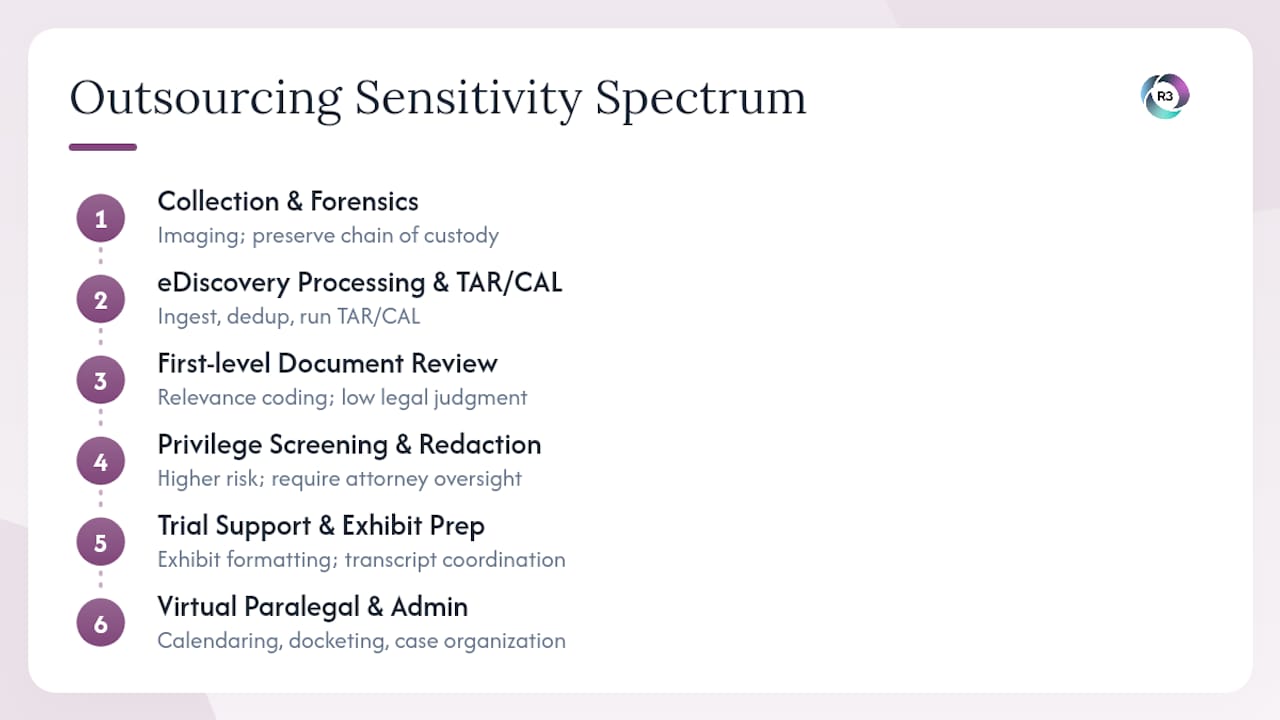
Not every litigation task is a good outsourcing candidate, but a wide band of process-heavy work fits cleanly. Understanding where each service category sits on the spectrum, from purely mechanical to legally sensitive, helps you decide what to hand off first.
Collection, preservation, and forensics triage. Providers image devices, preserve chain of custody, and run early data culling before anything reaches a reviewer. This is largely technical work with clear protocols, making it one of the lowest-risk categories to outsource.
eDiscovery processing and TAR/CAL workflows. This covers ingesting data into a review platform, deduplication, and running technology-assisted review or continuous active learning models to prioritize the most relevant documents. It requires technical skill but limited legal judgment, which is why it’s often the first service firms outsource.
Document review, privilege screening, and redaction. First-level review (relevance coding) is the classic outsourcing target. Second-level review and privilege calls carry more legal risk and usually need closer attorney supervision or should stay in-house entirely for genuinely close privilege questions.
Trial support, exhibit preparation, and deposition transcript handling. Formatting exhibits, building trial notebooks, synchronizing video depositions with transcripts, and managing exhibit databases are all high-volume, deadline-sensitive tasks well suited to trial preparation outsourcing.
Virtual paralegal and administrative litigation tasks. Calendaring, docketing, correspondence tracking, and case file organization free up in-house paralegals for substantive work. R3source’s dedicated remote professional services and similar staffing arrangements often start exactly here, since these tasks carry low ethical risk and immediate time savings.
A useful rule of thumb: the more a task resembles data processing or scheduling, the safer it is to outsource on day one. The more it resembles a legal judgment call, the more supervision you build in before you hand it off.
What Do ABA and Bar Opinions Require Before You Outsource?
The Model Rules do not ban outsourcing. They require you to manage it like you would any other delegation of legal work, and the obligations run through the supervising attorney, not the vendor. ABA Formal Opinion 08-451 makes clear that a lawyer who outsources work remains ultimately responsible for competent representation. That means supervising nonlawyers under Model Rule 5.3, protecting client confidences under Rule 1.6, checking for conflicts under Rule 5.1, and confirming the arrangement does not amount to unauthorized practice of law under Rule 5.5.
The NYC Bar’s report on outsourcing legal services overseas goes further, identifying five specific ethics issues firms need to address: competence and supervision, confidentiality, conflicts of interest, disclosure to clients, and avoiding assistance in the unauthorized practice of law. The committee’s core recommendation is practical: run small, controlled pilots and keep U.S.-licensed attorneys in the supervision chain. Since offshore staff typically fall outside U.S. bar discipline, scholarly analysis of offshore legal outsourcing recommends working with providers that maintain U.S. offices or U.S.-licensed attorneys in management roles specifically to close that accountability gap.
Informed client consent is not always required, but it becomes necessary when outsourced work touches confidential information in ways the client wouldn’t reasonably expect, or when the arrangement is significant enough that a client would want to know about it. The safest approach documents that consent in the engagement letter rather than relying on an assumption of implied consent.
Supervision in practice looks less like a policy document and more like a routine. Start with small pilots on low-risk tasks before moving anything substantive offshore, a sequencing the NYC Bar report itself recommends. Build in attorney spot checks on a sample of the work product, not just the final output. Keep a decision log that tracks who made judgment calls on ambiguous documents. Bill transparently, showing the client what portion of fees reflects outsourced work versus in-house attorney time.
Document the scope of work and confirm it stays within nonlawyer-appropriate tasks.
Obtain and file client consent when the arrangement warrants disclosure.
Require the vendor to confirm data-handling and confidentiality practices in writing.
Run periodic spot checks on review accuracy, not just final deliverables.
Maintain a paper trail showing attorney oversight of every substantive decision.
Pro Tip: Build your engagement letter’s outsourcing disclosure language before you sign a vendor contract, not after. Retrofitting consent language into an existing client relationship is far harder than setting the expectation on day one.
How Do You Vet a Litigation Support Provider?
Vendor selection is where most outsourcing arrangements succeed or fail, and the diligence process should feel closer to hiring a key employee than buying software. Start with staffing and credentials. Ask whether the vendor has U.S.-licensed attorneys or managers overseeing the account, request sample work product from a comparable matter, and call at least two references who used the provider for a similar case type or volume.
Security and compliance evidence comes next. A credible provider should be able to produce SOC 2 documentation, explain its encryption standards for data in transit and at rest, and walk you through its access-control model, meaning who on their team can see what, and when that access gets revoked after a matter closes. If the provider handles litigation materials without a documented data-handling policy, treat that as disqualifying rather than negotiable. A legal IT security specialist can help you benchmark what “adequate” security actually looks like for a firm your size before you sign anything.
Operational metrics matter as much as credentials. Ask how the vendor samples completed work for quality control, what error rate triggers a re-review, and whether you’ll get daily production reports or only a summary at the end. A provider that cannot tell you its typical error rate on privilege calls is a provider that has not been tracking it.
Confirm staffing model and request two client references from comparable matters.
Review security certifications, encryption standards, and access-control policies in writing.
Ask for the QA sampling rate and the error-rate threshold that triggers remediation.
Request a sample reporting cadence, ideally daily production logs during active review.
Negotiate pricing shape, service-level agreements, termination rights, and indemnity language before signing.
Watch for red flags during this process: vague answers about where data physically resides, reluctance to name a U.S.-based point of contact, or pricing that seems too low relative to the scope described. Commercial terms deserve the same scrutiny as technical ones.
Confirm whether pricing is per-document, per-hour, or a blended rate, and how that shifts with volume.
Review service-level agreements for turnaround time and remedies if they’re missed.
Check termination clauses for how quickly you can exit if quality slips.
Verify indemnity language covers data breaches and confidentiality failures, not just missed deadlines.
For a broader vendor-vetting framework outside the litigation context, R3source’s outsourcing checklist for growing businesses covers reputation checks and transition planning that translate directly to legal vendor selection.
How Should You Onboard and Manage an Outsourced Litigation Team?
A pilot program is the single best predictor of whether a full-scale engagement will work. Design it to run two to four weeks on a defined, bounded scope, not an open-ended trial. Set explicit acceptance criteria going in: a target accuracy rate on relevance coding, an acceptable error rate on privilege flags (often under 2% for critical coding errors), and a sample size large enough to be statistically meaningful. The Integreon case study’s QA approach shows how seed sets and rerun criteria caught missing metadata before it became a defensibility problem, which is exactly the kind of pilot design worth copying.
Onboarding needs a checklist, not a verbal handoff. Provision access to your review platform with appropriate permission levels. Deliver a written codebook covering relevance standards, privilege markers, and redaction rules specific to the matter. Set communication protocols upfront, including who escalates a coding question and how fast they should expect an answer.
Grant platform access with role-based permissions matched to task scope.
Deliver a written codebook covering relevance, privilege, and redaction standards.
Set escalation paths and response-time expectations for coding questions.
Establish a daily reporting cadence covering volume completed and error flags.
Confirm encrypted transfer protocols and single sign-on where the platform supports it.
Once the pilot clears its benchmarks, supervision shifts from constant checking to a steady cadence: daily production logs, a running decision register for ambiguous calls, and a clear escalation path when a reviewer hits something outside the codebook. Most platforms now support secure transfer and SSO integration, which shortens the technical setup timeline to days rather than weeks once security review is complete.
What Does This Look Like in Practice?
R3source’s dedicated remote professional model was built around exactly this kind of scoped, supervised staffing arrangement. Rather than task-based freelancers, firms get a long-term team member trained to integrate into existing workflows, whether that’s docket management, correspondence tracking, or trial exhibit organization, all of which fall squarely in the low-risk administrative litigation category discussed earlier.
R3source’s own customer support outsourcing pilot data points to pilot programs launching in two to four weeks and back-office transitions showing 40 to 60 percent savings when the scope is well defined from the start, a pattern consistent with the review-cost reductions documented in the FTI Technology and Integreon case studies above.
A workable rollout for a litigation support virtual role often follows a 30/60/90 structure:
Days 1 to 30: Access provisioning, codebook training, and shadowing on low-stakes administrative tasks.
Days 31 to 60: Independent handling of docketing, calendaring, and document organization with daily check-ins.
Days 61 to 90: Expanded scope into trial prep support with weekly rather than daily supervision.
R3source’s legal virtual assistant task breakdown walks through a similar onboarding structure in more detail for firms mapping out their first hire.
When Is Outsourcing the Right Call, and When Isn’t It?
The firms that get the most out of outsourcing share a pattern: repeatable processes, a real need for scale, and quality control they can articulate before the vendor ever touches a document. If you can’t describe your QC process in a sentence, you’re not ready to hand it to someone else yet.
The failures I see traced back to the same handful of mistakes. Vague scopes top the list. A vendor told to “help with discovery” instead of a defined task set will produce inconsistent work, and that’s a firm’s failure, not the vendor’s. Skipping the pilot is the second, because firms that jump straight to full-scale engagements lose the chance to catch problems while the stakes are still small. Insufficient supervision is the third, and it’s the one bar opinions warn about most directly. Outsourcing does not transfer your responsibility; it just changes who’s doing the typing.
Client trust survives outsourcing when you’re upfront about it. Clients rarely object to cost-effective legal solutions. They object to surprises.
— Ellis
A Different Way to Staff Your Litigation Support Work
If you’ve been weighing internal hires against per-project vendors for eDiscovery or trial prep, there’s a third path worth knowing about. R3source is the alternative to both: instead of a task-based freelancer or a full-time hire with benefits overhead, you get a dedicated, long-term remote professional who’s pre-vetted, trained, and integrated directly into your firm’s workflow, handling docketing, calendaring, correspondence, and administrative litigation support without the six-month ramp-up of a traditional hire.
A typical engagement starts small, mirroring the pilot structure outlined earlier in this piece: a defined scope, a short onboarding window, and daily oversight while your team confirms fit. From there, most firms expand the role’s responsibilities as trust builds, the same 30/60/90 progression that works for any outsourced litigation support arrangement. Dedicated staff may be employed long-term rather than as gig workers, which supports continuity of personnel over time.
If your firm is buried in administrative litigation tasks that a trained remote professional could handle starting next month, book an introductory consultation or review the dedicated remote professional services page to see how a pilot role could be scoped for your practice.
Where to Verify the Ethics and Case Study Claims
For the ethical framework, start with ABA Formal Opinion 08-451 and the NYC Bar’s report on outsourcing overseas. For managed-review outcomes, review the Integreon case study and the FTI Technology predictive-coding case study. For a broader look at managed services versus outsourced staffing models, Ventis Consulting’s decision guide is a useful comparison reference.
Sources
FAQ
What Is a Litigation Support Company?
A litigation support company provides services like document review, eDiscovery processing, trial exhibit preparation, and administrative case management to law firms, typically as an outsourced alternative to building that capacity in-house.
How Much Does a Paralegal Cost Per Hour?
Costs vary widely by market, experience level, and whether the paralegal is in-house or outsourced; firms considering outsourced legal support should request current rate sheets directly from providers rather than relying on a single national average, since regional pricing differences are significant.
Can Outsourced Staff Handle Confidential Litigation Documents Safely?
Yes, when the provider can demonstrate encryption standards, access controls, and a written data-handling policy, and when your firm maintains supervision and documented QA checks as required under the Model Rules and ABA Formal Opinion 08-451.
Does R3source Provide Litigation Support Staff?
R3source provides dedicated remote professionals suited to administrative litigation tasks like docketing, calendaring, and document organization; current pricing details are available directly on the R3source site.
Recommended
Comments