

6 KPIs to Prove Hotel Reservation Outsourcing Works for Owners


Outsourcing hotel reservations is a smart move for most independent hotels and small groups, but only when it comes with clear guardrails. The best outcomes show up when you keep control of pricing, guest data, and brand voice while handing off the phones, chats, and booking mechanics. Done that way, you typically see lower fixed costs, round-the-clock coverage, and a real shot at higher conversion. Skip the guardrails, and you inherit someone else’s guesswork instead of your own.
Outsourcing reservation services is most effective when hotels retain control over pricing, guest data, and brand voice to prevent guest experience fragmentation.
A properly managed outsourced team can improve conversion rates, reduce missed calls, and offer 24/7 multilingual support, especially during peak seasons or emergencies.
Critical KPIs for evaluating performance include conversion rate per agent, first response time, sales cycle length, and upsell ticket value, which must be linked to profitability.
Proper system integrations with property management, CRM, and payment gateways, along with a clear Owner’s Brief, are essential to prevent revenue leakage and service failures.
Hotels should start with a narrow pilot, model costs across scenarios, and maintain in-house control of rate strategy and guest experience standards to ensure long-term success.
Table of Contents
Which KPIs Actually Measure Outsourced Reservation Performance?
How Do You Choose the Right Reservation Outsourcing Partner?
Technology, Integrations, and Data Flows You Need to Plan For
Training and Onboarding: Protecting Brand Standards From Day One
Managing Guest Experience and Quality Control Once You’ve Outsourced
Transitioning From In-House to Outsourced Reservations Without Losing Momentum
A Publisher’s Take on Where Reservation Outsourcing Actually Delivers
Ready to See Reservation Outsourcing Work for Your Property?
What Does Hotel Reservation Outsourcing Actually Solve?
Every front desk manager knows the 2 a.m. call that never gets answered, or the OTA message that sits unread until the morning shift logs in. Hotel reservation outsourcing exists to close that gap without forcing you to hire a full night team just to catch a fraction of the volume.
The financial case is straightforward. Instead of carrying full-time payroll, benefits, and training costs for reservation agents, you convert that expense into a flexible line item that flexes with occupancy. Labor shortages across the hospitality sector have pushed more properties toward this model simply because qualified reservation staff have gotten harder to find and keep.
Hotels that shift reservation calls to a dedicated outsourced partner often see meaningful reductions in missed-call rates and cost per booking, particularly once the vendor is trained on rate logic and upsell scripts, according to industry analysis on outsourced reservations management.
The operational upside runs deeper than staffing math. A trained outsourced desk gives you:
24/7 phone and chat coverage without overtime pay
Surge capacity during storms, events, or system outages
Multilingual support for international guests
Lower call abandonment during peak booking windows
Revenue benefits follow naturally. Agents who are trained specifically on conversion, not just call handling, tend to close more direct bookings and attach more upsells, according to Prostay’s analysis of hotel outsourcing outcomes. That frees your onsite team to focus on the guest standing in front of them instead of juggling a ringing phone.
What Reservation Outsourcing Typically Covers
A reservation outsourcing engagement usually spans more than just answering the phone. Most partners structure their scope around the full booking lifecycle, from first inquiry to post-stay follow-up.
Typical coverage includes:
Inbound booking calls and voicemail response
OTA messaging, live chat, and email inbox management
Social media inquiry handling and response
Upselling room categories, packages, and ancillaries
Group booking coordination and modification/cancellation processing
CRM updates, pre-arrival messaging, and loyalty program handling
PCI-compliant payment capture for deposits and full-stay charges
Some partners go further with specialized add-ons. Revenue management as a service is one example, where the outsourced team applies pricing logic you’ve approved rather than setting rates independently. Chatbot-plus-human handoff is another, where a bot answers routine questions and escalates anything requiring judgment to a live agent. Multilingual desks matter for properties near airports, international conference centers, or markets with heavy overseas leisure traffic.
The scope you choose should map directly to where your current team struggles most, whether that’s after-hours coverage, peak-season overflow, or simply keeping up with a growing inbox across five different channels.
Which KPIs Actually Measure Outsourced Reservation Performance?
Six metrics matter more than any others when you’re judging whether an outsourced team is earning its cost, according to Asksuite’s breakdown of top hotel KPIs: conversion rate per agent, total service volume per agent, first response time, sales cycle length, operational inefficiency rate, and average ticket value.
Conversion rate tells you whether inquiries are turning into bookings, not just being answered politely. Volume per agent flags understaffing or overstaffing before it shows up as either lost calls or padded invoices. First response time predicts guest satisfaction almost as reliably as the stay itself. Sales cycle length shows how quickly a lead moves from question to confirmed reservation. Inefficiency rate exposes wasted agent time on transfers, holds, or repeat contacts. Average ticket value tracks whether upselling is actually happening.
KPI | What it reveals | Reporting cadence |
Conversion rate per agent | Booking effectiveness | Weekly |
Volume per agent | Staffing accuracy | Daily |
First response time | Guest experience risk | Daily |
Sales cycle length | Sales process friction | Weekly |
Operational inefficiency rate | Wasted agent time | Monthly |
Average ticket value | Upsell performance | Monthly |
HSMAI’s KPI research makes a point worth repeating here: link these numbers to profit, not just top-line activity. A vendor bragging about call volume while conversion sits flat isn’t performing.
Pro Tip: Set incremental targets during the pilot phase rather than expecting benchmark performance from week one. A team new to your property needs 30 to 45 days to learn your rate structure and guest patterns before the numbers stabilize.
How Do You Choose the Right Reservation Outsourcing Partner?
Picking a partner comes down to five checks that separate a genuine hospitality specialist from a generalist call center that happens to take hotel work.
Hospitality-specific experience. Ask for references from properties similar to yours in size and market, not just logo lists.
PMS and CRS integration capability. Confirm they’ve connected to your specific systems before, not adjacent ones.
Data custody and portability. You need a documented right to export your guest data on demand, in a usable format.
Timezone and language coverage. Match their staffing hours to your actual demand pattern, including your slowest and busiest seasons.
Cultural fit and communication style. Sit in on a live call recording before signing anything.
Commercial models vary. Fixed monthly retainers work well for predictable volume. Seat-based pricing suits properties running dedicated agents around the clock. Per-call or per-booking pricing fits seasonal operations. Hybrid models blend a base fee with volume incentives. Calculate total cost of ownership, not just the quoted rate. Onboarding, integration work, and management oversight all add real cost beyond the line-item price.
Structure your evaluation as a formal RFP followed by a 60 to 90 day pilot with narrow scope, such as after-hours coverage only, instrumented with daily KPI tracking, as recommended in Prostay’s guidance on outsourcing rollout. Insist on:
Written SLAs tied to the KPIs above
Clear escalation and termination procedures
Confirmed insurance and financial stability, per Hospitality
PCI compliance documentation
A signed Owner’s Brief defining what stays under your control
Technology, Integrations, and Data Flows You Need to Plan For
Reservation outsourcing lives or dies on integration quality. Your outsourced team needs real-time access to your property management system, central reservation system, channel manager, payment gateway, and CRM, or they’re working from stale information that creates double bookings and guest frustration.
Inventory synchronization deserves particular attention. Latency between systems is one of the most common sources of revenue leakage in outsourced operations, according to technical analysis of reservation service performance, which flags API reliability and reconciliation gaps as recurring failure points.
Key technical requirements include:
Real-time PMS/CRS syncing to prevent overbooking
Reconciliation loops that catch discrepancies within hours, not days
Payment gateway integration that meets PCI standards
A defined outage playbook for when any system goes down
Automation has a role, but it’s a supporting one. Chatbots handle routine questions well, such as check-in times or parking availability, and platforms like ChatzyBot show meaningful booking lifts when bots are paired with fast human handoff for anything complex. Bots without escalation paths frustrate guests fast.
Risks, Guardrails, and What Must Stay In-House
The clearest warning in outsourcing literature is this: outsource the task, never the guest. Hotels that hand over pricing decisions, inventory rules, or brand voice alongside call handling tend to see guest experience fragment within months, according to Demand Calendar’s guidance on managing guests through partners.
Keep these firmly in-house:
Rate strategy and pricing decisions
Inventory controls and allocation rules
Brand voice and tone guidelines
Definition of who counts as a “guest” across channels
Escalation and service recovery authority
Ownership of guest data
Drift shows up quietly, usually as a slow decline in review sentiment or a spike in rate-match complaints before anyone notices the root cause.
Pro Tip: Build a one-page Owner’s Brief covering what you own, what the vendor executes, required KPIs, escalation contacts, and data export rules. Attach it to the contract as a formal exhibit, not a side conversation.
How Outsourcing Scales for Seasonality and Peak Demand
Seasonal surges are exactly where outsourcing earns its cost. Building a rollout around demand spikes, rather than replacing your entire team at once, protects both budget and guest experience.
Start with a narrow pilot. Cover after-hours calls or a single peak weekend, instrumented with daily KPI tracking.
Model total cost across scenarios. Include onboarding, training, and oversight hours alongside per-call rates, not just the quoted price.
Negotiate flexible seat counts. Seasonal blocks or on-demand seats let you scale up for holiday weeks without paying for idle capacity in the off-season.
Protect SLAs during surges. Confirm response-time commitments hold even at 3x normal volume, not just under average load.
Expand only after measurement. Move from pilot to full coverage once conversion and satisfaction numbers meet your targets.
Training and Onboarding: Protecting Brand Standards From Day One
Brand consistency doesn’t happen by accident once someone outside your building is answering your phones. It happens because you invested in onboarding before the first live call.
Start with a documented brand voice guide, not a verbal briefing. Cover greeting scripts, tone expectations, upsell language, and the specific phrases you never want used, especially around discounts or rate matching. Your outsourced partner should shadow your best in-house agents, if any remain, or study call recordings from your top-performing periods.
Rate logic training deserves its own module separate from general customer service training. An agent who understands why a rate exists sells it with more confidence than one just reading numbers off a screen. Build in scenario practice for common edge cases: sold-out dates, group inquiries, complaint calls that arrive disguised as booking questions.
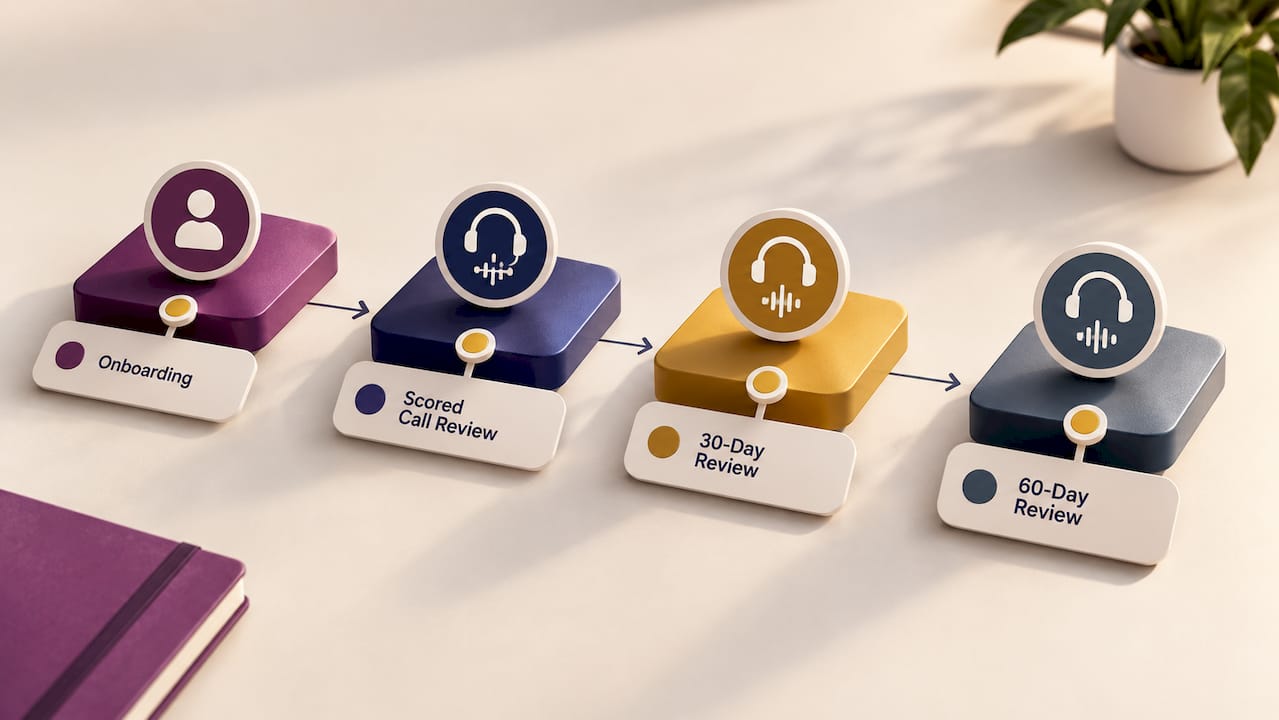
Certification checkpoints work better than a single training week. Require agents to pass a scored call review before going live, then repeat that review at 30 and 60 days. Vendors who resist structured certification, or who can’t produce training logs and shadowing records on request, are telling you something about how seriously they take quality control. A 60 to 90 day pilot period, as Prostay recommends, gives you room to catch training gaps before they reach full volume.
Refresher training matters just as much as initial onboarding, particularly around seasonal rate changes, new packages, or renovation-related messaging that guests will ask about the moment it’s announced.
Managing Guest Experience and Quality Control Once You’ve Outsourced
Quality control on an outsourced team requires more structure than walking the floor and listening in on your own front desk. You need systems that catch problems before they reach a guest review.
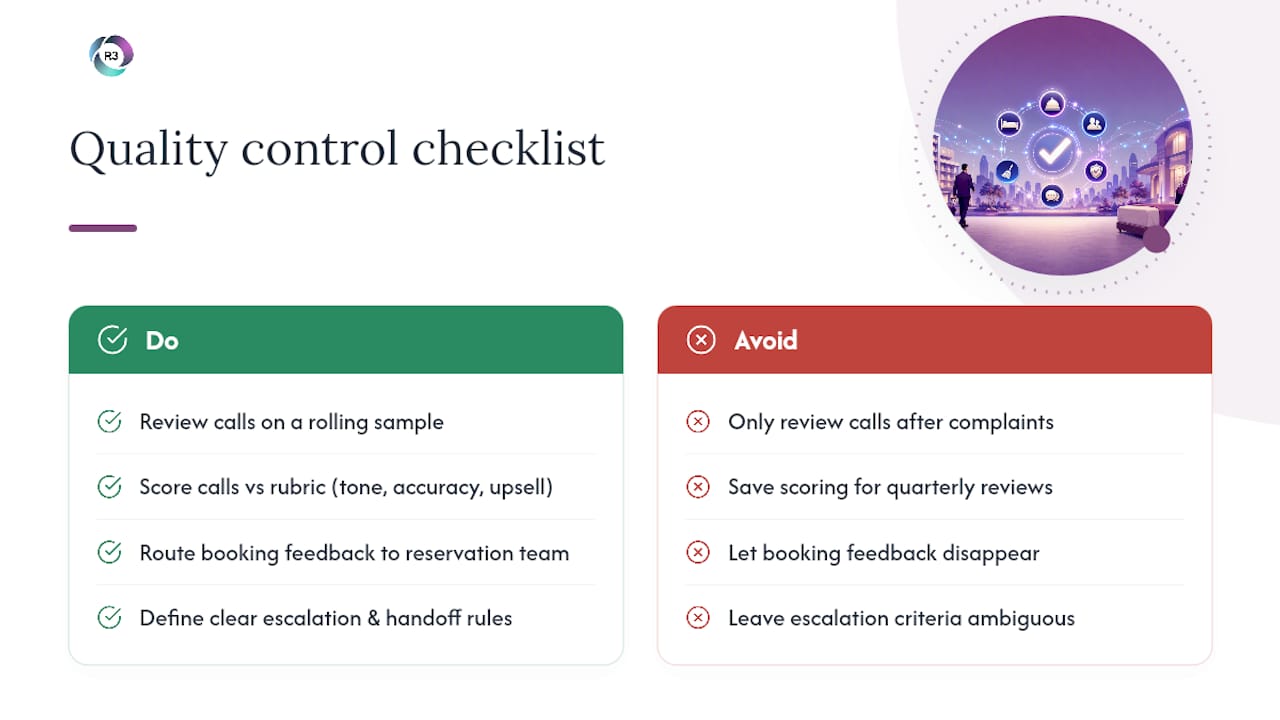
Call recording review should happen on a rolling sample, not just when a complaint triggers it. Score calls against a rubric covering tone, accuracy, and upsell attempts, then share that scoring with the vendor weekly rather than saving it for a quarterly review. Mystery shopping your own reservation line occasionally reveals gaps that internal metrics miss entirely.
Guest feedback loops need to flow both directions. Post-stay survey comments that mention the booking experience should route back to the reservation team, not disappear into a general feedback folder. If a guest mentions a confusing upsell pitch or a rate that didn’t match what they saw online, that’s data your vendor needs within days, not at contract renewal.
Escalation protocols deserve particular clarity. Define exactly which situations an outsourced agent can resolve independently and which require immediate handoff to an onsite manager, especially anything involving a compensation decision or a VIP guest. Ambiguity here is where guest experience actually breaks down, not in the routine calls.
Dashboards tying KPIs to guest satisfaction scores, not just call volume, give you the clearest read on whether quality is holding steady as the relationship matures.
Transitioning From In-House to Outsourced Reservations Without Losing Momentum
The switch from in-house to outsourced reservations creates real change management challenges, and pretending otherwise sets you up for a rocky first quarter.
Your existing front desk staff will likely feel some anxiety about job security, even when the plan is to redeploy them toward guest-facing work rather than eliminate positions. Address that directly and early, ideally before the vendor search even starts, so rumors don’t fill the silence.
Data migration is the technical challenge that trips up the most properties. Guest history, rate rules, and loyalty program details all need clean transfer into systems the new team can access immediately, not weeks into the engagement. Test this transfer thoroughly during the pilot phase, because a data gap discovered during a slow week is manageable; one discovered during a holiday surge is not.
Run a parallel period rather than a hard cutover. Keep in-house coverage active for a defined window, typically two to four weeks, while the outsourced team ramps up, so you have a safety net if integration issues surface. Communicate the transition to guests only if it changes their experience in a way they’d notice, such as a different callback number.
Expect a temporary dip in some metrics during the first 30 days. That’s normal for any new team learning your property, not a sign the decision was wrong, provided the trend line moves in the right direction by day 60.
A Publisher’s Take on Where Reservation Outsourcing Actually Delivers
Most outsourcing guides treat this as a staffing decision. It’s really a systems decision, and that distinction is where hotels either win or lose money on the arrangement.
Some remote staffing models build around guardrails like dedicated, long-term professionals who integrate into an existing operation rather than freelancers rotating through tasks. That matters more in reservations than almost any other function, because a guest calling about a rate discrepancy needs an agent who actually knows your property, not someone reading a script for the first time.
The practical fit starts with an Owner’s Brief defining what you keep and what the team executes, followed by a pilot period with KPI reporting you can actually read. Ongoing coaching keeps performance from drifting once the honeymoon period ends. If you’re weighing whether to outsource virtual assistant services for reservations specifically, that structure is the difference between a vendor and a genuine extension of your team.
— Ellis
Ready to See Reservation Outsourcing Work for Your Property?
Certain outsourcing providers are built for hotels wanting dedicated, long-term reservation staff rather than a rotating cast of freelance task-doers. Effective remote professionals are trained specifically for the operation and managed for consistency, not just assigned and forgotten.
A discovery call walks through your current reservation volume, your peak-season pain points, and where a dedicated remote professional would free up your onsite team fastest. From there, we help you scope a pilot with the KPIs that actually matter, conversion, response time, and ticket value, rather than vanity call counts. If a broader remote team makes sense across your operation, we’ll show you what that looks like too, including administrative, marketing, and customer service roles built the same way. Book your introductory consultation and get a straight answer on whether outsourcing fits your property before you sign anything.
Sources
FAQ
What Is the 10/5 Rule in Hotels?
The 10/5 rule is a hospitality service standard: acknowledge a guest with eye contact or a smile within 10 feet, and offer a verbal greeting within 5 feet. It applies mainly to in-person service but shapes the tone many hotels train outsourced phone and chat agents to match.
Is Outsourcing a Dying Concept?
No, outsourcing is expanding in hospitality, driven partly by ongoing labor shortages across the sector. Reservations, IT support, and specialized administrative roles remain among the most commonly outsourced hotel functions.
What Are the Four Types of Outsourcing?
The four common categories are professional outsourcing (specialized skills like accounting or IT), IT outsourcing, manufacturing outsourcing, and project-based outsourcing. Hotel reservation outsourcing generally falls under professional and process outsourcing, since it involves trained staff handling a defined operational function.
What Systems Do Hotels Use for Reservations?
Hotels rely on a property management system, a central reservation system, and a channel manager working together, often connected to a CRM for guest data. Any outsourcing partner needs verified integration experience with these systems before handling live reservations, since gaps between them cause double bookings and lost revenue.
How Much Does Reservation Outsourcing Cost?
Pricing varies by model, fixed retainer, seat-based, or per-call, and by scope of coverage. For staffing services like R3source’s dedicated remote professionals, current pricing is available directly on the R3source website after a consultation scoped to your property’s volume.
Recommended
Comments