

How to Use Virtual Assistant for Growth in 2026


You are building something meaningful, and somewhere along the way the back-office work started swallowing your day. Scheduling, inbox triage, CRM updates, client follow-ups. None of it drives revenue on its own, yet it demands your full attention. If you want to use virtual assistant for growth, you need more than a task-taker. You need a system owner. This article shows you exactly how to prepare your business, select the right person, integrate AI-powered workflows, and measure the results so your VA becomes one of the most important investments you make this year.
Table of Contents
Key Takeaways
Point | Details |
Quantify your lost time first | Identify the recurring tasks eating your week before you hire, so you delegate with purpose. |
Hire for system ownership | The best VAs manage entire workflows, not just individual tasks, which reduces your cognitive load. |
Use AI tools to multiply output | VAs equipped with automation platforms can handle what used to require multiple staff members. |
Onboard with a 30-day framework | Structured onboarding with SOPs and incremental responsibility produces faster, cleaner results. |
Track measurable outcomes | Monitor time reclaimed, CRM quality, and cost savings to verify and scale your VA investment. |
Why virtual assistants are critical for growth
Growth does not stall because you lack ideas. It stalls because you cannot get out of your own operations long enough to act on them.
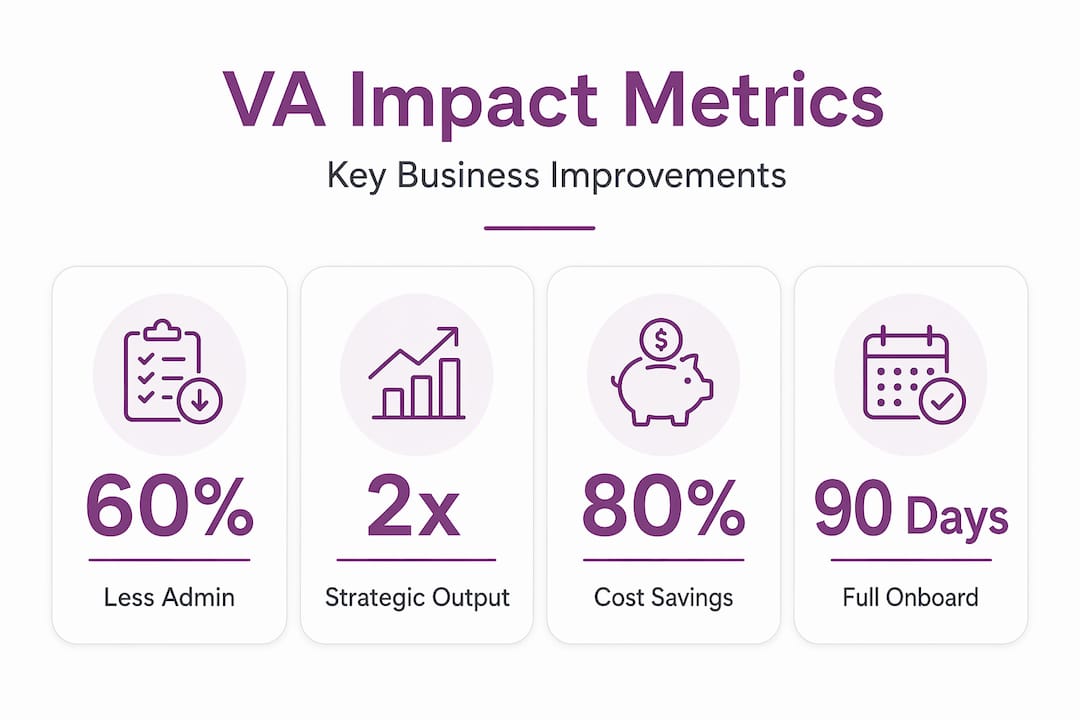
Professionals spend 60% of their work time on coordination, scheduling, and inbox overhead rather than strategic work. For a business owner, that ratio is often worse. You are the one approving invoices, answering client emails, and chasing down leads, all while trying to close deals and build your product. That is the leverage problem.
The fix is not hiring more full-time staff. The fix is building a support system that handles defined systems on your behalf so you can stay in your zone of strength. That is where virtual assistants come in, and that is exactly why the role of virtual assistants in growth hacking has moved from novelty to necessity.
Before you hire, you need to do three things:
Map your recurring tasks. Document everything you do in a week that follows a repeatable pattern. Inbox sorting, appointment setting, social media scheduling, data entry. These are your handoff candidates.
Identify your systems. A task is something you do once. A system is a process that runs repeatedly. Your VA should own systems, not tasks.
Define your SOPs. Standard operating procedures give your VA a clear playbook. Without them, you become the instruction manual, which defeats the purpose.
“The entrepreneurs who scale fastest are the ones who stop doing and start designing. Your VA executes the design.”
System-based VAs handle workflows like CRM hygiene and onboarding sequences within defined processes, dramatically cutting founder cognitive load and decision fatigue. The goal is not to delegate a task. The goal is to hand off ownership of an entire operational area.
Selecting and onboarding the right VA
Choosing the wrong VA costs you more than money. It costs you the time you spent training someone who cannot deliver. Here is how to get the selection right the first time.
Define the skill profile before you post. If you need someone to manage your CRM and run email campaigns, list those tools specifically. Vague job descriptions attract generalists who cannot handle specialized work.
Use paid test tasks. Give shortlisted candidates a real work simulation, not a hypothetical. Ask them to draft three follow-up emails using your tone or clean a sample CRM spreadsheet. Pay them for the task. You will see their actual output, not their pitch.
Assess their communication style. Asynchronous work requires clear, proactive communication. Ask candidates to send you a status update video using Loom or a written daily summary. Watch how they structure information.
Set expectations in writing from day one. Response time windows, preferred tools, escalation protocols, revision policies. Put all of it in an onboarding document before you start.
Secure access immediately. Credential sharing poses real vulnerabilities for businesses that hire remote staff. Use a password manager like 1Password or LastPass to grant access without revealing raw credentials. Assign role-based permissions so your VA only reaches what they need. Require a signed NDA before any sensitive information changes hands.
Pro Tip: Run a 30-day onboarding framework: Week 1 is orientation and shadowing, Week 2 is guided task completion, Week 3 is independent work with check-ins, Week 4 is full system ownership with performance review. Structured onboarding with SOPs and incremental responsibility reduces the oversight you need to maintain long-term.
You can also find reliable long-term partners by working with providers who have already vetted candidates for communication skills, reliability, and professional experience. It saves you the first round of filtering.

Amplifying growth with AI-powered VAs
Here is where the conversation shifts. The role of virtual assistants in hustle culture used to mean someone who answered emails and booked flights. Today, a well-equipped VA uses AI tools to perform work that used to require an entire team.
Consider what an AI-augmented VA can handle in a single day:
Triage your inbox using AI filters, draft responses using your stored templates, and flag only the messages that need your personal reply. AI-assisted inbox management can cut email handling time by 60 to 70 percent.
Repurpose a single blog post into five social media captions, an email newsletter intro, and a short-form video script using ChatGPT with a prompt library your VA manages.
Update your CRM after every sales call using a structured workflow so your pipeline is always current without you touching it.
Generate weekly performance reports by pulling data from your tools and formatting it into a summary you can read in five minutes.
Task | Without AI-augmented VA | With AI-augmented VA |
Inbox management | 2+ hours daily | 30-40 minutes daily |
Content repurposing | Requires separate hire | Handled in same workflow |
CRM updates | Manual after every call | Automated with template use |
Reporting | Compiled by founder | VA-generated weekly summary |
This is the real power when you use virtual assistant for growth. It is not one person doing one job. It is one skilled person using the right tools to multiply their output across your entire operation.
Pro Tip: Build a prompt library with your VA. Document the best ChatGPT prompts for your business tone, content formats, and client communications. Your VA manages and refines this library over time, and it becomes a compounding asset.
Common challenges and how to avoid them
Even the best hire can underperform if you make avoidable setup mistakes. These are the pitfalls that most business owners only learn after the fact.
Hiring a generalist for specialized work. Mismatched VA skill sets lead to shadow work, where you end up doing the task alongside your VA or correcting their output constantly. This is the opposite of delegation.
No feedback loop. Without a weekly check-in or written performance review, small errors compound into systemic problems. Build a brief weekly sync into your workflow from day one.
Oversharing credentials. Unmanaged device access and credential sharing are the most common security risks in VA relationships. Audit your VA’s access permissions every 60 days and remove access immediately upon any role change.
Stale SOPs. Your business evolves. If your VA is following a process you updated two months ago in your head but never documented, the output will reflect that gap. Treat SOPs as living documents and assign your VA to update them as processes change.
“The most productive VA relationships are built on clarity. Clear roles, clear processes, clear expectations. Ambiguity is expensive.”
Managing across time zones adds another layer of complexity. Establish overlap hours where you and your VA are both available for real-time questions. Outside of that window, asynchronous updates should carry the load. When communication protocols are established upfront, the time zone difference becomes an advantage. Your VA works while you sleep.
Measuring the impact on your business
You cannot manage what you do not measure. When you outsource tasks for growth, you need to know whether the investment is producing results.
Here is a simple framework for tracking your VA’s impact over the first 90 days:
Time reclaimed. Track how many hours per week you personally spent on delegated tasks before your VA started. Compare that to your current reality. Even recovering five hours per week adds up to 20 hours per month you can put toward revenue-generating work.
Operational quality. Is your CRM cleaner? Are client onboarding sequences running without your input? Are follow-up emails going out on time? Delegating onboarding and client intake to a VA can return nearly a full productive day per week to a business owner.
Cost comparison. Full-time U.S.-based administrative staff can cost $45,000 to $60,000 per year including benefits. Experienced VAs in the Philippines deliver equivalent or specialized support at a fraction of that cost, with businesses saving 60 to 80 percent on support costs compared to domestic hiring.
Revenue indicators. Are you taking more sales calls? Closing more deals? Launching campaigns faster? Time freed from administration should be redirected to revenue activities. If it is not, revisit your task delegation list.
Metric | Baseline (pre-VA) | 90-Day Target |
Hours on admin per week | Track your actual number | Reduce by 50% or more |
CRM data accuracy | Self-assessed score (1-10) | Reach 8 or higher |
Weekly content output | Current pieces published | Double or maintain with less time |
Cost vs. full-time hire | U.S. salary benchmark | 60-80% savings |
Use monthly performance reports, not just gut feel. Your VA should contribute to these reports directly. When they document their own output, it builds accountability and gives you the data you need to grow their responsibilities when ready.
My honest take on VA integration
I have watched business owners approach virtual assistants the same way they approach hiring an intern. They hand over the messy tasks, give a loose briefing, and hope for the best. That approach fails almost every time, and then they conclude that VAs do not work.
What I have seen actually work is something different. The founders who get the most out of this model treat their VA like a business unit, not a helper. They invest time in onboarding, build SOPs before they hire, and then get out of the way. The discipline upfront creates freedom later.
The AI angle is where I think most people are leaving real value on the table. A skilled VA who knows how to use AI tools is not a virtual assistant anymore. They are a force multiplier. I have seen one VA handle what used to require three people, specifically because they were empowered with the right tools and a system that gave them ownership.
My advice: do not wait until you are overwhelmed to bring in support. The best time to build your support system is before you desperately need it. Start small. Delegate one system. Measure the result. Then expand.
— Ellis
Ready to scale with dedicated remote support?
If you have been doing everything yourself, you already know the ceiling you have hit. R3source connects U.S. business owners with skilled, English-proficient virtual assistants from the Philippines who are trained to own your operations, not just assist with them.
Whether you need help with administrative work, CRM management, marketing support, or full remote staffing, R3source builds long-term partnerships designed around your business. Our professionals integrate directly into your workflows, delivering consistent results without the overhead of full-time domestic hiring. Explore your virtual assistant options and find out how quickly you can reclaim your time and grow with confidence.
FAQ
How do virtual assistants help business owners grow?
Virtual assistants take over recurring operational tasks like scheduling, inbox management, and CRM updates so business owners can focus on revenue-generating activities. When a VA owns entire systems rather than isolated tasks, the result is faster decisions, cleaner operations, and more time for strategic work.
What tasks should I delegate to a VA first?
Start with high-frequency, repeatable tasks that follow a defined process. Inbox triage, appointment setting, social media scheduling, and CRM data entry are strong starting points because they have clear inputs and outputs that are easy to document and measure.
How much can I save by hiring a virtual assistant?
Businesses that outsource to skilled VAs in regions like the Philippines typically save 60 to 80 percent compared to hiring equivalent full-time staff in the U.S. The savings are even greater when you factor in the reduced management overhead and faster onboarding timelines.
How do I keep my business data secure when working with a VA?
Use a password manager to share account access without exposing raw credentials, assign role-based permissions, and require a signed NDA before any data sharing occurs. Audit access permissions every 60 days and remove access immediately when roles change.
How long does it take for a VA to become fully productive?
A structured 30-day onboarding framework moves a VA from orientation to full system ownership in about four weeks when SOPs are in place and expectations are clearly communicated from day one.
Recommended
Comments