

How to Outsource Your Business Without Losing Control


Author: Ellis Jackson
Outsourcing is defined as delegating specific business functions to external partners while retaining full oversight of quality, outcomes, and strategic direction. You can outsource your business without losing control when you replace personal micromanagement with documented systems, clear metrics, and structured governance. Clear documentation and process standardization give any team member or partner the ability to follow established workflows consistently. ISO 9001:2015 quality standards provide a proven framework for verifying outsourced performance. The result is a business that grows through delegation, not despite it.
What foundational preparations keep you in control before outsourcing
Control begins before you hand off a single task. The most common outsourcing failures trace back to one root cause: business owners delegate work before they have defined what “done right” actually looks like.
Start with a strategic outsourcing plan tied directly to your business goals. Identify which functions are non-core, meaning they consume your time but do not require your unique expertise. Administrative support, customer service, lead generation, and CRM management are strong candidates. You can review what to outsource first to prioritize by impact.

Document every process you plan to delegate before the handoff. Control comes from documented systems and standards, not from personal supervision. Write step-by-step procedures, define acceptable quality thresholds, and record the expected output format for each task.
Segment your suppliers by criticality and risk level. Not all partners need the same level of oversight. Segmenting suppliers by risk helps you allocate your attention efficiently and avoid wasting time auditing low-risk vendors.
Preparation step | Purpose | Suggested tool or format |
Strategic outsourcing plan | Aligns delegation with business goals | One-page written plan |
Process documentation | Gives partners clear instructions | SOPs, video walkthroughs |
Supplier segmentation | Focuses oversight where risk is highest | Tier One / Tier Two classification |
Role and escalation map | Prevents confusion when issues arise | RACI chart |
Quality standards document | Defines acceptable output | Checklist or rubric |
Clarify roles and escalation rules before work begins. Every partner should know who makes decisions, who approves deliverables, and who to contact when something goes wrong. Ambiguity at this stage is the single fastest path to losing control.
Pro Tip: Record a short screen-capture video walking through each process before you document it in writing. Video walkthroughs reduce onboarding time and eliminate the “I didn’t understand the written instructions” excuse.
How do governance frameworks prevent outsourcing from going off track?
Governance is the system that keeps outsourced work aligned with your standards without requiring you to watch every step. Visual dashboards, standardized reporting, and structured frameworks allow leaders to monitor work effectively without hovering. This is the practical difference between micromanagement and real control.
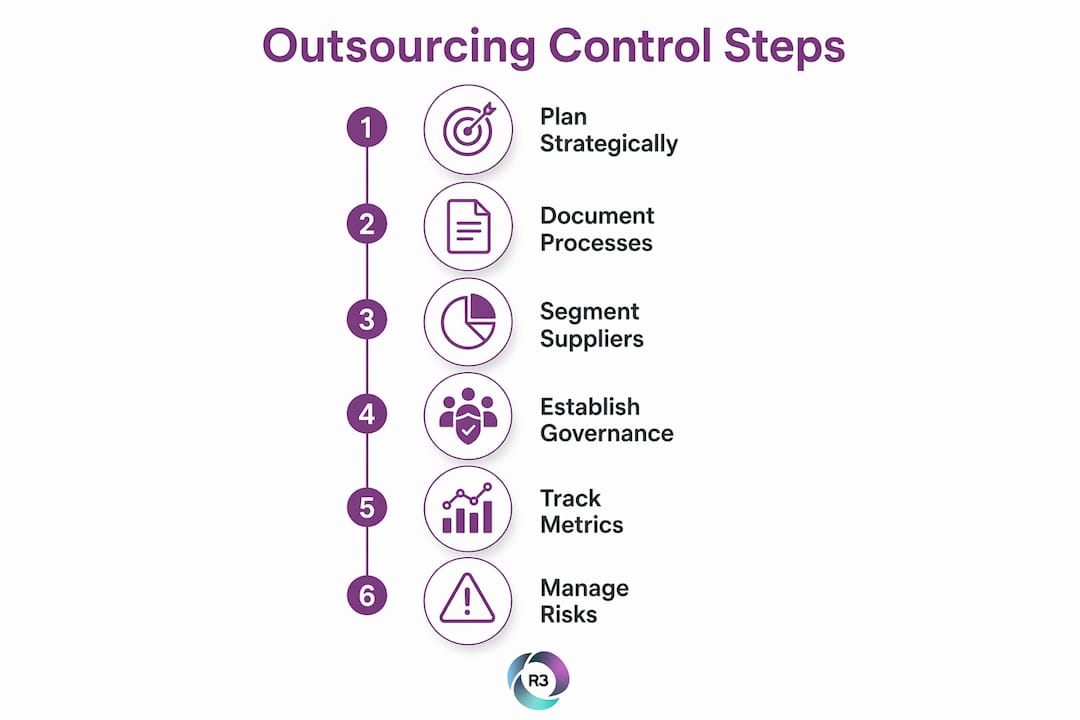
Establish a regular operating cadence with your outsourced team. Weekly check-ins, bi-weekly demos, and monthly performance reviews create natural checkpoints. These meetings are not status updates. They are decision points where you review data, address gaps, and confirm alignment.
Use vendor scorecards to enforce accountability. A 10–15% acceptance holdback in contracts tied to performance milestones keeps vendors financially motivated to meet your standards. Pair this with a 5–10 day deliverable review window so you have time to verify quality before releasing payment.
Automate your reporting wherever possible. Standardized weekly reports in a fixed format remove the guesswork from performance tracking. When every partner sends data in the same structure, you can spot problems in minutes rather than hours.
Set a clear escalation ladder with named decision-makers at each level. Assigning a named senior owner who spends 15–25% of their time on oversight is critical for maintaining alignment. Operational failures most often trace back to unclear ownership, not poor vendor performance.
Weekly sync meetings with a fixed agenda
Bi-weekly deliverable demos or output reviews
Monthly scorecard reviews tied to payment milestones
Quarterly strategic alignment sessions
Onboarding checklist completed before any live work begins
Pro Tip: Build your dashboard before your first vendor starts. A simple shared spreadsheet tracking three to five metrics beats a complex tool you never open.
What metrics and audit practices sustain outsourced quality over time?
Metrics give you the evidence to act. Without them, you are managing on gut feeling, which is not control. It is hope.
ISO 9001:2015 guidance recommends tracking 2–4 key performance metrics for outsourced processes. The most useful metrics for most business owners are on-time delivery rate, defect or error rate, customer satisfaction scores, and response time. Tracking more than four metrics at once dilutes your focus and makes reviews harder to act on.
Audit frequency should match supplier risk level. Tailoring audit intensity to supplier tier balances control with operational efficiency and preserves the working relationship. Tier One suppliers, meaning those handling critical or high-volume work, warrant quarterly reviews. Tier Two suppliers handling lower-risk tasks need only annual reviews.
Supplier tier | Risk level | Recommended audit cadence |
Tier One | High criticality, high volume | Quarterly |
Tier Two | Low criticality, low volume | Annual |
Treat audits as collaborative reviews, not punitive inspections. When a metric falls below target, open a corrective action plan together with your partner. This approach fixes the problem faster and preserves the relationship. Punitive audits create defensive vendors who hide problems rather than report them.
Integrate metric reviews directly into your governance meetings. Reviewing performance data in the same meeting where you make decisions shortens the gap between identifying a problem and acting on it.
How do you manage outsourcing risks before they become failures?
Risk management is where most business owners skip steps and pay for it later. A structured approach prevents the majority of problems before they start.
A pre-engagement risk assessment taking around two hours can prevent over 60% of outsourcing problems. That is two hours of work that protects weeks of potential recovery time. Cover scope clarity, communication protocols, data security, and acceptance criteria in this assessment before signing any agreement.
Once work begins, use a weekly risk dashboard to catch issues early. Early issue detection by Week 3 via weekly dashboard reviews shortens resolution from 8 or more weeks to just 2–3 weeks. A 15-minute weekly review is all it takes to spot warning signs before they compound.
When you catch a problem at Week 3, you have options. When you catch it at Week 10, you have a crisis. Weekly risk dashboards are the difference between a course correction and a full restart.
Prepare a recovery playbook before you need one. Define the steps you will take if a vendor misses a deadline, delivers substandard work, or goes silent. Having a written plan means you respond with clarity instead of panic.
The most common outsourcing pitfalls are:
Unclear acceptance criteria that leave quality open to interpretation
Split ownership where no single person is accountable for outcomes
Skipping the onboarding phase and assuming vendors will figure it out
Reviewing performance monthly instead of weekly in the early stages
Failing to document escalation paths before a problem occurs
Structured risk monitoring reduces failure rates by 35–40%. That number reflects the difference between businesses that treat outsourcing as a system and those that treat it as a handoff. You can learn more about offshore team productivity to apply these principles to remote teams specifically.
Pro Tip: Add a “risk flag” column to your weekly status report. Ask your vendor to rate each active task as green, yellow, or red. This forces early disclosure and gives you a visual signal before a problem becomes a failure.
Key Takeaways
Retaining control while outsourcing requires documented systems, defined metrics, and structured governance, not personal supervision of every task.
Point | Details |
Document before delegating | Write clear SOPs and quality standards before handing off any task to a partner. |
Segment suppliers by risk | Apply quarterly audits to Tier One vendors and annual reviews to Tier Two to focus oversight efficiently. |
Use acceptance holdbacks | A 10–15% payment holdback tied to scorecards keeps vendors accountable to your standards. |
Catch problems early | Weekly risk dashboards detect issues by Week 3, cutting resolution time from 8+ weeks to 2–3 weeks. |
Assign a named owner | One senior decision-maker spending 15–25% of their time on oversight prevents operational failures. |
What I’ve learned about control and delegation after years of outsourcing
The biggest misconception I see business owners carry into outsourcing is that handing off work means handing off responsibility. It does not. Responsibility stays with you. What you hand off is execution.
The owners who struggle most are the ones who either micromanage every detail or disappear entirely after the handoff. Both extremes fail. The ones who succeed treat outsourcing as a dynamic partnership. They show up to governance meetings with data, ask direct questions, and make decisions quickly.
The single most valuable shift I have seen is when a business owner stops asking “Did they do it?” and starts asking “Did the system catch whether they did it right?” That question changes everything. It moves you from reactive supervision to proactive oversight. You can build that capacity by reading how outsourcing supports entrepreneurial freedom at scale.
Sharing your quality standards in explicit, written formats reduces rework more than any amount of follow-up calls. When your partner knows exactly what “good” looks like, they can self-correct before you ever see the output. That is the version of control worth building.
— Ellis
R3source helps you outsource with confidence and full oversight
Building a reliable outsourced operation takes the right partner, not just the right process. R3source provides dedicated virtual assistants and remote professionals from the Philippines who integrate directly into your business operations.
Every R3source team member is trained to follow your documented workflows, report on your schedule, and meet your quality standards from day one. Whether you need virtual assistant support for administrative tasks, customer service, or CRM management, R3source delivers consistent, accountable performance. You set the standards. Your team delivers to them. If you want to experience this firsthand, R3source is currently offering a chance to win 90 days of free support with a dedicated remote professional. Take the next step and see what structured outsourcing actually feels like.
FAQ
What does it mean to outsource without losing control?
Outsourcing without losing control means delegating execution to external partners while retaining oversight through documented systems, defined metrics, and structured governance. Control comes from clarity and measurement, not personal supervision.
How many KPIs should I track for outsourced work?
ISO 9001:2015 guidance recommends tracking 2–4 key performance metrics per outsourced function. On-time delivery rate and defect rate are the most practical starting points for most business owners.
How often should I audit an outsourced vendor?
Audit frequency depends on supplier risk level. Tier One suppliers handling critical work warrant quarterly reviews, while Tier Two suppliers handling lower-risk tasks need only annual reviews.
What is the fastest way to recover from an outsourcing problem?
Early detection is the fastest recovery path. Weekly risk dashboards that flag issues by Week 3 reduce resolution time from 8 or more weeks to 2–3 weeks when paired with a prepared recovery playbook.
How much time should I spend overseeing outsourced work?
A named senior owner should allocate 15–25% of their time to oversight and decision-making. This level of involvement prevents operational failures without requiring micromanagement of daily tasks.
Recommended
Comments