

How to Interview and Vet Virtual Assistants Effectively

Hiring a virtual assistant without a structured process is one of the most expensive mistakes a business owner can make. You post a job, someone responds quickly, they seem eager, and suddenly you’re three weeks in with missed deadlines and a calendar full of confusion. The decision to interview and vet virtual assistants properly is not optional. It’s the difference between adding real capacity to your business and spending weeks undoing damage. This guide walks you through every step, from clarifying your needs before the first call to verifying credentials before you hand over access.
Table of Contents
Key takeaways
Point | Details |
Start with a task audit | List your recurring and time-sensitive tasks before writing a job description or contacting candidates. |
Screen before you interview | Use resumes, portfolios, and identity verification to filter candidates before scheduling any calls. |
Test with a paid trial task | A 30-minute paid task reveals more about a candidate than most interviews can. |
Verify credentials and references | Direct reference calls and work samples confirm trustworthiness far better than self-reported skills. |
Set communication expectations early | Define availability, response times, and preferred tools before work begins to avoid friction later. |
Understanding your needs before the interview
Most hiring mistakes happen before the first interview question is ever asked. The problem is not the candidate. It is the lack of a clear picture of what you actually need.
Start by conducting a task audit. Audit last week’s tasks and categorize everything you did into three buckets: recurring tasks, project-based tasks, and time-sensitive tasks. Look for work that is repetitive, rule-based, or does not require your specific judgment. Those are your outsourcing candidates.
Once you have that list, decide whether you need a generalist or a specialist. A generalist VA handles a mix of administrative and coordination work. Inbox management, scheduling, data entry, and basic research are all fair game. A specialist brings depth in one area, such as social media, bookkeeping, or CRM management. Hiring a generalist when you need a specialist is a fast track to disappointment for both parties.
Before you post anything, define:
The specific tasks the VA will own daily and weekly
The tools they need to use (CRM, project management software, communication platforms)
Availability requirements, including time zone overlap and hours per week
Communication style preferences, whether asynchronous or real-time
Experience level and any required certifications or software proficiency
Here is a quick overview of VA types to help you match your needs:
VA Type | Best For | Common Tools |
Administrative generalist | Scheduling, email, data entry | Google Workspace, Slack, Trello |
Marketing support VA | Social media, content, ads | Canva, Buffer, Meta Ads Manager |
Customer service VA | Inbound support, live chat | Zendesk, Freshdesk, HubSpot |
CRM and sales support VA | Lead gen, follow-ups, pipeline | Salesforce, HubSpot, GoHighLevel |
Pro Tip: Write a one-page job description before you open any hiring platform. It forces you to think through the role clearly and gives candidates a fair basis for self-selection, which saves you time on both ends.
If you want more detail on what support roles actually cover in practice, this resource on virtual admin support breaks it down clearly.
How to screen candidates before the interview
Strong candidates get filtered out and weak candidates slip through when screening is treated as an afterthought. Before you schedule a single interview, put a deliberate screening process in place.
Start with the application materials. Resumes tell you about breadth of experience. Portfolios tell you about quality. Look for candidates who describe specific results, not just duties. “Managed CEO calendar” is vague. “Reduced scheduling conflicts by coordinating across three time zones using Calendly” is evidence of real skill.
Watch for these red flags in application materials:
Generic cover letters that could have been sent to anyone
No portfolio or work samples for roles that should produce them
Gaps in experience left unexplained
Overqualification for a part-time or entry-level role (raises questions about retention)
Claims of proficiency in every tool imaginable without specifics
One step many business owners skip entirely is identity verification. IDV confirms a candidate’s true identity using government-issued ID and biometric checks before deeper screening begins. This matters especially for remote hires, where you cannot verify someone in person. More critically, failed IDV stops the process early, preventing wasted time on background checks for candidates who cannot confirm who they are. It is an underappreciated but real fraud risk in remote hiring.
Only after identity is confirmed should you move to background checks. Sequencing matters. Skipping IDV and going straight to a background check costs money and can expose you to impersonation risk.
Pro Tip: Send a brief pre-interview questionnaire before scheduling calls. Ask two or three targeted questions about tools they use, how they handle unclear instructions, and their availability. Candidates who give vague or templated answers rarely perform better in the actual interview.
How to Conduct effective interviews with VA candidates
The interview is where many business owners lose the thread. They ask soft questions, get charming answers, and mistake enthusiasm for competence. Structure your interviews deliberately.
Use behavioral and scenario-based questions rather than open-ended prompts. Structured interviews with task prioritization and practical scenarios reveal how candidates actually think, not just how well they present. Try questions like:
“Walk me through how you manage a day when two urgent tasks land at the same time.”
“Tell me about a time you caught an error before it reached your manager or client.”
“How do you handle instructions that are unclear or incomplete?”
“What tools do you use to stay organized, and how do you track ongoing tasks?”
For remote candidates, video and asynchronous interviews provide far better signals on communication quality and professionalism than a resume alone. Asynchronous formats also let you compare candidates on the same questions without scheduling chaos.
Pay close attention to how candidates communicate during the interview itself. Do they ask clarifying questions when something is ambiguous? Do they listen carefully or jump to answers? Do they speak about past clients with professionalism or grievance? These signals tell you more than their answers to formal questions.

After interviews, use a simple comparison table to keep evaluations objective:
Evaluation Area | Candidate A | Candidate B | Candidate C |
Communication clarity | Strong | Moderate | Strong |
Tool proficiency | Confirmed | Unconfirmed | Confirmed |
Scenario response quality | Excellent | Average | Good |
Availability match | Yes | Partial | Yes |
Cultural and tone fit | High | Low | Moderate |
Common interview mistakes to avoid: rushing through questions because a candidate seems likable, skipping the scenario-based section, and forgetting to ask about communication preferences and expected response times. Setting clear SLAs for availability and response windows is something you discuss during the interview, not after you hire.
Pro Tip: After the interview, send a short follow-up email and ask one practical question by message. Observe how quickly they respond, how they format their reply, and whether they answer precisely or vaguely. Written communication habits show up immediately.
Verifying credentials, references, and work samples
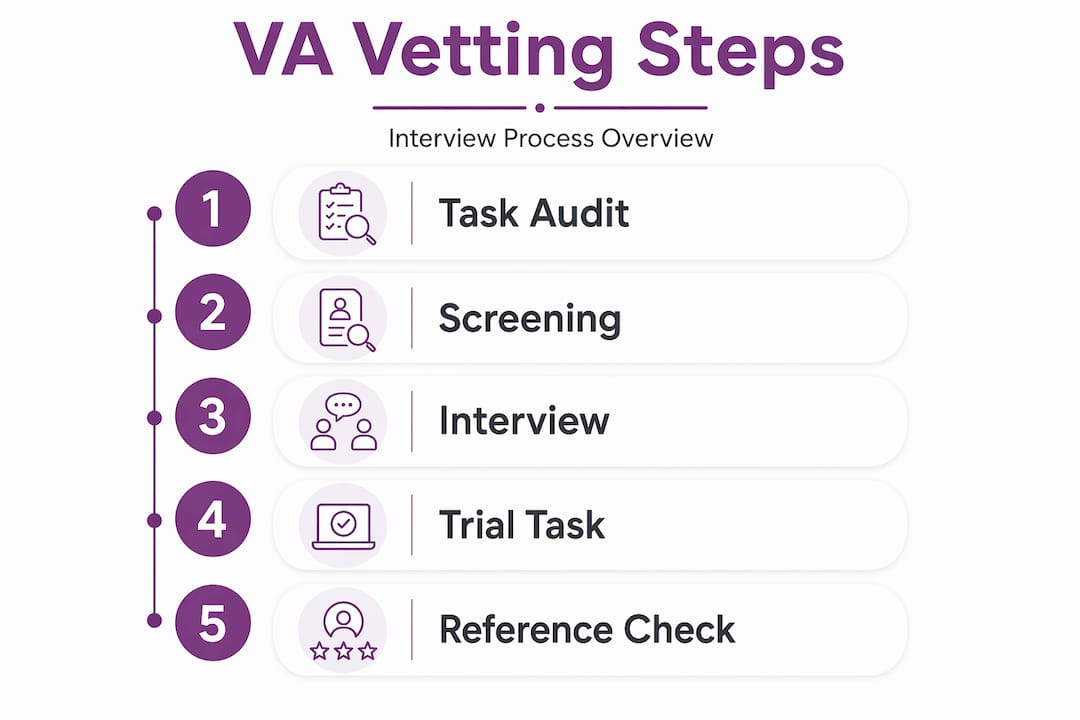
Passing an interview is not the same as being the right hire. Before you make an offer, complete these verification steps:
Call references directly. Do not rely on written testimonials. A 10-minute reference call with a former manager or client reveals real work dynamics. Ask what challenges the candidate faced, how they handled feedback, and whether the reference would work with them again.
Review actual work samples. Ask for samples specific to the tasks you need covered. A VA claiming CRM experience should be able to show a workflow they built or a report they generated. Vague portfolios or samples that cannot be attributed are worth questioning.
Confirm data security practices. If the VA will access sensitive systems, ask directly about their practices. Verifying data handling habits like password manager use, private network connections, and willingness to sign an NDA is not optional. It is the minimum bar for anyone touching client data or business credentials.
Apply least privilege access from day one. Once verified, only grant access to the tools and systems the VA actually needs. Identity verification paired with least privilege access management is the security standard for remote professionals accessing sensitive platforms.
Run a paid trial task before full commitment. Testing with a small real task exposes accuracy, communication style, time management, and how the candidate handles ambiguity. Thirty minutes of real work tells you more than an hour of questions.
Pro Tip: Include one intentionally ambiguous step in your trial task. Candidates who ask for clarification before proceeding are demonstrating exactly the habit that prevents expensive errors later.
Common pitfalls when interviewing and vetting virtual assistants
Even business owners who follow a process make avoidable mistakes. Recognizing these now will save you weeks of frustration.
Skipping identity verification. Many owners jump to background checks or skip verification entirely. IDV is a distinct step. It should happen first, before any further screening investment.
Hiring for enthusiasm, not task fit. A hard-working attitude matters, but it does not substitute for task-specific skills. Evaluate candidates on the exact work you need done.
Leaving communication expectations vague. Not defining response time expectations before someone starts is a setup for misaligned days and missed deadlines.
Overloading candidates during assessment. Giving a 10-part test to evaluate someone for a 5-task role creates unnecessary pressure and poor results. Test what actually matters.
Skipping the reference call. It feels like an extra step. It is not. It is one of your most reliable signals about how this person performs under real conditions.
“The business owners who build strong VA relationships are not necessarily the ones with the best instincts. They are the ones with the clearest processes.”
If you want a deeper look at building a long-term working relationship once you have hired the right person, the guide on finding a reliable VA covers the retention side well.
My honest take on hiring VAs in 2026
Over the years, I have seen business owners treat the VA hiring process like a quick transaction. They want someone working by Monday. That urgency is understandable. But that attitude is exactly why so many of them are rehiring for the same role six months later.
What changed my own approach was adding structure before the interview even started. I stopped evaluating candidates based on first impressions and started evaluating them based on responses to specific scenarios. The difference in quality was immediate.
The identity verification step is one that I find consistently underused. People treat it like a legal formality. It is not. When you are hiring someone remotely, you genuinely cannot confirm who is sitting at that keyboard without it. That matters for trust, for compliance, and for the safety of your systems.
Paid trial tasks are the single most reliable signal I have found. A well-designed trial task does not just show whether someone can do the work. It shows how they think when they are unsure, how they communicate when something is unclear, and whether their output actually matches what they claimed in the interview.
What most owners overlook is cultural and communication fit. Skills can be developed over time. But someone whose communication style consistently misaligns with yours creates friction every single day. Pay attention to how they write, how they ask questions, and whether they take ownership or deflect.
My recommended approach is to build for the long term from day one. Define the role clearly, screen thoughtfully, test practically, and verify thoroughly. The process takes longer upfront. But it pays back every week after that.
— Ellis
How R3source helps you hire with confidence
If you have read this far, you already understand that the process to interview and vet virtual assistants takes real structure and time. That is exactly what R3source has built on your behalf. R3source provides pre-vetted, dedicated virtual assistants and remote professionals from the Philippines, with built-in screening, identity verification, and background checks already handled. You get a professional who is ready to integrate into your operations from day one, without rebuilding the hiring process each time.
Whether you need administrative support, customer service, CRM management, or a full remote team, R3source matches you with the right person for your specific needs. Explore virtual assistant services to see how R3source can reduce your hiring risk and help you scale with confidence. You can also review client results to see how other business owners have built dependable remote teams.
FAQ
What are the most important interview questions for virtual assistants?
Ask behavioral and scenario-based questions that reveal how candidates prioritize tasks, handle unclear instructions, and manage errors. Questions like “How do you handle two urgent tasks at the same time?” uncover real working habits better than general prompts.
Why is identity verification important when screening VAs?
IDV confirms a candidate’s true identity using government-issued ID and biometric checks before background screening begins. Skipping it exposes you to impersonation risk, which is a real concern in fully remote hiring.
How do I evaluate virtual assistant skills before hiring?
Assign a short paid trial task that mirrors actual work you need done. A practical test reveals accuracy, communication style, and how the candidate handles ambiguity far more reliably than interview answers alone.
What should I look for in VA references?
Call references directly rather than relying on written testimonials. Ask whether the candidate handled feedback constructively, what challenges they faced, and whether the reference would work with them again.
How do I set clear expectations with a new virtual assistant?
Define availability windows, preferred communication tools, and response time requirements before work begins. Setting these expectations upfront prevents misalignment and creates a working relationship built on accountability from the start.
Recommended
Comments