

How Remote Professionals Handle Business Ops in 2026

Most business owners assume remote professionals are just office workers without a commute. That assumption costs them. Understanding how remote professionals handle business ops reveals something more deliberate: a system-driven, documentation-first approach that outperforms traditional in-office setups when done right. Remote work business management is not a compromise. It is a design challenge. And the teams that solve it correctly build operations that run with less friction, more accountability, and genuine capacity for growth.
Table of Contents
Key takeaways
Point | Details |
Remote ops require intentional design | Effective remote operations rely on structured systems, not informal check-ins or replicated office routines. |
Documentation replaces meetings | Documentation-first workflows maintain transparency and reduce unnecessary synchronous time across distributed teams. |
Handoff protocols prevent stalls | Explicit handoff documentation with clear completion criteria stops status ambiguity before it derails projects. |
KPIs must link to outcomes | Transparent KPIs tied to OKRs measure real impact, not hours logged or activity volume. |
Offline continuity matters | Remote teams need offline-first backup systems to maintain operations during network or connectivity failures. |
How remote professionals handle business ops today
The role of remote professionals in business systems goes far beyond answering emails or scheduling meetings. Today’s remote professionals act as central operational coordinators, building systems, managing automations, and converting routine tasks into repeatable workflows that multiply organizational output.
Think about what that actually covers. A skilled remote professional might own your CRM pipeline, manage vendor communications, coordinate cross-timezone project handoffs, and maintain the documentation library that keeps your team aligned, all without a single in-person meeting. The role of remote staff in online businesses has matured significantly. These are not task-doers filling a seat. They are systems thinkers building infrastructure.
Here is what modern remote professionals typically manage across business operations:
Administrative and scheduling operations: Calendar management, inbox triage, internal communications, and meeting coordination across multiple time zones
Customer-facing workflows: Live support, ticket management, follow-up sequences, and customer onboarding
CRM and pipeline management: Lead tracking, data hygiene, contact segmentation, and deal stage updates
Project coordination: Task assignment, deadline tracking, status reporting, and handoff documentation
Marketing support: Content scheduling, social media management, research, and campaign coordination
The role of remote staff in business development has expanded too. Many businesses working with dedicated remote professionals report faster lead follow-up, more consistent CRM data, and better client communication simply because someone owns those processes full-time. When you need to scale your business with remote staff, the infrastructure they build is what makes scaling possible.
Systems and tools that make it work
Knowing what remote professionals do is one thing. Understanding the frameworks they rely on is where the real education begins.
Companies like Dropbox have pioneered what they call a Virtual First model, reserving specific windows for synchronous collaboration and protecting the rest of the day for deep, autonomous work. Four hours of shared time. The rest is yours to execute. That structure sounds simple, but it requires deliberate calendar design and team-wide buy-in to actually function.
Documentation-first workflows are equally critical. The GitLab TeamOps framework treats remote operations as a shared reality built on written records rather than verbal agreements. Instead of replicating office meeting culture on video calls, teams write decisions, processes, and updates in a centralized knowledge base. Everyone reads before they meet. Meetings become decisions, not discussions.

Pro Tip: Create a “before you message me” doc for your remote team. It should cover how to find project files, who owns which processes, and what counts as urgent. This single document eliminates dozens of redundant questions every week.
The tools that support efficient remote operations tend to cluster around a few categories:
Project management platforms like Asana, ClickUp, or Notion with clearly defined task statuses and completion criteria
Async communication tools like Loom for video updates and Slack with channel conventions that separate urgent from non-urgent
Documentation systems like Confluence or Notion wikis that capture decisions, SOPs, and process maps in one searchable place
CRM platforms with clearly assigned ownership so no lead or client falls through the cracks
One often-overlooked system is offline continuity planning. Offline-first business practices involve caching critical documents, using locally accessible AI tools, and establishing communication protocols that do not require live internet access. For remote professionals managing operations across different regions, this is not paranoia. It is practical preparation.
Best practices for operational handoffs and accountability
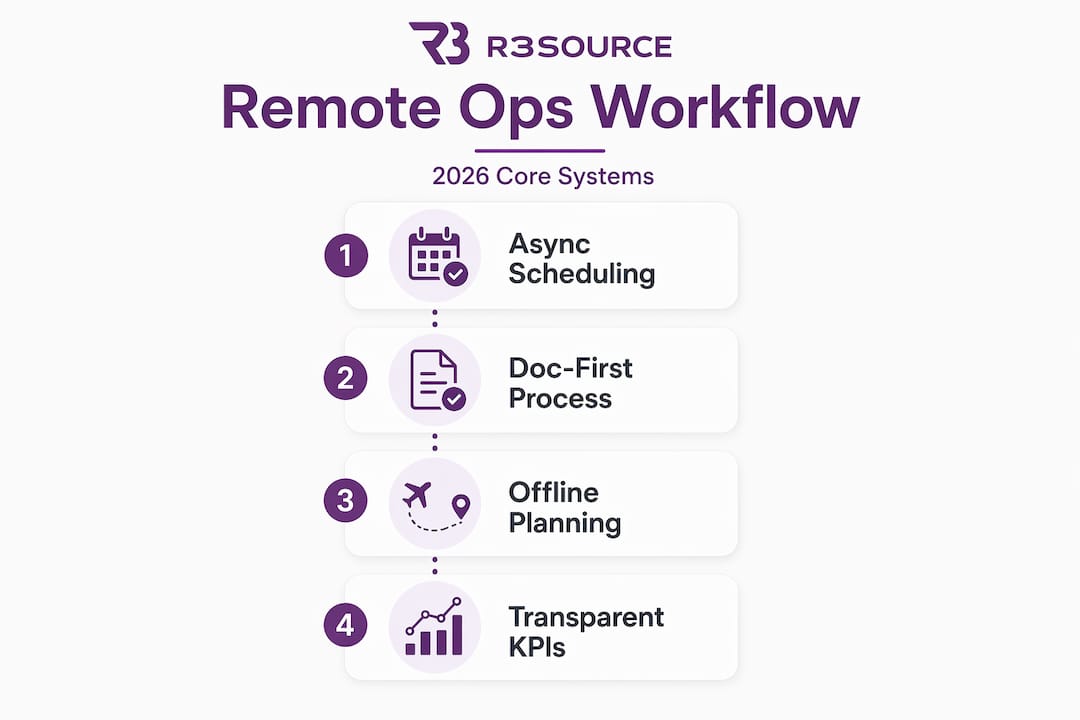
Efficient remote operations live or die on what happens between tasks, between team members, and between time zones. The handoff is where most remote teams lose time.
Explicit handoff documentation specifies three things: what information exists, where it is stored, and what “done” actually means. Without all three, the next person picks up a task without context, wastes time searching for files, or delivers work that misses the mark. This is not a minor inconvenience. It compounds across every project, every week.
Here is a four-step protocol that high-performing remote teams use consistently:
Define done before you start. Every task should have a written completion definition that a new team member could follow without additional clarification.
Document in real time, not after. Notes, decisions, and updates go into the project management tool as they happen, not during a Friday wrap-up.
Use public information defaults. As the Dropbox remote work approach suggests, information should be accessible by default. Siloed knowledge creates bottlenecks.
Reserve synchronous time for decisions, not updates. Status updates belong in writing. Live meetings belong to problems that genuinely require real-time dialogue.
Pro Tip: Set a weekly async standup ritual. Each team member posts a short written update covering what they completed, what they are working on, and any blockers. It replaces most status meetings and gives managers a clear view of momentum without requiring anyone to be online at the same time.
Measurement clarity is what holds this together. KPIs that are transparent, linked to broader OKRs, and focused on outcomes rather than activity volume give remote professionals and their managers a shared understanding of what good performance looks like. You are not tracking hours. You are tracking impact.
Challenges in remote ops and how to solve them
No system is perfect. Remote operations come with specific friction points that in-office work simply does not face in the same way. Knowing them ahead of time means you can build around them.
Network and connectivity failures: A single internet outage can stall a customer support queue or delay a critical client deliverable. The solution is an offline-first toolkit with locally cached SOPs, offline task visibility, and clear escalation protocols that do not depend on a live connection.
Ambiguity creep: When processes are not documented, knowledge lives in people’s heads. When those people are in different time zones, that knowledge becomes inaccessible for hours at a time. Rigorous documentation is not optional in distributed teams. It is the operating system.
Burnout from always-on culture: The misconception that remote work means constant availability is a real problem. Intentional async design protects focused work time and sets clear expectations about response windows. Remote professionals need deep work blocks just as much as any other high-performer.
Micromanagement disguised as oversight: Managers who track activity rather than outcomes destroy remote team trust quickly. The fix is shifting focus to results. If someone completes their work with the quality and timing agreed upon, the path they took to get there is their business.
Understanding the types of remote professionals you are working with also helps. A virtual assistant handling admin tasks needs different oversight structures than a remote operations manager building automation systems. What is a remote professional? The answer depends on the scope of responsibility, the tools they own, and the outcomes they are measured against.
What most teams get wrong about remote ops
I have seen a lot of businesses attempt remote operations and fall into the same trap every time. They take their existing office workflow, move it to Zoom and Slack, and call it remote work. It does not work. It never works.
What I have learned from watching high-performing distributed teams is that the ones who win do not try to replicate office life. They rebuild their operations from scratch with async-first assumptions. That means writing over talking. Recorded over live. Documented over remembered.
The other thing most managers miss is that accountability in remote settings is not about visibility. It is about clarity. When I look at teams that genuinely thrive, the managers are not watching screens or tracking clock-in times. They are reviewing outcomes against clearly defined expectations. That is it.
I will also say this: treating remote work as a temporary arrangement or a second-tier setup is a mistake that shows up in your results. If you design your operations with the assumption that remote is permanent and the work must be built around that reality, everything changes. The quality of documentation goes up. The communication design improves. The people you hire take the work more seriously because they can see the infrastructure behind it.
Remote work business management is not easier than running an office. It is different. The teams that treat it as a genuine discipline, with real systems behind it, build something that scales. The ones that wing it get chaos.
— Ellis
Build the remote operations team you actually need
If you are working through how to manage remote teams effectively, or you are carrying too much operational load on your own, the answer is usually not more tools. It is the right people.
R3source specializes in placing dedicated remote professionals from the Philippines who integrate directly into your business systems. These are not short-term freelancers. They are trained team members who own your CRM, manage your admin operations, handle customer communications, and keep your workflows running consistently. Nearshore remote talent can cost 30 to 60% less than US market rates while delivering the kind of reliability and accountability growing businesses need. Whether you are looking to outsource a virtual assistant or build a full remote operations team, R3source makes it practical and cost-effective. Explore your options and see what dedicated remote support can do for your business.
FAQ
What does a remote professional actually do in business ops?
Remote professionals handle day-to-day operational functions including scheduling, CRM management, customer support, project coordination, and process documentation. They act as operational coordinators who build and maintain the systems that keep a business running.
How do remote teams maintain accountability without in-person oversight?
High-performing remote teams use transparent KPIs linked to OKRs to measure outcomes rather than activity, as outlined in the GitLab measurement clarity framework. Clear definitions of done and written documentation replace the need for physical supervision.
What is the biggest risk in remote business operations?
The biggest operational risk is ambiguity. When processes are undocumented and knowledge lives only in verbal conversations, distributed teams lose continuity every time someone is offline, unavailable, or transitions out of a role.
How should remote teams handle handoffs across time zones?
Effective handoffs require written documentation that covers what information exists, where it is stored, and what the completion criteria are. Teams that follow explicit handoff protocols avoid the status stalls that slow down distributed workflows.
How do you maintain business continuity during a network outage?
Teams that build offline-first systems, including locally cached SOPs and offline task visibility, can maintain operations even when connectivity fails. Having documented protocols that do not require a live internet connection is a practical safeguard for any distributed team.
Recommended
Comments