

How Much Does a Virtual Assistant Cost in 2026?


Virtual assistant cost in 2026 ranges from $3 per hour for entry-level administrative support to over $100 per hour for specialized expertise, making it one of the most flexible staffing investments available to small business owners. The right rate depends on three core variables: the complexity of the tasks, the experience level of the assistant, and where in the world that person is based. Understanding these variables before you hire protects your budget and sets your working relationship up for success.
What are the main factors that influence virtual assistant pricing in 2026?
Virtual assistant fees in 2026 are not one-size-fits-all. The price you pay reflects a combination of what you need done, who you hire, and how you structure the engagement.
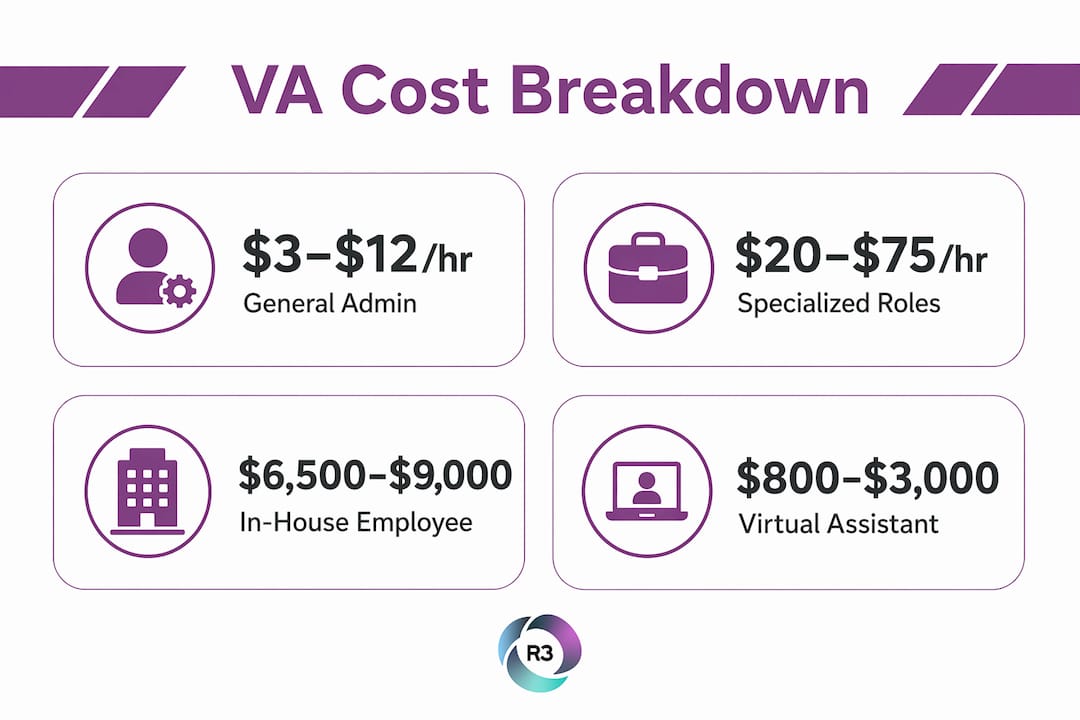
Task complexity is the single biggest driver. General administrative tasks like calendar management, data entry, and email filtering cost $3–$12 per hour. That means routine work is genuinely affordable. Specialized roles in bookkeeping, SEO, or content strategy push rates into the $20–$75 range because they require training, judgment, and industry knowledge.

Experience level matters just as much. A VA handling basic tasks with close supervision charges far less than one who manages projects independently. The gap between entry-level and executive-level support can be $60 or more per hour.
Key pricing factors to evaluate before you hire:
Task type: Routine admin, specialized marketing, or executive support each carry different rate expectations.
Experience tier: Entry-level, mid-level generalist, or senior executive assistant.
Location: US-based, Philippines-based, or Latin American VAs each occupy distinct price bands.
Engagement model: Hourly, retainer, or dedicated monthly plan.
Hours committed: Higher monthly hour commitments often reduce the effective hourly rate.
Project vs. ongoing work: One-time projects may cost more per hour than long-term retainer arrangements.
Pro Tip: Before posting a job, write out every task you want the VA to handle. Group them by complexity. This one step tells you exactly which experience tier you need and prevents you from overpaying for simple tasks.
How much do virtual assistants cost by task type and expertise?
Concrete numbers make budgeting real. Here is how 2026 virtual assistant rates break down by task category and experience level.
Entry-level VAs charge $5–$10 per hour for basic tasks like scheduling, inbox management, and simple data entry. That rate reflects limited experience and the need for clear instructions. Senior-level assistants managing strategic or executive functions charge $35–$75 or more per hour. The premium reflects independent judgment, specialized knowledge, and the ability to represent your business without hand-holding.
Task Type | Experience Level | Typical Hourly Rate |
General admin (scheduling, data entry) | Entry-level | $3–$12/hr |
Admin with minimal supervision | Mid-level generalist | $18–$35/hr |
Bookkeeping, content writing | Specialized | $20–$45/hr |
SEO, project management | Specialized/senior | $45–$75/hr |
Executive assistant, technical roles | Senior/executive | $40–$100+/hr |
Monthly costs follow the same logic. A part-time VA working 20 hours per month on general admin might cost $200–$400. A full-time specialized VA in the Philippines handling SEO or project management typically costs $1,450–$2,700 per month. That is a meaningful investment, but it is a fraction of what a comparable in-house hire would cost.
For context, a mid-level in-house employee costs $6,500–$9,000 per month when you include salary, benefits, payroll taxes, and office overhead. A comparable VA costs $800–$3,000 per month with no overhead at all. The savings are not marginal. They are structural.
Pro Tip: If you need both admin support and specialized skills, consider hiring two VAs at different rate tiers rather than one generalist at a premium rate. You get better output and often spend less overall.
When you look at the cost of virtual assistants in 2026 across task types, the pattern is clear: match the task to the tier, and you control costs without sacrificing quality.
What pricing models do businesses use for virtual assistants?
How you pay for a VA shapes the total cost as much as the hourly rate itself. Three models dominate the market in 2026.
Hourly pay. You pay only for time used. This works well for unpredictable workloads or one-time projects. The trade-off is that hourly VAs may prioritize multiple clients, which can affect response time and consistency.
Retainer or dedicated hours plan. You commit to a fixed number of hours per month at a set rate. This gives you priority access and a predictable monthly expense. A 10-hour monthly plan costs around $390, which works out to roughly $39 per hour. A 40-hour plan costs around $1,480 per month, or about $37 per hour. The rate stays similar, but the consistency and reliability improve significantly with higher commitment.
Full-time dedicated staffing. You hire a VA as a dedicated team member working exclusively for your business. This model delivers the deepest integration into your operations and the most predictable output. It is the right choice when you have enough recurring work to fill 160 hours per month.
The retainer model suits most small business owners best. It balances cost predictability with reliable access. If your workload fluctuates, a 10-hour or 20-hour monthly plan gives you support without locking you into full-time costs. As your needs grow, you scale the hours up.
Understanding when to hire a virtual assistant is as important as knowing what to pay. Choosing the wrong model at the wrong stage wastes money and creates frustration on both sides.
How do location and hiring model affect virtual assistant costs?
Geography is one of the most powerful levers in 2026 virtual assistant pricing. Where your VA is based determines the baseline rate before task complexity or experience even enters the picture.
US-based VAs average $25–$27 per hour. Philippines-based VAs charge $6–$15 per hour. Latin American VAs fall in the $15–$30 per hour range. These differences reflect local labor markets, not quality gaps. Many Philippines-based VAs hold college degrees, speak fluent English, and work in time zones that overlap with US business hours.
Geographic pricing by region:
United States: $25–$27/hr average. Best for roles requiring deep cultural alignment or real-time US-hours availability.
Philippines: $6–$15/hr. Strong English proficiency, high education levels, and significant time zone overlap with US West Coast hours.
Latin America: $15–$30/hr. Closer time zone alignment with US East Coast, growing talent pool in marketing and tech support.
Beyond geography, the hiring model changes your total cost and your risk profile.
Freelance platforms connect you directly with individual VAs. Rates are often lower, but vetting, onboarding, and management fall entirely on you.
Agency or staffing partners handle recruitment, vetting, and often provide backup coverage. Rates are slightly higher, but the reliability and accountability are built in.
The comparison between VA and employee costs consistently favors the VA model for small businesses that need reliable support without the overhead of a full employment relationship. Agencies that specialize in offshore staffing, like R3source, add another layer of quality control by pre-screening candidates and managing performance accountability.
What practical steps can small business owners take to control VA costs?
Controlling costs starts before you hire. The businesses that get the most value from their VAs are the ones that plan the engagement carefully from day one.
Steps to get the most from your VA budget:
Audit your task list first. Write down every recurring task you want to delegate. Estimate the weekly hours each task requires. This tells you the minimum hours you need and the right experience tier to hire.
Start with entry-level for routine work. If the task is repetitive and well-documented, an entry-level VA at $5–$10 per hour handles it just as well as a senior VA at $50 per hour.
Use monthly plans for predictable work. Hourly billing suits irregular projects. For recurring tasks, a fixed monthly plan gives you better rates and more consistent output.
Set clear expectations in writing. Document every process, preferred communication style, and deadline expectation before the VA starts. Ambiguity costs time, and time costs money.
Review and adjust quarterly. Your needs will change. Reassess the hours, task mix, and experience tier every three months to make sure you are not overpaying or under-utilizing your VA.
Pro Tip: Avoid the common mistake of hiring a specialized VA for tasks that a generalist could handle. Reserve your higher-rate VA hours for work that genuinely requires their expertise. Route everything else to a lower-cost tier.
For a deeper look at affordable VA options tailored to small businesses, the cost savings become even clearer when you map them against your current operational expenses.
Key takeaways
Virtual assistant costs in 2026 range from $3 to over $100 per hour, and the right rate depends entirely on task complexity, experience level, and location.
Point | Details |
Task complexity drives price | General admin costs $3–$12/hr; specialized roles cost $20–$100+/hr depending on expertise. |
Location creates major savings | Philippines-based VAs charge $6–$15/hr versus $25–$27/hr for US-based equivalents. |
Monthly plans beat hourly for consistency | A 40-hour monthly plan at $1,480 delivers better reliability than ad hoc hourly billing. |
VAs cost far less than employees | A comparable in-house hire costs $6,500–$9,000/month; a VA costs $800–$3,000 with no overhead. |
Match tier to task | Assigning routine work to entry-level VAs and specialized work to senior VAs maximizes your budget. |
The real cost conversation nobody is having
The pricing conversation around virtual assistants tends to focus on hourly rates. That is the wrong place to start. The more useful question is: what does it cost you to keep doing this work yourself?
Most small business owners I talk to are spending 15 to 20 hours a week on tasks that a well-briefed VA could handle in the same time at a fraction of their own hourly value. When you calculate the opportunity cost of a founder doing inbox management or data entry, the math gets uncomfortable fast.
The other thing I have noticed is that businesses often hire at the wrong tier. They either overpay for a senior VA to handle tasks that do not require that level of skill, or they underpay for a generalist and then get frustrated when specialized work comes back wrong. Task segmentation is the skill that separates businesses that get real ROI from their VAs and those that give up after 90 days.
The Philippines-based VA market deserves more credit than it gets. The combination of English proficiency, professional education, and competitive rates makes it one of the strongest value propositions in offshore staffing today. R3source has built its entire model around this reality, and the businesses that commit to it long-term consistently outperform those that treat VA hiring as a short-term experiment.
One more thing: hidden costs are real. Onboarding time, management overhead, and turnover all add to the true cost of a VA. Working with a staffing partner that handles vetting and accountability reduces those hidden costs significantly.
— Ellis
R3source: dedicated remote professionals at the right price
R3source connects small and mid-sized businesses with dedicated remote professionals from the Philippines, covering everything from administrative support and customer service to CRM management, lead generation, and marketing. Every team member is vetted, trained, and accountable, so you get consistent performance without the overhead of a full-time hire.

If you are ready to build a support system that fits your budget and your growth goals, R3source makes it straightforward. Visit the offshore virtual assistant page to see service options, or explore the full remote professionals FAQ to understand exactly how the hiring process works. You can also get a customized plan at r3source.com/outsource-virtual-assistant.
FAQ
What is the average cost of a virtual assistant in 2026?
The average virtual assistant hourly wage in 2026 ranges from $6–$15 per hour for Philippines-based VAs to $25–$27 per hour for US-based VAs. Monthly costs for dedicated support typically fall between $800 and $3,000 depending on hours and task complexity.
How much does a specialized virtual assistant cost?
Specialized VAs handling roles like SEO, bookkeeping, or project management charge $20–$75 per hour. Full-time specialized VAs in the Philippines cost $1,450–$2,700 per month on average.
Is a monthly VA plan cheaper than paying hourly?
Monthly plans offer similar per-hour rates but deliver better consistency and reliability. A 40-hour monthly plan costs around $1,480, which works out to roughly $37 per hour, with dedicated availability that hourly arrangements rarely match.
How do VA costs compare to hiring an in-house employee?
A mid-level in-house employee costs $6,500–$9,000 per month including overhead. A comparable VA costs $800–$3,000 per month with no benefits, payroll taxes, or office expenses, making the VA model significantly more cost-efficient for most small businesses.
What tasks are best suited for entry-level virtual assistants?
Entry-level VAs at $5–$10 per hour handle scheduling, data entry, inbox management, and basic research well. Reserve higher-rate VAs for tasks that require specialized knowledge, independent judgment, or client-facing communication.
Recommended
Comments