

Done for You Business Support: Hire Dedicated Remote Staff


If you’re running a U.S. business and your to-do list is growing faster than your capacity, done for you business support is the right move. A dedicated managed remote professional takes full ownership of execution, not just advice or hourly tasks. Rankpeak defines DFY as the provider handling strategy, setup, production, and ongoing management end-to-end. R3source delivers exactly that model: long-term, dedicated remote professionals from the Philippines integrated directly into your operations. Your immediate next step is to book an introductory consultation and scope a 30-day pilot.
Table of Contents
What does “done for you” business support actually mean?
Prism Consulting defines DFY simply: “You hand it off, and we get it done.” No training on your end, no homework, no ongoing management of the work itself.
That’s the line that separates DFY from every other model. Here’s how the four main options compare:
Model | You control | Provider delivers | Speed to results | Typical investment |
DFY (managed remote staff) | Strategy and goals | Full execution and reporting | Fast | Monthly managed fee |
Done-with-you (coaching) | Execution | Guidance and frameworks | Moderate | Coaching retainer |
Freelancer | Task scope and QA | Task output only | Variable | Per-project or hourly |
DIY tools | Everything | Software access | Slow | Low subscription |
DFY fits you when your time is scarcer than your budget, the work is repeatable, and you want predictable outcomes without managing every step, as explained by expert business brokers on acquisition strategies and operational readiness. It’s not the right fit if you want full hands-on control of every deliverable or if your workflow changes too frequently to document.
What services does a managed remote professional actually handle?
The scope is broader than most owners expect. Common DFY formats range from subscription-based repeatable tasks to fully managed operational ecosystems. Here are the core categories and what they look like in practice:

Service category | Example tasks |
Administrative operations | Calendar management, inbox triage, travel booking, document prep |
Customer service | Live chat, email support, ticket resolution, follow-up sequences |
Lead generation | Prospect research, outreach lists, LinkedIn prospecting, data enrichment |
CRM management | Contact updates, pipeline tracking, deal stage management, reporting |
Appointment setting | Outbound calls, scheduling, confirmation sequences, no-show follow-up |
Marketing support | Social media scheduling, content coordination, ad asset prep, reporting |
Bookkeeping | Invoice processing, expense categorization, reconciliation, payroll prep |
IT helpdesk | Ticket triage, software setup, user access management, troubleshooting |
Project coordination | Task tracking, vendor communication, deadline management, status updates |
Industry-specific roles | Legal intake, medical billing, e-commerce order management, listing updates |
Some providers offer turnkey bundles for a fixed scope. Others build fully customized packages around your workflow. The difference matters: a bundle is faster to start but may not map perfectly to your operations, while a custom package requires more upfront documentation but delivers tighter fit. Knowing what you can outsource before your first vendor call saves significant time.
Who benefits most from dedicated remote staff?
DFY works best when business owners want the weight lifted and reliable operational execution, not more tools to manage. The profiles that see the clearest results:
Real estate teams: A transaction coordinator VA handles contract-to-close paperwork, MLS updates, and client follow-up, freeing agents for showings and negotiations.
E-commerce stores: An operations VA manages order tracking, supplier communication, and customer service tickets, often reclaiming 15–20 hours per week for the owner.
Service-based businesses: A CRM manager keeps the pipeline clean and follow-ups consistent, so no lead goes cold while the owner is delivering work.
Founder-led companies: An executive VA handles scheduling, inbox, and project coordination, giving founders back their mornings for high-value decisions.
Busy consultants: A marketing operations specialist manages content scheduling and reporting, maintaining visibility without the consultant touching a single post.
Most owners report meaningful time savings within the first 30 days once onboarding is complete. By day 60, a well-integrated remote professional is running independently on core tasks. Outsourcing can accelerate business momentum precisely because the compounding effect of consistent daily execution adds up fast.
Pro Tip: Before hiring, list every task you do in a week that someone else could do with clear instructions. That list is your first SOP draft and your pilot scope.
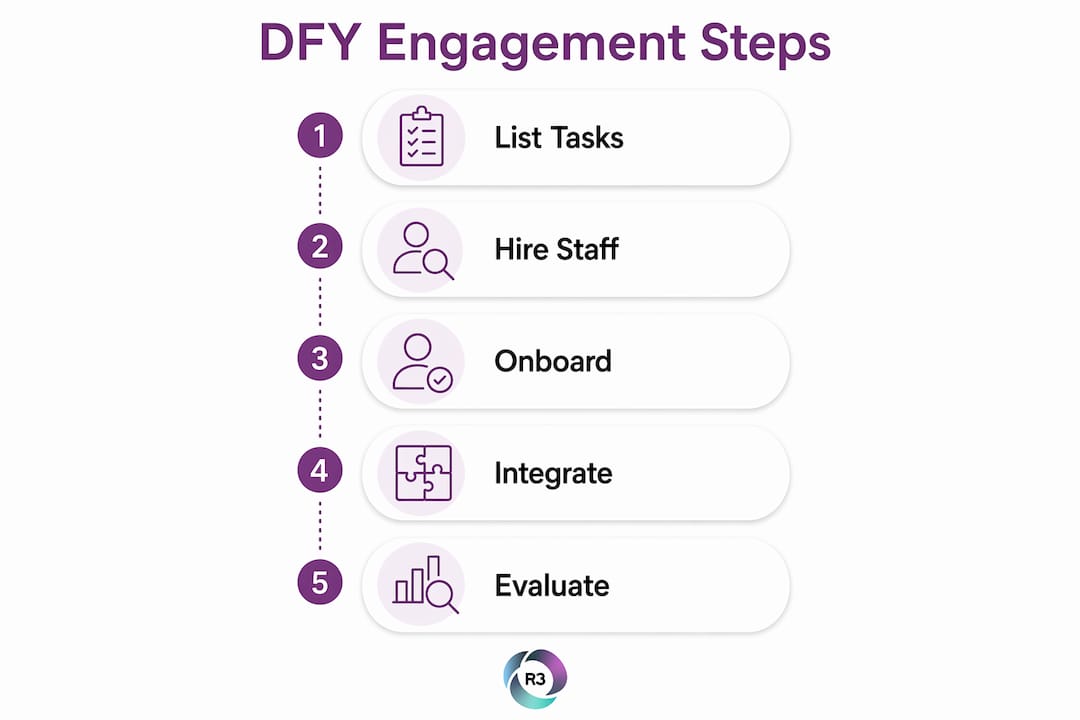
How do DFY engagements work, and what does pricing look like?
Most long-term dedicated remote staffing engagements follow one of three billing shapes:
Per-seat monthly fee: One fixed monthly rate per dedicated professional, covering their time, management, and QA oversight.
Managed retainer: A broader scope with a dedicated team lead, reporting, and account management included.
Bucket hours: Pre-purchased hours drawn down monthly, better for variable workloads than for true dedicated staffing.
For dedicated FTE-style remote staff, pricing depends on skill level, time-zone overlap requirements, scope complexity, and SLA expectations. Entry-level administrative roles typically cost less than specialized positions like medical billing or CRM management.
A 2–4 week pilot is the standard low-risk entry point. Define “done” clearly in the pilot scope: specify revision limits, turnaround times, and the exact tasks in scope. Specialized implementations, such as AI-powered marketing systems, often run 60–90 days before full handoff. Your pilot milestones should look like this:
Milestone | Timeline | What to confirm |
Access and SOP handoff | Days 1–5 | Logins, brand assets, process docs delivered |
First independent task cycle | Days 1–14 | Quality, turnaround, and communication checked |
Pilot review and go/no-go | Day 30 | KPIs met, replacement or continuation decided |
Steady-state operations | Days 31–90 | Full task load, weekly reporting active |
How do you evaluate and choose a DFY provider?
Fragmented vendors for research, writing, and implementation are one of the most common failure modes in DFY engagements. A single provider who owns the full operating rhythm, from intake to reporting, eliminates that risk.
Pre-sale checklist:
Ask for industry-specific experience and two client references you can actually call.
Request a sample SOP or onboarding document to see how they structure handoffs.
Confirm their staff hiring, vetting, and training process in writing.
Ask who owns deliverables, credentials, and data if you end the contract.
Verify security controls: NDAs, data handling policies, and access management.
Interview questions that reveal real capability:
“Walk me through your onboarding process for a new client from day one.”
“What happens if my assigned professional leaves or underperforms?”
“How do you handle escalations, and who is my point of contact?”
“What KPIs do you track, and how often do you report them?”
Red flags to walk away from:
Vague definitions of “done” with no measurable deliverable
No replacement guarantee or a replacement timeline longer than two weeks
Missing SLAs, no reporting cadence, or reporting only on request
No clear escalation path beyond the assigned VA
KPIs to include in your contract:
Task completion accuracy rate (target: 95%+)
Response time to client messages (target: within 4 business hours)
Weekly task completion rate against agreed scope
Replacement timeline if performance falls below threshold
Monthly reporting delivery date
Your 30/60/90 onboarding playbook for a remote professional
Structured onboarding is the single biggest predictor of DFY success. Rankpeak confirms that engagements fail most often when onboarding is missing or rushed.
30/60/90 plan:
Days 1–30: Hand off access, brand assets, customer FAQs, and your decision matrix. Run the first task cycle together. Set weekly check-ins.
Days 31–60: Shift to independent execution on core tasks. Review KPIs at day 45. Adjust scope if needed.
Days 61–90: Full steady-state. Monthly KPI review replaces weekly check-ins. Quarterly business review scheduled.
Reporting element | Frequency | Format |
Task completion log | Weekly | Shared spreadsheet or project tool |
KPI dashboard | Monthly | One-page summary with targets vs. actuals |
Strategic review | Quarterly | Video call with account manager |
SOP checklist before day one:
System logins and access credentials
Brand voice guide and approved messaging
Customer FAQ document
Approval windows (who approves what, in how long)
Escalation path (VA → account manager → you)
Pro Tip: Record a 10-minute Loom walkthrough of your most critical process on day one. It cuts back-and-forth questions by more than half and gives your remote professional a reference they can replay.
Real role examples and what to expect at 30, 60, and 90 days
Role | Core tasks | Day 30 | Day 60 | Day 90 |
Operations VA | Inbox, calendar, document prep, vendor follow-up | Handling 80% of tasks with check-ins | Fully independent on core tasks | Proactively flagging issues |
CRM manager | Pipeline updates, lead tagging, follow-up sequences | Data clean and sequences live | Reporting weekly on pipeline health | Suggesting process improvements |
Marketing ops specialist | Content scheduling, ad asset coordination, analytics | First month of content published | Reporting cadence established | Running campaigns independently |
Bookkeeping support | Invoice processing, reconciliation, expense tracking | Current month reconciled | Monthly close completed on time | Preparing owner-ready reports |
A real estate team that adds a transaction coordinator VA typically offloads significant hours of contract-to-close administration per week. An e-commerce owner who brings on an operations VA often reclaims substantial time previously spent on order management and supplier emails, redirecting it to product sourcing and marketing. For outsourcing before hiring full-time, these roles prove the model before you commit to a larger team.
Key Takeaways
Done for you business support works when you pair a structured onboarding plan with clear KPIs, a defined pilot scope, and a provider who owns execution end-to-end.
Point | Details |
DFY vs. other models | DFY means the provider owns execution and outcomes; you set goals and review results. |
Pilot first | Start with a 30-day pilot with defined tasks, turnaround times, and a go/no-go review. |
Vet providers carefully | Require a replacement guarantee, SLAs, a reporting cadence, and client references before signing. |
Onboarding drives success | Hand off SOPs, access, and a decision matrix in the first five days to accelerate time-to-value. |
R3source as your next step | R3source provides dedicated remote professionals from the Philippines with structured onboarding and account management for U.S. businesses. |
What actually makes DFY engagements succeed or fail
Most DFY engagements don’t fail because the remote professional was unqualified. They fail because the client handed off work without handing off context. No SOP, no decision matrix, no clear definition of “done.” The remote professional guesses, the client corrects, and both sides lose confidence in the model.
The engagements that work have one thing in common: the owner treated the first two weeks as an investment, not a test. They recorded processes, answered questions thoroughly, and gave the remote professional room to build momentum. By week four, those owners were genuinely out of the day-to-day. The ones who handed off a vague task list and expected magic were disappointed by week two.
The other underappreciated factor is account management. A dedicated account manager who sits between you and your remote professional catches problems before they become patterns. That layer of oversight is what separates a managed staffing model from simply hiring a freelancer and hoping for the best.
R3source delivers fully managed remote staffing with built-in accountability
R3source gives U.S. business owners something most staffing models don’t: a dedicated remote professional from the Philippines who is trained, managed, and accountable from day one, without the overhead of a full-time hire.

Every engagement includes a structured onboarding methodology, a dedicated account manager as your escalation point, and a replacement guarantee if performance falls short. You get weekly task reporting and monthly KPI reviews built into the service, not available as an add-on. Services span administrative support, customer service, lead generation, CRM management, appointment setting, marketing support, bookkeeping, and industry-specific roles across real estate, e-commerce, and service businesses.
If you’re ready to reclaim your time and build a dependable support system, explore R3source’s offshore VA services or book a consultation to scope your pilot today.
Useful sources and next reading
Done-for-You Services: A Practical 2026 Guide — Rankpeak: Definitions, pilot structure, onboarding components, and failure modes referenced throughout this article.
Done-for-You vs. Done-with-You — Prism Consulting: Industry definition of DFY and contrast with coaching models.
Done For You Businesses — Brand Me Now: Common DFY service formats and investment horizons.
Done For You Services — Expert Business Agency: Rationale for DFY when time is the binding constraint.
R3source — Offshore Virtual Assistant Services: R3source’s service model, role categories, and engagement options for U.S. businesses.
Business Scaling Outsourcing Checklist — R3source: Practical checklist for preparing your business to outsource critical functions.
Recommended
Comments