

Benefits of a Virtual Assistant for Business Owners


A virtual assistant is a remote professional who handles administrative and specialized tasks so you can focus on the work that actually grows your business. The benefits of a virtual assistant go well beyond simple task delegation. They include measurable cost reduction, reclaimed time, and the kind of operational consistency that lets you scale without burning out. For business owners carrying more than they ever expected, this is not a luxury. It is a practical solution with a clear return.
What are the real benefits of a virtual assistant?
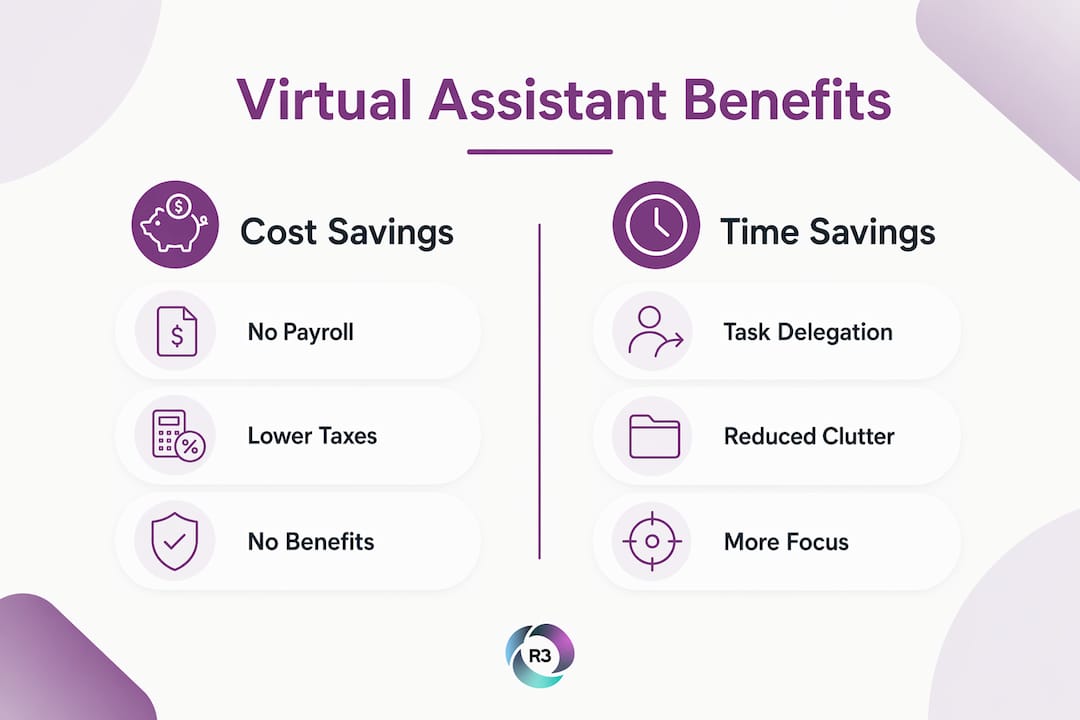
Hiring a virtual assistant is one of the most cost-efficient decisions a growing business can make. Unlike a full-time employee, a virtual assistant eliminates payroll taxes, benefits, office space, equipment, and recruitment costs. You pay only for productive hours. That shift alone changes the financial structure of your operations.
The time savings are just as significant. Business owners frequently undervalue their own time, which leads to a costly pattern of doing low-value work themselves. Every 10 hours per week spent on $10-per-hour tasks costs a business $1,500 weekly if the owner’s time is worth $150 per hour. That math makes delegation not just appealing but financially necessary.
The true ROI of a virtual assistant is not just what you save. It is what you gain by redirecting your time toward revenue-generating work. R3source builds its model around exactly this principle, matching business owners with trained remote professionals who integrate directly into daily operations.

How do virtual assistants save costs compared to full-time employees?
The cost difference between a full-time employee and a virtual assistant is substantial. A full-time hire comes with a fixed salary, employer-side payroll taxes, health benefits, paid time off, onboarding costs, and often equipment and office overhead. A virtual assistant removes every one of those line items.
Cost comparison by category
Cost category | Full-time employee | Virtual assistant |
Base compensation | Fixed annual salary | Hourly or part-time rate |
Payroll taxes | Employer-paid | Not applicable |
Health and benefits | Employer-funded | Not applicable |
Office space and equipment | Required | Not required |
Recruitment and onboarding | High upfront cost | Reduced or managed by provider |
Scalability | Slow and costly | Adjust hours as needed |
The pay-for-productive-hours model is the core financial advantage. You are not paying for downtime, lunch breaks, or slow periods. When your workload drops, you scale back. When it grows, you scale up. That flexibility is built into the model from day one.
No long-term employment contracts to manage
No severance obligations when workload decreases
No HR infrastructure needed for a remote professional
Faster onboarding compared to traditional hiring cycles
Pro Tip: Before calculating your VA budget, list every recurring task you handle weekly and assign a time value to each. This gives you a clear picture of what you are actually spending on low-value work right now.
Virtual assistant services from providers like R3source also remove the burden of sourcing and vetting candidates. The overhead reduction is immediate and ongoing, not just a one-time saving.
In what ways do virtual assistants improve time management and productivity?
Delegation is the fastest path to better productivity. Founders spend hours on tasks that do not require their expertise, and that time compounds into weeks of lost strategic focus every year. A virtual assistant takes those tasks off your plate so you can work on the business, not just in it.
The scope of what a virtual assistant can handle is broader than most business owners realize. Common tasks include:
Inbox management and email filtering
Calendar scheduling and appointment setting
Data entry and CRM updates
Customer service follow-ups and order tracking
Content scheduling and social media posting
Light bookkeeping and expense tracking
Research and report preparation
Lead generation and outreach support
Each of these tasks is rule-based and repeatable, which makes them ideal for delegation. They consume time and mental energy without requiring your specific expertise or judgment.
Delegating to a virtual assistant also reduces mental clutter. When your mind is not occupied by scheduling conflicts and inbox backlogs, your decision-making improves. Business owners who delegate effectively report less stress and sharper focus on priorities that matter.
Pro Tip: Start by delegating tasks you do on autopilot. If you can write a short instruction for it, a well-trained VA can handle it. Save your time for decisions only you can make.
Learning how to use a virtual assistant for growth is a skill in itself. The business owners who get the most from their VAs are the ones who delegate clearly and communicate expectations from the start.
What operational advantages do virtual assistants provide for flexibility and growth?
Operational flexibility is one of the most underrated advantages of virtual assistants. Traditional hiring locks you into fixed costs and long timelines. A virtual assistant model gives you the ability to scale support up or down based on actual workload. That is a structural advantage for any growing business.
Workload flexibility: Add hours during busy seasons and reduce them during slower periods without restructuring your team.
Global talent access: Geography is no longer a constraint. You can hire specialized professionals with skills in marketing, tech, customer service, and creative roles regardless of location.
Workflow consistency: A dedicated virtual assistant learns your systems and maintains consistent output, reducing errors and delays in daily operations.
Professional image: Reliable customer response times and organized back-end operations improve how clients and prospects perceive your business.
R3source specializes in long-term remote staffing from the Philippines, which gives U.S. business owners access to a highly educated, English-proficient workforce at a cost structure that works for small and mid-sized businesses. This is not a task-based freelance model. It is a dedicated professional who becomes part of your team.
The combination of flexibility and consistency is rare in traditional hiring. With a virtual assistant, you get both. You can find guidance on when to hire a virtual assistant based on your current workload and growth stage.
How can entrepreneurs apply virtual assistant benefits to grow their businesses?
Applying virtual assistant benefits effectively starts with clarity. You need to know which tasks are pulling you away from high-value work before you can delegate them well. Start by auditing your week and identifying every task that does not require your direct expertise or judgment.
Align delegation with business goals. If your goal is revenue growth, delegate everything that is not a sales or client-facing activity.
Set clear expectations upfront. Document your processes before handing them off. A short standard operating procedure prevents miscommunication and speeds up onboarding.
Measure ROI beyond cost savings. Track how many hours you reclaim each week and what you do with them. If those hours go toward client work or business development, the return is compounding.
Build a long-term relationship. A virtual assistant who understands your business over time becomes more valuable, not less. Invest in communication and feedback early.
The ROI of a virtual assistant grows as the relationship matures. A VA who has worked with you for six months knows your preferences, your clients, and your systems. That institutional knowledge has real value. You can read more about finding a reliable long-term virtual assistant to make sure your first hire sets the right foundation.
For a deeper look at the full outsourcing model, R3source’s outsource virtual assistant page covers how to structure your remote support from day one.
Key Takeaways
Hiring a virtual assistant delivers compounding returns: cost savings, reclaimed time, and operational consistency that grows more valuable as the working relationship matures.
Point | Details |
Cost savings are immediate | VAs eliminate payroll taxes, benefits, equipment, and office overhead from day one. |
Time reclaimed drives revenue | Hours saved from low-value tasks can be redirected to client work and business development. |
Flexibility beats traditional hiring | VA support scales up or down with workload, removing fixed cost risk. |
Global talent expands your options | Skilled professionals in marketing, admin, and tech are accessible regardless of geography. |
Long-term relationships compound value | A VA who knows your business deeply reduces errors and speeds up execution over time. |
What I have learned about making virtual assistants actually work
Most business owners approach a virtual assistant hire as a cost-cutting move. That framing is understandable, but it limits the outcome. The owners who get the most from their VAs treat the hire as a productivity investment, not a budget line item.
The biggest time trap I see is owners who delegate tasks but then spend just as long reviewing, correcting, or redoing the work. That usually points to a process problem, not a people problem. When you hand off a task without a clear standard, you are setting both yourself and your VA up for friction. The fix is simple: document the process once, review it together, and give honest feedback in the first two weeks. After that, the relationship runs itself.
The burnout piece is real and often overlooked. When you are doing everything yourself, you are not just losing money on low-value tasks. You are depleting the mental energy you need for the decisions that actually move your business forward. Delegation is not a sign of weakness. It is how you protect your capacity for growth.
My honest advice: start with one or two tasks that frustrate you most. Get those off your plate first. Once you feel the difference, the next round of delegation becomes obvious.
— Ellis
R3source offshore virtual assistants for business owners
R3source connects U.S. business owners with dedicated offshore virtual assistants from the Philippines who are trained to integrate directly into your operations. Whether you need administrative support, customer service, CRM management, or marketing help, R3source matches you with a professional who fits your business and stays for the long term.
The model is built for growing businesses that need reliable support without the overhead of traditional hiring. You get consistent performance, clear accountability, and a team member who learns your systems and grows with you. If you are ready to reclaim your time and build a support system that scales, R3source is ready to help you get there.
FAQ
What are the main benefits of a virtual assistant for small businesses?
The main benefits include cost savings, time recovery, and operational flexibility. Virtual assistants remove overhead expenses and free up business owners to focus on revenue-generating work.
Why hire a virtual assistant instead of a part-time employee?
A virtual assistant costs less than a part-time employee because you pay only for productive hours with no benefits, taxes, or equipment costs. The model also offers flexibility to scale hours based on workload.
What tasks can a virtual assistant handle?
Virtual assistants handle inbox management, scheduling, data entry, CRM updates, customer service, content scheduling, lead generation, and light bookkeeping. Their scope covers most repeatable administrative and support functions.
How do I measure the ROI of a virtual assistant?
Track the hours you reclaim each week and assign a dollar value based on what you do with that time. If reclaimed hours go toward client work or sales, the return exceeds the cost of the VA.
When is the right time to hire a virtual assistant?
The right time is when low-value tasks are consistently pulling you away from work that grows your business. If you are spending more than five hours a week on repeatable admin tasks, a virtual assistant pays for itself quickly.
Recommended
Comments