

Affordable Virtual Assistant Services for Small Business


Running a small business means wearing too many hats, and the overhead keeps climbing. Affordable virtual assistant services give you a real way out. Instead of hiring full-time staff for every function, you delegate to skilled remote professionals at a fraction of the cost. The challenge is knowing which services actually deliver value and which ones leave you managing more problems than you started with. This guide walks you through the top options, what separates good from great, and how to make a confident hiring decision that fits your budget and your goals.
Table of Contents
Key takeaways
Point | Details |
Price is not the only factor | Evaluating reliability, skills, and cultural fit prevents costly mistakes that offset savings. |
Billing models vary widely | Hourly, task-based, and monthly packages each suit different business needs and cash flow situations. |
Trial periods reduce risk | Testing a VA service with a low-commitment trial lets you confirm quality before a long-term contract. |
Offshore VAs offer strong savings | Philippines-based professionals can cost as little as $6 per hour, making them a top choice for SMBs. |
The right VA multiplies your capacity | Optimized VA use has been linked to 34% revenue uplift and measurable profit margin growth. |
1. What to look for in affordable virtual assistant services
Before you compare providers, you need a clear framework. Price is the starting point, not the finish line.
Here is what actually matters when evaluating your options:
Pricing structure and hidden fees. Task-based pricing starts around $5 per task, while monthly packages range from $100 to over $1,000 depending on hours and specialization. Understand exactly what you are paying for before you commit.
Skill sets and service scope. Administrative support is the baseline. The best providers also offer bookkeeping, social media management, CRM work, lead generation, and appointment setting.
Reliability and communication. A VA who misses deadlines or communicates poorly costs you more than their hourly rate. Look for services that vet their talent and offer account management.
Cultural fit and time zone alignment. Offshore VAs can present cultural and time zone challenges that affect communication quality and supervision overhead. This is a real cost that does not show up on the invoice.
Contract flexibility. Month-to-month options protect you early on. Avoid long-term contracts until you have confirmed the relationship works.
Technology and integration. Your VA should be able to work inside your existing tools, whether that is a CRM, project management platform, or communication stack.
Pro Tip: Before you sign anything, ask the provider how they handle performance issues and what their replacement process looks like. A provider confident in their talent will answer this clearly and quickly.
2. Fiverr and task-based platforms
Fiverr is the most accessible entry point for budget-conscious business owners. You post a need, browse profiles, and hire for a single task. No retainer. No commitment.
Pricing: Tasks start as low as $5, though quality work typically runs $25 to $100+ per task depending on complexity.
Best for: One-off projects like data entry, email drafting, social media graphics, or research tasks.
Strengths: Zero overhead to get started, massive talent pool, and transparent reviews.
Limitations: Inconsistent quality across sellers, no dedicated support, and no continuity between tasks. You are essentially rehiring every time.
Task-based platforms work well for testing specific functions before you commit to a dedicated assistant. Think of them as a low-stakes proving ground. What they cannot do is replace the consistency and institutional knowledge that comes from a long-term working relationship.
Pro Tip: When using task-based platforms, create detailed briefs with examples of exactly what “done” looks like. Vague instructions produce vague results, regardless of the platform.

3. Upwork and freelance marketplace VAs
Upwork sits in the middle ground between task-based gigs and dedicated staffing. You can hire a virtual assistant on an hourly basis or negotiate a fixed monthly rate, giving you more flexibility than most platforms.
Pricing: Dedicated assistants on Upwork range from $200 to $900 per month for administrative support, depending on hours and skill level.
Best for: SMBs that need consistent part-time support without committing to a full-time hire.
Strengths: Large talent pool, built-in time tracking, payment protection, and the ability to interview candidates directly before hiring.
Limitations: You are responsible for sourcing, vetting, onboarding, and managing the VA yourself. That takes time. Quality varies significantly, and turnover is common among freelancers who are juggling multiple clients.
Upwork is a solid option if you have the bandwidth to manage the hiring process. If you do not, the management overhead can quietly eat into your savings.
4. Introductory trial services
Some providers offer low-commitment trial packages specifically designed for SMBs who want to test before they invest. Certain VA services offer trial periods at introductory rates as low as $2 for four hours, letting you evaluate fit and quality with minimal financial risk.
Pricing: Trial packages typically range from free to $20 for a set number of hours.
Best for: Business owners who are new to delegating and want to confirm the model works for them before spending more.
Strengths: Near-zero financial risk, real-world testing of communication and task quality, and a clear decision point before committing.
Limitations: Trial VAs may not be the same person you work with long-term. The experience can feel disconnected from what ongoing service actually looks like.
Use trials strategically. Assign a real task you do regularly, not a synthetic test. That gives you the most accurate read on whether the service fits your workflow.
5. Dedicated offshore VA services from the Philippines
Philippines-based virtual assistants represent one of the strongest value propositions in remote staffing. Philippine VAs typically cost $3 to $10 per hour, with dedicated full-time professionals available at rates that would cover only a few hours of domestic administrative help.
Pricing: Full-time dedicated VAs from the Philippines often run $800 to $1,500 per month, depending on skill set and provider.
Best for: SMBs that need consistent, full-time or near-full-time support across administrative, customer service, or operational functions.
Strengths: Strong English proficiency, a deep talent pool trained in U.S. business practices, and significant cost savings compared to domestic hires.
Limitations: Time zone differences require some scheduling coordination. Quality varies significantly between providers, so vetting the staffing company matters as much as vetting the individual.
Pro Tip: Look for providers that assign dedicated account managers and offer replacement guarantees. These two features signal that the company is invested in long-term outcomes, not just initial placement fees.
6. Specialized VA services by industry
Not every VA service is built the same. Some providers specialize in specific industries like real estate, e-commerce, healthcare, and professional services, offering assistants trained in the tools and workflows specific to those fields.
Pricing: Specialized services typically command a premium, ranging from $15 to $35 per hour or $1,200 to $2,500 per month for dedicated support.
Best for: Business owners who need more than general admin help. Real estate agents needing CRM management, e-commerce operators needing order processing support, or service businesses needing appointment setting all benefit from industry-trained VAs.
Strengths: Faster ramp-up time, fewer mistakes, and VAs who understand your business context from day one.
Limitations: Higher cost and fewer providers to choose from. If your industry is niche, options may be limited.
The time you save on training a specialist VA often pays back the premium within the first month.
7. Side-by-side comparison of top options
Use this table to quickly assess which type of service fits your current needs and budget.
Service Type | Starting Rate | Best For | Contract Flexibility | Key Limitation |
Task-based platforms (e.g., Fiverr) | $5 per task | One-off tasks, testing | None required | No continuity or dedicated support |
Freelance marketplaces (e.g., Upwork) | $200/month | Part-time consistent support | Month-to-month | You manage hiring and oversight |
Trial-based VA services | $2 to $20 trial | First-time VA users | No commitment | Trial VA may differ from ongoing VA |
Dedicated offshore VAs (Philippines) | $800/month | Full-time operational support | Varies by provider | Time zone coordination needed |
Specialized industry VAs | $1,200/month | Industry-specific workflows | Varies | Higher cost, fewer providers |
The right choice depends on what you actually need right now, not what sounds best in theory. A solopreneur testing delegation for the first time has different needs than a 20-person team looking to offload an entire department.
8. How to choose the right service for your business
Now that you have seen the options, here is how to match them to your situation.
Start with your biggest time drain. Identify the three to five tasks eating the most of your week. That tells you whether you need a generalist or a specialist.
Set a realistic budget. Know your ceiling before you start comparing. Budget-friendly VA services exist at every price point, but your ceiling determines which category to focus on.
Prioritize reliability over the lowest rate. Optimized VA use has been linked to an 84% improvement in client response times. A slightly higher monthly rate for a reliable VA beats a cheap one who needs constant supervision.
Use a trial period before committing. Even if a provider does not advertise a trial, ask for one. Most reputable services will accommodate a short paid trial.
Evaluate onboarding support. The best providers help you set up workflows, not just hand you a contact. Ask what onboarding looks like before you sign.
Think about scale. If you plan to grow, choose a provider that can grow with you. Adding a second VA should be straightforward, not a new procurement process.
Check for replacement policies. If your VA leaves or underperforms, how quickly can the provider replace them? This is a critical question that most buyers forget to ask.
Learning how to hire a virtual assistant the right way saves you months of trial and error. The process is learnable, and the payoff compounds over time.
My honest take on balancing cost and quality
I have seen business owners make the same mistake repeatedly. They find the cheapest option, run into quality or communication problems, spend weeks managing the fallout, and then conclude that virtual assistants do not work. That conclusion is wrong. The service model works. The selection process failed.
The cheapest VA is rarely the most cost-effective one. What actually delivers ROI is a VA who integrates into your operations, communicates clearly, and shows up consistently. That combination is worth paying a modest premium for. Administrative cost reductions of over 60% are achievable, but only when the right person is in the right role with the right support structure.
My advice: treat your VA as a strategic partner, not a task dispenser. The businesses I have seen get the most out of remote assistant services are the ones that invest in onboarding, communicate expectations clearly, and build real working relationships with their remote staff.
The cost savings are real. So is the capacity for growth you unlock when you stop doing everything yourself.
— Ellis
How R3source helps you build the right remote team
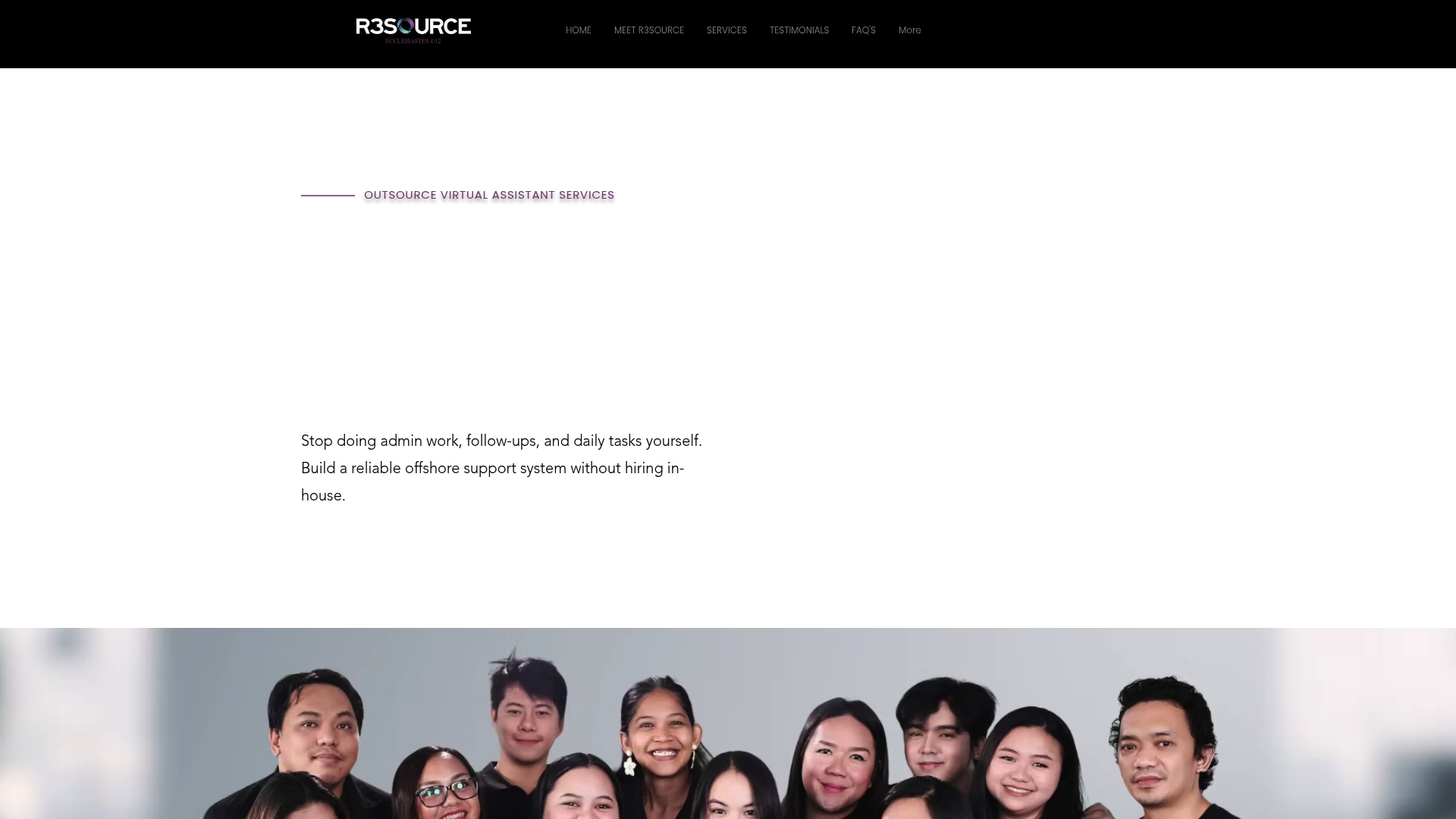
R3source connects U.S. small and mid-sized businesses with dedicated, vetted virtual assistants and remote professionals from the Philippines. These are not freelancers cycling between clients. They are long-term team members trained to integrate into your operations from day one.
R3source covers administrative support, customer service, lead generation, CRM management, appointment setting, and marketing support. Every professional goes through a thorough vetting process, and you get account management support to make the transition smooth.
If you are ready to build your remote team or want to explore what dedicated support looks like for your business, R3source offers scalable solutions that fit real SMB budgets. You can also learn more about outsourcing virtual assistant work to see exactly how the model works before you commit.
FAQ
How much do affordable virtual assistant services cost?
Pricing ranges widely. Task-based options start around $5 per task, while dedicated monthly plans typically run $200 to $1,500 depending on hours, skill set, and whether the VA is domestic or offshore.
What tasks can a virtual assistant handle for a small business?
VAs handle administrative work, email management, scheduling, customer service, CRM updates, lead generation, social media, and bookkeeping. Specialized VAs also support industry-specific workflows in real estate, e-commerce, and professional services.
Is it worth hiring a virtual assistant from the Philippines?
Yes, for most SMBs. Philippines-based VAs offer strong English proficiency, familiarity with U.S. business practices, and rates significantly lower than domestic hires, making them one of the most cost-effective options available.
How do I know if a VA service is reliable before committing?
Ask about replacement policies, request a trial period, and look for providers with dedicated account managers. Reading verified client reviews and checking how the provider handles underperformance gives you a clearer picture than pricing alone.
Can a virtual assistant actually reduce my business overhead?
Yes. When matched correctly to your needs, the right VA can cut administrative overhead significantly and free up your time for revenue-generating work, which is where the real financial impact shows up.
Recommended
Comments