

15 Tasks to Outsource to a Virtual Assistant Today


Outsourcing specific tasks to a virtual assistant is the fastest way for overwhelmed business owners to reclaim their time and refocus on growth. The 15 tasks you should outsource to a virtual assistant today span inbox management, bookkeeping, customer service, and more. Delegating even three core administrative tasks can reclaim 8–15 hours per week. That time compounds. Every hour you stop spending on repetitive work is an hour you can put toward decisions only you can make.
Which tasks are best suited for outsourcing to a virtual assistant?
The best tasks to delegate share three traits: they repeat on a regular schedule, they follow a clear process, and they do not require your direct professional judgment or legal authority.
Tasks that fit this profile include inbox sorting, data entry, appointment scheduling, and social media posting. Tasks that do not fit include crisis management, licensed financial advice, and any decision that carries legal or reputational risk. Successful outsourcing separates high-fit tasks from judgment-heavy ones. Mixing the two is the most common reason early outsourcing attempts fail.
Before you hand off any task, ask two questions:
Is it ready? Does your virtual assistant have every login, template, and data source needed to start without asking you?
Is it done-able? Can you describe exactly what “finished” looks like, for example, “all contacts entered with no duplicates” rather than “clean up the contacts”?
Pro Tip: Write your Definition of Done before you assign any task. One clear sentence describing the finished state cuts revision cycles in half.
15 tasks you should outsource to a virtual assistant today
The tasks below are the highest-impact items on any virtual assistant task list. They are ordered by how quickly most business owners feel the relief after delegation.
1. Email and inbox management
Your inbox is a productivity trap. A virtual assistant can sort, label, draft replies, and flag only the messages that need your attention. Email management is one of the top three time-saving tasks business owners outsource. Most owners reclaim one to two hours daily from this single delegation.
2. Calendar and appointment scheduling
Scheduling is a back-and-forth that consumes far more time than it appears. A virtual assistant handles meeting requests, sends confirmations, blocks focus time, and reschedules conflicts. You show up where you need to be, without the coordination overhead.

3. Travel planning and logistics
Booking flights, hotels, ground transport, and building itineraries is detail-heavy work that follows a repeatable process. A virtual assistant manages the entire sequence, including backup options when plans change. You receive a ready-to-use travel brief.
4. Bookkeeping and expense management
Bookkeeping and administrative support rank among the top outsourcing categories because they are repeatable and require no specialized licensed judgment for day-to-day entry. A virtual assistant logs receipts, categorizes expenses, reconciles accounts, and prepares reports for your accountant. You stay financially organized without touching a spreadsheet daily.
5. Social media content scheduling and engagement
Consistency on social media requires time, not creativity. A virtual assistant schedules posts using tools like Buffer or Later, responds to comments, and tracks basic engagement metrics. You provide the content direction; they handle the publishing cadence.
6. Data entry and CRM maintenance
Dirty data costs sales. A virtual assistant enters leads, updates contact records, merges duplicates, and keeps your CRM current. This task has a clear Definition of Done and zero ambiguity, making it a perfect fit for delegation.
7. Customer service and client follow-up
Customer service is a top outsourcing category because response speed directly affects client satisfaction. A virtual assistant handles first-response emails, follows up on open tickets, and escalates complex issues to you. Clients feel heard faster, and you handle only the conversations that require your authority.
8. Document preparation and formatting
Proposals, reports, slide decks, and contracts all need formatting before they go out. A virtual assistant applies your brand templates, corrects formatting inconsistencies, and prepares final versions for your review. You sign off on polished documents instead of building them from scratch.
9. Research and information gathering
Market research, competitor analysis, vendor comparisons, and background checks on prospects all follow a repeatable research process. A virtual assistant compiles findings into a structured summary you can act on. You get the insight without the hours of digging.
10. Content creation support
A virtual assistant can proofread blog posts, format articles, write first-draft social captions, and repurpose existing content into new formats. This is not a replacement for your voice or strategy. It is the production support that turns your ideas into published content faster.
11. Basic graphic design and media editing
Tasks like resizing images, creating branded social graphics in Canva, or editing short video clips for social media are time-consuming and process-driven. A virtual assistant with basic design skills handles the production queue. You focus on creative direction.
12. Vendor and supplier research
Finding new vendors, comparing quotes, and building shortlists is research work that follows a clear brief. A virtual assistant gathers options, organizes them in a comparison format, and presents you with a decision-ready summary. You make the final call with full information in front of you.
13. Invoice and payment tracking
Chasing unpaid invoices and reconciling payments is critical but repetitive. A virtual assistant monitors due dates, sends payment reminders, logs received payments, and flags overdue accounts. Cash flow visibility improves without you managing the follow-up manually.
14. Event planning and coordination
Virtual and in-person events require logistics management: venue research, vendor coordination, attendee communication, and timeline tracking. A virtual assistant manages the moving parts against a master checklist. You show up prepared instead of scrambling.
15. HR and payroll administrative support
Onboarding paperwork, timesheet collection, benefits enrollment coordination, and employee record maintenance are all process-driven HR tasks. A virtual assistant handles the administrative layer while your HR decisions remain yours. This is especially valuable for small teams without a dedicated HR department.
Pro Tip: Start by outsourcing just two or three tasks from this list. Build confidence in the process before expanding. Incremental delegation builds better systems than trying to hand off everything at once.
How to delegate tasks to a virtual assistant effectively
Effective delegation is a skill. The quality of your handoff determines the quality of the output.
Documenting tasks with outcome definitions, quality standards, and escalation paths allows virtual assistants to work independently and gives you a clear audit trail. Without documentation, you spend more time correcting than you save by delegating. The best practices for VA integration consistently point to upfront clarity as the single biggest factor in outsourcing success.
Follow this framework before handing off any task:
Write a standard operating procedure (SOP). One page is enough. Describe the task, the tools used, the steps, and the expected output.
Define the outcome, not just the activity. “Send follow-up emails to all leads from last week’s event by Friday at 5 p.m.” is a clear outcome. “Do some follow-up” is not.
Provide all access upfront. Logins, templates, style guides, and data sources should be ready before the first task begins. Gaps in access create delays and erode trust.
Set a review checkpoint. For new tasks, review the first completed batch before the virtual assistant continues. Catch misalignments early.
Keep high-risk tasks with yourself. Legal decisions, financial approvals above a set threshold, and client relationship crises stay on your plate.
Outsourcing repeatable, measurable work while retaining direct ownership of judgment-heavy tasks is the principle that separates successful outsourcing from frustrating experiences.
Pro Tip: Record a short screen-share video the first time you complete a task yourself. Send that video to your virtual assistant as the primary training resource. It is faster than writing and easier to follow.
Key takeaways
Outsourcing repetitive, process-driven tasks to a virtual assistant is the most direct path for business owners to reclaim time, reduce mental load, and focus on work that actually grows their business.
Point | Details |
Start with three core tasks | Inbox, calendar, and customer service deliver the fastest time savings after delegation. |
Define done before you delegate | A clear outcome statement prevents rework and miscommunication from the start. |
Provide all access upfront | Missing logins or templates are the top cause of early outsourcing delays. |
Keep judgment-heavy tasks yourself | Legal, financial, and crisis decisions should never be delegated to a virtual assistant. |
Build incrementally | Delegating two or three tasks first builds the systems and trust needed to scale further. |
What I have learned from watching business owners outsource
Business owners almost always underestimate the mental relief that comes from outsourcing. They go in expecting to save money. What they actually gain first is the ability to think clearly again.
The owners I have seen struggle with outsourcing share one pattern: they delegate tasks without delegating the context. They hand off inbox management but never explain what a priority email looks like. They assign CRM entry but never define what a complete record means. The virtual assistant does their best with incomplete information, the output falls short, and the owner concludes that outsourcing does not work. It does work. The handoff just needed more structure.
The owners who get it right start small and document everything. They treat the first two weeks as a setup investment, not an immediate time-saver. By week three, the hours start coming back. By week six, they have stopped thinking about the tasks entirely.
The real productivity benefit of outsourcing is not the hours on a timesheet. It is the mental space to work on the things that only you can do. That shift changes how you run your business.
My honest advice: pick one task from this list today. Write the SOP tonight. Hand it off this week. The confidence you build from that first successful delegation is what makes the next fifteen possible.
— Ellis
R3source can handle these tasks for you
Building a capable support system does not require a long hiring process or a large budget. R3source provides trained offshore virtual assistants from the Philippines who integrate directly into your operations and handle the tasks on this list from day one.
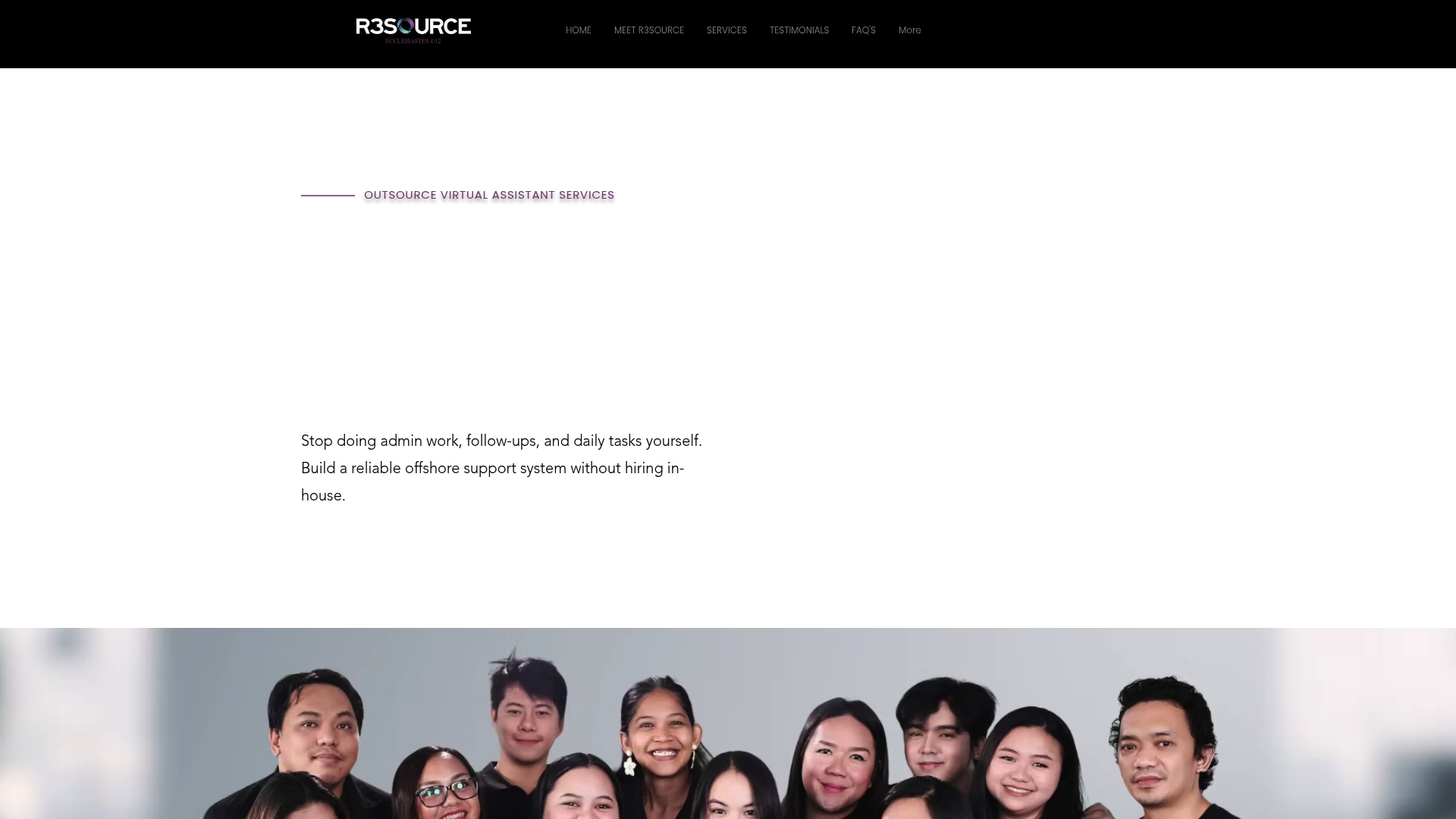
Whether you need offshore virtual assistant services for administrative work, customer service, or CRM management, R3source matches you with a dedicated professional who fits your business. Every engagement is built for the long term, not just a one-off project. If you are ready to build your team, R3source is a dependable place to start. You can also explore virtual assistant options for entrepreneurs to compare what level of support fits your current stage.
FAQ
What tasks should I outsource to a virtual assistant first?
Start with inbox management, calendar scheduling, and customer follow-up. These three tasks deliver the fastest time savings and are the easiest to document for a new virtual assistant.
How many hours per week can a virtual assistant save me?
Delegating two or three core administrative tasks can reclaim 8–15 hours per week. The exact number depends on your current workload and how clearly you define each task before handoff.
What tasks should I never outsource to a virtual assistant?
Avoid delegating legal decisions, licensed financial approvals, and any client situation that carries reputational risk. High-risk or judgment-heavy tasks should stay with you regardless of how experienced your virtual assistant is.
How do I know if a task is ready to delegate?
A task is ready when you can describe the finished output in one sentence and provide every tool, login, and template your virtual assistant needs before they start. If either condition is missing, prepare those materials first.
Is outsourcing to a virtual assistant cost-effective for small businesses?
Outsourcing key functions like bookkeeping, admin, and customer service costs significantly less than hiring a full-time employee for the same work. The savings compound when you factor in the additional revenue-generating time you recover.
Recommended
Comments