

30 Day Document First Delegation Playbook for Founders' Time Freedom


Time freedom for founders means having genuine control over when, where, and how much you work, including the ability to step away without your business breaking down. The path there runs through three moves: design systems, delegate the repeatable work, then protect what’s left of your calendar. It rarely happens by accident. Most founders who get there did deliberate, often uncomfortable work first.
Most founders can identify their top three weekly time drains within five minutes and test delegating one task for at least a month.
Creating clear standard operating procedures and assigning outcome-focused ownership are essential steps for long-term delegation success.
Building structural boundaries like no-meeting days and boundary-based decision rights helps protect reclaimed operational hours.
Achieving durable time freedom typically takes six to 18 months of consistent experiments, documentation, and building operational independence.
Focused remote staffing in roles like CRM management, support triage, and admin tasks supports scalable, ongoing operational autonomy.
Table of Contents
Key Takeaways for Founders Chasing Time Freedom
You don’t need a five-year plan to start moving toward time freedom. You need a short list of honest observations and a willingness to test one change at a time.
Here’s what actually moves the needle, based on how founders who’ve built real operational independence describe the process:
Time freedom has a visible shape. It looks like taking a full week off without your inbox catching fire, or setting office hours you actually keep, instead of answering client texts at 9 p.m.
Start by naming your time drains. Most founders can list their three biggest time sinks in under five minutes once they actually sit down and track a week.
Write one SOP before you hire anyone. A documented process turns “only I know how to do this” into “anyone trained can do this.”
Hire for one task, not a vague role. A dedicated virtual assistant who owns your inbox triage or CRM updates will outperform someone hired to “help with stuff.”
Block a no-meeting day and defend it. This is the cheapest, fastest time freedom experiment you can run this month.
Measure hours reclaimed, not just tasks completed. If you delegated calendar management but you’re still checking it daily, nothing actually changed.
Expect the payoff to lag the investment. The structural advantages that reduce founder time pressure usually show up months after the systems work, not the week you build them.
The founders who get frustrated with delegation often skipped the documentation step. The ones who stick with it treat the first month as data collection, not failure.
What Counts as Time Freedom (and What Doesn’t)
Time freedom for a founder looks nothing like time freedom for an employee. An employee who wants flexibility negotiates remote days or a four-day week with their employer. A founder has to build the entire scaffolding, from client relationships to cash flow, that makes stepping away possible at all. That’s a fundamentally different problem, and it’s why generic productivity advice tends to fall flat for business owners.
The clearest way to define it: time freedom is the ability to choose when, where, and how much you work, without your revenue or operations collapsing the moment you’re unreachable. It’s a state of control over your schedule that has to be engineered, not wished into existence. Notice what’s missing from that definition. It doesn’t say “working fewer hours.” A founder who works 20 hours a week but has to personally approve every invoice, answer every support ticket, and manage every client relationship doesn’t have time freedom. They have a smaller job with the same leash.
This is where people conflate three separate things: time freedom, financial freedom, and autonomy. Financial freedom means the business generates enough income that money stops being the constraint. Autonomy means you get to set your own rules and priorities, even if you’re still working constantly. Time freedom means the business runs without your constant physical presence. You can have autonomy without time freedom. Plenty of founders have complete control over their calendars, on paper, yet feel obligated to fill every hour because no one else can do what they do. That’s autonomy without operational independence, and it’s a trap disguised as success.
Here’s the trade-off most founders don’t see coming: starting a business almost always reduces time freedom before it expands it. You trade a boss’s schedule for a customer’s schedule, a vendor’s deadline, a server that goes down at 2 a.m. The early years of running a business often demand longer hours than any job you left behind, precisely because you’re building the systems that will eventually buy back your time. Skipping that investment doesn’t get you to freedom faster. It just means you never build the foundation that makes freedom possible.
Why Founders Chase Time Freedom and Where They Get Stuck
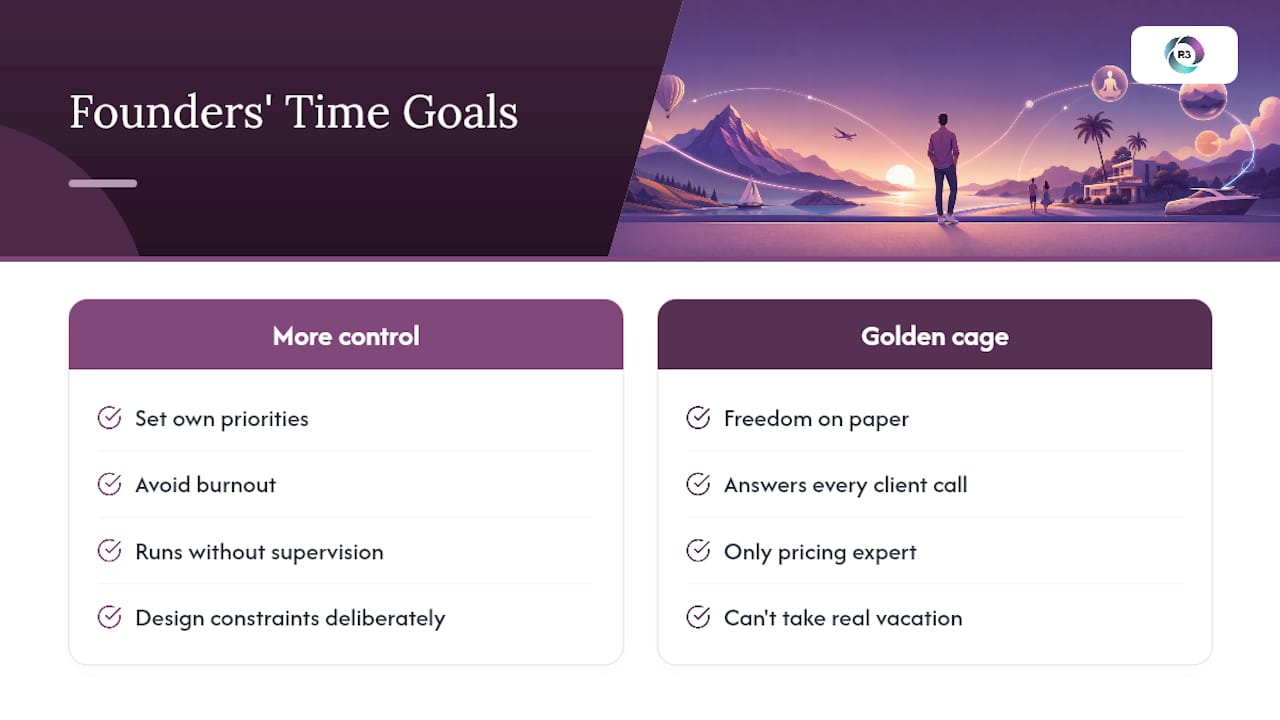
Founders don’t chase time freedom because they want to work less. Most want control. They want to set their own priorities, avoid the burnout that swallowed a previous job or a previous version of the same business, and build something that doesn’t require their constant supervision to survive. That distinction between wanting less work and wanting more control matters, because it changes what you should actually optimize for.
The most common trap is what some founders call the golden cage. Revenue is good. The lifestyle looks enviable from the outside. But the founder is still answering every client call, still the only person who understands the pricing logic, still unable to take a real vacation. Freedom on paper. Handcuffs in practice. It’s easy to mistake a profitable business for a free one, and plenty of founders don’t notice the difference until they try to take two weeks off and realize the business can’t run without them.
Bootstrapped companies have a particularly rough version of this problem. Growth tends to be slow in the first year or two, personal financial pressure stays high, and the founder absorbs every operational gap because there’s no team yet to absorb it. Companies that survive what’s sometimes called the 18-month wall tend to share a structural trait: lower fixed costs and some kind of support system, whether that’s a co-founder, an early hire, or outside help, that takes pressure off the founder before burnout sets in. The founders who don’t build that support tend to be the ones who quietly disappear from the market at month 14 or 15.
The deeper mistake is treating freedom as something you find rather than something you design. Real autonomy, according to one framing from a founder-focused business blog, comes from choosing your constraints deliberately: which clients you’ll say no to, which hours are genuinely off limits, which decisions you’ll delegate even if you could technically make them faster yourself. Founders who wait for freedom to arrive once revenue hits some number usually keep moving that number. Founders who design constraints now tend to get there faster, with a business that’s actually smaller in scope but larger in what it can run without them.
A Founder’s Playbook for Building Time Freedom
Time freedom isn’t a mindset shift. It’s an operational rebuild, and it follows a fairly predictable sequence once you’ve watched enough founders go through it. Here’s the order that actually works, based on how founders successfully move from doing everything themselves to running something that functions without their constant input.
1. Find the three tasks eating your week
Before you delegate anything, you need to know what’s actually consuming your time. Most founders guess wrong here. They assume it’s the big strategic work when it’s actually email triage, scheduling, and answering the same five customer questions on repeat.
Track your hours for one week, in 30-minute blocks if you can stand it. At the end of the week, circle the three tasks that ate the most time and ask a simple question about each: does this require my judgment, or does it require a documented process someone else could follow? The tasks in the second category are your delegation candidates. Founders who work through this exercise often find that a handful of workflow habits are quietly consuming ten or more hours a week without producing anything a client would notice.
Then run a 30-day experiment. Pick exactly one of those tasks and commit to removing yourself from it for a full month, whether that means delegating it, automating it, or cutting it entirely. One task, one month, and a clear before-and-after read on your calendar. That’s the whole test.
2. Turn the task into a document someone else can follow
You can’t delegate what only exists in your head. Before you hire anyone or hand off anything, write it down. Not a novel. A short, working checklist: what to do, when to do it, and how to check the work is right.
The best SOPs read like instructions, not essays. “Check the shared inbox every morning at 9 a.m. Sort by client tier. Respond to tier-one tickets within two hours using the templates in the shared drive. Flag anything involving a refund over $200 to the founder.” That’s a usable document. A five-page narrative about your customer service philosophy is not, and it’s one of the most common mistakes founders make when they try to hand off work for the first time. Treat the checklist as a living document, too. The first version won’t be perfect, and the person who ends up owning the task should be updating it within the first few weeks.
3. Delegate to someone who owns the outcome, not just the task
Freelancers are useful for one-off projects. They’re often the wrong fit for the recurring, integrated work that actually frees up a founder’s calendar, because a new person shows up every time and you’re back to re-explaining context. This is the core reason dedicated remote staff outperform gig freelancers for ongoing operations: the same person learns your business once and gets better at running it every week after that.
A clean handoff needs three things: a named owner, a documented SOP, and a short list of what “done right” looks like. Example roles that lend themselves well to this kind of dedicated ownership:
CRM management — keeping lead records current, tagging follow-ups, flagging stale opportunities
Customer support triage — first-response handling, ticket categorization, escalation for anything outside the SOP
Appointment setting and calendar management — running your booking pipeline so meetings land on your calendar already qualified
Administrative support — invoicing, data entry, vendor coordination, the dozens of small tasks that don’t need founder judgment but do need consistency
The handoff checklist matters as much as the hire. Walk the new owner through the SOP together, have them run it while you watch, then let them run it solo while you review results, not process. That last step is where most founders slip. They keep checking how the work gets done long after they should only be checking whether the outcome is right.
4. Automate the parts that don’t need a human at all
Some tasks don’t need delegation. They need a trigger. Email rules that route messages by subject line, CRM workflows that auto-tag leads based on source, calendar automation that blocks off recovery time after a string of client calls. None of that requires a person, and setting it up once tends to save more time than any single delegated task. Automation examples like these, from CRM triggers to scheduled reporting, work best when they’re paired with delegation rather than treated as a replacement for it. A person still needs to own the exceptions the automation can’t handle.
5. Price for value, not for hours
If your revenue is tied directly to your personal hours, you will never fully separate your calendar from your income. This is the quiet reason a lot of founders can’t take real time off even after they’ve delegated the operational work: the pricing model still assumes they’re the product.
Shifting toward productized offers, retainers, or flat packages breaks that link. A client paying for a defined outcome, delivered by a defined process, doesn’t need to know or care whether you personally touched every step. That’s a pricing conversation as much as an operations one, but it’s often the missing piece for founders who’ve delegated everything else and still feel chained to their revenue.
6. Protect the time you’ve bought back
Delegation without boundaries just creates more capacity for you to fill with new obligations. Set a no-meeting day and treat it as immovable. Require an agenda before any meeting gets booked on your calendar at all; if no one can articulate what decision needs to be made, the meeting doesn’t need to exist. And push decision rights down to the people running your delegated processes. If your CRM owner has to check with you before tagging a lead correctly, you haven’t actually delegated the task. You’ve just added a step.
Pro Tip: Pick one recurring meeting on your calendar right now and ask whether it could be replaced with a short written update instead. If the answer is yes, cut it this week, not next quarter.
7. Measure your operational hours, not just your revenue
Track your own weekly hours spent on operations, separate from strategic or creative work, for at least a month before and after each delegation experiment. If you delegated your inbox but you’re still spending six hours a week reading it “just to check,” the experiment hasn’t worked yet, whatever your calendar app claims. Set an explicit target, even a rough one like “under ten operational hours a week,” and revisit it every quarter.
The Foundations That Make Time Freedom Last
A single successful delegation experiment doesn’t make time freedom durable. What makes it stick is the structure underneath: clear roles, solid onboarding, and metrics that tell you when something’s drifting before it becomes a crisis.
Start with decision rights. Every role you delegate needs an explicit answer to “what can this person decide without me?” A CRM owner who can update lead statuses but has to escalate anything involving pricing changes has clear boundaries. Without that clarity, every decision defaults back to the founder, and you’ve built a title without actually removing yourself from the loop.
Onboarding is where a lot of delegation quietly fails. A new hire who gets a document and a “good luck” tends to produce inconsistent work for months. A structured onboarding process that includes shadowing, supervised practice, and a clear review cadence gets someone to reliable performance far faster, and it’s the difference between a delegation experiment that sticks and one you quietly walk back after six weeks of frustration.
Once someone’s running a role, watch the numbers that actually indicate whether the system is working:
Response time — how quickly customer inquiries get a first reply
Ticket backlog — whether unresolved items are piling up or staying current
Scheduling accuracy — the error rate on appointments or calendar bookings
Founder operational hours — the metric that matters most, tracked weekly
The outsource-versus-hire question comes down to volume and specialization. If a task takes a few hours a week and doesn’t require deep company-specific context, a dedicated remote professional handling it as part of a broader role often makes sense. If a function is core to your competitive advantage and growing fast, an in-house hire eventually makes more sense. Most founders start with the former because it’s faster to set up and doesn’t require the full commitment of a direct hire while you’re still testing which roles genuinely need dedicated ownership.
How Long Time Freedom Actually Takes to Build
Founders searching for time freedom often want a date. There isn’t a clean one, but there is a reasonably predictable arc if you’re doing the work in the right order.
Months 0 to 3: run your first delegation experiment. Pick one task, document it, hand it off, and track the hours you actually reclaim. This phase is about proof, not scale. You’re testing whether the process holds up, not trying to overhaul your whole operation at once.
Months 3 to 6: stabilize the SOP and fix what breaks. The first version of your documentation will have gaps. Expect to revise it two or three times as the person running it hits edge cases you didn’t anticipate.
Months 6 to 18: build one reliable owner per core function. By this stage, a founder who’s stayed consistent usually has customer support, scheduling, and administrative work each sitting with a dedicated owner, not bouncing back to the founder’s desk.
Ongoing: run a quarterly time audit. Every three months, track your operational hours for one week and compare it to the prior quarter. A trend line moving down, alongside steady or improving SLA metrics like response time and ticket backlog, is the clearest sign the system is holding.
The signs of real progress aren’t dramatic. They’re a Tuesday where nothing broke while you were offline, a client question that got answered without you, a week where your calendar had more strategy time than firefighting. Small, boring, and repeatable. That’s what durable freedom actually looks like in practice.
Where Dedicated Remote Staff Fit Into the Time Freedom Equation
A dedicated virtual assistant can take real ownership of the recurring work that keeps founders tied to their desks, provided the handoff is structured. This isn’t about outsourcing a single task to whoever’s available. It’s about placing one consistent person into a defined role, long enough that they stop needing constant supervision.
The roles that tend to transfer well to a dedicated remote professional include CRM management and lead follow-up, customer support triage, calendar and appointment management, and the administrative backbone of daily operations, invoicing, data entry, vendor communication. None of these require the founder’s specific judgment once the process is documented. All of them eat hours every single week.
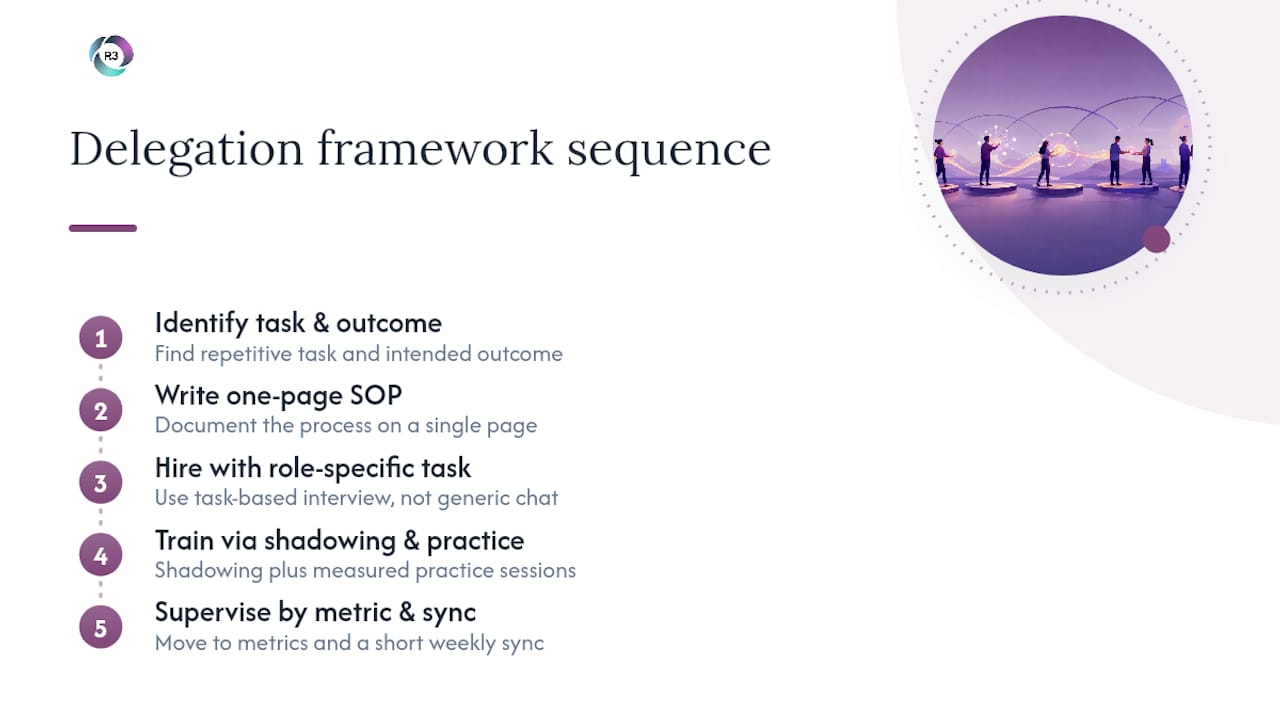
The delegation framework that tends to produce reliable results follows five steps: identify the repetitive task and its intended outcome, write a one-page SOP, hire a dedicated resource using role-specific interview tasks rather than generic interviews, train through shadowing and measured practice, and move to supervision-by-metric with a short weekly sync. This is the same structure that helps founders avoid burnout when they try to scale past the point where they can personally do everything.
These are examples of typical outcomes when onboarding and supervision are done carefully, not guarantees for every business.
Pro Tip: Before you hire for a role, write the SOP first, even a rough one. Interviewing a candidate against a real, documented task tells you far more than a general conversation about their experience.
What I’ve Noticed About Founders Who Actually Get There
The founders who reach real time freedom rarely talk about it in grand terms. They talk about small, specific wins: a Friday where nothing needed their input, a client call that got handled without them, a vacation where they didn’t check their phone for four straight days. That’s the tell. Time freedom doesn’t announce itself. It shows up as an absence, the meeting that didn’t need to happen, the fire that didn’t need putting out.
What surprises people most is how much of this comes down to saying no early and often. Saying no to the client who wants a call instead of an email. Saying no to being the person who personally approves every small decision. Saying no to a pricing model that keeps your income tied to your hours. Every one of those choices feels like a small loss of control in the moment. Together, they’re what actually builds the control founders say they want.
If you want to test this instead of theorizing about it, pick one recurring task you’re doing right now that someone else could learn to do. Document it this week. Hand it off next week. Measure what happens to your calendar in 30 days. Keep the experiment small enough that a failure costs you almost nothing and a success teaches you something real about what your business actually needs from you.
— Ellis
Ready to Build Your First Delegation Win?
If you’ve made it this far, you already know the tasks quietly running your calendar instead of the other way around. There are services that provide dedicated, long-term remote professionals who integrate into your daily operations instead of showing up as one-off freelancers you have to re-explain everything to every time. That’s the practical difference between hiring for a task and hiring for an outcome.
An introductory consultation with a remote staffing service often starts with the same exercise this article walks through: identifying the two or three tasks eating the most founder time and mapping which ones are ready to hand off now. From there, you’ll get a clear picture of what a dedicated virtual assistant could own within the first 30 days, along with realistic expectations for onboarding and the metrics worth tracking early on. If you’re ready to see what that first delegation win could look like for your business, book a free strategy call and start the conversation this week.
Sources
Recommended
Comments