

Save 40–60%: SMBs Transition Their Back Office With a 2–4 Week Pilot


Run a scoped pilot before you sign anything long-term. Pick one or two high-volume, rules-based functions, test them for two to four weeks with a real provider, and only then commit to a full 30, 60, 90 day transition. Map your processes first, set baseline metrics, and put SLAs in writing. Providers succeed or fail based on that discipline, not on promises made in a sales call.
Conduct a two to four-week pilot on high-volume, rules-based functions with a real provider before committing to long-term outsourcing.
Expect cost reductions of 40 to 60 percent when scope is well defined and the provider is qualified, with quick ramp-up in accuracy and performance.
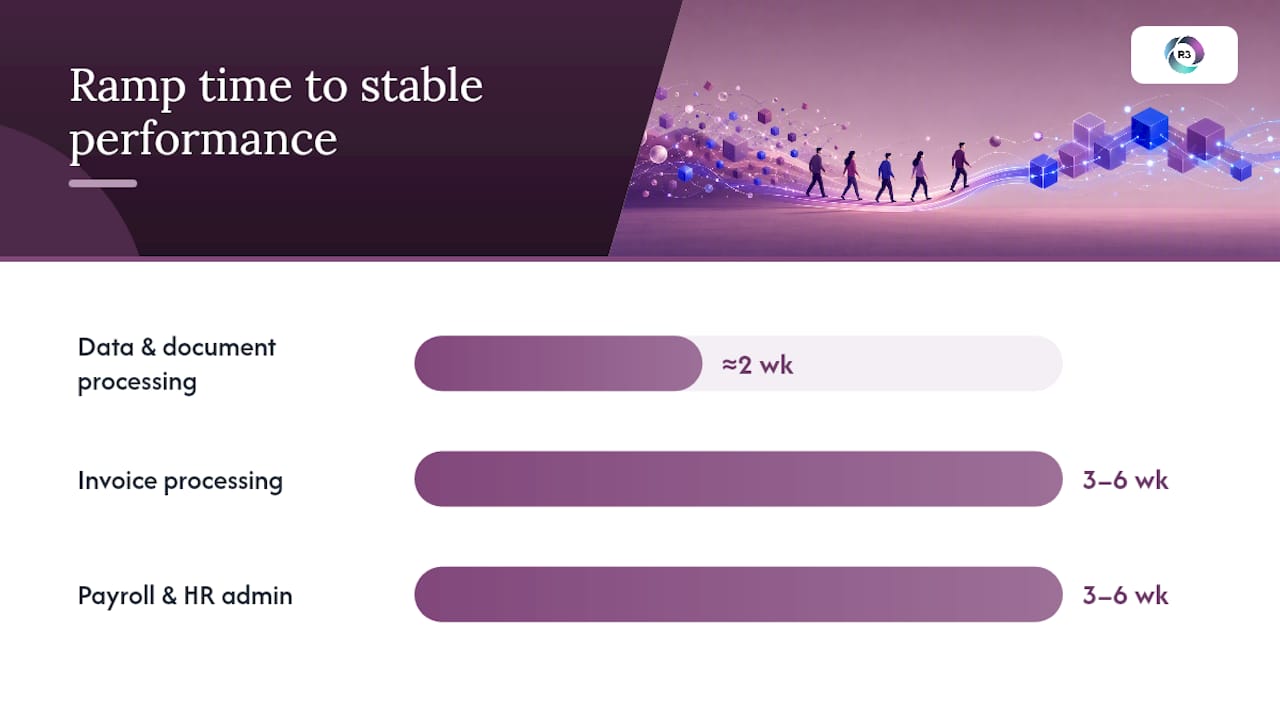
Start outsourcing with tasks like data entry, invoice processing, and payroll, which typically reach stability within three to six weeks.
Use a phased approach over 30, 60, and 90 days to map processes, automate routine steps, and establish performance benchmarks and governance routines.
Carefully scope, score, and set measurable SLAs, and budget for integration, exception handling, and vendor management to avoid hidden costs.
Table of Contents
What Measurable Benefits Should You Expect From Outsourcing?
The financial case is usually the easiest one to make, and it is also the most misunderstood. You’re not just swapping a salary line for an invoice. You’re converting a fixed cost into a variable one, which means you pay for output instead of paying for a desk, a chair, and a benefits package whether the work shows up or not.
Cost reductions of 40 to 60% compared to an equivalent in-house team are common when the provider is qualified and the scope is well defined, according to industry benchmarks on back-office outsourcing. That range holds up because most SMB owners undercount what their in-house team actually costs. Recruiting fees, software licenses, management hours, and turnover all hide inside a payroll number that looks smaller than it really is.
Beyond raw savings, here’s what else shows up on the balance sheet within the first two quarters:
Scalability that matches demand instead of lagging behind it (adding headcount for a busy season without a hiring cycle)
Access to skills you couldn’t justify hiring full time, like a bookkeeper who also understands e-commerce reconciliation
24/7 processing on tasks that don’t need to wait for a 9-to-5 shift
Fewer errors and less rework when automation handles routine steps and a person checks the exceptions
That last point matters more than people expect. The best-performing outsourcing models pair automation with human oversight, not one or the other. Skip the governance, and you’ll still save money. You just won’t save as much as you could.
Which Back-Office Functions Should You Outsource First?
Start with work that’s high in volume, low in ambiguity, and painful to keep doing in-house. These functions tend to ramp fastest and deliver the clearest proof of concept:
Data entry — repetitive, rules-based, easy to measure for accuracy within the first week or two.
Invoice processing — high transaction volume, clear success metrics (turnaround time, error rate), and immediate cash-flow visibility once it’s running smoothly. Our guide to invoice processing outsourcing walks through what good looks like.
Document processing and management — filing, indexing, and data extraction that eats hours without requiring judgment calls.
Payroll administration — structured, calendar-driven, and often the first thing owners admit they dread doing themselves.
HR admin — onboarding paperwork, benefits enrollment tracking, and PTO logging.
Each of these can reach stable performance in three to six weeks once the provider has clean documentation to work from. Data entry and document processing usually ramp fastest, often hitting target accuracy within the first two weeks. Payroll and HR admin take slightly longer because they touch compliance deadlines that leave no room for a learning curve.
Functions like underwriting, tax filing, or anything with heavy regulatory exposure deserve more caution. Consider a nearshore or onshore option, or at minimum a longer supervised period, before letting an offshore team run those independently. The risk isn’t competence. It’s the cost of a compliance miss while everyone is still learning the process.
If you want a broader list of starter tasks before committing to a full function, 15 tasks to outsource to a virtual assistant today is a useful place to browse.
How Do You Decide What to Outsource First?
Score every candidate function on five criteria before you commit a pilot slot to it. This takes fifteen minutes and saves months of second-guessing later.
Volume: Does this task happen often enough that a provider can build muscle memory quickly?
Rules-based clarity: Can you write the steps down without needing a judgment call on most cases?
Cost per transaction: What does it cost you in-house right now, per invoice or per record, including the time nobody tracks?
Compliance sensitivity: Would an error here trigger a fine, an audit, or a client relationship problem?
SME dependence: Does this work currently live in one person’s head, with no documentation anywhere else?
Score each function from 1 to 5 on the first three criteria (higher is better for outsourcing) and invert the last two (lower risk scores better). A function that scores high on volume and rules-clarity but low on compliance sensitivity, like invoice coding, is your pilot candidate. A function that scores high on SME dependence, like a founder’s personal client negotiations, stays in-house until it’s documented well enough to hand off.
Pro Tip: *Run this scoring exercise with whoever currently does the work, not just with leadership.
The 30-60-90 Day Transition Plan That Actually Works
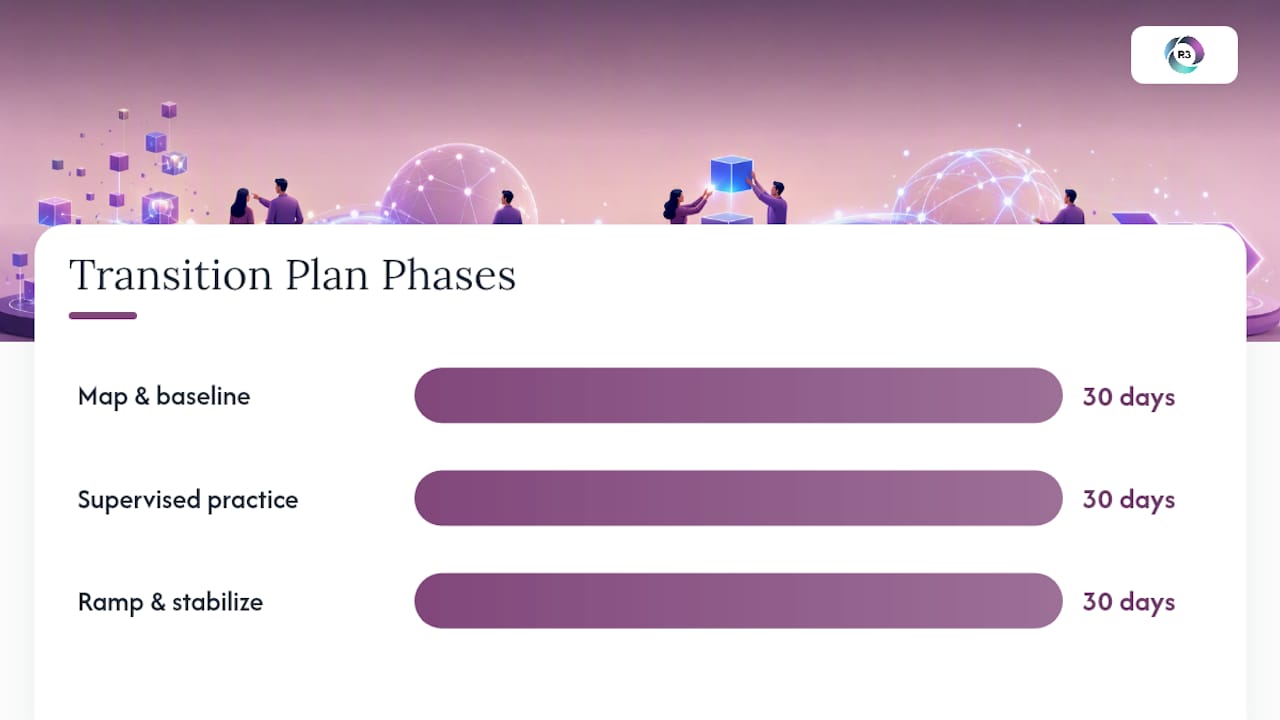
A phased transition beats a hard cutover almost every time. The 30-60-90 model gives you natural checkpoints to catch problems before they compound, and it gives your provider room to earn trust instead of demanding it up front.
Days 0 to 30: Map and baseline
Document your current process end to end, including the exceptions nobody writes down.
Set baseline metrics: current turnaround time, error rate, and cost per transaction, so you have something real to compare against later.
Select your pilot scope, one or two functions, and assign an internal owner who has time to actually manage the relationship.
Kick off knowledge transfer sessions and get standard operating procedures into writing.
Days 31 to 60: Supervised practice and automation
Run the pilot function with close supervision, reviewing output daily at first, then weekly as accuracy stabilizes.
Build an exception taxonomy so both sides know what counts as a routine case versus one that needs escalation.
Layer in automation rules for the parts of the process that don’t need a human touch.
Stand up a basic dashboard tracking accuracy, turnaround time, and volume against your baseline.
Days 61 to 90: Ramp and stabilize
Increase volume toward full production levels.
Move from a ramp-period SLA to the full contracted SLA, with performance now measured against real targets instead of learning-curve allowances.
Start a root-cause review of any recurring errors, not just a count of how many happened.
Establish a governance rhythm, typically a monthly or quarterly strategic review, alongside weekly operational check-ins.
Build a buffer into every phase. If leadership expects full production by day 45, tell them the honest number is closer to day 75 once you account for holidays, unexpected volume spikes, and the reality that knowledge transfer never goes exactly as planned. Presenting a realistic timeline up front protects your credibility later, when the pilot inevitably needs one more week than the spreadsheet said.
How Should You Design a Pilot Before Committing Long-Term?
A pilot only works if it’s designed to fail informatively, not just to succeed quietly. Keep the scope narrow: pilot projects of two to four weeks with a parallel run against your existing process give you a clean, apples-to-apples comparison.
Set numeric targets before you start, not after:
Volume target (how many transactions or records processed per week)
Accuracy target (percentage correct against a reviewed sample)
Turnaround time target (hours or days from receipt to completion)
Knowledge transfer should move in a specific order: capture your SOPs in writing, walk the new team through supervised practice on real (not test) data, shadow a few live cycles together, then open a tight feedback loop where corrections happen daily instead of piling up for a monthly review.
Pro Tip: Watch for a specific failure signal: if your provider stops asking clarifying questions after week one, that’s not competence. That’s someone guessing instead of confirming, and it usually shows up as a quiet accuracy drop by week three.
Exit criteria matter as much as success criteria. Decide in advance what “this isn’t working” looks like, whether that’s missed accuracy targets two weeks running or a communication gap that never closes, so you’re not making that call emotionally in the middle of a busy month.
What SLAs and KPIs Should You Require From a Provider?
Your contract should specify numbers, not adjectives. “High quality” means nothing when there’s a dispute six months in. Here’s what belongs in writing:
Accuracy percentage, measured against a defined sample size and review method
Turnaround time, stated in hours or business days per transaction type
Exception aging, tracking how long unresolved cases sit before escalation
Rework rate, the percentage of completed work that has to be redone
Cost per outcome, not just cost per hour, so you’re measuring value delivered
The smartest structure separates ramp-period SLAs from full SLAs. A well-built agreement, as detailed transition guides recommend, starts performance at a percentage of the eventual target during the first four to eight weeks, then steps up to full commitment once the team has proven itself. Build in remedies for missed milestones at each step, whether that’s a credit, an extended ramp, or an escalation to a senior account manager.
Governance shouldn’t be an afterthought bolted onto the contract’s last page. Weekly operational check-ins catch small problems before they become patterns. Quarterly strategic reviews are where you evaluate whether the partnership is still solving the problem you hired it to solve, and whether it’s time to expand scope. Your account owner, on both sides, should be named in the contract, not left as “someone from the team.”
Ask for dashboard access, not a monthly PDF. Real-time visibility into volume, accuracy, and exception status turns governance from a guessing game into an actual conversation.
What Risks and Hidden Costs Should You Watch For?
The sticker price on a provider’s proposal rarely tells the whole story. Budget for these before they surprise you:
Integration costs, since connecting your systems to a provider’s platform almost always takes longer and costs more than the sales deck implies
Exception handling time, which scales with complexity, not just volume
Vendor management hours, because someone on your side has to actually run this relationship
Switching costs, if the provider underperforms and you need to move on
Before signing anything that touches sensitive data, demand evidence, not assurances. Ask for documentation on background checks, SOC 2 or ISO 27001 compliance, and encryption standards. A provider that can’t produce this quickly is telling you something.
The best mitigation is structural: run the pilot, write a documented exit plan before you need one, and define your internal change management process so staff know what’s changing and why, before the transition starts rather than after complaints pile up.
Some managed staffing models build every client relationship around this same phased logic, because skipping steps is where most outsourcing transitions go wrong. Onboarding starts with process mapping and SOP capture, moves through supervised practice, and settles into an ongoing account manager model so there’s a named point of contact, not a rotating support queue.
Clients typically experience across the first 90 days:
Weeks 1 to 2: role definition, documentation review, and staff matching against the specific function being outsourced
Weeks 3 to 6: supervised practice with daily feedback, similar to the pilot structure outlined above
Weeks 7 to 12: full production volume with a dedicated account manager monitoring performance against agreed metrics
The model prioritizes long-term dedicated staff over task-based freelancers, which matters most in functions like invoice processing or CRM management where continuity and institutional knowledge compound in value over months, not days.
Outsourcing as a Growth Lever, Not Just a Cost Cut
The conventional pitch for outsourcing focuses almost entirely on savings, and that framing undersells what’s actually available. The real value shows up when outsourcing frees your best internal people from repetitive work so they can do the thing you actually hired them for. That’s a growth lever, not a budget line.
Accelerate adoption once a pilot proves out, and don’t stop at one function. The businesses that get the most from this model treat their first successful transition as a template, not a one-time fix.
The caution: none of this replaces governance. A provider without SLAs, metrics, and a named account owner will drift, regardless of how good the individual staff members are.
— Ellis
Start Your Transition With a Pilot, Not a Leap of Faith
R3source gives you a lower-risk way to test outsourcing than hiring your first in-house remote employee cold: you get a dedicated, long-term professional matched to your specific function, with onboarding support and SOP capture built into the process from day one, instead of a freelancer who disappears after one project.
Booking a consultation gets you a real conversation about pilot scope: which function to start with, a realistic timeline, and what account management looks like once the pilot moves to full production. There’s no pressure to commit to a full team on the first call. You’re scoping a two-to-four week test, the same disciplined approach outlined throughout this guide, before deciding what comes next. If you’re weighing outsourcing against outstaffing models generally, this comparison of core differences is worth a read first.
Ready to see what a dedicated remote professional looks like for your business? Book an introductory consultation and start scoping your pilot this week.
Sources
For readers who want to go deeper on specific pieces of this plan, these guides informed the recommendations above:
Recommended
Comments