

What Does Business Scalability Mean for Growth?

Business scalability is defined as the capacity to grow revenue and output without a proportional increase in costs or a decline in performance. It is not simply about getting bigger. It is about getting more efficient as you grow. A software platform that serves 100 users and 100,000 users at nearly the same operating cost is the textbook example. A consulting firm that must hire one new employee for every new client is not scalable by that same standard. Understanding this distinction is the foundation every entrepreneur needs before making decisions about systems, hiring, or technology.
What does business scalability mean vs. general growth?
Growth and scalability are related but not the same. Growth means your revenue increases alongside your costs. You add customers, you add staff, you add overhead. The ratio stays roughly constant. Scalability means growing output while keeping cost increases disproportionately small. Revenue climbs faster than expenses. That gap between the two is where profit and operational leverage live.
Consider two service businesses. The first is a staffing agency that places workers manually. Every new client requires more recruiters, more phone calls, and more administrative hours. Revenue grows, but so does the cost base at nearly the same rate. The second is a SaaS platform that automates candidate matching. Adding 500 new clients requires almost no additional labor. The platform scales. The staffing agency grows.

Dimension | Business growth | Business scalability |
Cost relationship | Costs rise with revenue | Costs rise slower than revenue |
Headcount | Increases proportionally | Stays flat or grows minimally |
Margin over time | Stays flat or compresses | Expands as volume increases |
Primary driver | More inputs | Better systems and processes |
Risk profile | Predictable but limited | Higher upfront investment, higher long-term return |
Pro Tip: Before you hire your next employee, ask whether a documented process or a software tool could handle that workload instead. Scalability starts with that question.
The importance of business scalability becomes clear when you look at long-term sustainability. Businesses that grow without scalability hit a ceiling. Margins compress, founders burn out, and the operation becomes too complex to manage. Businesses that scale build capacity ahead of demand and protect their profitability as they expand.
What are the key dimensions of scalability in business operations?
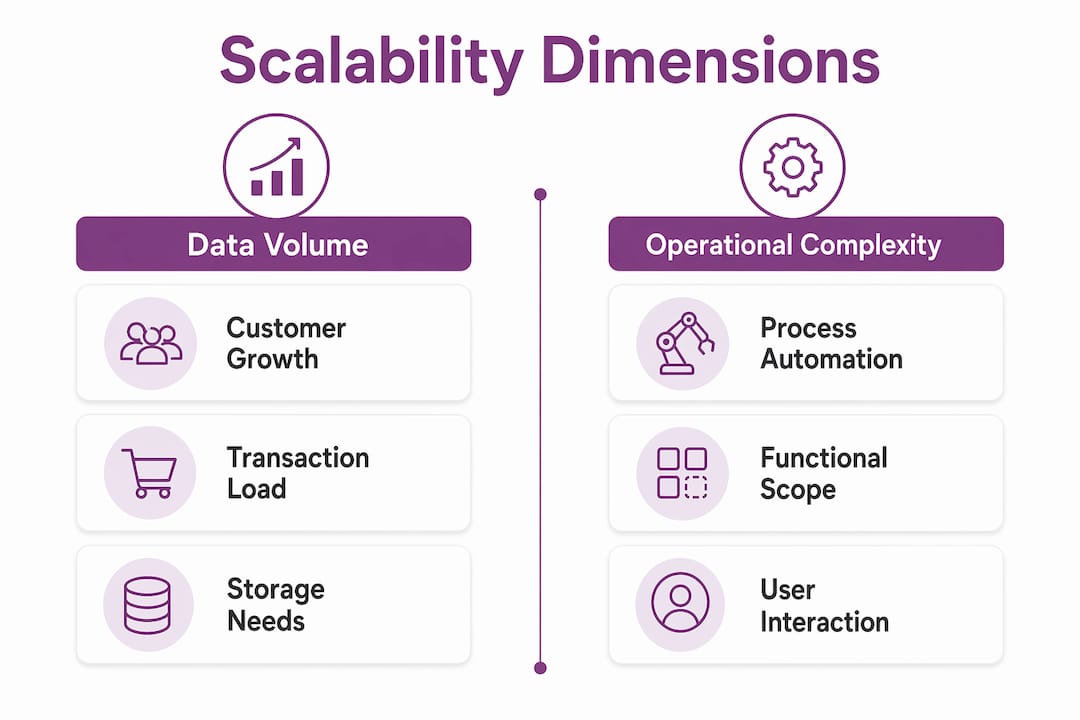
Scalability in business systems is measured across three practical dimensions: data volume, functional complexity, and user capacity. A business that handles 50 invoices a month needs different infrastructure than one handling 50,000. The question is whether your current systems can absorb that growth without breaking or requiring a complete rebuild.
Revenue per employee is one of the clearest operational benchmarks for scalability. Targets above $300,000 in revenue per employee signal that a business is generating high throughput without proportional labor costs. That number operationalizes what scalability actually looks like in practice. It tells you whether your systems are doing the heavy lifting or whether your people are.
Here are the core indicators that a business is genuinely scalable:
Consistent service quality regardless of whether you serve 100 or 10,000 customers
Documented, repeatable workflows that do not depend on any single person’s knowledge
Technology infrastructure that handles increased load without degrading performance
Margins that hold or improve as customer volume increases
Onboarding processes that add new clients or team members without slowing operations
A business that handles 10,000 customers with the same quality it delivered at 100 is demonstrating real scalability. That is not an accident. It is the result of deliberate system design.
Pro Tip: Map your current cost-to-serve per customer. If that number does not decrease as volume grows, you have a scalability problem worth addressing now rather than later.
Operational leverage is the underlying concept here. It describes how much additional revenue a business generates for each additional dollar of cost. High operational leverage means the business earns significantly more without spending proportionally more. Software companies and platforms typically have high operational leverage. Traditional service businesses often do not, unless they redesign their delivery model.
What are the most common scalability challenges businesses face?
The most damaging scalability mistake is ignoring it early. A design decision that takes one day at the seed stage can take months to fix at Series A when scalability debt has accumulated. This applies to software architecture, operational processes, and organizational structure equally. The cost of rework grows exponentially with the size of the business.
Founder-dependence is one of the most common and least discussed scalability killers. When the founder is the decision-maker, the relationship manager, and the quality controller, the business cannot grow beyond what one person can personally manage. Every new customer adds pressure rather than profit. The business is not scalable. It is a high-revenue job.
Common pitfalls that block scalability include:
Monolithic system architecture that requires a full rebuild to add new features or handle more users
Manual workflows that cannot be handed off, documented, or automated
Founder-dependent processes where institutional knowledge lives in one person’s head
Skipping scalability testing until a growth surge exposes the bottleneck at the worst possible moment
Reactive infrastructure decisions made under pressure instead of proactively during planning
Continuous scalability testing prevents the emergency patchwork that derails growth. Stress-testing your process steps, data handoffs, and system capacity before you need them reveals limits while you still have time to fix them. Businesses that treat scalability testing as a quarterly practice rather than a crisis response protect their growth trajectory.
Pro Tip: Audit your three most time-consuming operational processes. If any of them require you personally to complete, that is your first scalability bottleneck to resolve.
The shift from monolithic to modular design applies beyond software. Operationally, it means building departments, workflows, and teams that can function independently and expand without disrupting the whole. A customer service team that operates on documented scripts and CRM workflows scales. One that relies on tribal knowledge and verbal handoffs does not.
How to achieve scalability in your business
The foundation of scalable business models is documented, repeatable workflows that do not depend on any individual’s memory or availability. When a process lives in a written standard operating procedure, it can be handed to a new team member, automated, or improved without starting from scratch. That shift from founder-dependent to system-dependent operations is where scaling becomes achievable rather than theoretical.
Here are the strategic steps that build genuine scalability:
Document every core process before you try to delegate or automate it. You cannot systematize what is not written down.
Adopt cloud infrastructure that scales on demand. Tools like AWS, Google Cloud, and Microsoft Azure allow you to pay for capacity as you grow rather than over-investing upfront.
Measure unit economics consistently. Track your cost to acquire a customer, cost to serve a customer, and revenue per employee. These numbers tell you whether you are scaling or just growing.
Build modular teams where each function operates with clear ownership, documented workflows, and minimal cross-dependency.
Test before you need to. Run load tests on your systems and process audits on your operations before a growth surge forces the issue.
Outsource non-core operations to free internal capacity for revenue-generating work. Remote teams support scalable growth by handling operational tasks without the overhead of full-time local hires.
Scale proven models, not experiments. Validate your unit economics at small scale before investing in aggressive expansion.
Scalability is a multidomain challenge involving leadership, culture, operations, governance, and HR, not just technology. MIT Sloan’s course on scaling entrepreneurial ventures emphasizes that operational coordination is the harder problem. Technology is the enabler. People and processes are the constraint. Businesses that treat scalability as a technology problem alone consistently underperform those that address the organizational dimensions simultaneously.
AI initiatives deliver large value gains only when workflows and operating models are redesigned end-to-end. That finding from BCG applies broadly. You cannot bolt scalability onto an existing operation. You have to design for it. That means making architectural and process decisions early, even when the current volume does not demand it yet.
Key takeaways
Business scalability requires deliberate system design, documented workflows, and operational leverage built before growth demands it.
Point | Details |
Scalability vs. growth | Scalability grows revenue faster than costs; growth increases both at a similar rate. |
Revenue per employee | Targets above $300K per employee signal genuine operational leverage and scalability. |
Early design decisions | Scalability debt compounds fast; a one-day fix at seed stage becomes months of work at Series A. |
Founder-dependence | Documented, repeatable workflows replace individual dependency and make scaling achievable. |
Multidomain challenge | Scalability requires aligned leadership, culture, operations, and technology, not technology alone. |
Why scalability is won or lost before you think it matters
I have watched businesses make the same mistake repeatedly. They treat scalability as a future problem. They tell themselves they will fix the processes once they have more revenue, hire a systems person once the team is bigger, and document the workflows once things slow down. Things never slow down. That is the point.
The businesses I have seen scale well share one trait. They made decisions at small scale that looked unnecessarily rigorous at the time. They wrote SOPs when they had five clients. They chose modular architecture when a monolith would have been faster to build. They hired for process ownership, not just task completion. Those decisions looked like over-engineering. Two years later, they looked like foresight.
The cultural shift is harder than the operational one. Founders who built the business on instinct and relationships have to accept that the business cannot run on instinct at 10 times the size. That is not a failure of leadership. It is the natural transition from building a business to running one. The entrepreneurs who make that transition deliberately, by outsourcing side business operations and building systems around their strengths, are the ones who actually get to scale.
The 2026 business environment rewards this mindset more than ever. Operational costs are rising, talent is competitive, and customers expect consistent quality regardless of your size. Scalability is not a luxury for funded startups. It is the operating standard for any business that wants to grow without burning out.
— Ellis
Scale your operations without scaling your overhead
R3source helps business owners build the operational capacity they need to grow without adding proportional overhead. Our offshore virtual assistants handle the daily operational tasks that consume your time and limit your capacity: administrative support, customer service, CRM management, lead generation, and appointment setting. Each team member integrates directly into your workflows, following your documented processes and maintaining your standards. You get consistent, accountable support without the cost of full-time local hires. If you are ready to build a dedicated remote team that grows with your business, R3source is the partner that makes it practical.
FAQ
What does business scalability mean in simple terms?
Business scalability means a business can increase its revenue and output without increasing its costs at the same rate. A scalable business serves more customers without proportionally more staff, infrastructure, or expense.
How is scalability different from business growth?
Growth increases both revenue and costs together. Scalability increases revenue faster than costs, expanding profit margins as volume rises. The key difference is operational leverage.
What are examples of scalable businesses?
Software platforms, e-commerce businesses, and online course providers are classic examples of scalable businesses. They add customers without adding equivalent operational costs, because their delivery model is built on systems rather than labor.
Why does scalability matter for entrepreneurs?
Scalability determines whether a business can grow without the founder becoming a bottleneck. Without it, every new customer adds pressure rather than profit, and growth becomes unsustainable.
How do you measure scalability in a business?
Track revenue per employee, cost to serve per customer, and margin trends as volume increases. If margins hold or improve and cost-to-serve decreases as you grow, your business is scaling effectively.
Recommended
Comments