

Time Management for Business Owners: Delegate and Grow


Hiring a dedicated virtual assistant is the single fastest way to reclaim your time as a U.S. business owner. Start this week: audit your last two weeks in 30-minute calendar blocks to surface repeatable tasks, pick one to hand off immediately, and set up a shared password manager so access is ready before your VA’s first day. Those three steps alone can free your first recovered hours within 48–72 hours.
Run a 7-day time audit. Log every task in 30-minute blocks. Anything repeatable that appears three or more times is a delegation candidate.
Pick one task to hand off first. Calendar management, inbox triage, and CRM updates are the highest-yield starting points for most owners.
Prepare minimal access. Create a shared folder in 1Password or LastPass, then schedule a one-hour trial assignment before committing to a full engagement.
Table of Contents
Why does a dedicated VA improve your time management?
Dedicated VAs reduce context-switching, which is one of the most expensive hidden costs in a small business. Every time you stop a revenue-generating activity to answer a scheduling email or update a CRM record, you pay a re-entry tax measured in minutes, not seconds. Entrepreneurs who delegate repeatable work can reclaim 13–15 hours per week, and businesses that pair VA support with a clear tech stack often see a ~13% productivity boost alongside those recovered hours.
The decision cue is straightforward: if recurring admin, inbox coordination, or data-entry tasks interrupt your deep work more than twice a day, you are past the threshold where delegation pays. The U.S. Small Business Administration specifically recommends VAs for inbox management, social media, and customer support — tasks that are remote-friendly and process-driven by nature.
One important caveat: if your processes are not yet documented, hire after you audit, not before. A VA handed unclear or judgment-heavy work without a system will create more management overhead than they remove.
Pro Tip: Before posting a job, spend 30 minutes writing out the exact steps for the first task you plan to delegate. If you cannot write the steps, the task is not ready to hand off.
Which tasks should you delegate first?
Use this three-question filter for every candidate task:
Does it require your unique judgment or relationships?
Is it repeatable at least weekly?
Does it block or interrupt revenue-generating work?
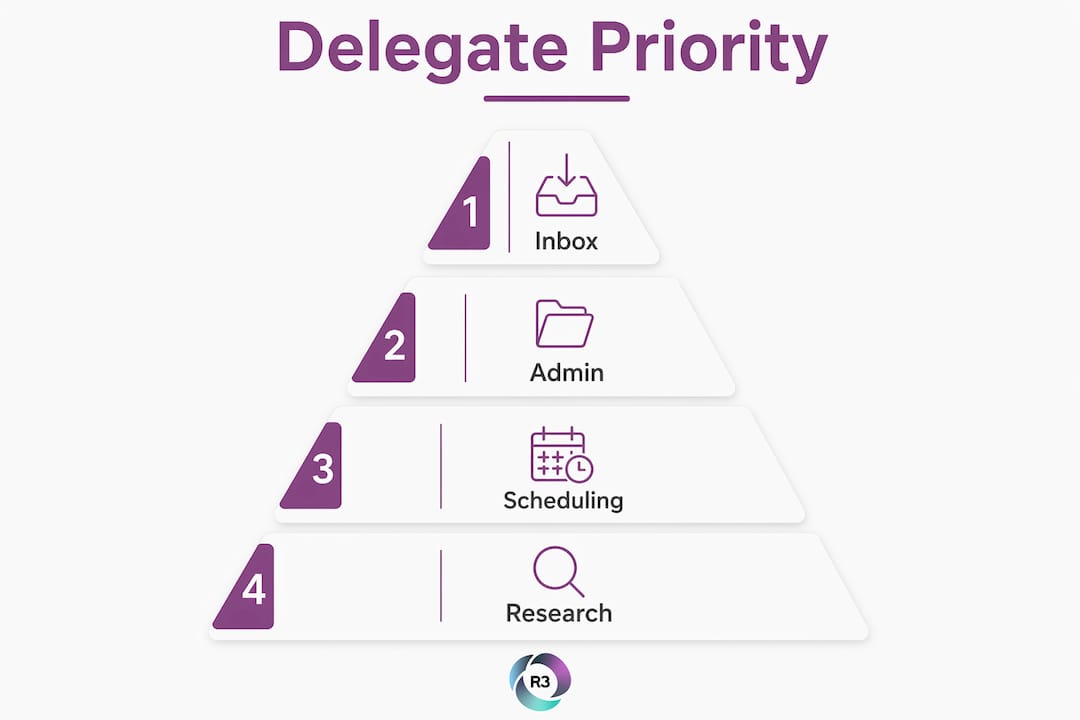
If the answer is “no, yes, yes,” the task belongs on your delegation queue. Here are the ten highest-impact tasks for most small-business owners, ranked by time saved and interruption cost:
Priority | Task | Weekly Time Saved | Interruption Cost |
1 | Inbox triage and email drafts | 4–6 hrs | Very high |
2 | Calendar scheduling and rescheduling | 2–3 hrs | High |
3 | CRM data entry and updates | 2–4 hrs | High |
4 | Appointment setting and follow-up | 2–3 hrs | High |
5 | Research and competitive summaries | 2–4 hrs | Medium |
6 | Social media scheduling | 1–3 hrs | Medium |
7 | Travel and logistics coordination | 1–2 hrs | Medium |
8 | Invoice tracking and payment follow-up | 1–2 hrs | Medium |
9 | Customer support ticket routing | 2–4 hrs | Medium |
10 | Report compilation and data formatting | 1–3 hrs | Low |

Spending significant weekly hours on tasks a VA handles represents a substantial opportunity cost — time you could spend closing deals or building client relationships instead.
How do you choose the right hiring model?
Pick a dedicated long-term VA or a managed provider when you need reliability, backup coverage, and low management overhead. Task-based freelancers work for one-off projects; they are a poor fit for recurring operational work because the re-onboarding cost resets every engagement.
Dimension | Freelancer | Dedicated offshore VA | Managed team |
Availability / time-zone | Variable, project-based | Fixed hours, often overlapping US time | Covered by provider SLA |
Industry experience | Varies widely | Matched at hire | Curated by provider |
Communication skills | Self-reported | Screened at intake | Vetted and supervised |
Scope model | Task-based | Long-term, expanding scope | Full-service |
Pricing shape | Hourly, no commitment | Monthly fixed or hourly retainer | Monthly managed fee |
Onboarding support | None | Partial (owner-led) | Provider-supported |
Replacement policy | None | Depends on provider | SLA-backed |
Screening checklist before you hire:
Assign a paid trial task that mirrors real work (inbox sort, research brief, CRM update).
Ask for two references from previous long-term clients, not one-off projects.
Confirm willingness to use your password manager and sign an NDA before day one.
Check written English in the application itself — it predicts async communication quality better than an interview.
Use a structured skills assessment to score candidates on the specific tasks they will own.
Red flags: no references, reluctance to use a password manager, vague answers about past responsibilities, or a pattern of short engagements with no explanation.
How do you onboard a VA in the first 90 days?
A staged onboarding plan cuts management overhead and builds the SOP library you will rely on for months. Start with small wins and documented processes, then expand scope as reliability proves itself.
Days 1–30: Foundation
Grant access via shared password manager folders only — never send credentials by email.
Assign one low-stakes task with a written brief and a Loom walkthrough.
Ask the VA to write the SOP for that task as their first deliverable. This proves comprehension and gives you a reusable document.
Set up one task system (Asana, ClickUp, or Notion) and one primary communication channel (Slack or email — pick one and stick to it).
Days 31–60: Expansion
Add two to three tasks from your delegation queue, one at a time.
Run a 15-minute weekly standup (async voice memo works fine) to surface blockers early.
Review output quality against the SOP the VA wrote, not your mental model.
Days 61–90: Ownership
The VA should own their task queue independently, flagging exceptions rather than asking for step-by-step guidance.
Measure reclaimed owner hours weekly. The meaningful metric is not “Is the VA busy?” but “Is the VA removing cognitive load and interruptions from me?”
Build a structured SOP library so a replacement hire can onboard in days, not weeks.
Pro Tip: Have your VA produce the SOP as their very first deliverable, not after they have been working for a month. Owners who skip this step report significantly more re-training time when staff turns over.
Entrepreneurs who delegate repeatable work can reclaim 13–15 hours per week when they combine a dedicated VA with a clear tech stack and documented SOPs.
What does a VA actually cost, and when does it pay for itself?
Pricing varies by model. Offshore dedicated VAs typically run at competitive hourly or monthly rates depending on the arrangement. Managed-service providers charge a premium for supervision, replacement guarantees, and account management.
The number that matters is not the VA’s rate — it is your effective cost after management hours:
True cost = VA monthly cost + (owner management hours × owner hourly rate × 4 weeks)
Worked example (conservative):
VA cost: $1,500/month
Owner management time: 2 hours/week × $150/hour × 4 = $1,200/month
Effective cost: $2,700/month
Hours reclaimed: 13 hours/week × 4 weeks = 52 hours × $150/hour = $7,800/month in recovered capacity
Net gain: $5,100/month
Even at a higher management overhead of 4 hours per week, the math still favors delegation by a wide margin. The break-even point for most owners is roughly the first two to three weeks of the engagement. The owners who report VA failure almost always skipped the audit step and hired for judgment-heavy work without documented processes — which drives management hours up and erases the ROI.
Hourly offshore: flexible, suits variable workloads, higher per-task management cost
Monthly dedicated: predictable, builds institutional knowledge, lower effective cost over time
Managed retainer: highest sticker price, lowest management tax, best for owners with no time to supervise
What R3source offers U.S. business owners
R3source provides dedicated, long-term remote staff from the Philippines, matched to your industry and integrated directly into your operations. Every hire goes through a structured screening process covering English proficiency, relevant experience, and a trial assignment before placement. A dedicated account manager stays involved after onboarding, so you are not managing the relationship alone.
Key trust signals:
Screening and training: candidates are vetted for communication skills, task-specific experience, and cultural fit with U.S. business norms.
Replacement policy: if a placement is not working, R3source provides a replacement under a defined SLA rather than leaving you to restart the search.
NDA and security practices: all staff sign confidentiality agreements and work within your password manager setup from day one.
Trial period: an introductory consultation helps align expectations before a long-term commitment.
Services covered: administrative support, customer service, lead generation, CRM management, appointment setting, and marketing support.
R3source’s offshore virtual assistant services are built for owners who want reliability and accountability, not just a low hourly rate. The account manager model means your VA has supervision and support, which reduces the management tax you carry personally.
Legal considerations for hiring VAs in the U.S. context
Hiring an offshore VA as an independent contractor is the most common structure for U.S. small businesses, but it carries specific obligations. The IRS distinguishes between employees and independent contractors based on behavioral control, financial control, and the nature of the relationship — misclassification carries penalties.
Contract essentials for every VA engagement:
Independent contractor agreement specifying scope, deliverables, payment terms, and termination conditions.
NDA / confidentiality clause covering client data, business processes, and proprietary information.
IP assignment clause confirming that work product belongs to your business.
Data handling terms aligned with any applicable state privacy laws (California’s CCPA is the most stringent for U.S.-based businesses handling consumer data).
For offshore hires, U.S. businesses generally do not withhold federal income tax or pay FICA on payments to foreign contractors. However, if payments exceed $600 in a calendar year to a U.S.-based contractor, a Form 1099-NDA is required. Foreign contractors typically complete a Form W-8BEN to certify their non-U.S. status.
The U.S. Chamber of Commerce recommends establishing clear written expectations and monitoring work through agreed tools — both of which also protect your contractor classification. Consult a qualified employment attorney or CPA for your specific situation, as rules vary by state and business structure.
Key Takeaways
Hiring a dedicated virtual assistant is the most direct path to better time management for business owners — but only when paired with a task audit, documented SOPs, and a clear onboarding plan.
Point | Details |
Audit before you hire | Track tasks in 30-minute blocks for 7 days to identify repeatable delegation candidates. |
Delegate low-judgment tasks first | Inbox triage, CRM updates, and calendar management return the most hours per week. |
Use the true-cost formula | Add owner management hours to VA cost; the break-even point is typically 2–3 weeks. |
Stage onboarding over 90 days | Have the VA write the first SOP, then expand scope as reliability proves itself. |
R3source for dedicated staffing | R3source provides screened, long-term offshore VAs with account management and a replacement SLA. |
What most owners get wrong about delegation
The conventional wisdom says delegation is about trust. It is not. It is about systems. Owners who struggle with VAs almost always hired before they had a repeatable process, then blamed the hire when the real problem was the absence of a documented workflow. A VA cannot execute what has never been written down.
The other common mistake is optimizing for the lowest hourly rate. A $6/hour VA who requires three hours of your time per day costs more than a $15/hour VA who works independently. Price is the last filter, not the first. Screen for communication quality, reliability track record, and willingness to follow a process — then negotiate on rate.
At 90 days, a well-onboarded VA should own their task queue without daily check-ins, your SOP library should have at least five documented processes, and you should be able to point to specific hours each week that you now spend on revenue-generating work instead of operations. That is what good looks like. It is not a dramatic transformation — it is a quiet, compounding shift in how your week is structured, and it builds from there.
Useful sources and next steps
A short list of resources to consult as you move from reading to hiring:
U.S. SBA: 5 Ways a Virtual Assistant Can Make You More Productive — authoritative overview of VA use cases and owner benefits, useful for validating your task list.
U.S. Chamber of Commerce: Hiring Virtual Assistants for Small Businesses — practical guidance on contracts, onboarding, and performance monitoring.
TalentApproved: Evaluating Part-Time Applicant Skills Quickly — structured assessment techniques for screening VA candidates before you commit.
R3source: Delegation examples for entrepreneurs — real-world examples of tasks owners have successfully handed off and the outcomes they saw.
R3source: Tools for managing remote assistants — tool recommendations for password management, task systems, and async communication.
R3source introductory consultation — book a no-pressure call to discuss your specific delegation needs and get matched with a VA.
R3source: a direct path to reclaiming your time

If you have read this far, you already know which tasks are eating your week. R3source exists to take those tasks off your plate permanently, with dedicated remote professionals from the Philippines who are screened, trained, and supported by an account manager from day one. Unlike a freelance marketplace where you manage the search, the vetting, and the re-hiring yourself, R3source handles the staffing infrastructure so your only job is to onboard and grow.
The practical difference: your VA arrives with a defined replacement policy, an NDA already in place, and a supervisor in the loop. You get the reclaimed hours without the management overhead that makes low-cost freelancers a false economy.
Owners across real estate, e-commerce, and service businesses use R3source to reduce overhead and build the kind of operational capacity that lets them focus on growth. If you are ready to stop doing $15/hour work at your leadership rate, book an introductory consultation and find out exactly which tasks R3source can take off your plate this month.
Recommended
Comments