

Lead Generation Outsourcing: Your 2026 B2B Hiring Guide


For most B2B sales teams, outsourcing lead generation to a dedicated offshore assistant, rather than an anonymous agency pool, delivers the best combination of cost control, accountability, and pipeline quality. The fastest path to a working program is a 60–90 day pilot with named staff, a documented ICP, and deliverability protections built into the contract before day one. R3source places dedicated remote professionals from the Philippines directly into U.S. B2B operations, giving you a named person who learns your product, works inside your CRM, and reports to you weekly. Managed outsourced programs typically run $2,000–$15,000 per month, with pay-per-meeting pricing often landing between $150 and $600 depending on target seniority and qualification depth.
If you are ready to run the readiness checklist below, you are probably ready to pilot. If you are still building your offer or your CRM is a mess, fix those first.
Key Takeaways
Outsourcing lead generation to a dedicated offshore assistant, with named staff, deliverability protections, and a 60–90 day pilot structure, gives most U.S. B2B teams a faster and more cost-effective path to qualified pipeline than building in-house.
Point | Details |
Pass all five readiness gates first | Document your ICP, validate your offer, confirm CRM use, and secure two quarters of budget before engaging any vendor. |
Dedicated named staff outperforms pooled agencies | Named offshore assistants allow direct coaching, faster iteration, and genuine accountability that pooled models cannot match. |
Philippines offers the best cost-quality fit | Dedicated offshore assistants from the Philippines typically cost $6,000–$15,000/month with strong English and U.S. cultural alignment. |
Deliverability setup is non-negotiable | Require dedicated warmed subdomains, SPF/DKIM/DMARC, and inbox placement SLAs in every contract before signing. |
R3source provides managed dedicated offshore staff | R3source places named remote professionals from the Philippines into U.S. B2B operations with CRM integration and a 60–90 day pilot option. |
Table of Contents
Are you ready to outsource lead generation?
Outsourcing is not a fix for a broken sales process. Before you engage any outside help, run through these five gates honestly.
Documented ICP. You can describe your ideal customer in writing: industry, company size, title, and the trigger event that makes them a buyer. Without this, an outsourced team will generate volume, not pipeline.
An offer that has actually closed deals. If your offer has never converted a cold prospect into a paying customer, outsourcing amplifies the problem. Validate the offer internally first.
Sales capacity to take the meetings. Outsourced prospecting creates calendar demand. If your closers are already at capacity, booked meetings go to waste.
An active CRM used consistently. Lead handoffs, qualification notes, and follow-up sequences all depend on a CRM your team actually uses. A spreadsheet is not a substitute.
At least two quarters of budget runway. Outsourced lead generation programs take 60–90 days to reach steady output. Cutting the program at week six because cash got tight is the most common reason pilots fail.
Decision flow: Pass all five? Run a pilot. Missing ICP or offer validation? Fix the product first. Missing CRM or budget? Hire internally or delay. This checklist is adapted from the readiness framework at Martal’s 2026 B2B playbook.
Pro Tip: Print this checklist and walk through it with your sales manager before your first vendor call. Vendors who push you to skip gates are a red flag, not a sign of confidence.
What service model actually fits your situation?
Outsourced B2B lead generation comes in three distinct models, and choosing the wrong one wastes both time and money.
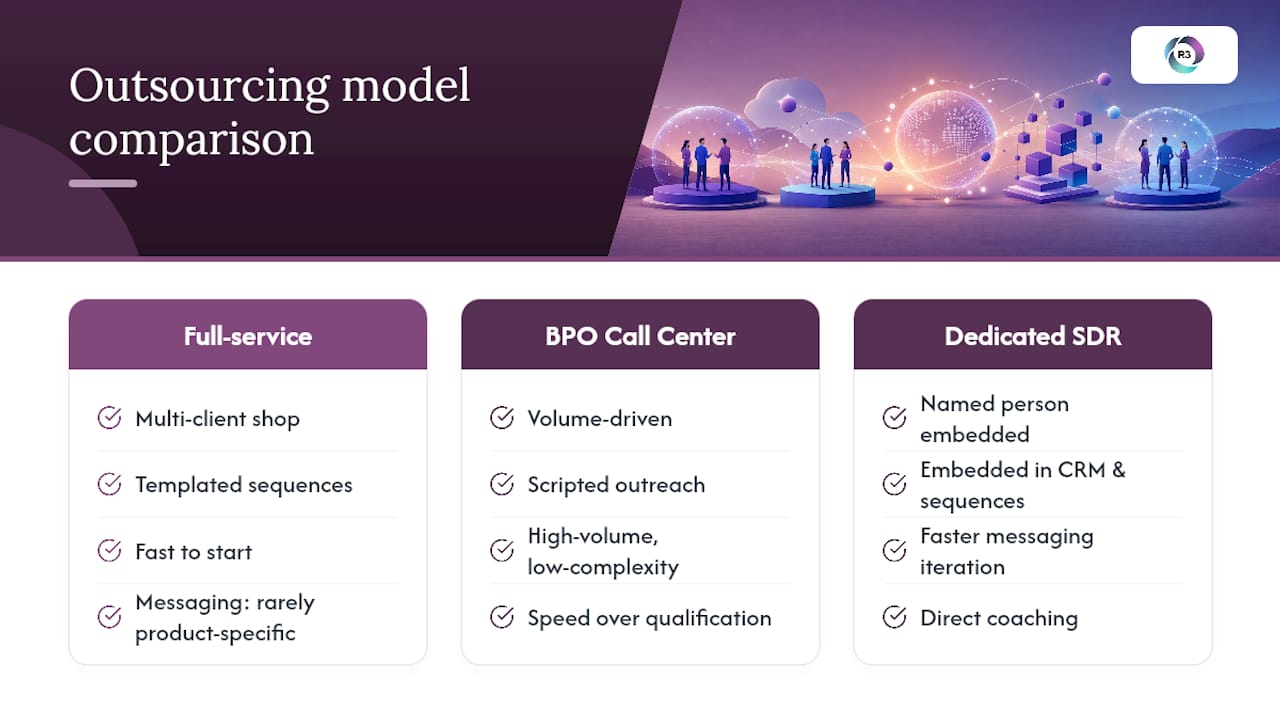
Full-service agency. Multi-client shops that run templated sequences across a shared SDR pool. Fast to start, but your account is one of many. Messaging is rarely product-specific, and you rarely know who is sending on your behalf.
BPO or call center. Volume-driven, scripted outreach at scale. Works for high-volume, low-complexity prospecting where speed matters more than qualification depth. Cultural and language fit for U.S. outbound varies significantly by region.
Dedicated offshore staff or SDR-as-a-service. A named person embedded into your CRM, your sequences, and your weekly rhythm. This model supports faster messaging iteration, direct coaching, and genuine accountability because you know exactly who is doing the work.
How geography shapes the model
The Philippines is the strongest match for dedicated offshore staff supporting U.S. outbound. English proficiency is high, the time zone overlaps with U.S. afternoons (Philippine Standard Time runs 12–13 hours ahead, making 8 AM–5 PM Manila time align with U.S. evening hours, but most teams shift schedules to overlap with U.S. mornings), and the cultural familiarity with American business norms is well-established. Cost is typically the lowest of the three regions for comparable skill.

Latin America (LatAm) offers near-time-zone alignment with U.S. business hours, which makes live phone prospecting and same-day follow-up easier. English proficiency varies more than in the Philippines, and costs run slightly higher for senior SDR roles.
Eastern Europe brings strong technical and analytical skills, making it a good fit for complex B2B products where qualification requires deeper research. Time zone overlap with U.S. East Coast is limited to early mornings, and costs for senior talent are comparable to LatAm or higher.
Philippines: best for dedicated, long-term outbound and CRM-integrated roles
LatAm: best for phone-heavy outreach requiring real-time U.S. hour coverage
Eastern Europe: best for research-intensive qualification and technical verticals
How do the costs actually compare?
The honest financial case for outsourcing comes down to one comparison: the fully loaded cost of an in-house SDR versus what you pay for an outsourced or offshore equivalent.
A single in-house SDR in the U.S. carries salary, benefits, payroll taxes, tooling, management overhead, and recruiting costs. Two in-house SDRs can cost $18,200–$36,100+ per month in fully loaded terms, while outsourced models commonly fall in the $6,000–$15,000 per month range. Outsourcing shifts fixed overhead into a flexible operating expense, which matters when you are still validating your outbound playbook.
Calculate your fully loaded in-house cost. Add base salary, benefits (typically 20–30% of base), payroll taxes, tools (CRM, sequencer, data enrichment), and a pro-rated share of management time.
Get a CPL or per-meeting quote from vendors. Pay-per-meeting pricing typically runs $150–$600 per qualified meeting. Retainer models for managed multi-channel programs run $3,500–$10,000+ per month.
Apply your customer acquisition cost math. Divide your average contract value by your close rate from cold meetings. If a meeting costs $400 and you close 20% of them, your CAC from this channel is $2,000. Does that work against your ACV?
Add hidden costs. Domain setup and warming, data enrichment subscriptions, CRM integration work, and onboarding time are real costs that retainer quotes often exclude.
Regional cost ranges for dedicated offshore assistants
These ranges reflect dedicated, managed staff rather than freelance marketplace rates, which vary widely and carry more management overhead on your side.
How do you choose the right outsourcing partner?
The difference between a vendor who fills your pipeline and one who burns your domain comes down to a short list of non-negotiable criteria. Buyer evaluation should require named SDRs, transparent pricing, a written qualified-meeting definition, and month-to-month or short pilot terms.
Core evaluation criteria:
Named team members assigned to your account, not a rotating pool
Clear client-to-SDR ratio (anything above 5:1 is a warning sign)
Deliverability practices: dedicated warmed subdomains, SPF/DKIM/DMARC authentication, controlled per-mailbox send volumes
Reporting on pipeline metrics, not just activity counts
Data ownership: you own the lists, the sequences, and the CRM data from day one
References from clients in your industry or with a similar ICP
Questions to ask during vendor diligence:
Who specifically will work on my account, and can I speak with them before signing?
How many active clients does each SDR carry?
What subdomain and DNS setup do you use, and will you hand over the infrastructure if we part ways?
How do you define a qualified meeting, in writing?
What does your reporting dashboard show, and how often do we review it together?
Can you provide two client references I can call this week?
Red flags to walk away from:
No pilot option or minimum 6-month commitment required upfront
Sending from your primary corporate domain
Qualified meeting defined vaguely as “anyone who shows up”
Refusal to hand over sending infrastructure or contact data at contract end
Reporting limited to emails sent and open rates, with no pipeline attribution
Pro Tip: Check third-party review platforms like G2 for vendor reputation signals. Look for patterns in negative reviews, not just the star rating.
Contract must-haves: 60–90 day pilot with defined go/no-go criteria, a written qualification checklist, explicit data ownership language, a clear exit and data-transfer timeline, and SLAs for inbox placement and reporting frequency.
What does a strong first 90 days look like?
The first 90 days of an outsourced program are where most pilots succeed or fail. A clear milestone structure keeps both sides accountable.
Days 1–30: Foundation. Set up dedicated sending subdomains and begin mailbox warmup. Finalize the ICP and build the first contact list. Configure CRM tagging and lead-routing workflows. Agree on the qualification checklist and disqualification rules. Write and review the first two sequence variants.
Days 31–60: Testing. Launch sequences at controlled volume (typically 20–40 emails per mailbox per day during warmup). Track inbox placement and reply rates weekly. Run A/B tests on subject lines and opening value propositions. Hold weekly 30-minute reviews where sales leadership listens to raw call recordings or reads actual reply threads, not just summary dashboards.
Days 61–90: Scale and optimize. Increase send volume on sequences with positive reply signals. Refine ICP based on which segments are actually booking and showing. Make the go/no-go decision using pre-agreed criteria: meetings booked, show rate, and at least one closed or advanced opportunity.
Internal roles to assign before day one:
A single vendor owner who is the primary contact and attends every weekly review
A sales manager who reviews raw lead quality and gives weekly feedback
A marketing point person who approves messaging and owns brand consistency
Pro Tip: Build your outsourcing readiness checklist before the contract is signed, not after. Onboarding stalls most often because the client side is not ready, not because the vendor is slow.
Deliverability is a frequent failure point: reputable providers use warmed dedicated subdomains, SPF/DKIM/DMARC, and controlled send volumes. Require your vendor to show you the warmup schedule and inbox placement data before you approve scaling.
What KPIs tell you if the program is working?
Tracking the right metrics separates a program that is improving from one that is quietly failing. Organize your dashboard into three tiers.
Weekly metrics (operational health):
Inbox placement rate (target: above 90%)
Bounce rate (target: below 3%)
Spam complaint rate (target: below 0.1%)
Reply rate on cold email sequences
Monthly metrics (pipeline contribution):
Meetings booked per SDR
Meeting show rate (a healthy benchmark is 70–80%)
Lead-to-booking ratio
Disqualification reasons (tracks ICP accuracy)
Quarterly metrics (revenue attribution):
Meetings that advanced to proposal stage
Closed revenue attributed to outsourced pipeline
Cost per qualified meeting vs. target
Require these fields in your reporting contract: spam complaint rate, bounce rate, lead-to-booking ratio, and appointment close rate. A vendor who resists putting SLAs on these metrics is telling you something important about how they operate.
Optimization loop: Each week, pull a sample of raw email replies and call recordings. Identify the objection or disengagement pattern. Adjust the sequence or ICP filter. Test the revised version the following week. This cycle, run consistently, is what drives compounding improvement in a managed program.
Why dedicated offshore staff outperforms anonymous agency pools
The case for named, managed offshore assistants over agency pools is not just about cost. It is about the feedback loop that determines whether your program improves or stagnates.
When you work with a named person, you can review their specific emails, coach their messaging, and track their individual performance over time. With a pooled agency model, you are reviewing aggregate metrics from people you have never met, running sequences you did not write, on infrastructure you do not control.
The named-team advantage in practice:
Faster messaging iteration because feedback goes directly to the person writing the sequences
Easier call review and coaching because you know whose calls you are listening to
Deeper product knowledge over time as the assistant learns your ICP, objections, and competitive positioning
Direct accountability: if quality drops, you know who to address
Deliverability and brand protection are the other side of this argument. Most programs that fail do so because high-volume outreach was sent from the company’s primary corporate domain, damaging inbox reputation for the entire organization. Dedicated warmed subdomains, authenticated DNS records (SPF, DKIM, DMARC), and controlled per-mailbox volumes are the technical baseline. These are not advanced practices; they are the minimum standard for any program that expects to reach inboxes at scale.
A U.S.-based B2B services firm that shifted from a pooled agency to a dedicated offshore assistant model saw its meeting show rate improve and its cost per qualified meeting drop within the first two quarters, primarily because the named assistant could be coached weekly and owned the sequence optimization directly. R3source provides exactly this model: dedicated, long-term remote professionals from the Philippines, integrated into your CRM and your weekly operating rhythm, with full data ownership on your side.
For more on building offshore team productivity into your management cadence, the strategies that work for remote teams apply directly here.
What is the right decision for your team?
Outsourcing lead generation makes the most sense for B2B teams that have a validated offer and ICP, need to scale prospecting without adding headcount, and want a faster path to pipeline than a 90-day in-house hiring cycle allows. The dedicated offshore staff model, particularly from the Philippines, delivers the best combination of cost, English proficiency, cultural alignment for U.S. outbound, and long-term accountability.
Building in-house makes more sense once you have a validated playbook, a predictable pipeline volume that justifies full-time headcount, and a stable ICP that does not require frequent repositioning.
Prioritized next steps:
Run the five-point readiness checklist above. Be honest about each gate.
Scope a 60–90 day pilot with a vendor who offers named staff and a written qualification checklist.
Require deliverability protections in the contract: dedicated subdomains, DNS authentication, and inbox placement SLAs.
Assign a single internal vendor owner before the contract is signed.
Schedule weekly quality reviews from day one. Read the emails. Listen to the calls.
When to bring it in-house: your outsourced program has produced a repeatable playbook, pipeline volume is predictable enough to justify a full-time hire, and your ICP has been stable for at least two quarters. At that point, outsourcing before hiring full-time has done its job.
What I have learned placing dedicated remote teams for U.S. B2B clients
The most common mistake I see is clients launching an outsourced program before their CRM is ready. Leads arrive, there is no agreed tagging structure, routing breaks down, and the vendor gets blamed for a problem that was internal from the start.
Three hard-won lessons from working with U.S. B2B teams:
Vet deliverability before anything else. Ask for the warmup schedule and the subdomain setup on the first call. If the vendor cannot explain SPF/DKIM/DMARC in plain language, move on.
Insist on named staff. The accountability difference between a named assistant and a pooled resource is not marginal. It is the difference between a program that improves weekly and one that produces consistent mediocrity.
Run tight weekly feedback loops. The teams that compound results are the ones where a sales leader spends 20 minutes every week reading raw replies and giving specific feedback. Summary dashboards are not enough.
The clients who get the most from dedicated offshore assistants treat them as part of the team, not as a vendor deliverable. That mindset shift, more than any tool or tactic, is what drives sustained pipeline growth.
R3source offers a managed dedicated offshore assistant pilot
Filling your pipeline with qualified meetings should not require a six-month agency commitment or a full-time U.S. hire. R3source gives U.S. B2B teams a dedicated, named remote professional from the Philippines, fully onboarded into your CRM, your sequences, and your weekly review cadence, with deliverability setup included from day one.
The pilot structure is straightforward: a 60–90 day engagement with a named assistant, defined go/no-go criteria, and full data ownership on your side from the start. You get onboarding support, CRM integration, and a deliverability setup that protects your primary domain. No pooled resources. No rotating staff. One person who learns your product and your ICP.
To get started, book a free strategy call or explore R3source’s offshore virtual assistant services to see the full scope of what a dedicated remote professional can handle for your team.
Sources
Use these sources to validate benchmarks, evaluate vendors, and dig deeper into specific topics covered above.
Recommended
Comments