

Reclaim Manager Hours with Outsourcing, Improve Efficiency in 90 Days


Focus first on finding your biggest bottleneck, measuring it with the right KPI, and running one focused 90-day improvement wave before you spend a dollar on new software. Stabilize the process with standard work and 5S, cut waiting time between steps, and only then layer in automation or outsourcing to lock in the gains. Quick wins come from sequence, not spending.
TL;DR:
Focusing on fixing the single biggest bottleneck and measuring its impact is crucial before investing in new technology or automation.
Standard work, 5S, and reducing wait times between steps deliver sustainable improvements without additional costs.
Automation should only be introduced once the process is stable and measured with KPIs like cycle time, yield, or OEE, not before.
Running short, focused improvement cycles over 90 days, with clear ownership and baseline data, generates continuous gains.
Outsourcing routine administrative tasks frees managers’ time for core process improvements and should be integrated with well-defined SOPs.
Table of Contents
Quick Shortlist: The Core Levers For Improving Efficiency
You don’t need a transformation program to move the needle. You need to pull the right levers in the right order. Here’s the shortlist that applies whether you’re running a service desk, a warehouse, or a five-person back office.
Remove the bottleneck first. Every process has one constraint limiting the whole system; fix that before anything else.
Map the process. You can’t fix what you haven’t drawn out step by step, with handoffs and wait times marked.
Install standard work and 5S. Consistent steps and an organized workspace cut errors before you touch a KPI.
Run PDCA or Kaizen cycles. Small, fast experiments beat big annual overhauls.
Add predictive maintenance once your maintenance basics are stable, not before.
Cut waiting time between steps. Reducing waiting time and improving visibility routinely outperforms new tech purchases.
Train and cross-train your people. Skills gaps quietly cause more downtime than machines do.
Automate narrow, repetitive tasks. Save broad automation for after the process is proven stable.
Outsource routine administrative work. Free up manager and staff hours for the improvement work that actually pays off.
How Do You Map A Process And Find The Real Constraint?
Start by baselining. Before changing anything, spend two to four weeks tracking cycle time, the number of handoffs, and how long work sits idle between steps. If you run a production line, a 30-day Operational Equipment Effectiveness (OEE) baseline or a straightforward cycle-time log gives you a number to argue with instead of a hunch. Most teams are shocked by how much of their total lead time is waiting, not working.
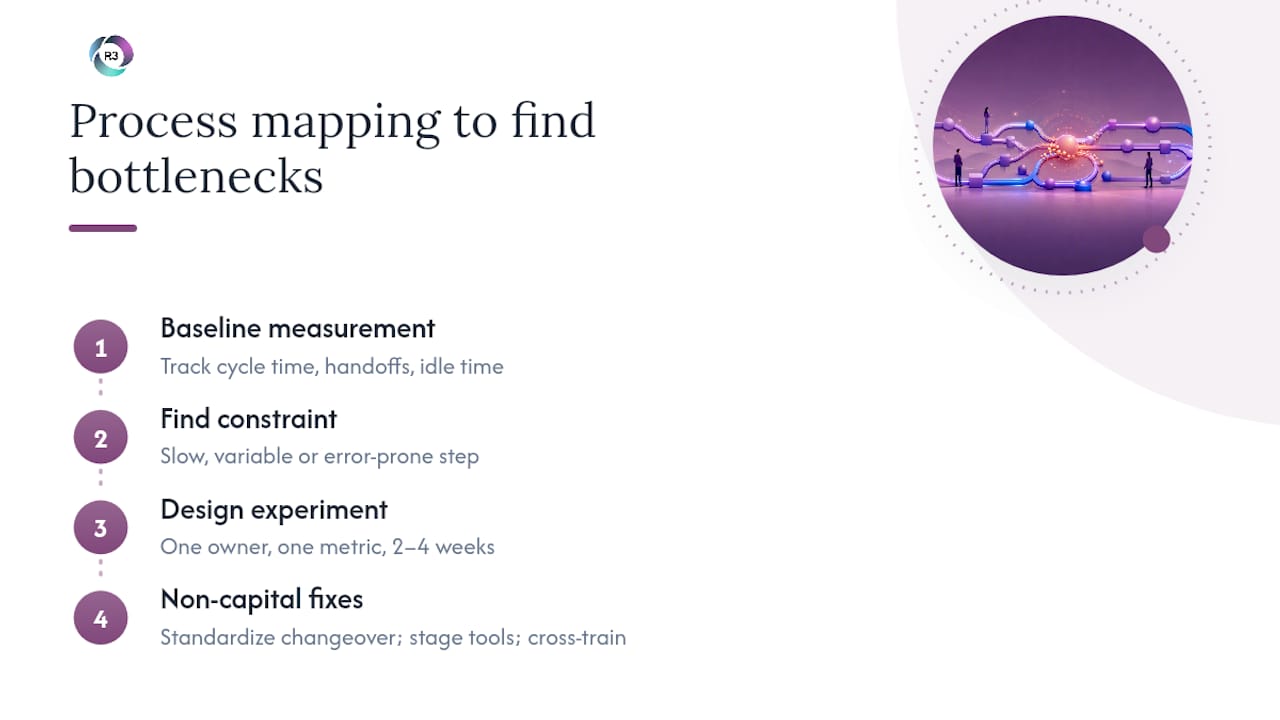
Once you have that baseline, apply the theory of constraints: find the single step that limits everything downstream of it. Fixing a fast station that isn’t the bottleneck feels productive but changes nothing. The real constraint is usually the slowest, most variable, or most error-prone step, and it’s often obvious once you plot the data on paper instead of relying on memory.
From there, design a narrow experiment. Give it one owner, one metric, and a firm deadline, typically two to four weeks. Resist the urge to fix five things simultaneously; you won’t know which change caused the result. Purdue’s Manufacturing Extension Partnership points to process optimization paired with measurement as one of the most reliable productivity levers available to manufacturers, and the same logic holds in an office setting.
Non-capital fixes tend to deliver disproportionate results: standardizing changeover steps, staging tools and materials before a shift starts, and cross-training two people on the bottleneck task so it never sits idle waiting on one specialist. None of that requires a purchase order.
Why Standard Work And Training Make Improvements Stick
Standard work and 5S aren’t bureaucratic overhead. They’re what lets a process survive when your best performer takes vacation. Written, visual steps reduce the variation that causes defects, and they make it obvious to a new hire, or a new remote team member, exactly how the job should look on a good day.

Training programs work best when they’re tied to a measurable outcome, not attendance. Link cross-training to first-pass yield or error rate, and track whether the number moves after the session. If it doesn’t, the training missed the mark, and you’ll know within weeks instead of guessing for a year.
Leaders sustain improvement by protecting their own time for it. Leader standard work, a short daily or weekly routine of walking the process and checking the visual boards, keeps gains from quietly eroding once the initial excitement fades. It also builds the kind of trust that gets a floor employee to flag a problem the day it happens instead of hiding it until the monthly report.
When Should You Add Automation Or AI Tools?
Only after you’ve stabilized and measured the process. That sequencing rule matters more than which tool you pick. Businesses increasingly use AI for supply chain and customer service tasks, but bolting automation onto a broken workflow just automates the chaos faster.
Once your basics are solid, a few moves consistently pay off. Predictive maintenance (PdM) and condition monitoring let you schedule repairs before a machine fails instead of after, and Deloitte-cited industry data shows PdM programs can cut facility downtime meaningfully, with well-executed programs delivering roughly a 10 to 20% uptime improvement. MES and ERP integration reduces the manual re-entry that eats an afternoon every week. Shop-floor terminals give operators real-time data instead of end-of-shift guesswork. In the office, AI assistants can absorb repetitive administrative tasks, like drafting routine emails or updating records, giving managers back hours for higher-value work. Tools like the ones covered in AI workflow use cases for MSP clients show how this plays out in practice for service-based teams.
The caveat: don’t automate an unstable process. If the steps change every week, automation just locks in the current chaos and makes it harder to fix later. Get operator buy-in and training before rollout, or the tool sits unused within a month.
Which KPIs Actually Tell You If You’re Improving?
A handful of metrics cover almost every efficiency question you’ll face. OEE, which multiplies availability, performance, and quality, is the closest thing manufacturing has to a single source of truth. Cycle time, changeover time, first-pass yield, downtime, utilization, and cost per unit round out the toolkit for most operations.
Pro Tip: Baseline one KPI, run a two-week test tied to a single change, and measure the delta before you touch a second metric. Testing everything at once tells you nothing about what actually worked.
The most common pitfall is chasing uptime alone. A machine can run 95% of the time and still produce garbage if quality isn’t tracked alongside it. Combine availability with a yield or defect measure before declaring victory. When a KPI trend flattens despite process fixes, that’s your signal to escalate from tweaks to real investment, whether that’s new equipment or a staffing change. Customer-facing teams should watch the equivalent metrics; average handle time, first-contact resolution, and CSAT function the same way OEE does on a factory floor.
Manufacturing Tactics: TPM, Changeovers, And Material Flow
On the plant floor, three tactics deliver outsized returns fast.
Track the six big losses under Total Productive Maintenance (TPM): breakdowns, setup/adjustment, small stops, reduced speed, startup rejects, and process defects. Each one is a lever, not a mystery.
Reduce changeover time. Stage tooling ahead of the changeover, write it down as standard work, and cross-train a backup operator.
Fix material flow before adding equipment. Point-of-use stock and pull signals cut the transport and searching time that quietly steals hours every shift.
Layer in predictive maintenance after the basics are stable. PdM changes maintenance from reactive firefighting to scheduled work, which is exactly when it delivers its strongest returns.
OEE and first-pass yield together expose which of these losses is actually costing you the most, rather than the one that’s loudest.
How Do You Run A 90-Day Efficiency Wave?
Prioritize with an impact-versus-effort view: rank your candidate fixes, then commit only to the ones with a named, accountable owner. Everything else waits.
Days 1 to 15: Baseline. Map the process, collect cycle time and handoff data, and pick the one KPI you’ll move.
Days 16 to 45: Attack. Run the focused experiment on the constraint you identified, adjusting weekly based on the data.
Days 46 to 75: Standardize. Write the new steps into standard work, update visual boards, and train the team on the new normal.
Days 76 to 90: Institutionalize. Fold the change into leader standard work so it survives after the project team moves on.
A mid-size distribution client that ran a wave like this on order-picking cut its cycle time noticeably within the first 45 days simply by relocating fast-moving SKUs and fixing a single handoff. Structured, cumulative improvement cycles like this tend to outperform one-off fixes because each wave builds on the last instead of starting from zero. Watch for stop signals (the KPI isn’t moving after 30 days), scale signals (it’s working, roll it to a second line), and lock-in signals (updated SOPs, visual controls, and leader walks are all in place).
How Outsourcing Routine Tasks Frees Up Time For Real Improvement Work
Every hour a manager spends on data entry, appointment scheduling, or CRM cleanup is an hour not spent on the bottleneck analysis above. That’s the practical case for outsourcing routine and administrative tasks: CRM updates, appointment setting, and repetitive customer follow-up are high-volume, low-judgment work that a trained remote professional can absorb reliably.
The integration matters more than the outsourcing decision itself. Clear SOPs, a defined service-level agreement, and one named internal owner keep outsourced staff working inside your improvement cycle instead of operating as a disconnected task queue. R3source’s own guidance on integrating virtual assistants into daily operations reflects this: dedicated remote staff who understand your standard work become part of the system, not a workaround to it. Done well, this is one of the fastest ways to reclaim manager hours for the work that only you can do.
A Manager’s Perspective: Three Commitments That Actually Move The Needle
Three commitments separate teams that sustain gains from teams that celebrate a good quarter and slide back. Protect your own time for leader standard work, even fifteen minutes a day. Measure before you buy anything, every time, no exceptions. And pick one bottleneck at a time instead of fighting on five fronts.
For the next 7 days, baseline your top constraint. For the next 30, run one focused PDCA cycle against it. For the next 90, standardize what worked and decide what, if anything, deserves real investment. Use this article’s checklist as your working agenda, not a reference to revisit later.
— Ellis
If your team is buried in administrative work instead of the improvement projects above, R3source’s offshore virtual assistant services give you dedicated, trained remote staff who handle the routine work reliably, so your managers get back the hours a 90-day wave actually requires. Book an introductory consultation to talk through where outsourcing fits your specific bottleneck.
Sources
Recommended
Comments