

How Virtual Assistants Help Small Businesses Grow Faster


A skilled virtual assistant (VA) can multiply your effective working hours and shift your attention toward revenue-generating work by taking recurring operational and marketing tasks off your plate entirely. According to a 2026 guide for small business owners, many owners who delegate consistently to a VA reclaim 13–15 hours per week and often report a productivity boost of around 13%. The global virtual assistant market is experiencing rapid growth, reflecting a sustained expansion trend.
Start here: The first task to delegate is inbox triage and calendar management. It is low-risk, high-frequency, and immediately frees 60–90 minutes every day.
VAs handle admin, marketing, CRM, customer support, bookkeeping, and e-commerce operations
Delegation converts owner time into capacity for sales calls, client work, and strategic decisions
Managed dedicated remote staff outperforms freelance gigs on reliability and integration for most SMBs
Table of Contents
Why virtual assistants drive growth: the core business outcomes
What tasks can you actually delegate to a virtual assistant?
Which SMB niches benefit most from virtual assistant support?
What are the biggest risks when working with a virtual assistant?
Managed dedicated remote staff vs. freelance VAs: which model supports growth better?
R3source gives you a dedicated remote team, not a revolving door
Why virtual assistants drive growth: the core business outcomes
The most direct benefit is time. When you stop answering routine emails, scheduling appointments, and updating spreadsheets, you get hours back that you can spend closing deals or building partnerships. That shift alone changes the growth trajectory of a small business.
Cost savings are the second lever. Hiring a full-time in-house employee in the U.S. carries significant salary, payroll taxes, benefits, office space, and equipment costs that often surpass typical entry-level compensation. A dedicated remote VA typically costs a fraction of that, with no benefits liability and no physical overhead. BusinessNewsDaily reporting on outsourcing benefits consistently highlights cost reduction and productivity gains as the primary drivers behind SMB outsourcing decisions.
Beyond cost, VAs give you access to skills you may not have in-house. Need someone who knows HubSpot, Canva, Shopify, and basic bookkeeping? That profile exists in the VA labor market. You can also scale up or down without the legal and financial friction of hiring or laying off a full-time employee.
Market signal: The virtual assistant market is projected to grow at a ~24% CAGR through 2030, reaching $23.97 billion. That pace reflects genuine enterprise and SMB adoption, not hype.
The benefits of hiring a virtual assistant compound over time. Once a VA owns a process, your business runs that process reliably whether you are in a client meeting or on vacation.
Cost reduction: — No payroll taxes, benefits, or office overhead on remote staff
What tasks can you actually delegate to a virtual assistant?
The practical answer is: more than most owners expect. Industry reporting on VA functions identifies a broad set of tasks that VAs commonly handle across business functions.
Administrative and operations
Inbox management, email drafting, and follow-up sequences
Calendar scheduling, meeting coordination, and travel booking
Data entry, file organization, and document formatting
Research tasks: vendor comparisons, competitor monitoring, market data
Marketing and content
Social media scheduling and basic graphic creation (Canva, Adobe Express)
Blog post formatting, proofreading, and publishing in WordPress or Webflow
Content repurposing: turning a podcast episode into a LinkedIn post, a newsletter, and three short clips
Email marketing support in Mailchimp, Klaviyo, or ActiveCampaign
Sales support and CRM
CRM updates and pipeline hygiene in HubSpot, Salesforce, or Zoho CRM
Lead list building and initial outreach sequencing
Appointment setting and follow-up reminders
Proposal formatting and sending
Customer support
Responding to inbound messages via email, chat, or social DMs
Order tracking, returns coordination, and FAQ responses
Escalation routing and ticket management in Zendesk or Freshdesk
Bookkeeping and finance admin
Invoice creation and tracking in QuickBooks or FreshBooks
Expense categorization and receipt logging
Accounts receivable follow-up
E-commerce operations
Product listing creation and optimization on Shopify or Amazon Seller Central
Inventory tracking and supplier communication
Order fulfillment coordination and customer messaging
A complete guide to VA tasks for small businesses recommends starting with repeatable, recoverable tasks before handing over anything that touches client relationships or financial decisions directly. That sequencing builds trust and catches errors early, when the stakes are low.
Pro Tip: Map two weeks of your own calendar before hiring. Highlight every task that is recurring, rule-based, or does not require your specific expertise. That list is your first delegation queue.
How do you measure a VA’s impact on your business?
Measurement starts before the VA’s first day. Without a baseline, you cannot prove ROI or catch underperformance early.
Primary KPIs to track
KPI | What “good” looks like | Why it matters |
Owner hours reclaimed | — | Directly converts to revenue capacity |
Task completion rate | — | Signals reliability and SOP clarity |
Lead response time | Under 2 hours for inbound leads | Faster follow-up closes more deals |
CRM hygiene score | 90%+ of records updated weekly | Keeps pipeline data actionable |
Content output volume | Agreed deliverables met each week | Tracks marketing execution |
A simple ROI calculation
Say you bill clients at $150 per hour and your VA reclaims 12 hours per week that you redirect to billable work. That is $1,800 per week in recovered revenue capacity, or roughly $7,200 per month. If your VA costs $2,000 per month, the net gain is $5,200 monthly before accounting for any other efficiency improvements.
That math is conservative. It does not count faster lead follow-up, more consistent marketing, or the compounding effect of a well-maintained CRM.
How to hire and onboard a VA in 30 days
The hiring process matters as much as the candidate. Weak onboarding is the leading cause of early VA churn, according to reporting on SMB staffing patterns. A structured 30-day plan dramatically reduces that risk.
Step 1: Write a focused job description
Keep it to one page. Include:
The three to five core tasks the VA will own
Tools they must know (e.g., HubSpot, Slack, Google Workspace)
Working hours and time zone overlap required
Communication expectations (daily check-in, weekly report)
Step 2: Interview for judgment, not just skills
Ask these questions:
“Walk me through how you would handle an inbox with 200 unread emails.”
“Describe a time you caught an error before it reached a client.”
“What tools do you use to stay organized across multiple tasks?”
Skills can be trained. Judgment and proactive communication are harder to develop.
Step 3: Follow the 30-day onboarding checklist
Week 1 (Orientation):
Share company overview, brand voice guide, and tool logins
Walk through the first two or three tasks live on a screen share
Set up communication channels (Slack, Asana, or ClickUp)
Week 2 (Supervised execution):
VA completes tasks independently; you review all output
Record a Loom video for any task that needs clarification
Begin building written SOPs together
Week 3 (Independent ownership):
VA runs assigned tasks without daily check-ins
You review output twice per week
Identify the next task to hand off
Week 4 (Feedback and expansion):
Hold a structured 30-day review
Confirm KPIs are on track
Add one new responsibility if performance is solid
Pro Tip: Use Loom for async training videos and Notion or Google Docs for SOPs. A VA who can reference a written process does not need to ask you the same question twice.
For VA integration best practices, including SOP templates and management cadence guides, R3source publishes detailed operational playbooks.
What does a virtual assistant actually cost?
Pricing varies by model, and the model you choose affects more than just the monthly bill.
Pricing models compared
Model | Typical cost structure | Best for |
Hourly freelancer | $15–$30/hr; pay per task | One-off projects, variable workloads |
Part-time contractor | Fixed monthly retainer, 20 hrs/week | Consistent but limited scope |
Dedicated remote staff (managed) | Fixed monthly fee, full-time equivalent | Ongoing operations, growth-stage SMBs |
In-house employee (U.S.) | $45,000–$65,000/yr + benefits + overhead | When physical presence is required |
A dedicated remote VA through a managed provider like R3source typically costs significantly less than a comparable U.S. in-house hire when you account for salary, payroll taxes, health insurance, and office overhead. The managed model also removes your recruiting, HR, and performance-management burden.
Dedicated remote staff — is the right model when you need someone integrated into your daily operations, owning processes and communicating proactively.
For most growth-stage SMBs, the dedicated remote staff model delivers the best combination of cost, reliability, and integration depth.
Which SMB niches benefit most from virtual assistant support?
Every business type can benefit, but some see faster, more measurable ROI.
High-impact VA specializations
Marketing and content repurposing is one of the highest-leverage functions. A single VA can take your weekly podcast, blog post, or webinar and turn it into a LinkedIn article, an email newsletter, three social posts, and a short video script. That output would otherwise require a part-time content team. VA skills that drive business growth increasingly include proficiency in AI writing tools like ChatGPT and Jasper, which multiply a single VA’s content output further.
CRM and sales support keeps your pipeline moving. A VA who updates HubSpot daily, flags stale deals, and sends follow-up sequences means no lead falls through the cracks. For a service business billing $5,000–$20,000 per client, one recovered deal per month more than covers the VA’s cost.
Customer service is where AI-enabled virtual assistants and human VAs work well in combination. A VA handles nuanced or escalated conversations while automation covers FAQs and routing.
E-commerce operations is a natural fit. Product listings, inventory updates, supplier emails, and customer order questions are all high-volume, rule-based tasks that a VA can own completely. Real estate businesses use VAs for lead follow-up, listing coordination, and CRM management with measurable results.

Bookkeeping support keeps cash flow visible without the cost of a full-time bookkeeper. A VA trained in QuickBooks or Xero can handle invoicing, expense categorization, and AR follow-up.
Generalist vs. specialist: Hire a generalist first if your needs span multiple functions and your volume is moderate. Move to a specialist once a specific function (marketing, CRM, customer service) becomes a full-time workload on its own.
What are the biggest risks when working with a virtual assistant?
The risks are real, but every one of them is preventable with the right setup.
Data and security access is the most serious concern. A VA who has access to your email, CRM, banking, and client files is a significant trust position. Mitigate this by using a password manager like 1Password or LastPass (never share raw passwords), setting role-based permissions in every tool, and revoking access immediately if the relationship ends.
High early churn happens when onboarding is weak. A VA who does not understand the role, the tools, or your communication style will disengage within the first 30 days. The structured onboarding plan above directly addresses this.
Vague instructions produce inconsistent output. If you cannot describe a task in writing, your VA cannot execute it reliably. SOPs are not optional.
Quality inconsistency is usually a process problem, not a people problem. Regular output reviews (twice weekly in the first month) catch drift before it becomes a habit.
IP and contract gaps matter. Make sure your agreement with any VA or staffing provider includes a confidentiality clause and clear ownership of work product. A managed provider like R3source handles this contractually as part of the engagement.
Red flags to watch for in the first two weeks:
Missed deadlines without proactive notice
Waiting to be told what to do rather than referencing the SOP
Inconsistent communication or slow responses during agreed hours
Output that does not match the written brief
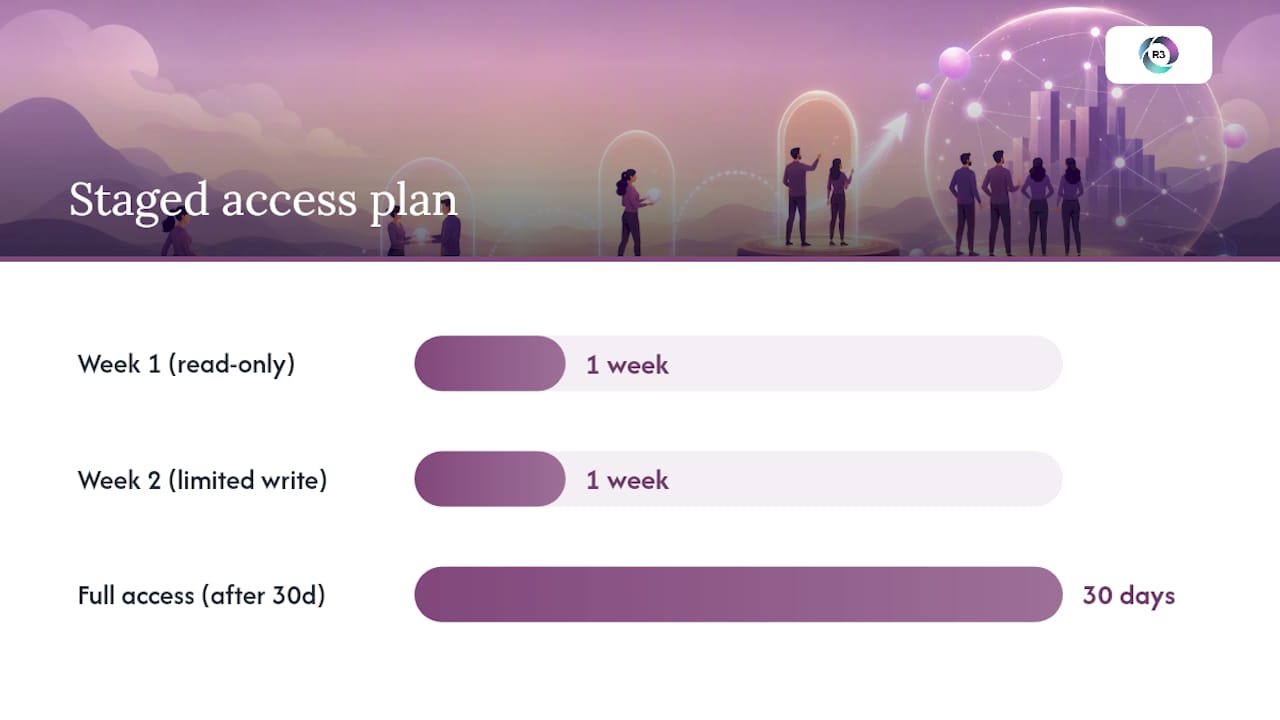
Pro Tip: Run a staged access plan. Give a new VA read-only access to tools in week one, limited write access in week two, and full operational access only after the 30-day review confirms reliability.
Managed dedicated remote staff vs. freelance VAs: which model supports growth better?
The choice between a managed remote staff model and a freelance VA shapes how much growth you actually get from the relationship.
Dimension | Managed remote staff | Freelance contractor | Platform gig VA |
Reliability | Dedicated, consistent availability | Variable; may juggle multiple clients | Highly variable; task-by-task |
Accountability | Provider manages performance | Self-managed | Self-managed |
Integration depth | Trained to work inside your systems | Depends on individual | Usually surface-level |
Cost predictability | Fixed monthly fee | Hourly or project-based | Per-task or hourly |
Onboarding support | Provider assists with setup | Owner-led entirely | Minimal |
Turnover risk | Lower; provider handles replacement | High; owner recruits again | Very high |
Demand for VAs who can integrate with AI tools and automation platforms is rising sharply. Managed providers who train their staff on tools like Zapier, Make, and generative AI platforms give you a VA who can do the work that previously required two or three hires, according to reporting on SMB scaling patterns.
When freelance works: Short-term projects, one-off design or writing tasks, or when you need a very specific skill for a defined period.
When managed remote staff wins: You need someone integrated into daily operations, owning a function, and available consistently. That is the growth model.
R3source sources dedicated remote professionals from the Philippines, a labor market with deep experience in U.S.-facing business support, and manages performance, onboarding, and replacement on your behalf. For an overview of virtual assistant service types and when each model fits, R3source’s resource library covers the decision in detail.
Key Takeaways
Virtual assistants help small businesses grow by converting owner time into revenue capacity, reducing overhead, and delivering consistent execution across operations, marketing, and sales.
Point | Details |
Hours reclaimed | Owners who delegate consistently reclaim 13–15 hours per week, with a reported productivity increase of about 13%, directly available for revenue work. |
Cost advantage | Dedicated remote staff costs a fraction of a U.S. in-house hire with no benefits, taxes, or office overhead. |
Start with low-risk tasks | Inbox triage, calendar management, and CRM updates are the safest first delegations and build trust fast. |
Measure from day one | Track owner hours reclaimed, task completion rate, and lead response time across the first 90 days. |
R3source model | R3source provides dedicated, managed remote professionals from the Philippines, integrated into your operations with full onboarding support. |
The case for dedicated remote staff over task-based hiring
The conventional wisdom says “start with a freelancer and upgrade later.” After seeing how SMBs actually grow with remote staff, that advice often costs owners six months of wasted time.
Here is why. A freelance VA optimizes for their own throughput across multiple clients. A dedicated remote professional optimizes for your business. That difference shows up in how proactively they flag problems, how deeply they learn your systems, and how much institutional knowledge they build over time. Institutional knowledge is the compounding asset that makes a VA genuinely valuable at month six versus month one.
The businesses that see the fastest ROI from virtual support are not the ones who hired the cheapest option. They are the ones who treated the VA role like a real team position: clear scope, proper onboarding, regular feedback, and a long-term commitment. When you invest in that structure, a single skilled VA can carry the operational load that would otherwise require two or three part-time hires.
One pattern worth noting: owners who start with inbox and calendar management almost always expand the VA’s role within 60 days. The time they reclaim creates space to see what else needs delegation. That is how a single hire becomes a growth lever.
R3source gives you a dedicated remote team, not a revolving door
If you have read this far, you already know that the managed dedicated remote staff model delivers more consistent growth results than task-based freelancing. R3source is built around exactly that model: dedicated remote professionals from the Philippines, trained to integrate into your daily operations, and managed for performance so you do not have to be an HR department.
R3source handles recruiting, onboarding support, and performance accountability. You get a remote professional who knows your systems, follows your SOPs, and shows up consistently. Services include administrative support, customer service, lead generation, CRM management, appointment setting, and marketing support, all as long-term dedicated roles, not gig assignments.
The difference between a VA who “helps out” and one who genuinely moves your business forward is structure and commitment. R3source provides both.
Book a free strategy call to scope your first role, or explore the offshore VA service to see how the managed model works in practice.
Sources and further reading
The following sources informed this article and offer additional depth for readers who want to go further.
Source | What you will find |
Virtual Assistant Global Market Report 2026 | Market size data, CAGR projections, and global adoption trends through 2030 |
Virtual Assistant for Small Business Owners: A 2026 Guide | Owner productivity stats, hours reclaimed, and practical delegation advice |
How SMBs Are Using VAs to Scale Without Full-Time Staff | 2026 case patterns, onboarding playbooks, and scaling models |
How Virtual Assistants Help Your Business Grow | Authoritative task list and function-by-function breakdown |
Virtual Assistant for Small Business: A Complete Guide | Delegation sequencing, SOP guidance, and measurement frameworks |
AI-enabled workflows and managed staffing integration for SMBs | |
How to Start a VA Career in 2026: Skills, Tools, and Demand | Demand trends, AI tool integration, and the skills employers want now |
BusinessNewsDaily: Outsourcing and Business Relationships | Outsourcing benefits, communication best practices, and relationship management |
Recommended
Comments