

Ecommerce Managers: Outsource Product Listings Once You Hit 500 SKUs


Outsourcing wins once you’re managing more than roughly 500 SKUs across two or more channels, or when catalog errors are already costing you sales. Below that, a well-trained in-house owner is usually cheaper and faster to coordinate. Check your channel count and your SKU complexity today, then either start vetting a partner for a 30 to 60 day pilot or begin building your internal hire plan this week.
TL;DR:
Outsourcing becomes cost-effective and necessary when managing more than 500 SKUs or dealing with frequent catalog errors that impact sales.
An experienced provider reduces errors through pattern recognition, leading to faster fixes during critical launches or marketplace transitions.
A high score on SKU complexity, multiple channels, and marketplace revenue share indicates the need to professionalize product listing management.
Outsourcing is most effective for repetitive, high-volume tasks like title and description creation, image editing, and bulk feed management, while strategic decisions stay internal.
Proper vendor vetting, clear pilot terms, and having an internal owner are crucial to successful long-term catalog outsourcing.
Table of Contents
Why Outsource Product Listing Management: The Real Payoff
The math on outsourcing rarely comes down to labor rates alone. It comes down to what a trained team catches that a generalist misses. Providers who manage dozens of catalogs develop what one analysis calls “scar tissue,” the accumulated pattern recognition from fixing the same Amazon suppression, the same Walmart attribute rejection, and the same eBay category mismatch dozens of times over. That experience shows up as fewer errors and faster fixes, not just faster typing.
The operational upside compounds during the moments that matter most. A seasonal launch, a new marketplace rollout, or a 200 SKU wholesale order lands very differently on a team that already knows Amazon’s backend requirements versus one relearning them under deadline pressure. Speed to publish becomes a competitive edge, not a hope.
Cost comparisons also look different once you include the full picture. A full-time in-house hire carries salary, payroll tax, benefits, software licenses, and management overhead. A managed remote-staff or retainer model swaps that fixed burden for a flexible one that scales up during peak season and down in slower months.
Watch these signals closely, because each one usually means revenue is already leaking:
Listing error rates climbing month over month, especially on attribute or variant fields.
Marketplace suspensions or content takedowns tied to policy violations.
Time-to-publish stretching past a week for routine new SKUs.
Support tickets piling up from customers confused by inaccurate specs or images.
Academic research on organizational choice backs this up directly: businesses that lean into specialization and scale for operational tasks tend to capture efficiency gains that a generalist, do-it-all internal team structurally can’t match once volume grows past a certain point.
How Do You Know When to Outsource Listing Management?
Three numbers tell you almost everything you need to know: SKU complexity, channel count, and the share of revenue running through marketplaces versus your own site. Score each on a simple scale, and the right structure usually reveals itself fast.
SKU complexity. Under 200 SKUs with simple attributes scores low. Over 500 SKUs, heavy variants (size, color, bundle), or frequent new-product launches scores high.
Channel count. Selling only on Shopify scores low. Managing Amazon, Walmart, eBay, and your own site simultaneously scores high, since each marketplace demands its own schema and formatting.
Marketplace revenue share. If marketplaces generate a small slice of total sales, keep it internal. If that share is growing and material to the business, professionalizing the operation stops being optional.
Add up the scores. Low across all three usually means in-house is still the cheaper, simpler path. A high score on two or more axes is the threshold most marketplace operations guidance points to as the moment to bring in dedicated help.
A hybrid model often makes the most sense in the middle ground. Keep one internal owner who protects brand voice, pricing strategy, and final sign-off, while a managed team handles the tactical uploads, feed syncing, and channel-specific formatting. Sequence it by starting with your highest-volume channel, proving the workflow, then expanding to the rest of your catalog once the process is tested.
Pro Tip: Don’t wait for a crisis to score yourself. Run this three-axis check quarterly. Fast SKU growth or a new channel launch can flip your score from “in-house is fine” to “outsource now” within a single quarter.
Watch for these switch signals specifically: a sudden wave of new SKU launches, expansion into a second or third marketplace, or repeated QA failures that keep eating your team’s week.
Which Listing and Catalog Tasks Should You Outsource?
Most brands outsource the repeatable, high-volume, formatting-heavy work and keep the strategic decisions in-house. That split matters more than most vendor conversations suggest.
Listing creation is the most commonly outsourced category:
Titles, bullet points, and long-form descriptions written to each channel’s style rules.
Attribute and variant mapping, including size charts and color families.
Image editing, background removal, and lifestyle shot formatting.
Enhanced or A+ content builds for Amazon-style comparison modules.
Operational catalog work follows close behind:
Bulk catalog uploads and template management across platforms.
Inventory and pricing feed synchronization to prevent overselling.
Error resolution when a marketplace flags a listing for rejection.
Specialized work requires more platform fluency and benefits greatly from adopting Ecommerce Programmatic SEO: A Practical Rollout Playbook strategies to optimize product pages efficiently. Taxonomy mapping between your internal categories and each marketplace’s required schema is tedious and error-prone by hand. Localization for international listings and digital asset management (DAM) for image libraries both fall into this bucket, as does channel-specific content like Amazon’s A+ modules, which have their own layout and character rules entirely separate from Walmart or eBay. Each marketplace treats a single Shopify product record differently once it has to be re-mapped into a different schema with different image variants and different failure modes.
What should stay internal, always? Brand voice guidelines, pricing strategy, and final content approval. A managed team should execute your standards, not invent them. Virtual staff handling product information and catalog work still need your sign-off on anything that touches brand positioning.
How Do You Choose the Right Outsourcing Partner?
Vetting a partner well takes about an hour of focused questions, and it saves months of cleanup later. Six dimensions separate a reliable partner from a risky one.
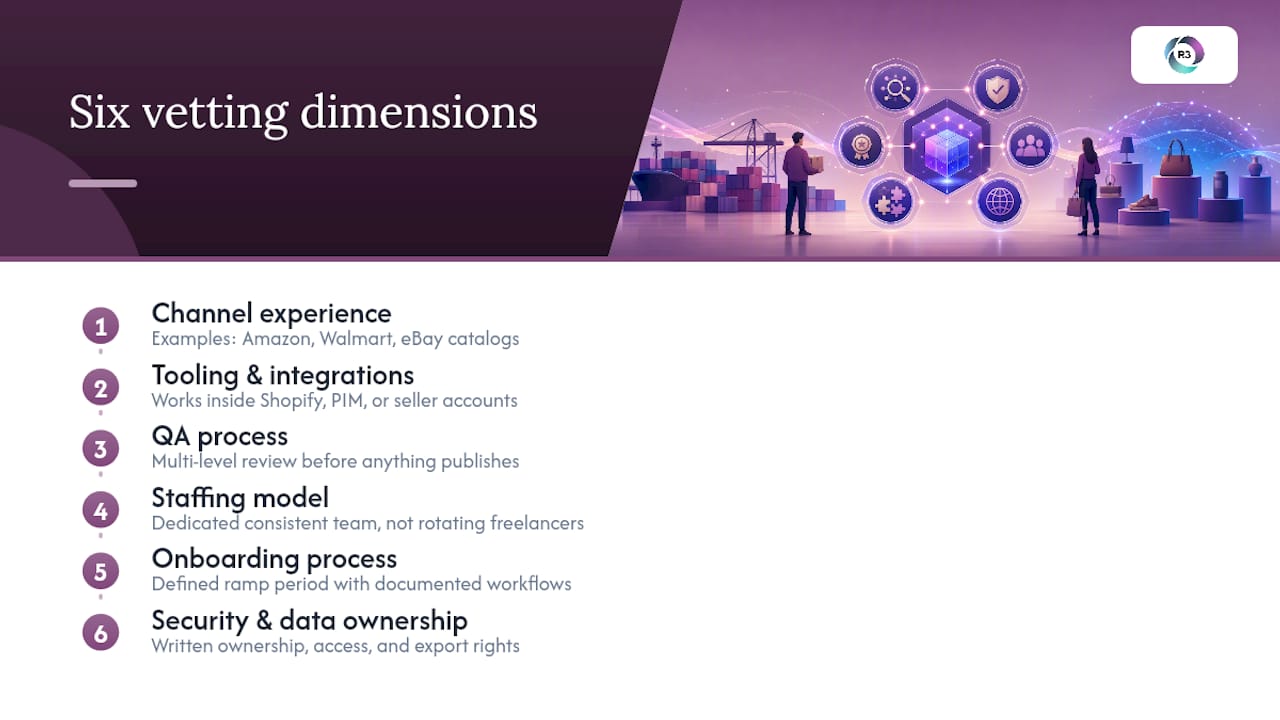
Channel experience. Ask for specific examples of Amazon, Walmart, and eBay catalogs they’ve managed, not a generic claim of “marketplace expertise.”
Tooling and integrations. Confirm they work inside your existing systems, whether that’s Shopify, a PIM, or a direct marketplace seller account, rather than asking you to adopt new software.
QA process. A serious provider has a multi-level review step before anything publishes, not a single person checking their own work.
Staffing model. Determine whether you’re getting a dedicated, consistent team member or a rotating pool of freelancers with no continuity between projects.
Onboarding process. A defined ramp period with documented workflows beats a vague promise to “figure it out as we go.”
Security and data ownership. Confirm in writing who owns your product data, images, and account access, and what happens to that data if you end the engagement.
In interviews, ask who specifically will touch your account day to day, and what happens if that person leaves. The answer reveals whether you’re hiring a team or a single point of failure.
Pro Tip: If a provider can’t tell you their listing accuracy rate off the top of their head, that’s the red flag itself. Teams that track quality know their numbers cold.
Watch for vague answers about data access, reluctance to name specific past clients, or pricing that seems too good relative to the scope you’re describing. Build data export rights and account ownership clauses into the contract itself, not just a verbal assurance. Guidance on outsourcing without losing control covers exactly this kind of contract language in more depth.
What Does a Successful Onboarding Process Look Like?
A pilot exists to answer one question cheaply before you commit fully: does this team actually deliver what they promised? Structure it tight enough that failure is obvious and success is measurable.
Define scope and KPIs upfront. Pick 20 to 50 representative SKUs, set a 30 to 60 day timeframe, and write down exact acceptance criteria before work starts, not after.
Set the approval workflow. Decide who signs off on content before it publishes, and how often you’ll review batches, weekly is typical during a pilot.
Lock the account access model. Grant the minimum access needed for the work, and confirm you retain administrative ownership of every platform account.
Write data and exit clauses into the agreement. Include data export rights, an NDA, and a clear statement that you own the underlying catalog data regardless of who touches it.
Set the ongoing measurement cadence. Weekly QA spot checks and monthly performance reporting catch drift before it becomes a pattern.
Pilot element | What to define | Typical target |
Timeframe | Start and end date for the trial | 30 to 60 days |
Sample size | Representative SKUs across categories | 20 to 50 SKUs |
Accuracy target | Listings meeting spec on first review | high accuracy |
Review cadence | Frequency of QA and reporting | Weekly during pilot |
Build in a handback trigger, too: a defined point at which, if quality targets are missed twice running, you pause and reassess rather than let a bad fit drift into a full-scale rollout. A resource like the outsourcing checklist built for growing SMBs is worth reviewing before you draft your own pilot terms.
How R3source Approaches Product Listing Operations
A managed remote-staff model solves the continuity problem that freelance marketplaces create. Instead of a different contractor for every batch of SKUs, you get dedicated roles, a catalog specialist who learns your taxonomy, a data engineer who maintains feed accuracy, an image editor who understands your brand’s visual standards, and those people stay assigned to your account over time.
That continuity matters more than it sounds. A freelancer who finishes a project and moves on takes their institutional knowledge with them. A long-term dedicated team member keeps it, which means fewer repeated mistakes and less time spent re-explaining your catalog structure every quarter. The growing case for flexible, remote-managed talent reflects exactly this shift, businesses increasingly building long-term remote capacity rather than one-off task relationships.
R3source structures onboarding around the same governance principles covered above:
A defined pilot scope with sample SKUs and clear acceptance criteria.
Documented approval workflows before any content goes live.
Client-retained account ownership and data access throughout the engagement.
This model fits best for ecommerce brands managing multiple channels or growing SKU counts who need reliable, accountable staff rather than another rotating freelancer relationship.
What Ecommerce Brands Get Wrong About Outsourcing
The most common mistake isn’t picking the wrong partner. It’s outsourcing without naming an internal owner first. Someone on your team has to hold the relationship, review the work, and catch drift, or quality erodes quietly over months.
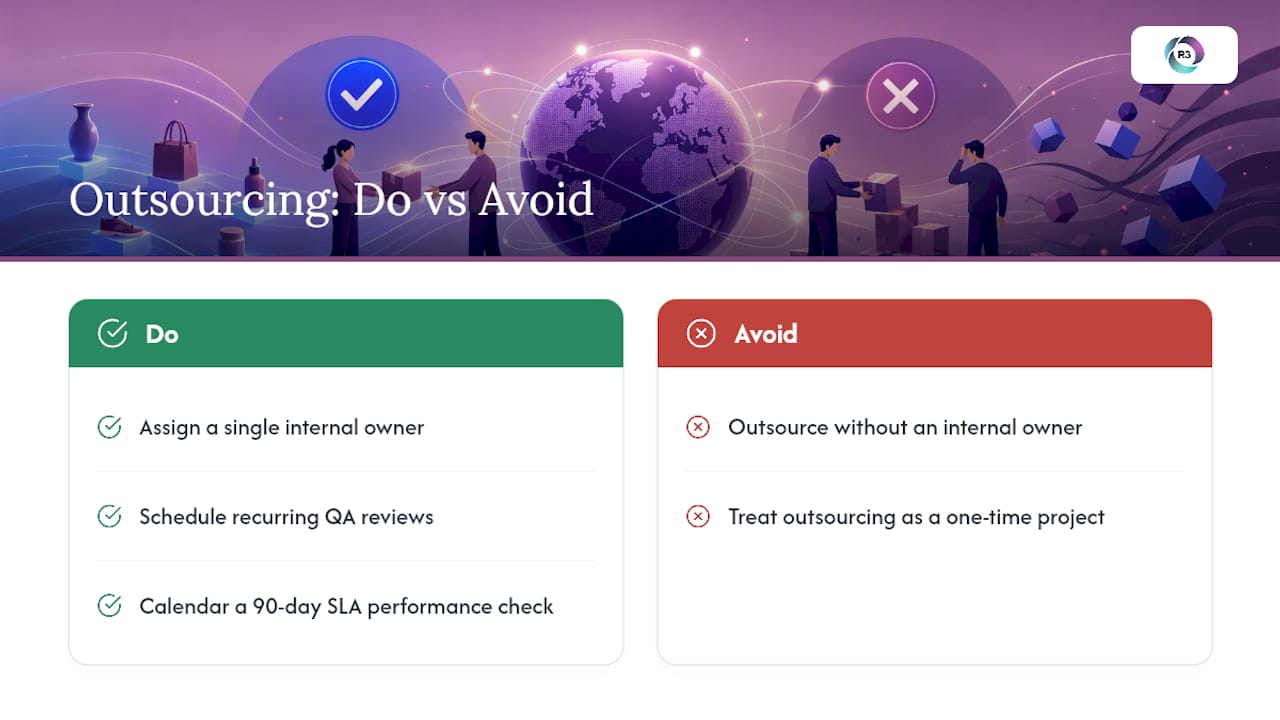
The second mistake is treating outsourcing as a project with an end date instead of an ongoing operating capability. Catalogs change, marketplaces update policies, and governance has to keep pace.
Three things to do immediately after signing a partner: assign one internal owner, schedule a recurring QA review, and calendar a 90 day performance check against your original SLA targets.
— Ellis
Get Reliable, Long-Term Support for Your Product Catalog
R3source built its model for exactly the gap this article describes: brands that need dependable, trained staff on their catalog work without the overhead of a full-time hire or the inconsistency of rotating freelancers. Rather than piecing together task-based gig workers for every listing batch, you get a dedicated remote professional who learns your taxonomy, your brand voice, and your marketplace quirks, and stays on your account long enough for that knowledge to compound.
This fits best if you’re managing growing SKU counts, expanding into a second or third marketplace, or watching listing errors eat into conversion faster than your current team can fix them. R3source’s offshore virtual assistant staffing covers exactly this kind of catalog and listing work, integrated directly into your existing systems and workflows.
If you want to see how this works before committing to anything long-term, book an introductory consultation and walk through your catalog, your channel mix, and what a pilot engagement would look like for your specific SKU count.
Sources
FAQ
What Are Ecommerce Outsourcing Services?
Ecommerce outsourcing services are third-party or managed remote teams that handle operational tasks like product listing creation, catalog uploads, image editing, and marketplace formatting, so internal staff can focus on strategy and growth.
What Are the Four Types of Outsourcing?
The four common types are staff augmentation (adding dedicated remote workers to your team), project-based outsourcing (a defined scope with an end date), business process outsourcing (an entire function like customer service), and offshoring (moving work to a lower-cost country while retaining oversight).
Is Outsourcing a Dying Concept?
No. Outsourcing is shifting toward long-term, dedicated remote staffing relationships rather than disappearing, a trend the World Economic Forum’s labor market analysis ties directly to growing demand for flexible remote talent.
What Are the 7 C’s of Ecommerce?
Definitions vary across sources, but the concept generally refers to factors like customer experience, content, community, convenience, cost, choice, and customer service, treated as pillars of a successful online storefront rather than a fixed, universally agreed list.
How Long Does It Take to Fully Outsource Listing Management?
A typical pilot runs 30 to 60 days with a representative SKU sample, and most brands can move to full operational outsourcing within one to two quarters once the pilot proves accuracy and turnaround targets.
Recommended
Comments