

Advantages of Hiring a Virtual Assistant for SMBs


Yes, for most small and medium businesses, hiring a virtual assistant delivers real time and cost advantages that pay back within weeks. Owners who delegate routine tasks to a VA reclaim 10–20 hours per week, and when that time gets reinvested into revenue-generating work, the net impact compounds quickly. The hourly-rate gap alone tells a compelling story: a skilled general admin VA typically costs $15–$30/hr, while your own time as an owner is worth multiples of that.
The top three outcomes most SMB owners experience:
Time back. Routine admin, inbox management, and scheduling move off your plate within the first week.
Lower overhead. No payroll taxes, benefits, or office costs compared to a full-time in-house hire.
Better customer responsiveness. A dedicated VA handles inquiries and follow-ups without you as the bottleneck.
If you spend more than 10 hours a week on admin tasks, it’s worth running a VA trial this month.
Table of Contents
1. The core advantages of hiring a virtual assistant
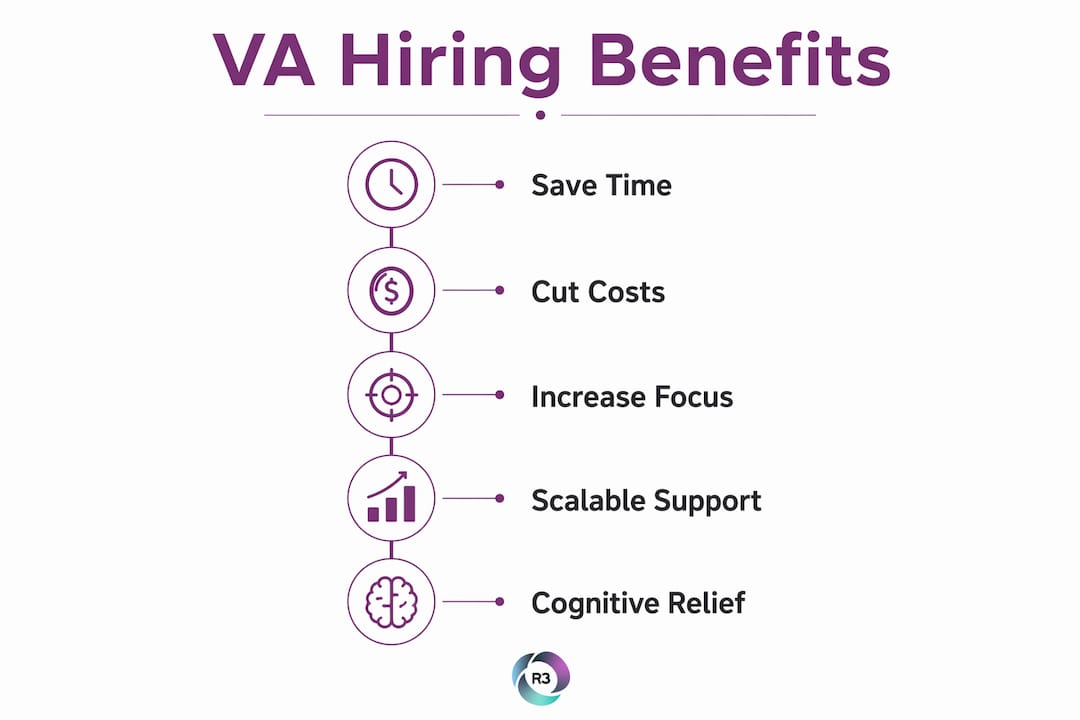
The benefits of bringing a VA onto your team go well beyond “saving time.” Each one connects to a measurable business outcome you can track.
Time reclaimed for revenue work. Owners who delegate consistently reclaim 10–20 hours each week, hours that can shift directly into sales calls, client delivery, or product development.
Reduced overhead costs. Compared to a full-time in-house employee, cost savings can be significant when you factor out benefits, payroll taxes, and office space.
Improved productivity across the team. When you stop context-switching between strategy and admin, your output quality on high-value work rises noticeably.
Scalability without hiring risk. You can increase VA hours during a busy quarter and scale back without severance or HR complexity.
Stronger customer responsiveness. A VA handling your inbox and CRM means clients hear back faster, which directly affects retention and referrals.
Better work-life balance. Handing off the tasks that follow you into evenings and weekends creates real separation between work and recovery time.
Institutionalized operations. When a VA works from documented SOPs, your processes stop living in your head and start living in your systems. That shift makes your business more reliable and more valuable.
Reduced cognitive load. Owner feedback consistently points to cognitive-load reduction as the biggest felt benefit: exiting “survival mode” and regaining the mental space to think strategically.
Compounding capacity. Each hour reclaimed and reinvested into growth work creates a compounding effect over 6–12 months that a simple hourly-rate comparison misses entirely.
Improved business continuity. A VA who owns specific workflows reduces single-point-of-failure risk when you travel, get sick, or take on a major project.
Pro Tip: Before you hire, map every task you do in a week and flag anything that blocks you from revenue-generating work. Delegate those first. The productivity gain from clearing your highest-friction tasks is far greater than delegating low-stakes admin.

2. What a virtual assistant is and the common types SMBs use
A virtual assistant is a remote professional who handles defined business tasks on a contract or dedicated basis. They work from their own location, use your tools and systems, and operate within the scope you set. They are not employees in the traditional sense, and they do not require a desk, equipment, or benefits from you.
Common VA types and when each fits:
General admin VA. Handles scheduling, inbox management, data entry, and document prep. The right starting point for most owners who are drowning in day-to-day operations.
Customer support VA. Manages live chat, email tickets, and phone follow-ups. Fits e-commerce and service businesses where response time directly affects reviews and retention.
Bookkeeping VA. Handles invoicing, expense tracking, and reconciliation prep. Not a replacement for a CPA, but keeps your books clean between accountant reviews.
Marketing VA. Manages social media scheduling, content repurposing, email campaigns, and basic graphic updates. Useful when you have a content strategy but no one to execute it consistently.
Lead generation and CRM VA. Researches prospects, updates CRM records, and manages outreach sequences. High-value for sales-driven businesses where pipeline hygiene matters.
Technical or specialized VA. Handles platform-specific tasks like WordPress updates, Shopify product uploads, or basic ad account management. Requires more specific vetting.
Freelancer vs. dedicated remote staff vs. agency:
Freelancer: High control, lower cost per hour, but you carry the recruitment, management, and continuity risk yourself.
Dedicated remote staff: A VA assigned full-time or part-time to your business, typically through a provider like R3source. Lower management overhead, stronger continuity, and faster ramp-up because the provider handles sourcing and vetting.
Agency or platform: Reduces recruitment risk and offers replacement guarantees, but may standardize processes in ways that limit how deeply the VA integrates into your specific workflows.
For most SMBs, the dedicated remote staff model offers the best balance of control and reliability. You get a consistent person who learns your business, without the full burden of independent hiring.
3. What tasks can you actually hand off to a VA?
The fastest way to get value from a VA is to hand off tasks that are repeatable, time-consuming, and do not require your direct judgment. Here is a practical breakdown by category.
Calendar and inbox management
Schedule and confirm appointments; send reminders
Sort and respond to routine emails using templates you approve
Flag priority messages and archive the rest
Email management alone can recover 5–7 hours a week for owners with high inbox volume
Customer support
Respond to FAQs via chat, email, or phone
Process refund or service requests using your defined policy
Follow up on open tickets and escalate edge cases to you
Bookkeeping basics
Log expenses and categorize transactions in QuickBooks or Xero
Send invoices and follow up on outstanding payments
Prepare weekly cash-flow summaries for your review
Lead generation and CRM maintenance
Research and build prospect lists from LinkedIn or industry databases
Update contact records, deal stages, and notes in HubSpot or Salesforce
Send initial outreach sequences and track reply rates
Social media and content operations
Schedule posts using Buffer or Hootsuite
Repurpose long-form content into short-form clips or captions
Monitor comments and flag engagement opportunities
Project follow-ups
Track task completion across Asana or Trello boards
Send weekly status updates to clients or team members
Compile progress reports from multiple contributors
Pro Tip: For any repeatable task, record a 3–5 minute Loom screen-capture walking through exactly how you do it. Pair that with a one-page SOP checklist. This combination cuts onboarding time dramatically and removes the ambiguity that causes most early VA mistakes.

4. How much does a virtual assistant cost?
VA pricing varies by skill level, engagement model, and whether you hire directly or through a provider. Here are the three main pricing structures:
Hourly. You pay per hour worked. Best for variable or low-volume needs. Requires time tracking.
Retainer / monthly hours block. You pre-purchase a set number of hours per month at a slightly lower rate. Predictable cost, good for consistent weekly workloads.
Dedicated full-time equivalent (FTE). A VA works exclusively for your business at a fixed monthly rate. Best for owners who need 30+ hours per week of consistent support.
Typical VA rate ranges
VA type | Typical hourly range | Best for |
General admin | $15–$30/hr | Scheduling, inbox, data entry |
Marketing VA | $15–$30/hr | Social media, content, email campaigns |
Bookkeeping VA | $15–$30/hr | Invoicing, expense tracking, reconciliation |
Technical / specialized | — | Platform management, ads, dev support |
Rate ranges sourced from Calcix’s VA ROI guide.
Sample ROI calculation
Say your time as an owner is worth $150/hr (a conservative estimate for most SMB operators). You hire a general admin VA at $25/hr and delegate 15 hours of weekly tasks.
Weekly cost of VA: $375
Weekly value of your reclaimed time: $2,250
Weekly net value gain: $1,875
Annualized impact: roughly $97,500 in reclaimed owner capacity
That figure assumes you reinvest those hours into revenue work, not more admin. The ROI compounds when reclaimed time goes into client acquisition, product development, or strategic planning.
Pro Tip: Cap your first month at 20 hours to reduce the onboarding J-curve. Expect the first 2–3 weeks to feel slower as your VA learns your systems. By week four, output typically exceeds the training investment. Build that ramp into your ROI expectations from day one.
5. How to hire a virtual assistant: a practical playbook
Getting the hire right matters more than getting it fast. A structured process reduces the risk of a bad fit and shortens the time to productive work.
Where to find VAs
Dedicated staffing providers (like R3source): best for long-term, integrated remote staff with vetting and onboarding support already built in
Freelance platforms (Upwork, Fiverr): high volume of candidates, but you carry all screening and management overhead
Direct referrals: often the fastest path to a reliable hire, but limits your candidate pool
For a deeper look at sourcing and vetting, the R3source guide on finding a reliable long-term VA covers the evaluation criteria that matter most.
Hiring checklist
Define the role scope: list specific tasks, expected weekly hours, and tools the VA must know
Write a short job description with three to five core responsibilities and two to three KPIs
Shortlist three to five candidates based on relevant experience and communication quality
Conduct a 30-minute video interview focused on judgment, reliability, and process thinking
Assign a paid trial task that mirrors real work (e.g., inbox triage for one day, a CRM data cleanup)
Evaluate the trial on accuracy, speed, and how they handle ambiguity
Build a 30-day onboarding plan with weekly check-ins and documented SOPs before day one
Interview questions that reveal fit
“Walk me through how you handle a task when the instructions are unclear.”
“Describe a time you caught an error before it reached a client.”
“What tools do you use to stay organized across multiple priorities?”
“How do you prefer to receive feedback?”
Red flags to watch for
Vague answers about past responsibilities or tools used
Reluctance to work from documented processes
Inconsistent communication during the hiring process itself
No questions about your business or how success will be measured
Using structured remote candidate evaluation techniques during the trial phase helps you score candidates on consistent criteria rather than gut feel alone.
6. U.S. tax and worker classification: what you need to know
Classifying your VA correctly under U.S. law is not optional. The IRS and the Department of Labor both apply multi-factor tests to determine whether a worker is an independent contractor or an employee, and misclassification carries real financial penalties.
The three-factor framework (IRS common-law test):
Behavioral control: Do you control how the work is done, not just the outcome? If yes, that points toward employee status.
Financial control: Does the worker set their own rates, work for multiple clients, and supply their own tools? That points toward contractor status.
Type of relationship: Is there a written contract? Are benefits provided? Is the relationship ongoing and exclusive? Ongoing exclusivity without a contractor agreement is a risk signal.
Practical compliance steps:
Use a written independent contractor agreement for every VA engagement, regardless of hours
Collect a completed W-9 before the first payment
Pay via invoice, not payroll, and keep records of all invoices
Avoid dictating specific work hours or requiring the VA to use only your equipment
Do not provide benefits, PTO, or reimbursements structured like employment perks
If the relationship is long-term and exclusive, review classification with a tax advisor annually
On taxes: Payments to contractors totaling $600 or more in a calendar year require a 1099-NEC filing. Keep all invoices and payment records organized by tax year.
Pro Tip: Document your VA engagement as task-based and outcome-oriented from day one. SOPs that define what to deliver (not when or how to sit at a desk) support the contractor relationship. For any borderline situation, consult a CPA or employment attorney before the relationship deepens.
7. Why cognitive load reduction is the most underrated benefit
Most articles about the benefits of virtual assistants focus on hours saved. The deeper gain is harder to quantify but more transformative: getting your mental bandwidth back.
“Business owners who delegate to VAs consistently report exiting ‘survival mode’ — the state of constant reactive task-switching that prevents strategic thinking. The cognitive relief of knowing routine operations are handled is often described as more valuable than the hours themselves.” — GrowthOutsourced
When you stop carrying every operational detail in your head, your decision quality improves. You think longer-term. You spot opportunities you were too busy to see before.
The second layer is what experienced entrepreneurs call institutionalization: moving tasks out of your head and into documented systems. A VA who works from SOPs and CRM workflows is not just doing tasks. They are converting founder knowledge into repeatable, auditable processes. That shift has a direct impact on business value.
How to capture these gains:
Identify the three to five tasks you mentally carry even when you are not doing them (the ones that wake you up at 2 AM).
Document each one as a step-by-step SOP before handing it off.
Assign ownership to your VA and set a weekly check-in to review output quality.
Track how you use the reclaimed mental space: are you spending it on revenue work, product thinking, or client relationships?
Over 6–12 months, this compounding effect can materially shift your business’s growth trajectory. There is also an equity angle worth considering: businesses that run on systems rather than founder heroics command higher exit multiples. Paying for reliable VA support is, in part, an investment in future sellable value.
The R3source guide on VA operations strategy goes deeper on how this plays out across different business models.
Key Takeaways
Hiring a virtual assistant delivers its strongest ROI when owners delegate revenue-blocking tasks first, document processes before handoff, and reinvest reclaimed time into growth work.
Point | Details |
Start with revenue-blocking tasks | Delegate what stops you from selling or delivering first; the productivity gain is largest there. |
Expect 10–20 hours reclaimed weekly | Most SMB owners recover 10–20 hours per week after a structured VA handoff. |
Cost savings are significant | Compared to in-house hiring, VA arrangements can reduce overhead costs by 59–78%. |
Classify correctly from day one | Use a written contractor agreement, collect a W-9, and pay by invoice to stay IRS-compliant. |
R3source for dedicated remote staff | R3source provides vetted, long-term VAs from the Philippines with onboarding support built in. |
The real shift happens when you stop doing everything yourself
Most business owners I speak with underestimate how much of their cognitive capacity is consumed by tasks a skilled VA could own within two weeks. The conversation usually starts with “I just need help with emails,” and within 90 days, the owner has handed off CRM maintenance, appointment setting, and weekly reporting. That progression is not accidental. It happens because the first successful delegation builds trust in the process, and trust creates the confidence to delegate more.
The 30/60/90-day framework is worth using deliberately. At 30 days, measure task accuracy and communication quality. At 60 days, evaluate whether the VA is working from SOPs independently or still requiring constant direction. At 90 days, assess whether your own weekly hours on high-value work have increased by 10–20 hours. If they have not, the problem is usually upstream: unclear scope, missing documentation, or tasks that were not truly delegated.
One practical tip: resist the urge to check in on every task in the first month. Over-supervision signals distrust, slows the VA’s development of independent judgment, and recreates the cognitive load you were trying to shed. Set clear outcomes, review the output, and give direct feedback when something misses. That rhythm builds a working relationship that compounds over time.
R3source connects you with dedicated remote professionals
If you have read this far and you are thinking “I need this, but I do not have time to run a hiring process,” that is exactly the problem R3source was built to solve.
R3source provides dedicated virtual assistants and remote professionals from the Philippines to growing businesses across the United States. The model is not a freelance marketplace. Every team member is vetted, trained, and assigned to your business long-term, with onboarding support built into the process so you are not starting from scratch.

The services cover administrative support, customer service, lead generation, CRM management, appointment setting, and marketing operations. Whether you need one VA or a full remote team, R3source scales with your business without the overhead of traditional hiring.
The cost advantage is real: offshore dedicated staffing typically runs well below U.S. in-house rates, with no payroll taxes, benefits, or office costs on your side. You get consistent performance and accountability without the management burden of independent freelancer sourcing.
Ready to see what the right VA can do for your business? Explore offshore VA services or book an introductory consultation to talk through your specific needs with the R3source team.
Useful sources and further reading
The claims and figures in this article draw from the following authoritative sources. For tax and classification questions, always confirm current guidance with a qualified CPA or employment attorney.
Calcix: Is a Virtual Assistant Worth It? ROI & Cost Guide — Primary source for hourly rate ranges ($15–$75/hr by skill level), the 10–20 hours reclaimed figure, and the onboarding J-curve framework. Useful for building your own ROI calculation.
GrowthOutsourced: The Real Benefits of Outsourcing to a VA — Owner feedback and narrative evidence on cognitive-load reduction and compounding operational improvements. Supports the deeper benefits argument beyond simple time savings.
ApprovedExperiences: Virtual Assistant for Small Business Owners — SMB-focused market figures including the 13–15 hours reclaimed per week and 59–78% cost savings versus in-house hiring. Also covers freelancer vs. agency trade-offs.
U.S. Bureau of Labor Statistics: Office and Administrative Support Occupations — BLS data on the scale of administrative support employment (18.5 million jobs in May 2023), useful for understanding the labor supply context behind VA hiring.
BLS Occupational Outlook Handbook: Secretaries and Administrative Assistants — Official BLS role definitions and wage data for administrative support occupations; provides a baseline for comparing in-house vs. remote assistant costs.
She’s a Given: Tax Guide for Virtual Assistants — Practical guidance on contractor compliance steps: written agreements, W-9 collection, invoice-based payment, and 1099-NEC filing requirements.
R3source: How Virtual Staff Supports Digital Businesses — R3source’s operational guide on integrating remote staff into digital business workflows; relevant for owners in e-commerce, SaaS, and professional services.
TalentApproved: Remote Candidate Evaluation Techniques — Structured frameworks for evaluating remote candidates during trial tasks and interviews; useful for building a consistent scoring process.
This article is general information, not legal or tax advice. Confirm current IRS and DOL classification rules with a qualified tax professional for your specific situation.
Recommended
Comments