

Why U.S. businesses hire from the Philippines
- R3SOURCE TEAM

- 2 days ago
- 9 min read

More American small business owners than ever are building their teams across the Pacific, and it is not just the Fortune 500 companies doing it. The Philippines has become one of the most sought-after sources of remote talent for U.S. businesses of all sizes, driven by a powerful combination of skilled professionals, strong English communication, and cost structures that make real financial sense. If you have been wondering whether hiring from the Philippines is right for your business, this guide will walk you through the benefits, the numbers, and the practical steps to make it work.
Table of Contents
Key Takeaways
Point | Details |
Cost-effective talent | Hiring from the Philippines delivers high-quality work at a fraction of U.S. costs. |
Skilled, adaptable workforce | Filipino professionals offer strong English skills, education, and cultural fit. |
Wide range of roles | SMBs can fill administrative, creative, technical, and customer service roles with ease. |
Smooth team integration | Effective onboarding and communication unlock long-term success with Filipino hires. |
Beyond savings | Loyalty, innovation, and team spirit from Filipino professionals drive ongoing growth. |
Why the Philippines is a top choice for remote staffing
When U.S. business owners start exploring remote staffing options, they often look at several countries. What keeps bringing them back to the Philippines is a combination of factors that genuinely set it apart from other talent markets.
First, language is rarely a barrier. The Philippines has two official languages: Filipino and English. English is used in schools, government, and business at every level. This means that English proficiency is not just common, it is the professional standard. When you bring a Filipino team member on board, you are not navigating translation delays or miscommunication. Conversations are clear, emails are polished, and customer interactions feel natural.
Second, the cultural alignment with American business norms is remarkably strong. Decades of cultural exchange, American media, and Western-style education have shaped a workforce that understands how U.S. businesses operate. Filipino professionals are familiar with American holidays, communication styles, and professional expectations. That makes team integration significantly smoother compared to other offshore options.
Third, the educational system in the Philippines produces a steady stream of highly qualified graduates every year. Fields like business administration, information technology, accounting, marketing, and healthcare support are all well-represented. Many Filipino professionals hold four-year degrees and pursue ongoing certifications to stay competitive in the global market.
Here is what U.S. employers consistently highlight when describing their Filipino remote staff:
Reliability: Showing up, meeting deadlines, and following through without constant supervision
Positive attitude: A genuine willingness to learn, adapt, and contribute to team culture
Attention to detail: High accuracy in tasks like data entry, reporting, and client communication
Professionalism: Formal communication, respect for hierarchy, and strong work ethics
Adaptability: Comfortable working across time zones and adjusting to evolving business needs
“The Filipino workforce brings a level of commitment and professionalism that consistently exceeds expectations. Their cultural alignment with American business values makes collaboration feel effortless.” — A reflection shared by many U.S. business owners who partner with R3SOURCE
These qualities are not accidental. They reflect a workforce that has been shaped by strong family values, a culture that prizes education, and an economy where remote work with international companies represents a meaningful career path. Filipino professionals take their roles seriously because these positions matter to them and their families.
Cost savings: How hiring from the Philippines impacts your bottom line

Understanding the talent is one thing. Seeing the financial impact is another. This is where the numbers become very compelling for small and medium-sized business owners in the U.S.
Hiring Filipino professionals results in cost savings that go well beyond just lower salaries. When you factor in everything it costs to employ someone locally, the comparison becomes even more striking.
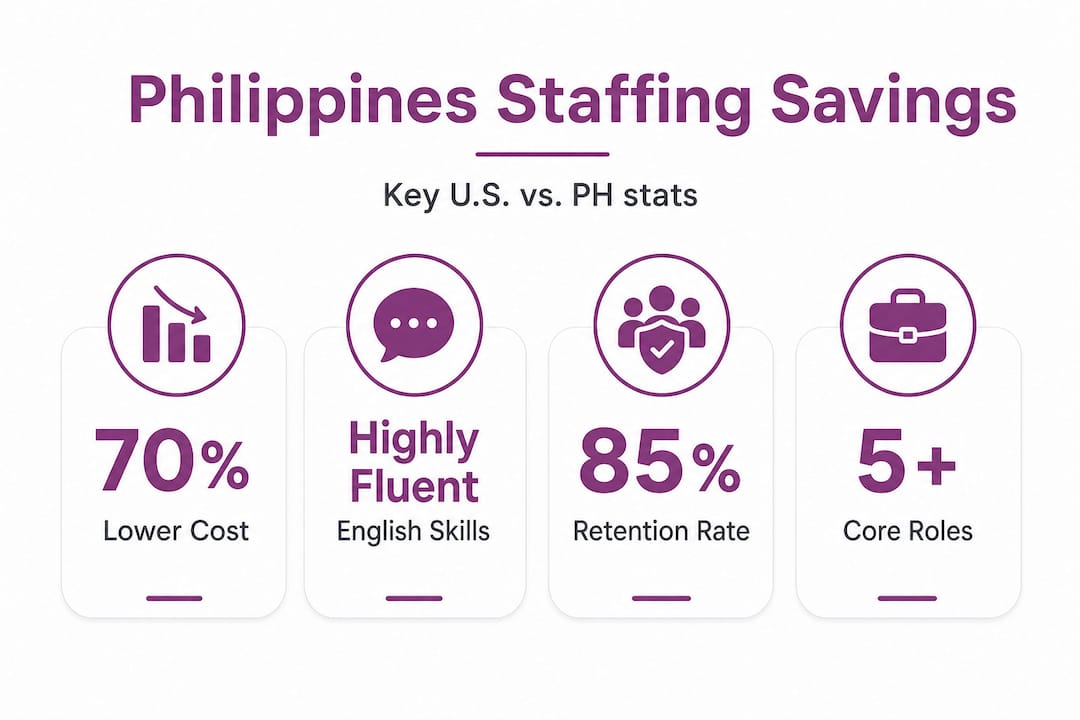
Role | U.S. Average Annual Cost | Philippines Average Annual Cost | Estimated Savings |
Virtual assistant | $45,000 | $12,000 | $33,000 |
Customer support rep | $40,000 | $10,000 | $30,000 |
Bookkeeper | $55,000 | $14,000 | $41,000 |
Digital marketing specialist | $65,000 | $18,000 | $47,000 |
IT support technician | $70,000 | $20,000 | $50,000 |
Note: Figures are approximate annual totals including base compensation. U.S. figures include benefits estimates.
These savings do not stop at salary. When you hire remotely, you eliminate costs tied to physical office space, equipment, utilities, and local employment taxes. You also reduce the financial burden of benefits packages, paid time off accrual, and workers’ compensation insurance that typically come with full-time U.S. employees.
There is also a hidden savings category that most business owners overlook: reduced turnover. Replacing an employee in the U.S. can cost anywhere from 50% to 200% of their annual salary when you account for recruiting, onboarding, and lost productivity. Filipino remote professionals, when treated well and given growth opportunities, tend to stay long-term. That stability protects your investment and keeps your operations running smoothly.
Pro Tip: When calculating your true savings, add up your current employee’s salary, benefits, payroll taxes, and any office-related costs. Then compare that full number to the cost of a remote professional. The gap is usually larger than most business owners expect.
You can even explore R3SOURCE’s free remote professional offer to experience the value firsthand before making a long-term commitment.
Types of roles U.S. businesses hire from the Philippines
One of the most common misconceptions about hiring from the Philippines is that it only applies to basic administrative work. The reality is far more versatile. U.S. companies employ Filipino remote staff in a wide range of roles that span operations, creative work, technical functions, and customer engagement.
Here is a breakdown of the most common role categories:
Administrative and operations support: Virtual assistants, executive assistants, project managers, data entry specialists, and office coordinators. These roles handle the day-to-day tasks that keep your business organized and moving forward.
Financial and bookkeeping roles: Bookkeepers, accounts payable and receivable specialists, and financial report preparers. Many Filipino professionals hold accounting degrees and are experienced with U.S.-based software like QuickBooks.
Creative and content roles: Graphic designers, video editors, content writers, social media managers, and email marketing specialists. The creative talent pool in the Philippines is deep and growing, with many professionals trained in global design standards.
Technical roles: Web developers, software testers, IT support technicians, and systems administrators. The Philippines has a strong technology education sector, and many developers are proficient in widely used programming languages and platforms.
Customer-facing roles: Customer support representatives, live chat agents, appointment setters, and sales development representatives. Filipino professionals in these roles are known for their warm communication style and patience with customers.
Role category | Common tools used | Best for |
Administrative | Google Workspace, Asana, Trello | Scheduling, inbox management, reporting |
Financial | QuickBooks, Xero, Excel | Invoicing, reconciliation, reporting |
Creative | Adobe Suite, Canva, Figma | Branding, content, social media |
Technical | GitHub, Jira, WordPress | Development, IT support, web management |
Customer service | Zendesk, HubSpot, Intercom | Support tickets, live chat, CRM updates |
The versatility of this talent pool means you can build an entire remote team around your specific business model, whether you run a real estate firm, an e-commerce store, or a service-based company. You are not limited to one type of support. You can grow your team role by role as your needs evolve.
How to successfully integrate Filipino remote professionals into your business
Hiring the right person is only the first step. The real work, and the real reward, comes from integrating them well into your team. Effective onboarding and support are what separate businesses that thrive with remote staff from those that struggle.
Here is a practical process to follow:
Create a detailed onboarding checklist. Before your new team member starts, document every tool, process, and expectation they will need to know. Include login credentials, communication protocols, task priorities, and performance benchmarks. A clear onboarding checklist reduces confusion and builds confidence from day one.
Schedule a live orientation call. Do not rely solely on written documents. A live video call in the first week allows you to answer questions, set the tone for your working relationship, and make your new hire feel genuinely welcomed. This small investment pays off in loyalty and engagement.
Address time zone logistics early. The Philippines is in the Philippine Standard Time zone, which is 12 to 13 hours ahead of U.S. Eastern time depending on daylight saving. Most Filipino professionals are experienced with flexible scheduling and can overlap with your core business hours. Establish your preferred overlap window upfront so everyone is aligned.
Use the right digital tools. Platforms like Slack, Zoom, Asana, and Google Workspace make remote collaboration feel seamless. Establish which tools your team will use for communication, task management, and file sharing before your remote professional starts. Consistency in tools reduces friction.
Invest in ongoing development. Filipino professionals respond strongly to growth opportunities. Offer regular feedback, share learning resources, and recognize strong performance. When your team member sees a future with your company, they invest more deeply in your success.
Pro Tip: Set a 30, 60, and 90-day check-in schedule with your new remote hire. Use these touchpoints to address any gaps, celebrate wins, and strengthen the working relationship. Businesses that do this consistently report faster productivity gains and higher retention rates.
Learning how to scale your business with remote support is a process, and you do not have to figure it out alone. Many business owners find that a structured approach to integration, combined with the right partner, makes the transition far smoother than they expected. You can also explore a broader perspective on team building in this grow your business guide to see how other U.S. businesses are making it work.
Why remote staffing from the Philippines offers more than just savings
Here is something most guides will not tell you: the cost savings are just the beginning. They get your attention, and rightfully so. But the businesses that get the most out of their Filipino remote teams are the ones that stop thinking about this as a cost-cutting strategy and start thinking about it as a talent strategy.
We have seen this shift happen with business owners who initially came to us focused entirely on the budget. Within six months, the conversation changes. They are not talking about what they saved. They are talking about what their remote team member built for them. A process they never had time to create. A customer experience that now runs without them. A marketing system that generates leads while they sleep.
Businesses experience improved loyalty and productivity when they invest in their remote teams as true members of the organization, not just task-fillers. Filipino professionals who feel respected, included, and valued tend to stay for years. They learn your business deeply. They anticipate problems before you do. They bring ideas to the table that you did not ask for but genuinely needed.
There is also an innovation angle that gets overlooked. When you free yourself from the daily operational grind, you gain mental space to think strategically. That is where real business growth happens. Your Filipino team handles the backend. You focus on the vision.
The businesses that treat this as a transactional arrangement, where they hire the cheapest option and expect minimal results, tend to get exactly that. But the ones who build genuine working relationships, who invest in communication and culture, who treat their remote staff with the same respect they would give any local employee, those businesses see exponential returns. Explore more insights on the UpLIFT blog to hear how other business owners are experiencing this shift firsthand.
This is not just outsourcing. It is building a team that believes in what you are building.
Discover your next team member with R3SOURCE
If this article has sparked something for you, the next step is simpler than you might think. R3SOURCE connects U.S. business owners with vetted, reliable remote professionals from the Philippines who are ready to integrate directly into your operations.
Right now, you can enter to win a free remote professional for 90 days through our current offer. It is a real opportunity to experience what dedicated remote support can do for your business without a major upfront commitment. You can also visit our learn about remote professionals page to get answers to your most pressing questions, or join us at an upcoming event to build your team with confidence. We are here to help you take the next step, at your pace, with the support you need to succeed.
Frequently asked questions
What are the most popular remote roles businesses hire from the Philippines?
The most common roles include virtual assistants, customer support representatives, bookkeepers, IT support technicians, and digital marketing specialists. U.S. companies employ Filipino remote staff across a wide range of functions, from administrative work to software development.
Is the time zone difference a problem when hiring from the Philippines?
Most Filipino professionals are flexible and can adjust their schedules to overlap with U.S. business hours. Effective onboarding that addresses time zone expectations from the start makes this transition straightforward for most teams.
How can I ensure good communication with my Filipino remote team?
Clear onboarding documentation, regular video check-ins, and consistent use of collaboration tools like Slack and Zoom all support strong communication. Remote staff integration works best when expectations are set clearly from the beginning and reinforced through regular feedback.
Is hiring from the Philippines only about cutting costs?
Cost is a significant advantage, but it is far from the only one. Businesses experience improved loyalty and long-term productivity gains when they invest in Filipino remote teams as genuine members of their organization, not just a budget solution.
Recommended
Comments