

What Is a Remote-First Business? How to Scale It

Running a remote team and running a remote-first business are not the same thing. Many business owners make this assumption, and it costs them. They hire remote staff, set up a video call tool, and call it done. But if your decisions still happen in side conversations, if your promotions still favor visibility over output, and if your new remote hire feels like an afterthought rather than a core part of the team, you haven’t built a remote-first business. You’ve built a traditional office business with a few people working from home. This guide breaks down what remote-first actually means, how it changes your operations, and how to use it as a real strategy for growth.
Table of Contents
Key Takeaways
Point | Details |
Remote-first is not just remote | Remote-first means the business is fundamentally structured around distributed work, unlike remote-friendly or hybrid setups. |
Operational discipline is essential | The benefits of remote-first come only when communication, documentation, and management systems are intentionally designed for remote teams. |
Global scaling opportunities | Remote-first businesses can access talent worldwide and optimize costs without physical office constraints. |
Avoid ‘pretend remote’ pitfalls | Office-centric communication and decisions undermine the advantages of remote-first approaches. |
Virtual assistants support remote-first | Virtual assistant services enable you to build efficient, scalable remote teams aligned with remote-first principles. |
Understanding remote-first: What it really means
Let’s start with clarity, because the terminology alone trips people up.
Remote-first means your entire business is designed for distributed work. Every system, every process, every communication channel assumes that people are not in the same room. It’s the default, not the exception.
Remote-friendly is different. A remote-friendly vs. remote-first distinction matters more than most owners realize: remote-friendly companies permit or accommodate remote work, but the organization’s systems and culture still center on co-located work. Remote-first companies design the entire company around distributed work from the ground up.
Hybrid sits somewhere in the middle. Some employees are in-office, some are remote, and the company tries to serve both. In practice, hybrid often defaults to favoring whoever is physically present.
Here’s a quick comparison to make this concrete:
Feature | Remote-first | Remote-friendly | Hybrid |
Default communication | Written, async | In-person + digital | Mixed |
Decision-making | Documented and accessible | Often informal | Depends on location |
Promotions | Based on output | Often visibility-based | Inconsistent |
New hire onboarding | Fully digital | Partially in-person | Mixed |
Knowledge storage | Centralized documentation | Partially documented | Inconsistent |
The practical difference shows up in moments you might not expect. Who gets looped into a key decision? Where does that information live after the meeting? Can a team member in a different time zone access it without asking someone to resend it? In a remote-first company, the answer to all of those is built into the system. In a remote-friendly company, it depends on who’s around.
Key features of genuinely remote-first organizations include:
Asynchronous communication as the default, not the fallback
Documented decision-making, so no critical knowledge lives only in someone’s head
Promotion and recognition tied to output, not in-person presence
Tools and workflows designed for distributed teams, not retrofitted from office setups
Onboarding that works entirely online, without requiring physical presence
When you’re scaling remote teams, these features aren’t optional. They’re what separates a business that grows smoothly from one that constantly struggles with miscommunication and missed handoffs.
How remote-first changes business operations
Once you understand what remote-first means, the next question is: what actually changes day to day?
The answer is almost everything, but in a way that ultimately makes your business more organized and more scalable. Here’s how operations shift in a remote-first model:
1. Documentation becomes your most important operational asset. In an office, tribal knowledge (information that lives in people’s heads or informal conversations) can survive because people are nearby. In a remote-first business, if it isn’t written down, it doesn’t exist. Standard operating procedures, meeting notes, decision logs, and process guides become the backbone of how work gets done.
2. Communication becomes intentional. You stop relying on quick hallway chats and start building clear communication channels with defined purposes. Slack channels for specific topics, project management tools for task tracking, and shared documents for reference. Every message has a home.

3. Management shifts from monitoring to outcomes. Remote-first managers don’t track hours. They track results. This requires clear goal-setting, regular check-ins with purpose, and trust built through consistent performance rather than physical presence.
4. Your hiring pool expands dramatically. When location is irrelevant to how your business operates, you can hire the best person for the role regardless of where they live. This is one of the most powerful advantages of going remote-first.
5. Meetings become rarer and more purposeful. Meetings in remote-first companies are reserved for decisions and relationship-building, not status updates. Status updates live in documentation.
A useful test: if critical decisions and knowledge still circulate through informal channels, or if promotions hinge on visibility rather than output, your company may be closer to “remote-friendly” or “pretend remote” than genuinely remote-first.
Here’s how virtual assistants fit into remote-first operations:
Role | Remote-first function | Impact |
Administrative VA | Manages calendars, inboxes, and documentation | Frees owner time |
Customer service VA | Handles support tickets and client communication | Improves response time |
CRM management VA | Updates records, tracks leads, manages pipeline | Keeps sales organized |
Marketing support VA | Schedules content, tracks analytics, coordinates campaigns | Maintains brand consistency |
Understanding virtual admin support essentials helps you match the right roles to the right gaps in your operations. Virtual assistants aren’t just task-doers in a remote-first model. They’re integrated team members with defined responsibilities and clear accountability.
Pro Tip: Before hiring your first remote team member, document your three most repeated daily tasks in step-by-step detail. This single exercise reveals gaps in your processes and gives your new hire a clear starting point without requiring constant hand-holding.
The businesses that successfully outsource for growth share one trait: they treat documentation as infrastructure, not paperwork.
Remote-first scaling: Accessing global talent and cost advantages
Here’s where remote-first stops being a management philosophy and starts being a competitive strategy.
When your business is built for distributed work, you can access talent from anywhere in the world. That matters because the best candidate for your open role probably doesn’t live within commuting distance of your office. And even if they did, hiring locally often means paying a premium for average talent when you could hire exceptional talent from a global pool at a fraction of the cost.
The financial case is real. Consider the cost difference between hiring a full-time in-house administrative assistant in a major U.S. city versus a highly skilled virtual assistant from the Philippines. The salary difference alone can be 60 to 80 percent, without accounting for benefits, office space, equipment, or employer taxes. That’s not a small number. That’s the difference between staying small and building a team.
Here’s a practical cost comparison:
Role | U.S. in-house (annual) | Remote VA from Philippines (annual) | Estimated savings |
Administrative assistant | $45,000 to $55,000 | $8,000 to $14,000 | Up to 75% |
Customer support rep | $40,000 to $50,000 | $7,000 to $12,000 | Up to 80% |
Marketing coordinator | $50,000 to $65,000 | $10,000 to $16,000 | Up to 75% |
These savings don’t require sacrificing quality. The Philippines has a highly educated, English-proficient workforce with strong cultural alignment to U.S. business practices. Many virtual assistants from the Philippines hold college degrees and have years of experience supporting American businesses.
A compelling real-world example comes from Otonomee, an Irish company that built a remote-first global scaling model specifically designed to access global talent and serve customers without relying on a physical call-center setup. Their approach demonstrates that remote-first isn’t just about flexibility. It’s a deliberate strategy for reaching better talent, reducing overhead, and building a more resilient operation.
“Remote-first is not a compromise. It’s a competitive advantage when built with intention.”
The benefits of remote-first scaling include:
Access to a global talent pool without geographic limitations
Lower overhead costs with no need for physical office space
Greater flexibility to scale up or down based on business demand
Reduced employee retention costs, since remote workers report higher job satisfaction and lower turnover
24/7 operational capacity when team members span multiple time zones
You can explore more about building a remote support team to understand how other U.S. business owners are putting this into practice right now.
Practical steps to go remote-first and avoid common traps
Knowing the benefits is one thing. Making the shift is another. Here’s a practical roadmap to help you transition from wherever you are now toward a genuinely remote-first operation.
Step 1: Audit your current communication habits. Where do decisions actually happen? In meetings? In email threads? In Slack messages? In hallway conversations? Map it out honestly. You can’t fix what you haven’t identified.
Step 2: Build your documentation foundation. Choose a central knowledge base (tools like Notion or Google Workspace work well) and start documenting your core processes. Start with onboarding, recurring tasks, and your most common client interactions.
Step 3: Define communication channels and their purposes. Create clear rules for what goes where. Real-time chat for quick questions, project management tools for task tracking, email for formal communication, and video calls for relationship-building and complex decisions only.
Step 4: Set measurable outcomes for every role. Before you hire anyone remotely, define what success looks like in that role. Not hours worked. Outcomes delivered. This protects you and gives your team member a clear target.
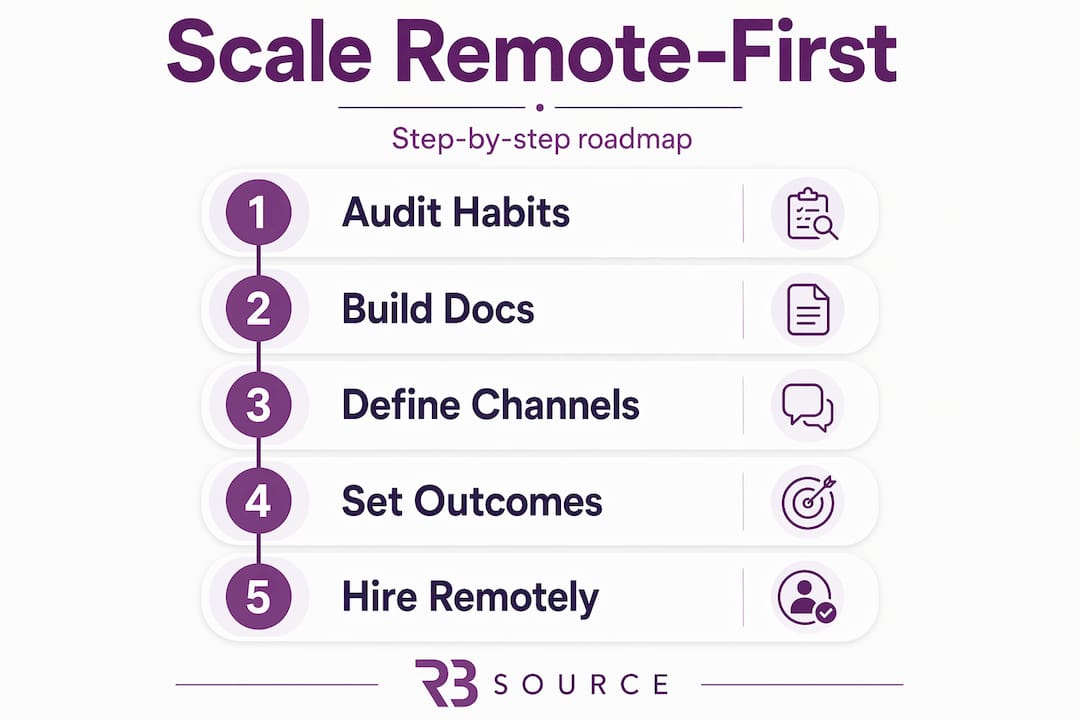
Step 5: Hire for remote-readiness, not just skills. Look for candidates who are self-directed, communicate proactively, and have a track record of remote work. Skills can be trained. Remote discipline is harder to teach.
Step 6: Integrate virtual assistants strategically. Virtual assistants work best when they have defined roles, documented processes, and regular check-ins. Don’t hire a VA and expect them to figure out your business on their own. Set them up to succeed.
Pro Tip: Run a “remote readiness audit” on your business every quarter. Ask: if your entire team worked from different time zones tomorrow, would your operations hold up? The gaps you find are your next improvement priorities.
The most common mistake business owners make is treating remote work as a perk rather than a model. They allow remote work but don’t redesign their systems for it. This creates frustration on both sides and leads to the “pretend remote” trap where people are technically remote but functionally excluded.
When finding reliable virtual assistants, look for partners who understand remote-first principles, not just task completion. And if you have questions about building a distributed team, the remote professionals FAQ is a solid starting point.
According to the Otonomee case study, remote-first benefits aren’t automatic. They depend on operational discipline, specifically communication practices, documentation habits, and management systems that support distributed work. The companies that succeed are the ones that treat remote-first as a business model, not a convenience.
Why most “remote” businesses aren’t truly remote-first and how to fix it
We’ve worked with a lot of business owners who describe themselves as remote-first. When we dig deeper, most of them are actually remote-friendly at best, and pretend-remote at worst.
Here’s the uncomfortable truth: adopting Zoom and Slack doesn’t make you remote-first. It makes you a company that uses video calls. The real test is whether someone who joins your team and never sets foot in an office can access every piece of information they need, participate in every decision that affects their work, and advance in their role based entirely on what they produce.
Most businesses fail that test. Not because they’re doing anything wrong intentionally, but because they built their culture and systems for in-person work and then layered remote tools on top without changing the underlying structure.
The fix isn’t complicated, but it does require intention. Start by identifying your “invisible office.” These are the informal channels where real decisions get made. The text thread between founders. The quick call before the official meeting. The email chain that never gets shared with the full team. Those channels exclude your remote staff, even if unintentionally.
Then systematically move those conversations into shared, documented spaces. It feels slower at first. It isn’t. It’s building a foundation that scales.
We’ve seen businesses transform their operations by committing to remote-first scaling insights and applying them consistently. The ones that succeed share one mindset: they stop thinking of remote as where people work and start thinking of it as how the business works.
Ready to scale with remote-first? Explore virtual assistant solutions
Building a remote-first business is one of the most powerful decisions you can make as a growth-focused entrepreneur. But you don’t have to figure it out alone.
At R3source, we specialize in connecting U.S. business owners with dedicated virtual assistants and remote professionals from the Philippines who are trained to integrate directly into remote-first operations. Whether you need administrative support, customer service, CRM management, or a full remote team, we provide consistent, accountable staffing that grows with your business. Explore our virtual assistant outsourcing options to find the right fit for your needs, or visit our remote team building FAQ to get answers before you take the next step. Your capacity for growth is waiting.
Frequently asked questions
How is remote-first different from remote-friendly or hybrid?
Remote-first businesses design their systems, culture, and communication around distributed work as the default, while remote-friendly and hybrid companies primarily center on office-based work and only accommodate remote options as a secondary arrangement.
What operational changes do I need to make for remote-first?
You’ll need robust documentation, clear digital communication channels, and management practices that support distributed teams. If critical decisions still circulate through informal or in-person channels, your business isn’t genuinely remote-first yet.
Are virtual assistant services a fit for remote-first businesses?
Absolutely. Virtual assistants can support remote-first businesses with specialized, recurring tasks, helping optimize operations and scale efficiently. The Otonomee remote-first model demonstrates how global talent access through remote staffing removes reliance on physical office presence entirely.
What’s the risk of “pretend remote” companies?
Companies that claim remote status but rely on informal, visibility-based communication can unintentionally exclude remote staff from key decisions, undermine team effectiveness, and miss the operational and financial benefits that genuine remote-first strategies deliver.
Recommended
Comments