

How to hire your first virtual assistant for small business success


You are building something real, and somewhere along the way, the daily grind started eating your growth. Answering emails, scheduling appointments, updating your CRM, chasing leads, and managing customer inquiries — these tasks matter, but they are not the reason you started your business. Hiring your first virtual assistant (VA) is one of the most impactful decisions you can make as a small business owner. This guide walks you through every step, from defining what you actually need to onboarding a VA who fits your operation and helps you scale with confidence.
Table of Contents
Key Takeaways
Point | Details |
Budget with real costs | Plan for more than just hourly rates—consider training time and management, too. |
Use paid trial projects | Testing through a small, paid task offers proof of reliability before you commit. |
Onboard for success | Clear communication and documented processes help your virtual assistant deliver value quickly. |
Choose your hiring method | Decide whether direct hire or agency best matches your risk tolerance and available management time. |
Before you hire: Define needs, scope, and budget
Now that you know why hiring a VA could be transformative, the next step is getting clear on what you need and what you can spend. Skipping this step is the single most common reason first-time VA hires go sideways. You end up with someone who does not quite fit, or you feel like you are constantly redirecting them because the role was never properly defined.
Start by identifying which tasks are consuming your time without moving your business forward. These typically fall into a few buckets:
Administrative tasks: Email management, calendar scheduling, data entry, travel booking, document formatting
Customer service: Responding to inquiries, managing support tickets, following up with clients
Marketing support: Social media scheduling, content formatting, basic graphic edits, email campaign management
Lead generation and CRM: Researching prospects, updating contact records, appointment setting
Specialized work: Bookkeeping, graphic design, SEO, paid ads management
Once you identify your categories, estimate how many hours per week each takes you. That number becomes your baseline for deciding how many hours your VA will work. A part-time VA at 20 hours per week is often the right starting point for small business owners who want to test the arrangement before scaling up.
Next, understand what you are actually paying for. VA pricing in the US breaks down by skill level: entry-level VAs typically run $5 to $15 per hour, mid-level VAs cost $15 to $30 per hour, and specialists can charge $30 to $75 per hour or more, depending on task type and location. However, the real cost of your VA hire includes more than their hourly rate.
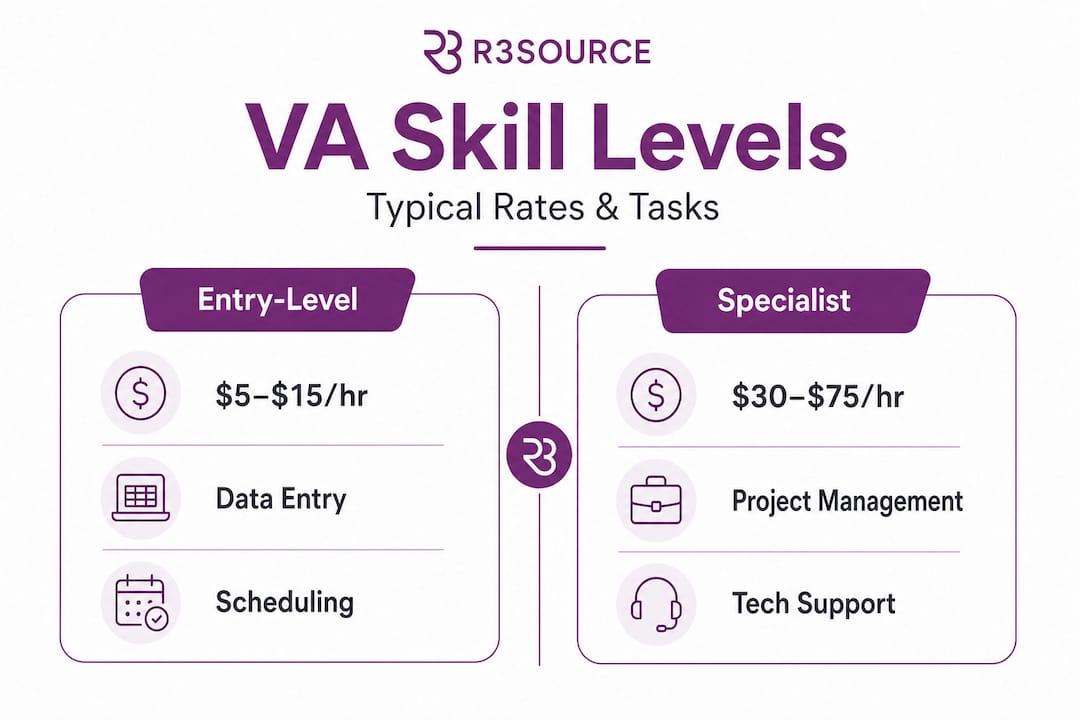
VA Level | Typical Hourly Rate | Common Tasks |
Entry-level | $5–$15/hour | Data entry, scheduling, inbox management |
Mid-level | $15–$30/hour | CRM management, content, customer service |
Specialist | $30–$75+/hour | SEO, design, paid ads, bookkeeping |
Training time, onboarding, and management overhead are real costs that many first-time hirers overlook. Budget an additional two to four hours per week in your own schedule, especially during the first month, to get your VA properly oriented. This investment pays back quickly once your VA is operating independently.
When it comes to finding a reliable VA who will genuinely support your operations, clarity on scope matters more than anything else. Unclear job descriptions attract mismatched candidates and lead to frustration on both sides. A well-defined role description that lists specific tasks, required tools, and expected output takes you 30 minutes to write and saves weeks of trial and error.

It is also worth exploring what VA admin support tasks actually cover in 2026. Many business owners are surprised by how broad the category has become, including calendar management, light bookkeeping, CRM updates, research, and even basic social media coordination.
Pro Tip: Before you post any job listing, spend three to five business days logging every task you complete. Write down what you did, how long it took, and whether it required your specific expertise. This simple exercise gives you an honest, data-backed picture of what can be delegated immediately and what only you can handle.
Where to find your first virtual assistant
With your ideal VA profile and budget set, it is time to decide where and how to search for your first hire. There are two main paths: direct hiring through freelance platforms or job boards, and working through a managed agency or referral network. Each has real trade-offs worth understanding.
Hiring Method | Cost | Risk Level | Onboarding Time | Support |
Freelance platforms | Lower | Higher | Longer | Minimal |
Managed agency | Higher | Lower | Shorter | Ongoing |
Referral/network | Varies | Medium | Medium | Varies |
Direct hiring through platforms gives you access to a broad pool of candidates and lower hourly rates. However, you take on all the screening, interviewing, and vetting yourself. If a hire does not work out, you start the process over from scratch. This approach works well if you have time to invest in the process and experience evaluating remote workers.
Managed agencies like R3source’s outsourcing model pre-screen candidates, handle much of the onboarding logistics, and can provide replacement coverage if a placement is not the right fit. The trade-off with agencies is that you typically pay a premium for these services, but you significantly reduce the risk of a bad hire and the time your own team invests in searching.
For many small business owners, the managed agency route is worth the additional cost, especially for your first VA hire. You are not just paying for the VA’s time. You are paying for a faster, lower-risk path to having reliable help in place.
A few checklist items to vet any platform or candidate before moving forward:
Verify communication skills through an asynchronous test (ask them to reply to a short email prompt)
Confirm availability and time zone overlap with your working hours
Review portfolio examples or past client work, especially for specialized roles
Ask for at least two professional references and actually contact them
Confirm they have access to necessary tools and a stable internet connection
If you work in real estate, it is worth knowing that VAs for real estate businesses come with a distinct skill set, including CRM management for listings, client follow-ups, appointment coordination, and transaction coordination support. Niche experience matters in specialized industries, so look for candidates with proven background in your field.
Screen, trial, and select: Building your VA relationship
Once you know where to search, use these steps to confidently choose and test your first VA before committing to a longer arrangement.
Post a clear, detailed job description. Include specific tasks, required tools, weekly hours, and communication expectations. Vague listings attract vague candidates.
Review applications for responsiveness and accuracy. Did they follow your application instructions? How quickly did they reply? These early signals reflect how they will operate as part of your team.
Schedule a video interview. Focus less on credentials and more on how they communicate. Ask them to walk you through a task they have handled before and how they resolved a challenge that came up.
Check two references directly. Ask specifically about their reliability, communication style, and how they handled unclear or changing instructions.
Issue a paid trial task. This is not optional. A real-world task from your actual workflow tells you far more than any interview.
On that last point, a paid trial project before any long-term commitment gives you a direct window into how a VA communicates, follows instructions, meets deadlines, and handles ambiguity. It also shows respect for their time, which sets a healthy tone for the working relationship.
Trial projects are essential for observing real-world communication and follow-through. Resumes show potential; trial tasks show reality.
The trial task should mirror actual work, not a test scenario. If you need someone to manage your inbox, give them a filtered sample of real emails and ask them to draft responses. If you need CRM updates, provide a list of contacts and ask them to enter the data using your actual platform. You want to see how they work, not how they perform under artificial conditions.
During the trial, note the following:
Did they ask clarifying questions upfront, or make assumptions?
Was their output accurate and on time?
How did they handle a step that was not clearly explained?
Did they communicate proactively or wait to be asked?
These behaviors, not their resume, predict how effective they will be as part of your business. You can find more on building a reliable remote team relationship as you move further into the hiring process.
Pro Tip: Create two or three short trial scenarios from your actual daily tasks and use them consistently across all finalists. This makes comparing candidates objective rather than based on gut feeling alone.
Onboard, manage, and set up for success
After you have chosen your VA, proper onboarding and communication transform short-term help into scalable support. Too many business owners hand off a login and expect things to run smoothly from day one. That approach leads to confusion, errors, and fast turnover.
Here is a structured approach to onboarding your new VA:
Create a written process document for every recurring task. Record a short screen-share video walking through each task. Tools like Loom make this simple and reusable.
Set up shared workspaces from day one. Use platforms like Google Workspace, Notion, or Trello to give your VA a clear view of tasks, priorities, and deadlines.
Define communication norms in writing. How fast should they respond to messages? What platform do you use for quick questions versus project updates? What is the protocol if they are stuck?
Schedule a 30-minute check-in for the first two weeks, then shift to weekly. These calls build accountability and let you catch misalignments early before they become habits.
Set a 30-day and 60-day review. Share honest feedback on what is working and what needs adjustment, and invite them to do the same.
The mistakes that sink most first-time VA arrangements are predictable. Vague goals leave your VA guessing. Micromanaging every small decision burns your time and demoralizes them. But the opposite extreme — going silent and assuming everything is fine — is equally damaging. The goal is structured autonomy: clear expectations, regular check-ins, and room to operate independently within defined boundaries.
You can maximize your business growth significantly when your VA is properly integrated into your systems. The businesses that benefit most from remote support are not the ones with the most complex setups. They are the ones who invested time upfront in building a reliable operating framework. For more ideas on managing and optimizing your outsourcing strategy, the R3source blog is a strong resource.
Tools worth using during onboarding include video call platforms for live check-ins, shared document libraries for SOPs (standard operating procedures), and project management platforms to track tasks and deadlines. The specific tools matter less than using them consistently.
Most people overcomplicate their first VA hire: Here’s what actually matters
With all the tactics covered, it is worth highlighting one mindset shift that separates those who scale from those who stay stuck. Most small business owners who delay hiring a VA do not lack information. They lack permission to move forward imperfectly.
The fear is understandable. You have built something meaningful, and handing any part of it to someone else feels risky. You wonder if they will represent your business well, communicate professionally, or care about quality the way you do. So you wait until you find the “perfect” candidate, or until things get so overwhelming that you hire in desperation. Neither outcome is good.
Here is what we have seen consistently: resume details matter far less than most people expect. Certifications and years of experience are nice, but they do not predict reliability or fit. What predicts success is how a candidate communicates during the trial, how they handle unclear instructions, and whether they take ownership of their output. These qualities show up in the trial, not the application.
The business owners who successfully scale with remote support are not the ones who found a perfect hire on the first try. They are the ones who started small, stayed communicative, gave direct feedback, and iterated quickly. They treated the first 60 days as a learning process for both themselves and their VA.
Progress over perfection is not just motivational advice. It is a practical hiring strategy. Start with a defined set of tasks. Build the relationship through honesty and consistent communication. Expand the role as trust develops. That is the model that creates long-term value.
Hire your first virtual assistant with expert help today
You have done the research and you understand the process. Now the question is: what is the most reliable way to take that first step without the risk of wasting time on the wrong hire?
R3source specializes in placing skilled, pre-vetted virtual assistants from the Philippines with small businesses across the United States. We handle the screening, skills matching, and onboarding support so you can move from overwhelmed to operational faster than going it alone. Every placement is built around your specific workflow, not a generic job post. Whether you need administrative support, customer service, lead generation, or CRM management, we match you with a remote professional who integrates directly into your business. You can get started with VA outsourcing today or explore answers to common questions in our remote professionals FAQ. And if you want to experience the impact risk-free, check if you qualify to win a free VA for 90 days through our current small business raffle.
Frequently asked questions
How much should I expect to pay for my first virtual assistant in the US?
Entry-level VA rates typically run $5 to $15 per hour, mid-level $15 to $30 per hour, and specialists $30 to $75 or more per hour, but your true total cost also includes the time you invest in training and managing your VA during the first few weeks.
Is it better to hire through a VA agency or directly?
Agencies typically cost more but significantly reduce hiring risk through pre-screening, faster onboarding, and replacement coverage, while direct hiring is often cheaper but demands more of your own time in recruitment and performance management.
What’s the best way to test a potential VA before committing?
Assign a paid trial project using real tasks from your business so you can evaluate actual communication, follow-through, and output quality before offering any long-term arrangement.
How do I protect my business information when working with a VA?
Use a signed NDA before sharing any sensitive materials, manage account access through role-based permissions in shared tools, and limit exposure to confidential data during onboarding and trial phases until trust is established.
Recommended
Comments