

Why Small Businesses Outsource Work: A 2026 Guide


Outsourcing is the practice of delegating specific business tasks to external providers so you can reduce costs, access specialized skills, and focus on what actually grows your business. More than half of U.S. small businesses now outsource at least one key function. That number reflects a fundamental shift in how small businesses operate. Outsourcing is no longer a workaround for companies that can’t afford full-time staff. It has become a deliberate strategy for staying competitive. Understanding why small businesses outsource work starts with recognizing that the goal is not just to cut costs. It’s to build a leaner, more capable operation.
What are the main benefits of outsourcing for small businesses?
The benefits of outsourcing for small businesses are direct and measurable. 59% of companies cite cost reduction as the primary reason they outsource. That single statistic explains why so many small business owners start exploring external providers when their overhead begins to climb.
Cost savings are the most immediate advantage. Small businesses can achieve savings of 40–60% compared to building equivalent in-house capabilities. Some businesses report up to 70% savings on labor costs for support and back-office functions. That kind of reduction turns outsourcing from a convenience into a financial strategy.

Beyond cost, outsourcing gives you access to specialized talent you could not otherwise afford. A small real estate firm, for example, cannot justify hiring a full-time CRM specialist, a marketing coordinator, and a customer service rep as separate employees. Outsourcing lets you bring in that expertise at a fraction of the cost. Outsourcing is evolving from pure cost-cutting into a way to access elite specialized talent and enterprise-grade tools that would otherwise be unaffordable.
Scalability is another major advantage. When your business grows, you can increase outsourced capacity quickly without the delays of recruiting, onboarding, and training new employees. When demand drops, you scale back without layoffs or severance costs. This flexibility is especially valuable for e-commerce businesses with seasonal spikes.
The outsourcing advantages for small firms also include a sharper focus on core activities. When you stop spending hours on payroll, inbox management, or data entry, you redirect that time toward revenue-generating work. That shift compounds over time.
Cost reduction: Shift fixed labor costs to variable costs you control by volume.
Talent access: Hire specialists in marketing, IT, or customer service without full-time salaries.
Scalability: Adjust your support capacity up or down without hiring cycles.
Focus: Spend your hours on sales, strategy, and client relationships instead of admin work.
Speed: Get tasks done faster by people who specialize in them daily.
Pro Tip: Before outsourcing any function, document exactly what that role does each week. A clear task list makes it far easier to brief an external provider and measure their output from day one.
What are the common risks and challenges of outsourcing?
Outsourcing carries real risks that small business owners often underestimate. The most overlooked is verification risk. Verification risk is the difficulty of measuring whether an outsourced provider is actually performing well when you lack the expertise to evaluate their work. If you outsource your SEO and you don’t understand SEO, you may not realize the work is poor until months of budget have been wasted.
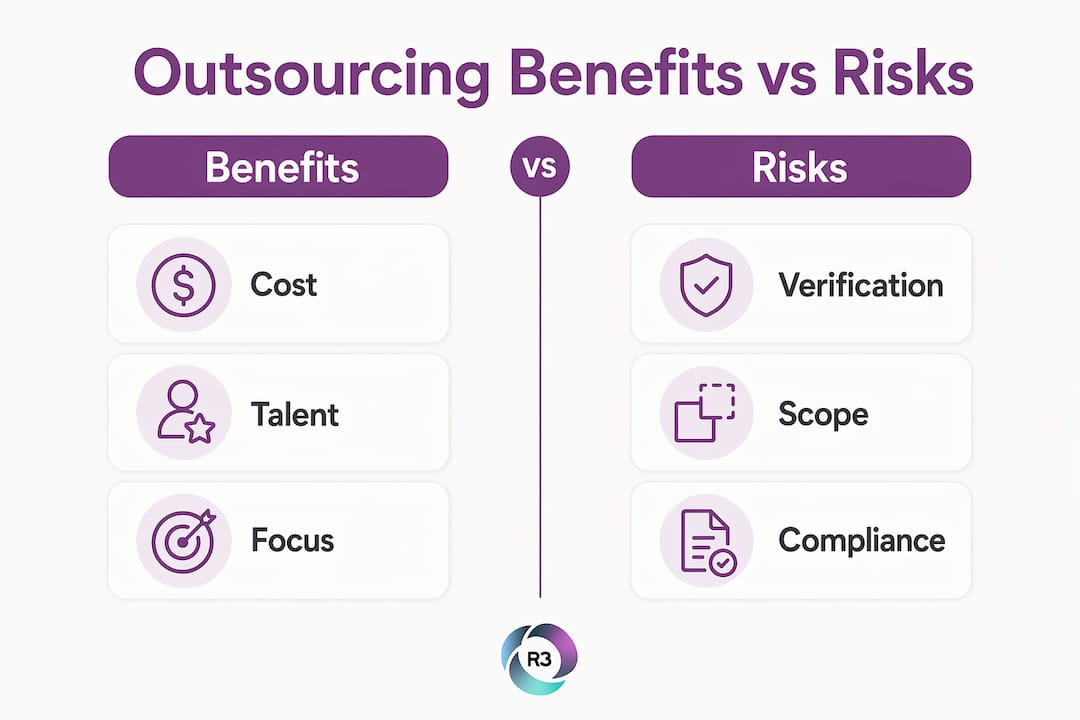
Contractual risk is equally serious. Scope creep is the most common cause of disputes in outsourcing relationships. Without clear documentation of deliverables, timelines, and change-control procedures, small disagreements grow into expensive conflicts. A provider who starts by managing your inbox can gradually absorb hours of work that was never priced into the original agreement.
Compliance and cybersecurity liability stay with you, not your provider. Small businesses remain fully liable for regulatory, compliance, and cybersecurity obligations even when outsourcing. If a provider mishandles customer data, your business faces the legal consequences. This means due diligence on every provider is not optional.
“While you can outsource the execution of a job, you cannot outsource the risk. Small businesses must perform risk-based due diligence on every provider.”
Fragmentation is a subtler problem. When you use multiple freelancers or task-based providers across different platforms, no single person understands your full operation. Communication gaps appear. Tasks fall between providers. The solution is to consolidate where possible and assign clear ownership for each function.
Verification risk: You may not have the expertise to judge whether outsourced work meets a professional standard.
Scope creep: Undefined boundaries lead to disputes and cost overruns.
Compliance liability: Regulatory and data security obligations stay with your business regardless of who does the work.
Fragmentation: Too many disconnected providers create coordination problems and operational blind spots.
Pro Tip: Run a brief quarterly audit of every outsourced function. Ask one question: “If this provider disappeared tomorrow, would I know exactly what they were doing and why?” If the answer is no, you need better documentation and oversight.
Which business functions do small businesses outsource most?
Small businesses tend to outsource functions that are time-intensive, require specialized knowledge, or carry compliance risk. These are the areas where the cost of getting it wrong is high and the cost of hiring in-house is even higher.
IT services. Outsourcing IT enables SMBs to cut IT expenditures by 25–45% while maintaining the flexibility to scale. Managed IT providers handle cybersecurity, software updates, and helpdesk support at a predictable monthly cost.
Accounting and bookkeeping. Tax compliance, payroll processing, and financial reporting require precision and current regulatory knowledge. External accountants deliver both without the overhead of a full-time finance team.
Administrative support. Virtual assistants handle scheduling, email management, data entry, CRM updates, and appointment setting. These tasks consume hours every week without directly generating revenue.
Marketing. Content creation, social media management, and lead generation require consistent effort and platform expertise. Outsourcing these functions to specialists produces better results than a generalist employee doing them part-time.
HR and payroll. Small businesses outsource HR tasks such as payroll and compliance to save time and reduce legal risk. Employment law changes frequently, and external HR providers stay current so you don’t have to.
If you’re unsure where to start, the functions you can outsource span nearly every department in a small business.
Function | Primary benefit | Risk if kept in-house |
IT services | 25–45% cost reduction | Security gaps, outdated systems |
Accounting | Compliance accuracy | Tax errors, audit exposure |
Admin support | Time recovery | Owner distraction from growth |
Marketing | Specialist output | Inconsistent brand presence |
HR and payroll | Legal risk reduction | Compliance penalties |
How can small business owners outsource without losing control?
Maintaining control while outsourcing is a discipline, not an accident. The businesses that lose control of outsourced work are almost always the ones that handed off a task without a clear framework for oversight. The Necessity Trap describes exactly this problem: outsourcing becomes necessary for survival, yet it demands more managerial oversight to avoid operational blind spots. The trap closes when owners delegate without systems.
Start with a contract that defines scope, deliverables, milestones, confidentiality obligations, and a change-control process. Successful outsourcing agreements explicitly document milestones, exclusions, and change-control procedures to prevent scope creep and disputes. A well-written contract is not bureaucracy. It is the foundation of a working relationship.
Build a reporting rhythm into every outsourced function. Weekly check-ins, shared dashboards, or simple status reports keep you informed without micromanaging. The goal is visibility, not control for its own sake. When you can see what is happening, you can catch problems early and course-correct before they become expensive.
Use documented procedures for every task you hand off. Standard operating procedures (SOPs) let a new provider pick up exactly where the last one left off. They also make it easier to audit quality because you have a written standard to compare against actual output.
Define scope in writing before work begins, including what is explicitly excluded.
Set milestones with dates and measurable outcomes, not vague deliverables.
Schedule regular reviews to assess quality, output, and alignment with your goals.
Document all processes so that knowledge lives in your business, not just in a provider’s head.
Assign internal ownership so one person on your team is responsible for each outsourced relationship.
For a structured approach, the outsourcing checklist for SMB owners covers the key steps from provider selection through ongoing oversight. If you want a deeper look at how to outsource without losing control, R3source has a practical guide built specifically for small business owners.
Pro Tip: Treat your outsourced providers like internal team members during onboarding. Share your brand voice, your goals, and your non-negotiables upfront. Providers who understand your business deliver better work from week one.
Key Takeaways
Small businesses that outsource strategically reduce costs, access specialized talent, and free up owner time, but only when they maintain clear contracts, documented processes, and consistent oversight.
Point | Details |
Cost savings are real and significant | Outsourcing can reduce labor costs by 40–60% compared to equivalent in-house capabilities. |
Compliance liability stays with you | Regulatory and cybersecurity obligations remain your responsibility regardless of who executes the work. |
Scope creep is the top contract risk | Document deliverables, exclusions, and change-control procedures before work begins. |
Control requires systems, not micromanagement | SOPs, reporting rhythms, and milestone reviews keep outsourced work on track. |
Outsourcing is now a competitive strategy | Access to specialized talent and enterprise-grade tools makes outsourcing a growth lever, not just a cost cut. |
What I’ve learned about outsourcing after years of watching small businesses get it wrong
Most small business owners approach outsourcing backwards. They find a provider, agree on a price, and assume the work will take care of itself. Then three months later they’re frustrated, the relationship has drifted, and they’ve concluded that outsourcing “doesn’t work.” The problem was never outsourcing. It was the absence of a system.
The businesses I’ve seen get the most out of outsourcing treat it like a management discipline. They document before they delegate. They set expectations in writing. They check in consistently without hovering. And they think carefully about which tasks to outsource first, usually starting with the work that is repetitive, time-consuming, and low-risk if a provider makes a small mistake.
The deeper insight is this: 83% of organizations that outsource successfully reduce costs. That figure is not a coincidence. Success correlates directly with preparation. The businesses in that 83% did not just hand off work. They built a structure around it.
My honest advice is to start with one function, get it right, and then expand. Administrative support is usually the best entry point for small businesses because the tasks are well-defined, the output is easy to measure, and the time savings are immediate. Once you see what a well-managed outsourcing relationship looks like, you’ll have the confidence and the framework to apply it elsewhere.
— Ellis
R3source: remote professionals built for small business growth
Running a small business means carrying more than you ever expected. R3source provides offshore virtual assistant services built specifically for small businesses across the United States. Every R3source professional is trained to integrate directly into your operations, handling administrative support, customer service, CRM management, appointment setting, and lead generation so you can focus on building revenue.
R3source does not place task-based freelancers. The team provides dedicated, long-term remote professionals who understand your business and show up consistently. If you’re ready to reclaim your time and build a support system that actually scales, book an introductory consultation and see what the right remote team can do for your business.
FAQ
Why do small businesses outsource work?
Small businesses outsource work primarily to reduce costs, access specialized skills, and free up owner time for revenue-generating activities. 59% of companies cite cost reduction as the top reason.
What are the biggest risks of outsourcing for small businesses?
The biggest risks are verification risk, scope creep, and compliance liability. Small businesses remain fully responsible for regulatory and cybersecurity obligations even when a third party handles the work.
Which tasks should a small business outsource first?
Administrative support, IT services, and payroll are the most common starting points. These functions are time-intensive, well-defined, and carry measurable cost savings when handled by an external provider.
How much can a small business save by outsourcing?
Small businesses can save 40–60% compared to building equivalent in-house capabilities, with some reporting up to 70% savings on back-office labor costs.
How do you maintain control when outsourcing business tasks?
Maintain control by writing clear contracts with defined scope and milestones, documenting all processes in SOPs, and scheduling regular performance reviews with every provider.
Recommended
Comments