

The Role of Virtual Staff in E-Commerce Operations


Virtual staff in e-commerce are defined as remote professionals who manage the daily operational tasks that keep an online store running, from product listings and order processing to customer support and performance reporting. The industry term for this model is remote staffing, and it sits at the center of how modern e-commerce businesses scale without adding physical overhead. Tools like ClickUp, Asana, and Slack have made it possible for a team in the Philippines to run your Shopify or Amazon store with the same precision as an in-house team. If you are an e-commerce owner carrying more than you ever expected, understanding the role of virtual staff in e-commerce is the first step toward building a support system that actually works.
What are the primary responsibilities of virtual staff in e-commerce?
E-commerce virtual assistants manage a wide spectrum of store operations, and the scope is broader than most owners realize when they first hire. The value is not just in offloading tasks. It is in having someone who owns specific outcomes every single day.
Here are the core responsibilities virtual staff typically handle in an e-commerce environment:
Product listing creation and updates: Writing descriptions, uploading images, setting pricing, and maintaining catalog accuracy across platforms like Amazon, eBay, Etsy, and Shopify.
Order processing: Confirming purchases, coordinating with fulfillment centers, and updating customers on shipping status.
Inventory tracking: Monitoring stock levels, flagging low inventory, and coordinating restock requests with suppliers.
Customer inquiries and post-sale support: Responding to questions via email, chat, or helpdesk tools like Zendesk or Freshdesk within agreed response windows.
Returns and refunds handling: Processing return requests, issuing refunds, and documenting reasons for trend analysis.
Marketplace listing management: Keeping listings compliant with platform rules, updating keywords, and managing sponsored ad placements.
Sales and performance reporting: Pulling weekly data from Shopify, Seller Central, or Google Analytics and summarizing it for owner review.
Each of these tasks is repeatable, documentable, and transferable. That is exactly what makes them ideal for virtual staff.
Pro Tip: Before hiring, map out every task you do in a week and tag each one as “owner-only” or “delegatable.” Most e-commerce owners discover that 60 to 70 percent of their weekly hours are spent on tasks a trained virtual assistant could handle.

How does outcome-based management transform virtual staff performance?
The biggest mistake e-commerce owners make with remote staff is managing hours instead of outcomes. Tracking when someone logs in tells you nothing about whether your store is running well.
Best practice in 2026 for remote e-commerce teams uses a model called DRI, which stands for Directly Responsible Individual. Each virtual staff member owns a specific set of deliverables, not just a list of tasks. A customer service VA is not just “answering tickets.” She owns CSAT score, first-response time, and resolution rate. That shift in framing changes everything about how performance is measured and improved.
“The shift from task-based to outcome-based management is what separates e-commerce teams that scale from those that stall. When every team member knows exactly what they own, accountability becomes automatic.” — eCommerce Circle
Digital-first communication and asynchronous workflows are the infrastructure that makes this model work. Your virtual staff should not need a live meeting to know what to do today. Standard operating procedures, recorded video walkthroughs, and a shared project management workspace replace the need for constant check-ins.
ClickUp consolidates tasks, docs, goals, and dashboards into one platform, which is why it is the preferred tool for e-commerce remote teams. It eliminates the information loss that happens when tasks live in email threads or scattered spreadsheets. Asana works well for teams that prefer a simpler interface, while Notion is strong for documentation-heavy operations.
Pro Tip: Set a weekly async check-in ritual. Ask each virtual staff member to submit a short update every Friday covering: what was completed, what is blocked, and what is planned for next week. This replaces most status meetings and gives you a written record of progress.
Which virtual staff roles deliver the most value in e-commerce?
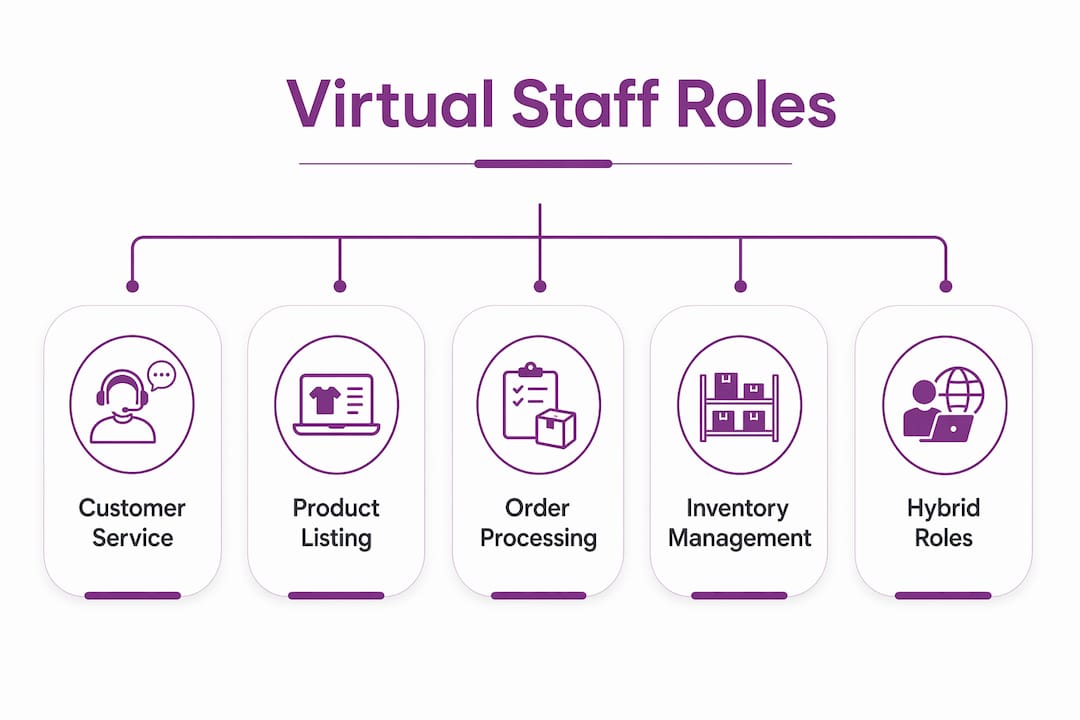
Specialized virtual assistant roles vary significantly in scope, and choosing the right one depends on where your biggest operational gaps are. The table below compares the most common roles, their typical tasks, and the direct business benefit each delivers.
Role | Typical tasks | Primary benefit |
Customer service VA | Ticket management, live chat, returns, reviews | Faster response times, higher CSAT scores |
Order fulfillment VA | Order processing, tracking updates, supplier coordination | Fewer errors, faster dispatch, fewer complaints |
Product listing VA | Catalog management, SEO copywriting, image uploads | Better search visibility, accurate store data |
Marketing VA | Email campaigns, social scheduling, ad reporting | Consistent brand presence, campaign accountability |
Admin and reporting VA | Data entry, reporting, inbox management, scheduling | Owner time freed for revenue-generating work |
Most small e-commerce businesses start with a customer service VA or a product listing VA because those roles have the most immediate, measurable impact. As the business grows, adding a marketing VA or a dedicated reporting VA creates the capacity for growth that owners cannot build alone.
Hybrid roles are also worth considering. A VA with both customer service and order processing skills can cover two critical functions at a lower cost than two separate hires. The tradeoff is depth. A specialist will always outperform a generalist in a single function, so the right choice depends on your volume and complexity.
What are best practices for onboarding virtual staff into e-commerce?
Onboarding is where most virtual staffing arrangements succeed or fail. A strong start creates momentum. A weak one creates confusion, rework, and turnover.
Structured onboarding accelerates new virtual staff productivity by 34%, cutting the time to full contribution from twelve weeks down to six. That difference compounds quickly when you consider how much operational drag an undertrained VA creates in the first months.
Here is a practical onboarding sequence that works for e-commerce teams:
Week 1: Orientation and access. Provide login credentials, introduce the team, and walk through the business model, product catalog, and customer personas. Use Loom or a similar screen-recording tool to create reusable video walkthroughs.
Weeks 2 to 3: Shadowing and supervised practice. Have the VA observe existing workflows, then complete tasks with review before they go live. Use a virtual assistant onboarding checklist to track completion of each step.
Weeks 4 to 6: Guided independence. The VA handles tasks independently but checks in daily. You review outputs and give structured feedback using a shared document.
Days 30 to 90: Full ownership with KPI tracking. Assign the VA their DRI metrics. Weekly scorecards with 3 to 5 key metrics per team member, such as CSAT score for customer service or order accuracy rate for fulfillment, create clear accountability without micromanagement.
Day 90: Formal performance review. Assess against the KPIs set at onboarding. Discuss growth, gaps, and goals for the next quarter.
Documentation is the backbone of this process. Every workflow your VA touches should have a written SOP before they start. If you do not have SOPs yet, building them together during onboarding is a productive way to create them.
Pro Tip: Assign a “buddy” from your existing team or a senior VA to every new hire for the first 30 days. Peer support reduces the time owners spend answering basic questions and builds team cohesion faster than any formal training program.
How does leveraging virtual staff improve e-commerce scalability?
Virtual assistants improve service levels through extended coverage hours, multilingual support, consistent service-level agreements, and documented SOPs. That is not a soft benefit. It translates directly into metrics that affect revenue and retention.
Here is what the operational impact looks like in practice:
Extended coverage: A VA team across time zones can provide 16 to 24 hours of customer support coverage without overtime costs, which is critical during peak seasons like Q4.
Faster order processing: Dedicated order fulfillment VAs reduce processing errors and cut average handling time, which directly lowers the rate of negative reviews tied to shipping delays.
Consistent SLAs: Documented response-time targets, enforced through helpdesk tools like Gorgias or Zendesk, keep service quality stable even as order volume spikes.
Scalable marketing output: A marketing VA managing your email calendar and social scheduling through tools like Klaviyo and Buffer maintains brand presence without requiring owner involvement in every post.
The virtual workforce model is a strategic transformation, not a temporary fix. It demands technology investment and a results-oriented culture to deliver lasting value. Owners who treat virtual staff as a short-term cost-cutting measure consistently underinvest in onboarding and systems, and they get inconsistent results. Owners who treat it as a growth infrastructure decision build teams that run without them.
For e-commerce businesses managing bookkeeping alongside operations, integrating financial tracking into your virtual team’s workflow early prevents the reporting gaps that slow down decision-making at scale.
Key takeaways
Virtual staff in e-commerce deliver maximum value when they own specific outcomes within a structured system built on clear SOPs, project management tools, and KPI-based accountability.
Point | Details |
Define outcomes, not tasks | Assign each VA a DRI role with measurable KPIs like CSAT or order accuracy. |
Invest in structured onboarding | Structured onboarding cuts ramp-up time by 34%, from twelve weeks to six. |
Use the right tools | ClickUp or Asana consolidates tasks and visibility for remote e-commerce teams. |
Match roles to gaps | Start with customer service or product listing VAs where operational drag is highest. |
Build for scale, not just relief | Treat virtual staffing as growth infrastructure, not a short-term cost fix. |
Where most e-commerce owners get this wrong
I have seen a consistent pattern across e-commerce businesses that struggle with virtual staff. The problem is almost never the VA. It is the absence of systems before the hire.
Founders often fail to manage remote teams because they never shift from hands-on doing to structured, system-led leadership. They hire a VA hoping to offload chaos, and instead they just share the chaos. The VA does not know what “done” looks like. The owner gets frustrated. The relationship ends within 90 days, and the owner concludes that virtual staffing does not work.
It works. But it requires you to build the system first, or build it together during onboarding. The businesses I have seen get this right treat their first VA hire as a forcing function. They document their workflows, define their KPIs, and set up a project management workspace before the VA’s first day. That preparation pays back in weeks.
The other myth worth addressing is that virtual staff are best suited for simple, repetitive tasks. That was true a decade ago. Today, skilled remote professionals from the Philippines handle CRM management, paid ad reporting, customer escalation resolution, and supplier negotiations. The ceiling is much higher than most owners expect, and it rises with the quality of your onboarding and management.
If you are serious about scaling with remote staff, the investment in systems is not optional. It is the work.
— Ellis
Build your e-commerce virtual team with R3source
R3source specializes in matching e-commerce businesses with dedicated remote professionals from the Philippines who are trained to integrate directly into your operations.

Whether you need a customer service VA to manage your Zendesk queue, a product listing specialist for your Amazon catalog, or a full remote team to handle daily operations, R3source provides the staffing and onboarding support to get your team running fast. Every placement is built for long-term performance, not one-off tasks. Explore dedicated remote professionals to see how R3source can help you reclaim your time and build the team your business needs to grow.
FAQ
What does virtual staff do in an e-commerce business?
Virtual staff in e-commerce handle day-to-day operations including product listings, order processing, inventory tracking, customer inquiries, returns, and sales reporting. These roles are fully remote and managed through project management tools and documented SOPs.
How do you manage virtual staff effectively in e-commerce?
The most effective approach uses outcome-based management, where each virtual staff member owns specific KPIs like CSAT score or order accuracy, tracked weekly through platforms like ClickUp or Asana. This replaces hours-based monitoring with results-based accountability.
How long does it take for a virtual assistant to become fully productive?
Structured onboarding reduces ramp-up time from twelve weeks to approximately six weeks. A phased 90-day integration plan with documented SOPs and a buddy system produces the fastest and most consistent results.
Which virtual assistant role should an e-commerce business hire first?
Most e-commerce businesses see the fastest return from hiring a customer service VA or a product listing VA first, since both roles directly affect customer satisfaction and store performance. The right choice depends on where your biggest operational gap currently sits.
Can virtual staff support e-commerce businesses during peak seasons?
Virtual staff are particularly effective during peak seasons because they provide extended coverage hours and scalable capacity without the cost of overtime or temporary in-house hires. Consistent SLAs and documented workflows keep service quality stable even as order volume increases significantly.
Recommended
Comments