

Tasks to Outsource to a Virtual Assistant: Small Business Guide


Hand off recurring admin, calendar management, and basic customer follow-up first. Those three categories alone can return significant hours per week to your schedule—time you can redirect toward revenue-generating work, client relationships, and decisions only you can make.
The highest-impact tasks to delegate right now:
Email and inbox triage — sorting, labeling, drafting standard replies
Calendar and scheduling — booking meetings, managing conflicts, sending reminders
Customer follow-up — checking in on leads, sending post-sale messages, handling routine inquiries
CRM updates and data entry — logging contacts, updating deal stages, cleaning records
Research and reporting — compiling competitor data, summarizing articles, building simple reports
Social media scheduling — queuing approved posts, monitoring comments, pulling engagement data
Start with just two or three of these. The goal in week one is not a full handoff. It is a proof of concept that builds your confidence in delegation and your VA’s understanding of your standards.
Table of Contents
What tasks can you outsource to a virtual assistant?
The honest answer is more than most business owners realize. The tasks below are grouped by function so you can scan for your biggest time drains and act on them quickly. For each category, the note on generalist vs. specialist tells you whether a well-trained general VA can handle it or whether you need someone with specific experience.

Administrative and executive support
A generalist VA handles most of these from day one.
Email management: inbox to zero, flagging urgent items, drafting replies from templates
Calendar scheduling: booking calls, blocking focus time, resolving conflicts
Travel research and booking prep: flights, hotels, itineraries
Document formatting and file organization
Meeting notes and action-item summaries
Administrative tasks form the core of most VA work precisely because they are high-frequency and low-judgment. A clear outcome statement like “inbox to zero twice daily; flag anything requiring a decision” produces far better results than a vague “help with email.”
Email and calendar management

This deserves its own note because it is usually the first thing owners hand off and the one that delivers the fastest relief. Give your VA access to your inbox and calendar with defined rules: which senders always get a same-day reply, which meeting types you accept, and which you decline by default. Document those rules once, and the task runs itself.
Customer service and client communication
Responding to routine support tickets and inquiries
Live chat coverage during business hours
Order status updates and return coordination (e-commerce)
Appointment confirmations and rescheduling
Post-service follow-up messages
A generalist VA works well here with good scripts and escalation rules. For technical products or regulated industries, a trained specialist is worth the extra cost.
Sales support and lead generation
Prospecting and list building from LinkedIn or industry directories
CRM data entry and deal-stage updates
Follow-up email sequences for warm leads
Appointment setting and calendar coordination for your sales team
Proposal formatting and send-out
Good first workflows to delegate include CRM updates and follow-up reminders — they are repeatable, low-risk, and immediately visible in your pipeline.
Marketing and content support
Social media scheduling using tools like Buffer or Hootsuite
Blog post formatting and publishing in your CMS
Graphic resizing and basic Canva work
Email newsletter assembly in Mailchimp or Klaviyo
Pulling monthly analytics reports from Google Analytics or Meta Ads
Content strategy and brand voice decisions stay with you. Execution and distribution are fair game for a trained VA.
Finance and bookkeeping support
Expense categorization in QuickBooks or Xero
Invoice creation and sending
Payment follow-up for overdue accounts
Receipt collection and reconciliation prep
Payroll data entry (with your review before submission)
A bookkeeping-trained specialist is worth the investment here. Errors in financial records cost more to fix than the savings from using a cheaper generalist.
HR and recruiting support
Job posting drafts and distribution
Resume screening against a defined criteria checklist
Interview scheduling and candidate communication
Onboarding document preparation
Employee record maintenance
Final hiring decisions stay with you. The VA handles the logistics that consume hours before you ever meet a candidate.
Operations and project coordination
Project tracking in Asana, Monday.com, or Trello
Vendor communication and follow-up
Meeting agenda preparation and distribution
Process documentation and SOP drafting
Reporting on project milestones
Technical and IT support
Tier-1 helpdesk tickets (password resets, account access issues)
Website content updates in WordPress or Webflow
Plugin updates and basic site maintenance
Software license tracking
This category requires a specialist. Do not assign technical tasks to a general VA without confirming their specific experience first.
Research and data work
Market and competitor research summaries
Contact list building and verification
Survey data compilation
Industry news monitoring and weekly digests
Pro Tip: Before handing off any recurring task, spend 20 minutes recording a Loom video of yourself doing it once. That single video becomes the foundation of your SOP and cuts onboarding time significantly.
How do you decide which tasks to outsource first?
The fastest way to pick your pilot tasks is a simple two-axis score: impact (how much time or mental energy does this task consume?) versus ease of delegation (how clearly can you define the outcome and hand it off without risk?).
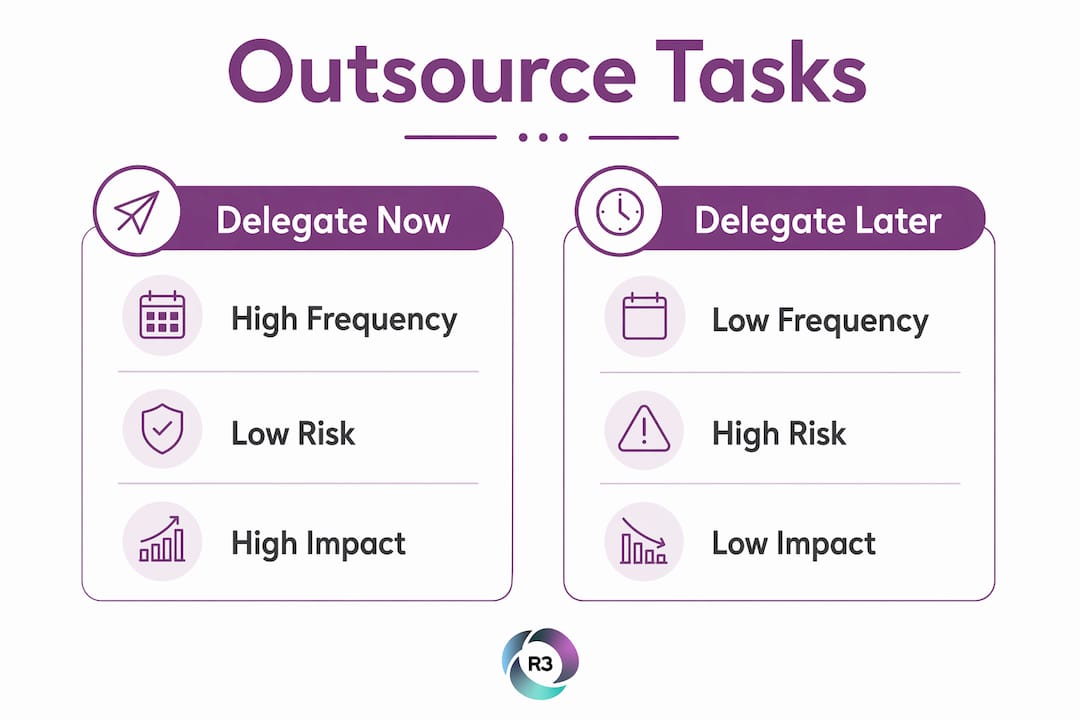
The prioritization matrix
Task | Time per week | Risk if done wrong | Ease of delegation | Priority |
Inbox triage | High | Low | High | Start here |
Calendar management | High | Low | High | Start here |
CRM data entry | Medium | Low | High | Start here |
Social media scheduling | Medium | Low | Medium | Week 2 |
Customer follow-up emails | Medium | Medium | Medium | Week 2 |
Bookkeeping entry | Medium | High | Medium | After SOPs |
Proposal writing | Low | High | Low | Later |
Hiring decisions | Low | Very high | Very low | Never fully |
Five steps to choose your pilot tasks
Audit two weeks of your calendar and task list. Write down every task you personally completed. Be honest about what took more than 30 minutes.
Mark every repeatable task. If you did it more than twice in two weeks, it is a candidate.
Estimate the time saved. Add up the weekly hours for each repeatable task.
Score by risk and complexity. Tasks requiring unique judgment, legal knowledge, or sensitive data score low on delegability. Routine, rule-based tasks score high.
Pick your top three. Start with the highest-impact, easiest-to-delegate tasks. Run them as a paid test engagement before expanding scope.
Quick rating checklist for any task:
Does it take more than 1 hour per week?
Can the outcome be described in one sentence?
Does it require tools your VA can access?
Would a mistake be recoverable within 24 hours?
Have you done it the same way at least three times?
If you answer yes to four or five of those, delegate it now.
How to hire, onboard, and manage a virtual assistant
Hiring steps
Define the three to five tasks the VA will own in the first 30 days.
Decide generalist or specialist based on the task list above.
Write a short role brief: tasks, expected outputs, tools used, and hours per week.
Run a paid pilot project of 5–10 hours before committing to ongoing work. This is the single best filter for fit.
During the pilot, watch for responsiveness, question quality, and whether they flag ambiguity or just guess.
Onboarding checklist
Once you have selected your VA, work through this list in the first week:
Account access: grant access to only the tools needed for pilot tasks; use a password manager like 1Password or LastPass so credentials are never shared in plain text
Tool training: record a short walkthrough of each tool and share it before day one
SOPs: provide a written or video SOP for every task in scope
Communication cadence: agree on response time expectations, preferred channels (Slack, email), and how to flag blockers
Escalation rules: define exactly which situations require your approval before action
Security setup: use a password manager and least-privilege access; expand permissions only as trust builds
NDA and confidentiality agreement: signed before access is granted
Day-to-day management
Keep management light but consistent. Assign tasks through a shared board in Asana or Trello so nothing lives in email threads. Ask for a brief async update at the end of each workday: what was completed, what is in progress, and any blockers. Hold a 15-minute weekly review to give feedback and adjust priorities.
Sample KPIs to track from week one:
Turnaround time on assigned tasks vs. agreed SLA
Accuracy rate on data entry or research tasks (spot-check 10% of output)
Response time to client or customer inquiries
Percentage of tasks completed without escalation
What does a VA typically cost, and when will you see results?
Pricing shapes
Pricing for virtual assistant services generally falls into three structures:
Hourly: flexible, good for variable workloads; typical ranges for skilled VAs vary by region and specialization
Block hours: prepaid packages (e.g., 20 or 40 hours per month) at a slight discount; predictable for steady workloads
Flat monthly (dedicated VA): one person, set hours per week, fixed monthly fee; best for owners who need consistent daily coverage
Managed dedicated VA services from the Philippines, like those R3source provides, tend to offer significantly lower monthly costs than hiring a U.S.-based employee for the same hours, without sacrificing quality or reliability.
Ramp-up timeline
Phase | Timeframe | What happens |
Pilot | Days 1–5 | Test project, evaluate fit, confirm tool access |
Initial onboarding | Weeks 1–2 | SOPs shared, first tasks in production |
Operational coverage | Weeks 2–4 | VA handles assigned tasks independently |
Full ramp | Steady-state performance, SOP refinements complete |
Calculating ROI
The math is straightforward. Multiply the hours your VA handles each week by your own effective hourly rate. If you reclaim substantial hours per week at a high value of your time, that results in significant recovered capacity. Compare that to your monthly VA cost. Most SMBs reach positive ROI within the first month of full operation.
Budget an extra 5–10 hours of your time during the first two weeks for training and overlap. That investment pays back quickly once the VA is running independently.
Managed VA service vs. freelance VA: which model fits your business?
The choice comes down to how much management bandwidth you have and how much continuity matters to your operations.
Managed VA service:
Recruitment, vetting, and training handled for you
Performance monitoring and replacement coverage included
Predictable monthly pricing with SOP libraries built in
Dedicated account manager as your point of contact
Managed-VA providers handle onboarding, performance monitoring, and VA replacement when necessary, which removes the owner from the HR loop entirely
Freelance VA:
You source, vet, and onboard the individual yourself
Lower hourly rates are possible, but management time adds hidden cost
No built-in backup if the VA is unavailable
Works well for simple, low-volume tasks with a clear scope
The hidden cost of freelance management: When a business owner spends 3–4 hours per week managing a freelance VA — handling questions, correcting errors, re-explaining tasks, and covering gaps — the effective cost of that “cheaper” option often exceeds a managed service. The managed model trades a slightly higher monthly fee for the owner’s time back.
When to choose managed: your task volume is steady, you need daily coverage, or you do not want to spend time on VA recruitment and performance management.
When freelance works: you have a one-time project, a very narrow task scope, or you already have an operations person who can manage the relationship.
For most growing SMBs, the managed VA model reduces owner overhead and improves continuity in ways that compound over time.
Tasks you should not outsource, and safeguards to use when you partially delegate
Some tasks carry too much strategic weight, legal exposure, or confidentiality risk to hand off fully. Knowing where the line is protects your business.
Never fully outsource these:
Final hiring and firing decisions
High-stakes client negotiations or contract sign-off
Legal strategy and compliance decisions
Executive-level financial decisions (budget approvals, equity discussions)
Payroll authorization without your direct review and sign-off
Anything involving your core intellectual property or unreleased product strategy
Safeguards for limited delegation:
Use red-line approval steps: the VA prepares the draft or data; you review and approve before it goes out
Provide masked or anonymized data for research tasks that do not require real customer records
Grant read-only access to sensitive systems until trust is fully established
Define escalation paths in writing: “If X happens, stop and message me before proceeding”
Require an NDA before sharing any proprietary processes or client data
Pro Tip: Set up a shared inbox alias (e.g., support@yourbusiness.com) for your VA rather than giving direct access to your primary business email. This keeps your personal correspondence private and makes it easy to revoke access cleanly if needed.
Security basics belong in your standard onboarding, not as an afterthought. A password manager, least-privilege access, and a signed confidentiality agreement are the three non-negotiables before any VA touches your systems.
How R3source’s managed VA model works in practice
R3source places dedicated remote professionals from the Philippines directly into your business operations. These are not task-based freelancers you manage on a project board. They are long-term team members who learn your processes, your tools, and your standards, then show up consistently every day.
What the managed model includes:
Recruitment and skills vetting before you ever meet a candidate
Structured onboarding aligned to your specific task list and tools
Ongoing performance management and quality monitoring
Backup coverage and replacement support when needed
A dedicated point of contact who keeps the relationship accountable
Practical benefits for U.S. SMBs:
Predictable monthly cost with no payroll taxes, benefits overhead, or office expenses
Daily coverage during your business hours without the management burden of a direct hire
Faster ramp than hiring locally, because the recruitment and vetting work is already done
Scalable from one VA to a full remote team as your business grows
The onboarding flow:
Discovery: R3source maps your task list, tools, and communication preferences
Pilot: a short engagement to confirm fit and build initial SOPs together
Scale: the VA takes on full task ownership as confidence and scope grow
What consistent delegation actually produces: business owners who move from doing everything themselves to having a dedicated VA handling daily operations typically describe the shift not as “getting help” but as finally having the capacity to work on the business rather than in it.
R3source works across real estate, e-commerce, and service-based businesses. Whether you need offshore virtual assistant services for admin and customer support or a specialist in CRM management and lead generation, the model is built for long-term reliability, not short-term task coverage.
Key Takeaways
Delegating the right tasks to a virtual assistant is the fastest way for a small business owner to reclaim time and build capacity for growth.
Point | Details |
Start with high-frequency, low-risk tasks | Inbox triage, calendar management, and CRM updates deliver the fastest time savings with minimal handoff risk. |
Use a paid pilot before committing | A 5–10 hour test project reveals fit, communication style, and tool fluency before you expand scope. |
Expect full ramp by week 4 | Steady-state performance and SOP refinements are typically complete within 4 weeks of onboarding. |
Managed models reduce owner overhead | Managed services handle recruitment, training, and performance management so you stay out of the HR loop. |
R3source for dedicated remote staffing | R3source provides managed, dedicated VAs from the Philippines for U.S. SMBs, covering admin, customer service, lead generation, and more. |
What actually makes delegation succeed or fail
Most delegation failures come down to one thing: the task was handed off before the outcome was defined. Not the process. The outcome. There is a meaningful difference between telling a VA “manage my inbox” and telling them “inbox to zero twice daily; flag anything from a client or requiring a financial decision; draft replies for everything else using the templates in this folder.” The second version produces consistent results. The first produces frustration on both sides.
What I have seen work reliably is a combination of a clear outcome statement, a short escalation rule set, and a weekly async update that keeps both parties calibrated. The weekly update does not need to be a call. A three-line message — what was done, what is pending, what needs a decision — is enough to catch drift before it becomes a problem.
The most underrated factor in successful delegation is the feedback loop in weeks two and three. That is when small misalignments surface. Owners who address them directly and specifically during that window end up with VAs who perform well for years. Owners who let ambiguity accumulate end up re-hiring six months later and wondering why it did not work.
R3source helps you build a remote team that actually runs
If you are ready to stop doing tasks that a skilled VA could handle, R3source makes the transition straightforward. You get a dedicated remote professional from the Philippines, fully managed, integrated into your daily operations, and accountable to your standards from day one. No recruitment headaches, no performance management overhead, and no guessing whether the right person is in the role.

R3source serves small and medium businesses across the United States in real estate, e-commerce, and service industries. The first step is a short conversation about your task list and what you want to get off your plate. Book your introductory consultation and find out how quickly a dedicated VA can start returning hours to your week.
Useful sources and further reading
The resources below are worth bookmarking as you move from planning to implementation.
Resource | Why it is useful |
Virtual assistant onboarding checklist | Step-by-step checklist covering account access, SOPs, security setup, and communication cadence |
Virtual assistant for small business: a complete guide | Broad primer on role design, SOP writing, and what to delegate first |
Explains how managed VAs integrate into daily business operations | |
Quick-reference list for owners who want to act immediately | |
Virtual assistant for startup operations | Best practices for early-stage businesses delegating operational tasks |
Offshore virtual assistant services | R3source’s primary service page for managed dedicated VAs |
Practical examples of client-facing workflows and communication SLAs |
Recommended
Comments