

Long-Term Virtual Assistant: Your Guide to Scaling Smart


A long-term virtual assistant is a dedicated remote professional who integrates directly into your business operations, handling ongoing tasks consistently over time rather than filling a one-off project gap. Unlike a freelancer you hire for a single deliverable, a dedicated remote assistant learns your systems, your voice, and your standards. The result is compounding value: less time spent re-explaining context, fewer errors, and a support system that actually grows with you.
Key benefits of hiring a long-term VA include:
Cost savings: Offshore remote professionals typically cost a fraction of a U.S.-based full-time employee, with no office overhead.
Specialized skills: Access to trained professionals in CRM management, customer service, lead generation, and marketing support.
Scalability: Add capacity without adding permanent headcount or benefits obligations.
Consistency: A long-term relationship builds institutional knowledge your business depends on.
Compliance clarity: Proper classification from day one protects you from IRS liability.
R3source specializes in placing long-term virtual assistants from the Philippines with U.S. businesses across real estate, e-commerce, and service industries.
Table of Contents
How to hire and onboard a long-term virtual assistant
A reliable long-term virtual assistant starts with a disciplined hiring process. Follow these steps:
Define the role clearly. Write a specific job description covering daily tasks, required tools, and performance expectations before you post anything.
Assess communication skills first. Run a short async video task using Loom to evaluate clarity, professionalism, and initiative before a live interview.
Test for cultural fit. Ask scenario-based questions about handling feedback, missed deadlines, and ambiguous instructions.
Standardize onboarding. Use a VA onboarding checklist covering system access, communication protocols, security practices, and a 30-day ramp plan.
Establish a formal operating model. A poorly defined operating model is the leading cause of remote team failure, not weak talent.
Managing and evaluating your VA’s performance
Strong performance management protects both productivity and trust.
Set outcome-based KPIs. Track deliverables and quality, not hours logged. Output quality and delivery timeliness matter far more than monitoring online presence.
Build a sync window. A 2–4 hour daily overlap for live collaboration, paired with async tools like Slack and Loom outside that window, keeps communication flowing without burnout.
Skip surveillance software. Outcome-based analytics build trust and improve performance; keystroke trackers destroy it.
Invest in cultural fluency. Cultural fluency training is critical for handling different feedback norms and decision-making styles across distributed teams.
Review performance monthly. Structured feedback sessions with clear metrics prevent small issues from becoming costly ones.
Pro Tip: Reserve live meetings strictly for decisions. Default to async for updates and questions. Your VA’s focus time is your productivity.
IRS classification rules you need to understand
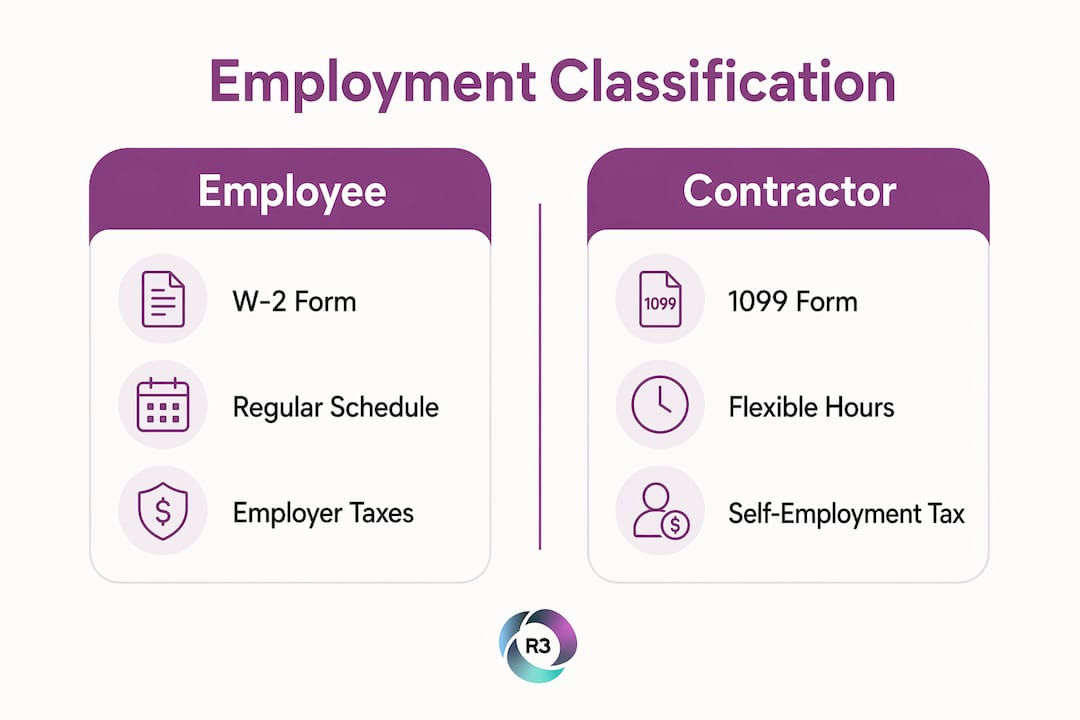
The IRS evaluates worker classification using three categories: behavioral control, financial control, and the type of relationship. No single factor is decisive. If you direct how, when, and where work is done, the IRS may classify your VA as an employee regardless of any contract language.
Key compliance steps:
Document every classification factor you considered. The IRS requires this documentation to support your determination.
Use Form SS-8 if classification is unclear. The IRS will issue an official determination, though it can take six months or more.
Include work-for-hire and IP assignment clauses in every contractor agreement, governed by the worker’s local law.
Consider an Employer of Record. An EOR handles payroll, tax withholding, and compliance, removing foreign-jurisdiction risk entirely.
Understand misclassification risk. Classifying an employee as a contractor without reasonable basis can trigger back employment taxes under IRC Section 3509.
For a deeper breakdown of these distinctions, the employee vs. contractor guide from T-Ledgers covers the critical differences clearly.
Budgeting for a long-term virtual assistant
Offshore VAs from the Philippines typically cost significantly less per month than a comparable U.S.-based hire when you factor in salary, benefits, and office overhead. Your total cost of ownership also includes software subscriptions, onboarding time, and occasional training investment. Long-term hiring reduces those costs over time: you spend less on recruiting, lose less institutional knowledge to turnover, and avoid the ramp-up cost of constantly replacing staff. Budget for communication tools like Slack, project management platforms like Asana or ClickUp, and a video tool like Loom. As your team grows, hiring a local team lead as your remote team grows mitigates communication lag and unresolved blockers.
Common challenges and how to solve them
Time zone gaps: Establish a fixed daily overlap window. Without it, simple questions become 24-hour delays.
Communication breakdowns: Use structured async updates with templates, not open-ended check-ins.
Unclear expectations: Document every process in a shared wiki or SOP library before your VA’s first day.
Accountability without micromanagement: Weekly KPI dashboards replace the need for constant check-ins.
Compliance exposure: Use a clear contractor agreement and consult an EOR if your VA’s role expands toward employee-level control.
Cultural misalignment: Schedule regular one-on-ones that include space for your VA to raise concerns, not just report status.
R3source gives you a dependable remote team, not just a hire
You’ve done the research. Now the practical question is where to find a VA who actually stays, performs, and grows with your business. R3source places trained remote professionals from the Philippines with U.S. businesses looking for exactly that: consistent, long-term support across administrative work, customer service, CRM management, lead generation, and more.


Every R3source team member is matched to integrate directly into your operations, with accountability built in from day one. Whether you need one dedicated VA or a full remote staffing solution, R3source delivers the consistency that task-based freelancers simply can’t. Book an introductory consultation to find the right fit for your business today.
Key Takeaways
A long-term virtual assistant delivers compounding operational value only when hired, classified, and managed with a clear structure from the start.
Point | Details |
Define the role before hiring | A specific job description and onboarding plan prevent the operating model failures that sink most remote teams. |
Classify correctly from day one | The IRS evaluates behavioral, financial, and relationship factors collectively; document every decision. |
Manage by outcomes, not presence | Track deliverables and delivery timeliness rather than hours logged or online status. |
Budget for the long term | Long-term hiring reduces recruiting and turnover costs; factor in tools, training, and a team lead at scale. |
R3source for reliable remote staffing | R3source places trained, long-term VAs from the Philippines into U.S. businesses across real estate, e-commerce, and services. |
Recommended
Comments