

Business Owners: Managed LinkedIn Outreach VA, Not Freelancers


Yes, a trained LinkedIn outreach virtual assistant can run targeted prospecting, manage message sequences, and log every result into your CRM to deliver qualified discovery calls, not just raw connection acceptances. R3source builds these roles around outcomes, and the industry benchmark worth knowing before you hire is Belkins’ finding of a 26% average connection rate across 15.1 million touchpoints. Expect a ramp period before results stabilize.
A LinkedIn outreach virtual assistant can build targeted prospect lists, manage messaging sequences, and log results to generate qualified discovery calls, not just connections.
Industry benchmarks show a 26% connection rate and a 7.2% reply rate, with higher success in warm outreach and industry-specific campaigns.
Hiring should focus on judgment and personalization skills, with assessments including ICP fit, messaging relevance, and CRM hygiene, not just LinkedIn familiarity.
Effective onboarding requires clear approval of messaging templates, segmentation, compliance rules, and escalation protocols before outreach begins.
Ongoing skill development involves regular review of messaging performance, tool proficiency, and compliance updates to maintain reply rates and ROI.
Table of Contents
What Does a LinkedIn Outreach Virtual Assistant Actually Do?
A LinkedIn outreach virtual assistant handles the full front end of your sales pipeline, from finding the right prospects to logging the outcome of every conversation. Scope creep is the biggest reason these hires underdeliver, so a precise job description matters more than most business owners expect.
The core responsibilities break down into five areas:
Lead research and ICP filtering: building and refining prospect lists by job title, industry, geography, and company size, then applying exclusion rules so your VA is not wasting cycles on the wrong accounts.
Daily outreach execution: sending connection requests, warm follow-up touches, and managing a messaging cadence that does not trip LinkedIn’s activity limits.
Profile optimization and engagement: keeping your (or your sales team’s) profile current, commenting on target-account content, and maintaining a visible, credible presence that supports the outreach.
CRM entry and scheduling: logging every reply, qualification note, and objection, then booking discovery calls directly onto a calendar.
Toolset management: working inside Sales Navigator, your CRM, and any approved automation tool, with access handled through a password manager rather than shared logins.
This is closer to a lead generation virtual assistant role than a simple messaging job. The best hires treat CRM hygiene as seriously as the outreach itself. A VA who sends 50 connection requests a day but never updates a deal stage is not actually running a pipeline. They are generating noise you have to clean up later.
What Outreach Results Should You Actually Expect?
Connection rate, reply rate, and meeting rate compound on each other, so a small drop at the top of the funnel shows up magnified at the bottom. If your VA sends 100 connection requests a week at a 26% acceptance rate, that is 26 new connections. Only a fraction of those become booked calls.
Industry benchmark: Belkins’ 2026 study of 15.1 million outreach touchpoints found a 26% average connection rate and 7.2% reply rate. Expandi’s 2026 benchmarks across 13.2 million attempts put connection rates slightly higher at 28% to 30%, with warm, already-connected outreach reaching a 10.4% reply rate.
These numbers shift by industry, seniority level, and campaign type, which is why a generic “good outreach” benchmark does not exist. What matters more than any single rate is pipeline quality. Twenty qualified calls from a smaller, well-targeted list beat two hundred acceptances from a scattershot one.
Run a real test before judging performance:
Set a 2 to 6 week baseline window before changing strategy.
Track connection rate, reply rate, and calls booked weekly, not daily.
Segment results by ICP tier so one bad list does not skew the whole picture.
Watch show rate on booked calls. It is often a better signal than reply volume.
How Do You Hire and Vet a LinkedIn Outreach VA?
Screening for this role means testing for judgment, not just familiarity with LinkedIn’s interface. A candidate who “knows LinkedIn” is different from one who can build a clean ICP list, write a personalized note, and recover gracefully from a cold reply.
Score every candidate against the same criteria so comparisons are fair:
ICP fit accuracy. Give them a rough target profile and see how tightly their sample list matches it.
Message personalization. Review three sample connection notes for genuine relevance versus templated filler.
CRM hygiene. Hand over a messy sample CRM row and see how they clean and structure it.
Show rate potential. Ask how they would confirm a booked call and handle a no-show.
Escalation instincts. Present a hostile or confused reply and ask how they would respond.
A short practical test tells you more than a resume ever will. Ask candidates to write a connection note for a specific persona and clean up a deliberately disorganized CRM entry. Watch how they handle ambiguity in the exercise. That is often exactly how they will handle it on the job.
Pro Tip: Build your scorecard around pipeline quality measures, not invitation volume. A candidate obsessed with connection counts over qualified conversations will optimize for the wrong number once they are hired.
Watch for red flags: vague answers about compliance, no questions about your ICP, or an eagerness to promise a fixed number of meetings before they have even seen your list. Put show-rate expectations and escalation boundaries directly into the engagement terms. For a deeper walkthrough of interview structure, see this guide to vetting virtual assistants.
What Onboarding and Escalation Rules Keep Outreach Safe?
Granting campaign access before onboarding is complete is how outreach goes wrong fast. A few missing guardrails, and a VA is improvising responses to pricing questions or complaints without any documented boundary to follow.
Before your VA sends a single message, confirm these are in place:
Profile and messaging library approved, including your core connection note and follow-up templates.
ICP and exclusion lists finalized and shared, not left to interpretation.
Access matrix documented: what tools, what permissions, and what stays with a manager.
Opt-out handling process written down, along with escalation triggers for pricing questions, technical claims, or complaints.
Do not let a virtual assistant improvise expertise your business does not actually claim. Set clear approval boundaries around pricing, technical promises, and disputes, and give them a short list of pre-approved replies they can send without waiting on you.
Compliance is not optional detail. The FTC’s CAN-SPAM guidance notes that commercial messages sent through social networks can be treated as electronic mail in some cases, which means truthful sender information and honoring opt-outs matter even on LinkedIn. Further FTC commentary reinforces that these scripts and escalation rules should exist before outreach starts, not after a complaint arrives. Review the funnel weekly against your KPI dashboard, and treat any unusual reply as an escalation, never an improvisation. A detailed onboarding checklist makes this far easier to standardize across hires.
What Messaging Sequence Actually Gets Replies?
A cold connection request with no warm-up is the weakest version of outreach. A stronger starter sequence looks like this: view the prospect’s profile, like or comment on a recent post, send the connection request, then follow with a short, specific message once they accept.
The note-versus-no-note decision matters more than most people assume. Belkins’ data shows personalized notes produced a 25.3% connection rate and 8.2% reply rate, while blank requests hit 27.6% connection but only 5.3% reply. No note gets you more connections. A note gets you more conversations, which is the metric that actually feeds your calendar.
A workable three-step sequence:
Day 0: Personalized connection request referencing something specific from their profile or activity.
Day 2 to 3 after acceptance: A short message tied to a real trigger, a recent post, a job change, a shared connection.
Day 7: A brief, value-forward follow-up if there is no reply, never a repeat of the same pitch.
Expandi’s research found connection-note reply rates have declined over time while post-connection message replies stayed more stable, which is a strong argument for leaning on warm-touch sequences rather than the note itself. AI-assisted drafting can speed up first drafts, but a human should still review anything going to a VIP account or a prospect who has already pushed back once.
How Should a VA Handle Negative or Inappropriate Replies?
Every outreach campaign eventually gets a hostile, dismissive, or inappropriate reply. How your VA handles that single message often determines whether your brand looks professional or reckless.
The rule is simple: de-escalate, document, and never respond in kind. A curt “not interested” needs nothing more than a polite acknowledgment and a note in the CRM to stop future touches. A rude or inappropriate message is different. It should be flagged to a manager immediately, not answered in the moment, and it should never trigger a defensive or sarcastic reply, even a well-deserved one.
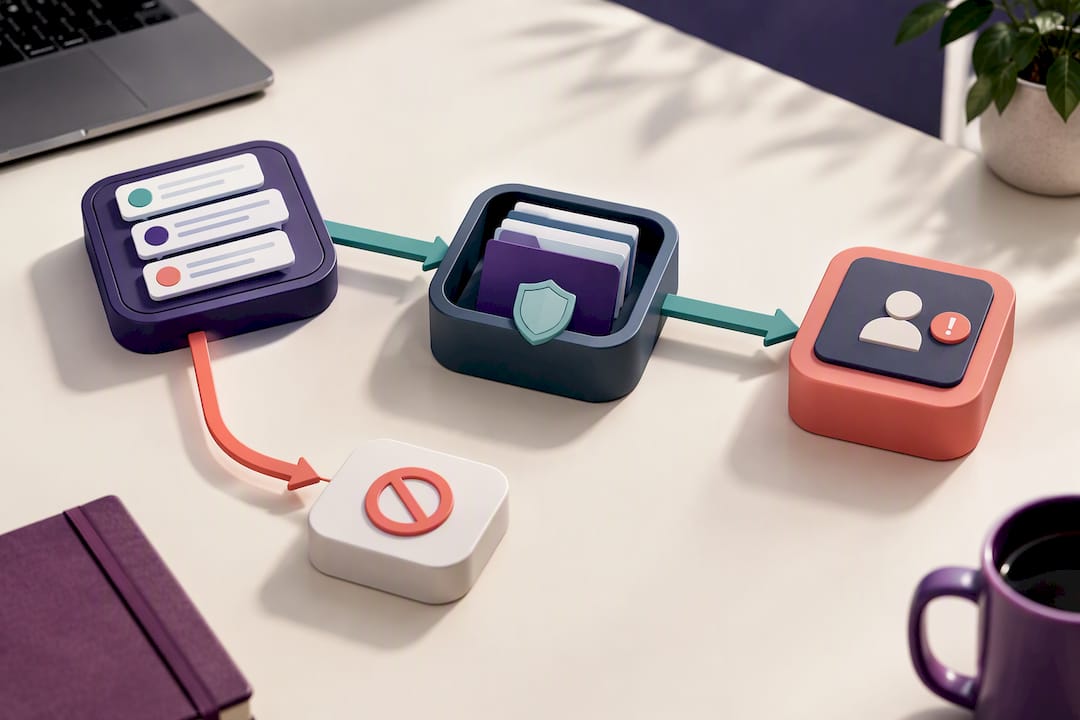
Build a short library of pre-approved responses for common scenarios: polite decline, request to stop contact, mild pushback, and confusion about who you are. Anything outside that library gets escalated rather than improvised. This is exactly the kind of boundary that belongs in your onboarding documentation, not something your VA figures out live under pressure.
There is also a compliance angle here. Any prospect who asks to stop being contacted needs that request honored and logged immediately, in line with the opt-out expectations under FTC guidance. Ignoring an opt-out because a reply was hostile rather than polite is still a compliance failure.
Track how often negative replies occur and why. A sudden spike often signals a targeting problem, not a messaging problem. If negative responses cluster around a specific job title or industry, that segment probably needs to come off the list rather than get a better message.
How Do LinkedIn Outreach VAs Keep Their Skills Sharp?
Outreach that worked six months ago will not necessarily work today. LinkedIn’s algorithm, professional norms, and prospect fatigue all shift, and a VA who never updates their approach will watch reply rates quietly erode.
Ongoing development should cover three areas. First, messaging craft: reviewing which openers and follow-ups are actually generating replies, and retiring the ones that have gone stale. Second, tool fluency: staying current with Sales Navigator filters, CRM workflows, and any approved automation so campaigns run efficiently rather than manually. Third, compliance awareness: staying current on platform policy changes and regulatory guidance so outreach practices do not quietly drift into risk.
A useful cadence is a monthly review where your VA presents what worked, what did not, and one specific change they want to test next. This does two things. It keeps you informed without requiring daily oversight, and it gives your VA ownership over their own performance rather than treating outreach as a script to execute blindly.
Pairing a newer VA with a more experienced one, even briefly, tends to shortcut a lot of trial and error. Real-world message examples and objection-handling patterns transfer faster through observation than through a written guide alone. If you are managing this relationship through a staffing partner, ask what structured training and coaching that partner provides between placements, not just at the start.
How Do You Measure Real ROI From LinkedIn Outreach?
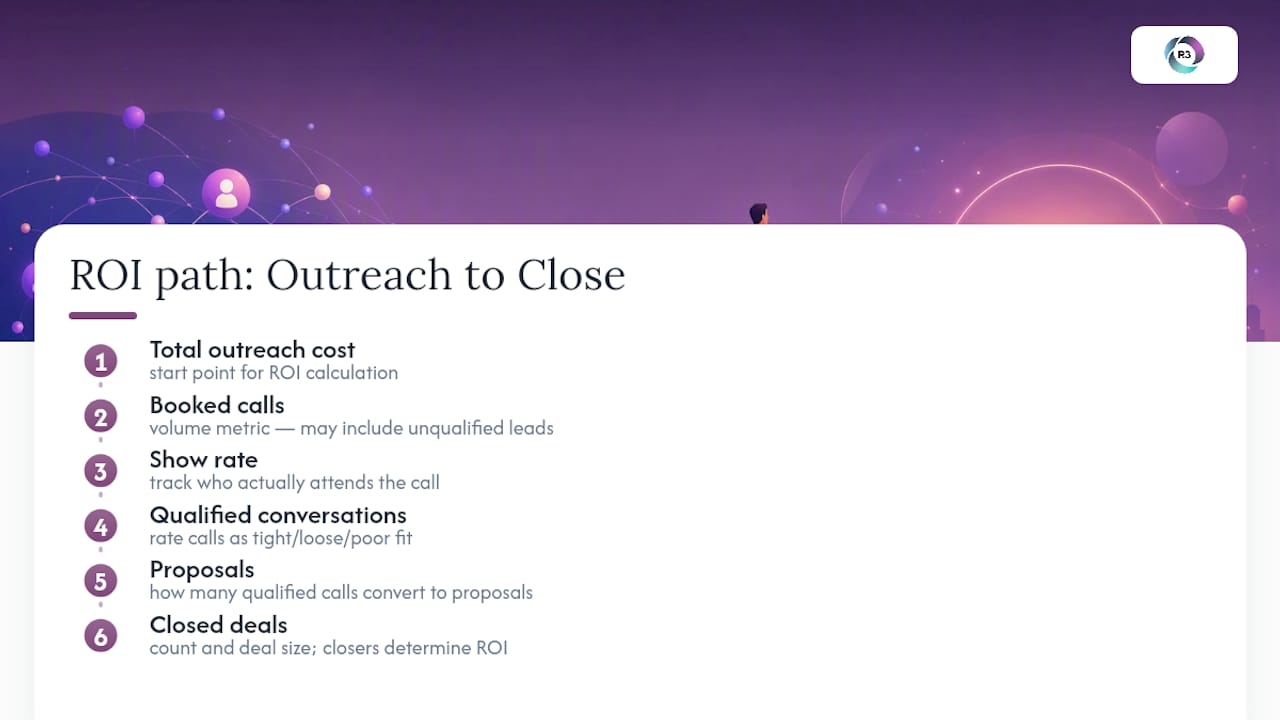
Funnel metrics tell you whether outreach is running. They do not tell you whether it is actually working for your business. A campaign generating twenty booked calls a month looks strong until you notice that eighteen of them are unqualified and going nowhere.
Real ROI measurement starts one step past the booked call. Track show rate, then track what happens after the call: how many convert to a proposal, how many close, and at what deal size. A VA whose calls close at a higher rate than average is worth more than one who books twice as many calls that go nowhere, even if their funnel metrics look less impressive on paper.
Lead quality scoring helps here. Rate each booked call on a simple scale, tightly qualified, loosely qualified, or poor fit, and review that distribution monthly alongside your standard KPIs. If quality is declining while volume holds steady, that is usually a targeting problem rather than a messaging one.
Cost per qualified conversation is a more honest metric than cost per connection or cost per reply. Divide your total outreach cost by the number of calls that were genuinely worth having, not the number that simply got booked. Tracking this over a full sales pipeline cycle, not just the outreach stage, gives you the clearest read on whether the hire is actually paying for itself.
Managed VAs vs. Freelancers: Which One Fits Your Pipeline?
A managed, dedicated VA tends to outperform a rotating cast of task-based freelancers once you need consistent CRM hygiene and clean handoffs between outreach and sales. Freelancers are useful for short experiments, a rapid outbound burst before a launch, or testing a new market before committing. But consistency is what actually compounds pipeline results over months, and that is harder to get from someone juggling five other clients.

The businesses that get burned here usually treated LinkedIn outreach as a one-off task rather than an ongoing operational function. It is not. It is a role that needs training, escalation rules, and performance review like any other position on your team.
That is the case for a managed relationship over a freelance marketplace hire. A managed, dedicated VA tends to outperform freelancers by integrating closely into existing CRM and sales processes rather than working in isolation on a task list. For a business that wants predictable outreach, not a rotating door of contractors, that structural difference tends to matter more than any single tactic in this article.
— Ellis
Ready to Add a LinkedIn Outreach Virtual Assistant to Your Team?
Instead of piecing together freelancers or running outreach yourself between client calls, consider hiring a dedicated, long-term remote professional trained on your ICP, your CRM, and your escalation rules, rather than a rotating contractor who disappears after the campaign ends.
R3source’s Outsource Virtual Assistant Services place remote professionals from the Philippines who handle LinkedIn prospecting, messaging, CRM updates, and calendar scheduling as a fully managed, ongoing hire, with onboarding, SOPs, and performance tracking built in from day one. This fits real estate teams, e-commerce brands, and service businesses that need steady pipeline activity without adding a full-time salary and benefits load. If pricing flexibility matters more right now, the Offshore Virtual Assistant Services page walks through engagement options built for scaling teams.
The next step is simple: book an introductory consultation to talk through your ICP, your current outreach gaps, and what a dedicated VA placement would look like for your business.
Sources
FAQ
What Is LinkedIn Outreach?
LinkedIn outreach is the practice of proactively contacting prospects on LinkedIn through connection requests and direct messages to build relationships and generate sales conversations. It typically combines profile research, personalized messaging, and CRM tracking to move contacts from a cold connection to a qualified conversation.
What Is the 4-1-1 Rule on LinkedIn?
The 4-1-1 rule is a content-balance framework (four curated, one repost, one self-promotional across six items). It was built for general social media use, and most experts recommend adapting it rather than applying it rigidly to a founder’s personal profile, where original authority content tends to perform better.
Can a Virtual Assistant Realistically Earn $10,000 a Month?
Most individual LinkedIn outreach virtual assistants do not earn that amount, since pay is typically tied to hourly or monthly rates rather than commission-heavy structures. That figure is far more common among agency owners or freelancers managing multiple client campaigns simultaneously, not a single outreach specialist.
What Does “Outreach” Mean for a Virtual Assistant Role?
In a virtual assistant job, “outreach” refers to the structured process of identifying prospects, sending connection requests and messages, and logging every response to move leads toward a booked call. It is distinct from general admin work because it is measured against specific funnel metrics like connection rate, reply rate, and calls booked.
How Much Does It Cost to Hire a LinkedIn Outreach VA Through R3source?
R3source does not publish flat rates online, since pricing depends on role scope, hours, and experience level. Current rates and engagement options are available directly through R3source’s service pages or by booking a consultation.
Recommended
Comments