

How to Hire a Virtual Assistant for Small Business


You can hire a reliable virtual assistant for your small U.S. business in a few weeks to a couple of months by following a six-step process: define the role, choose your hiring model, post and source candidates, vet and test, run a paid trial, then set KPIs and formalize the contract. Most small businesses complete this cycle in about six weeks when each step is followed and the role brief is clear from the start.
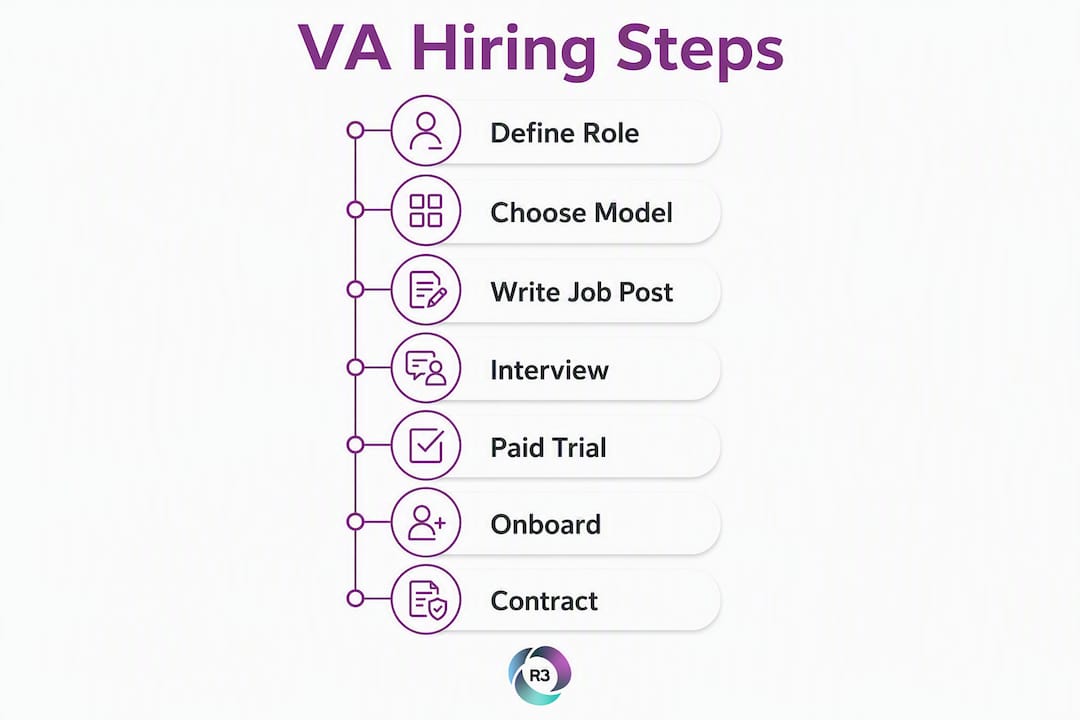
Here is what the process looks like at a glance:
Define the role — tasks, hours, timezone overlap, and measurable outcomes
Choose your model — freelancer, dedicated remote staff, or W-2 employee
Post and source — job boards, VA platforms, or a managed provider like R3source
Vet and test — screening call, skills test, paid sample task
Run a paid trial — 1–4 weeks with clear deliverables and evaluation criteria
Set KPIs and contract — scope of work, NDA, payment terms, and performance benchmarks
On cost: part-time VA support typically varies depending on skill level and hours; full-time dedicated staff through a managed provider generally involves bundled pricing that includes onboarding and ongoing management, which bundles onboarding and ongoing management. Learn more about VA cost structures before you set your budget.
Table of Contents
How do you define the virtual assistant role before you hire?
Which hiring model fits your small business: freelancer, agency, or employee?
How do you write a job post and where should you find candidates?
What does a strong interview and skills-testing process look like?
How do you run a paid trial and set up onboarding that actually works?
Why dedicated VAs usually outperform one-off freelancers for small businesses
How do you define the virtual assistant role before you hire?
Vague job posts attract vague candidates. Before you write a single word of your listing, map out exactly what you need done and how you will measure it.
Start with outputs, not titles. Instead of “I need an admin VA,” write specific tasks and measurable outcomes to filter applicants who cannot deliver them.
Common small-business VA task categories:
Administrative: calendar management, inbox triage, data entry, travel booking
CRM and sales support: lead entry, follow-up sequences, appointment setting
Customer service: email and chat support, order tracking, refund processing
Marketing support: social media scheduling, content research, newsletter formatting
Once you have your task list, add three to five KPIs so performance is never a guessing game. Useful starting points include tracking task completion rate, average email response time, error rate on data entry, and calendar utilization rate. Pair each KPI with a target and a review cadence. See role-by-role examples to build out your task list faster.
Which hiring model fits your small business: freelancer, agency, or employee?
The model you choose shapes your cost, your legal exposure, and how much management time you spend. Each option solves a different problem.

Model | Best for | Cost shape | Management burden | Continuity risk |
Freelancer (gig) | Short-term or project work | Hourly, variable | High (you manage everything) | High (turnover common) |
Dedicated remote staff / agency | Ongoing operations, growth | Monthly, predictable | Low (provider handles HR) | Low (long-term placement) |
W-2 employee | Full control, on-site integration | Salary + benefits | High (payroll, compliance) | Low |
For most small businesses, dedicated remote staff through a managed provider hits the best balance of cost, continuity, and compliance simplicity. R3source places long-term remote professionals from the Philippines who integrate directly into your operations, with onboarding and performance management included.
Legal classification matters here. The DOL’s 2024 final rule under the FLSA uses a six-factor economic reality test to determine whether a worker is an employee or an independent contractor. No single factor is dispositive. The IRS applies a similar framework covering behavioral control, financial control, and the type of relationship. A written contract that says “contractor” does not override these factors if the economic reality points to employment.
Pro Tip: Document your classification analysis before you sign anything. If you are genuinely uncertain, either party can file IRS Form SS-8 to request a formal determination, though the process can take several months.
How do you write a job post and where should you find candidates?
A strong job post does two things: it attracts qualified applicants and discourages unqualified ones. Keep it under 400 words and be specific about the role, the hours, and the trial structure.
Job post template (copy and adapt):
Role summary — one sentence on what the VA will own day-to-day
Must-have skills — list 3–5 non-negotiable tools or competencies (e.g., HubSpot, Google Workspace, English fluency)
Hours and timezone — “20 hours/week, overlap with U.S. Eastern Time required”
Trial structure — “We run a 2-week paid trial before extending a long-term contract”
Application filter — ask applicants to include a specific phrase or answer one short question; this screens out copy-paste applications instantly
Where to post:
Specialist VA platforms — faster filtering, candidates already understand remote work expectations
General gig marketplaces — wide reach, but expect more noise and higher screening time
LinkedIn — strong for VAs with industry-specific backgrounds (legal, real estate, e-commerce)
Niche Facebook groups and Slack communities — good for referrals and pre-vetted candidates
Managed providers like R3source — skip the posting entirely; candidates are pre-screened and matched to your role
Virtual assistants can work as employees or independent contractors and often provide their own equipment, which affects how you write the role and what tools access you need to provide.
What does a strong interview and skills-testing process look like?
Résumés tell you what someone has done. A paid skills test tells you what they will do for you. Run both.
A four-step vetting workflow:
Async screening — a short written questionnaire (5 questions, 15 minutes) to assess communication quality and attention to detail before you spend time on a call
30-minute video call — confirm availability, timezone, and communication style; use STAR-method questions (“Tell me about a time you managed competing deadlines”) to surface real behavior
Paid skills test — assign a real task from your workflow (draft three email responses, clean a 50-row spreadsheet, schedule a week of social posts); pay a flat fee of $25–$50 for 1–2 hours of work
Reference check — two professional references, asked specifically about reliability, communication, and how the candidate handled mistakes
Red flags to watch for:
Work samples that look plagiarized or generic
Evasive answers about why they left previous clients
Inconsistent availability claims across the application and interview
Inability to name specific tools they claim to know
Score each candidate on quality, speed, communication, and cultural fit using a simple 1–5 rubric. Two evaluators reduce bias.
How do you run a paid trial and set up onboarding that actually works?
A paid trial combined with clear KPIs is the single most reliable way to reduce hiring risk for remote roles. Design it as a real working period, not a test.
Trial structure (1–4 weeks):
Assign 3–5 real deliverables with deadlines and quality benchmarks
Provide access to the tools they will use on the job (Asana, Slack, your CRM)
Schedule a daily 10-minute check-in for the first week, then shift to weekly reviews
Evaluate on: output quality, communication responsiveness, initiative, and ability to follow SOPs
Onboarding checklist:
Signed contract and NDA before day one
Tools access and login credentials (use a password manager like 1Password)
Written SOPs for recurring tasks
Recorded walkthrough of key workflows
Clear escalation path for questions
Use this onboarding checklist to make sure nothing falls through the cracks.
Pro Tip: Set a formal “go/no-go” decision point at the end of the trial week. Write it into the contract so both parties know the evaluation is structured, not open-ended.
What does it cost, and what should your contract include?
Cost varies by skill level, hours, and hiring model. The ranges below reflect typical U.S. small-business engagements.
VA Type | Hourly Range | Part-time (20 hrs/wk) | Full-time |
General admin (offshore) | $8–$15/hr | $800–$1,200/mo | — |
Specialized (CRM, marketing) | $15–$25/hr | — | — |
Managed/dedicated (agency) | Bundled | $2,500/mo | $2,500–$3,000/mo |
Managed pricing bundles recruitment, onboarding, HR, and performance oversight. When you factor in the time you spend sourcing, screening, and managing a freelancer, the gap between DIY and managed narrows quickly.
Contract essentials:
Scope of work (specific tasks, hours, deliverables)
IP ownership and NDA clause
Trial period terms and go/no-go criteria
Payment schedule and method
Termination clause (notice period for both parties)
Confidentiality provisions for client data
Classification reminder: The DOL’s economic reality test and the Federal Register’s January 2024 final rule both make clear that a contract label does not determine worker status. Document your classification reasoning and consult a qualified employment attorney if your arrangement is complex.
This article provides general information, not legal or tax advice. Confirm your classification decisions with a qualified professional or the relevant primary source.
What does a 6-week hiring timeline look like in practice?
Week | Milestone |
Week 1 | Finalize role brief, KPIs, and job post |
Week 2 | Post job, begin screening applications |
Week 3 | Conduct interviews and paid skills tests |
Week 4 | Select finalist, issue contract, begin paid trial |
Week 5 | Run paid trial with daily check-ins |
Week 6 | Go/no-go decision, full onboarding, first-month KPIs set |
Two sample monthly budgets:
Part-time VA (20 hrs/wk, general admin): $800–$1,200/mo VA cost + ~$50/mo software (Asana, Slack) + 2–3 hrs/wk management time
Full-time dedicated staff (managed): $2,500–$3,000/mo all-in (includes onboarding, HR, performance oversight) + minimal management overhead
The freelancer path saves money on paper but adds 3–5 hours per week of sourcing, managing, and re-hiring when turnover happens. Dedicated staff through a managed provider trades a slightly higher monthly rate for predictable output and continuity.
Key Takeaways
Hiring a virtual assistant for your small business works best when you define the role precisely, choose the right model for your growth stage, and treat the paid trial as a structured evaluation, not a formality.
Point | Details |
Define before you post | Map specific tasks, KPIs, and timezone requirements before writing your job post. |
Model choice drives cost and risk | Dedicated managed staff offers lower turnover and predictable monthly costs vs. freelancers. |
Paid trial reduces hiring mistakes | A paid trial of a few weeks duration with clear deliverables is the most reliable vetting step for remote roles. |
Classify workers correctly | Document your DOL/IRS analysis before signing; mislabeling a worker as a contractor carries real legal risk. |
R3source as a managed option | R3source provides dedicated remote staff from the Philippines with onboarding and management included, reducing your hiring timeline and overhead. |
Why dedicated VAs usually outperform one-off freelancers for small businesses
The conventional wisdom says freelancers are cheaper. For a one-time project, that is often true. For ongoing operations, the math rarely holds.
When a small business replaces a freelancer every three to four months, the hidden costs add up fast: re-posting the job, re-screening candidates, re-training someone on your SOPs, and absorbing the productivity dip while the new person ramps up. A dedicated VA who has worked inside your systems for six months knows your clients, your tone, and your processes. That institutional knowledge is genuinely hard to price, but its absence is easy to feel.
The argument that freelancers offer more flexibility also tends to collapse under scrutiny. Most small businesses do not need flexibility in their admin support. They need reliability. A VA who shows up every day, knows what “done” looks like for your business, and flags problems before they escalate is worth more than a rotating roster of cheaper contractors who each need a week to get up to speed.
One pattern worth noting: businesses that switch from gig-based VA arrangements to dedicated long-term staff consistently report fewer errors, faster turnaround on recurring tasks, and less time spent on management. The productivity gains are not dramatic in week one. They compound over months.
R3source makes the managed VA path straightforward
Hiring a dedicated remote professional does not have to mean months of searching, screening, and hoping for the best. R3source places long-term offshore virtual assistants from the Philippines directly into your operations, with recruitment, onboarding, and performance management handled for you. Every placement includes a paid trial period, reference checks, and work sample review before you commit to a long-term arrangement.

The service covers administrative support, customer service, CRM management, lead generation, appointment setting, marketing support, and more. Whether you need 20 hours a week or a full-time team member, R3source builds the arrangement around your workflow, not a generic package. Book an introductory consultation to talk through your role requirements and get a clear picture of what a dedicated VA would cost and deliver for your business.
Useful sources and next-step reading
DOL Fact Sheet 13: Employment Relationship Under the FLSA — economic reality test factors for worker classification
DOL Small Entity Compliance Guide: 2024 Final Rule — six-factor framework for independent contractor vs. employee determination
DOL FAQ: Final Rule on Employee or Independent Contractor Classification — plain-language answers on the 2024 FLSA rule
Federal Register: January 10, 2024 Final Rule — full regulatory text on economic dependence and classification
IRS: Independent Contractor or Employee? — behavioral, financial, and relationship factors; Form SS-8 guidance
Oregon SBDC: How to Hire Virtual Assistants — practical hiring guidance including STAR interviewing and paid trial best practices
R3source: Virtual Assistant for Small Business Guide — role examples and benefits for service-based businesses
R3source: Virtual Assistant Integration Best Practices — workflow integration and team dynamics guidance
Recommended
Comments