

How Philippine Professionals Support US Business Growth

Updated: May 28

Most US business owners approach outsourcing to the Philippines thinking primarily about cost savings. That framing is understandable, but it misses most of the story. Understanding how Philippine professionals support US businesses requires looking at something deeper: cultural alignment rooted in decades of shared history, a service-oriented mindset that genuinely fits American workplace expectations, and a talent pool spanning everything from bookkeeping to software development. This article walks you through the real advantages, the roles that matter most, and how to make any Philippine partnership actually work.
Table of Contents
Key Takeaways
Point | Details |
Cultural fit runs deep | Filipino professionals share language, work norms, and values with US teams, reducing friction from day one. |
Roles go far beyond admin | Philippine professionals fill high-value positions in IT, healthcare, finance, and executive support. |
Integration is what makes it work | Documented SOPs and clear KPIs determine whether offshore partnerships succeed or stall. |
Strategic ties are strengthening | US-Philippines economic collaboration now extends into semiconductors, AI, and digital infrastructure. |
Retention is a real advantage | Filipino professionals have attrition rates below 10%, giving US companies rare operational continuity. |
How Philippine professionals support US businesses: core advantages
The phrase “it’s cheaper” sells Filipino talent short. Cost savings exist, but they are one layer of a multi-layered advantage. Here is what actually makes the Philippines a reliable talent source for US companies.
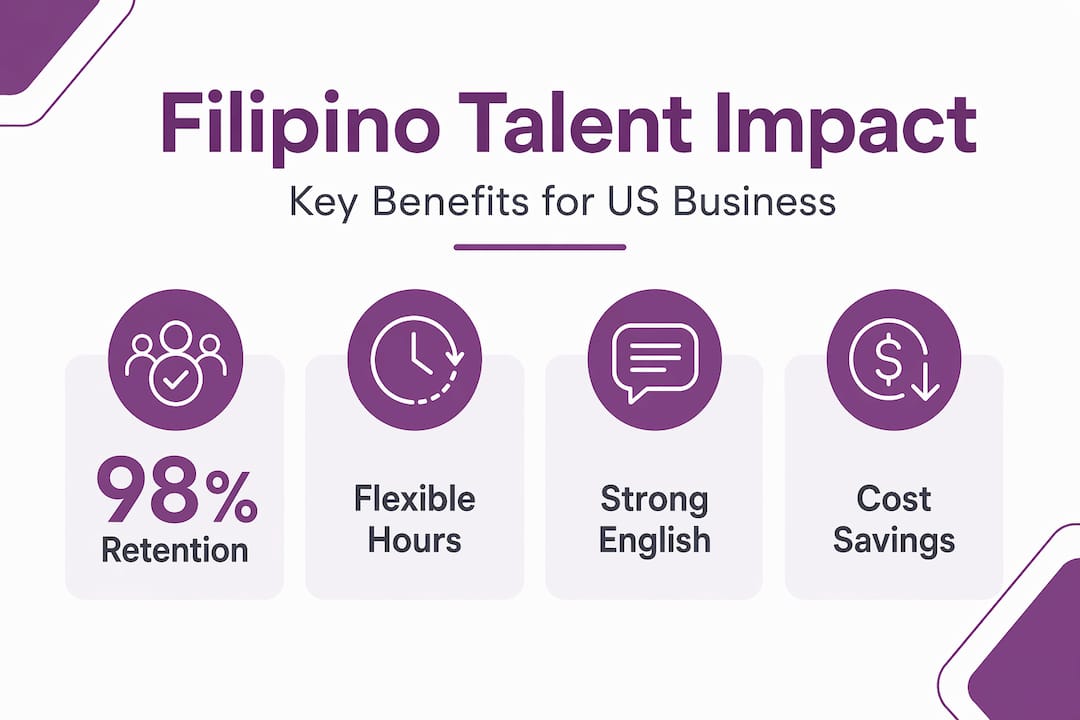
English proficiency and cultural alignment. The Philippines treats English as an official language. Most professionals use it daily from childhood through university. That removes the communication overhead that slows down other offshore partnerships. Beyond language, cultural affinity with Western norms runs through business communication styles, customer service expectations, and professional hierarchy. This is a product of historical ties to the United States, and it shows up in how Filipino professionals handle client-facing roles.
Time zone flexibility. Filipino professionals are widely known for their willingness to work graveyard shifts to align with US business hours. For a business in New York or Los Angeles, that means your remote team member is available when your customers are calling, not just when it’s convenient halfway around the world.
Scalability without proportional cost increases. Hiring in the United States involves salary, benefits, office space, and payroll taxes. Philippine-based professionals allow you to scale operations at a fraction of that cost, which matters most when you are growing quickly and need to add capacity without adding overhead.
Work ethic and loyalty. Filipino professionals consistently exceed expectations in service, adaptability, and retention. Average tenure of over three years is common in well-managed arrangements. That consistency translates directly to lower recruitment costs and better institutional knowledge over time.
Pro Tip: Do not evaluate a Philippine staffing arrangement on salary comparison alone. Calculate the total cost difference including employer taxes, benefits, and real estate, and you will typically find a 50 to 70 percent reduction in fully loaded cost per role.
Roles where Filipino professionals make the biggest difference
The breadth of what Philippine professionals deliver for US companies has expanded well beyond basic call center work. Here is where the most meaningful impact is happening today.
Customer support and technical helpdesk. This is where Philippine outsourcing built its reputation, and the infrastructure is unmatched. The BPO sector in the Philippines is mature, well-regulated, and has been running US-facing operations for over 25 years. Quality oversight, escalation protocols, and performance metrics are built into the standard operating environment.
Back-office operations. Bookkeeping, accounts payable, CRM management, data entry, and appointment setting are all functions that Filipino professionals handle with consistency. For service businesses and real estate firms especially, offloading these tasks frees up internal capacity for revenue-generating work.
Software development and IT support. The technology talent pool has grown substantially. Filipino developers, QA engineers, and system administrators support US technology companies with competitive skill sets and genuine technical depth.
Healthcare outsourcing. The Philippine healthcare BPO sector is growing at 10 to 11 percent annually, and the global healthcare outsourcing market is expected to exceed $423 billion in 2026. Medical billing, coding, transcription, and prior authorization support are all functions US healthcare organizations are actively moving to the Philippines.
Creative and executive assistance. Marketing support, social media management, graphic design, and executive calendar management are common roles filled by Filipino professionals who bring both technical skills and creative sensibility to US teams.
Industry | Common roles filled | Key benefit for US business |
Real estate | Transaction coordination, CRM management, lead follow-up | Faster response times and organized pipelines |
E-commerce | Order management, customer support, inventory tracking | Round-the-clock coverage at reduced cost |
Healthcare | Medical coding, billing, prior auth support | Compliance-aware talent at lower operating cost |
Technology | Software development, QA, IT support | Skilled technical talent at competitive rates |
Professional services | Bookkeeping, executive assistance, research | Reclaimed time for senior staff |
The specialized functions Filipino professionals provide go well beyond what many US business owners initially expect when they consider the Philippines as a talent source.

Making offshore partnerships actually work
The mechanics of integration separate successful Philippine partnerships from frustrating ones. The difference rarely comes down to talent quality. It comes down to how the engagement is structured and managed.
Map your workflows before hiring. Know exactly what tasks, systems, and decision-making authority the role involves before you recruit. Vague job descriptions produce poor matches. Specific ones attract the right people.
Use structured onboarding with written SOPs. Documented SOPs and clear escalation paths are the single most reliable predictor of a smooth offshore integration. Your remote team member should never have to guess what to do when something unusual happens.
Set KPIs within the first 30 days. Performance tracking should start early, not as a corrective measure but as a shared language for what success looks like. Regular check-ins prevent small misalignments from becoming larger problems.
Prioritize communication infrastructure. Shared project management tools, video standups, and defined response-time expectations create a remote team that feels genuinely integrated rather than disconnected.
Invest in relationship, not just performance. Filipino professionals bring strong loyalty and adaptability to well-managed work environments. When employers treat remote staff with the same respect extended to local teams, retention improves noticeably.
Working with a managed outsourcing provider transfers HR risk, handles compliance, and delivers accountability structures that most business owners lack the bandwidth to build from scratch.
Pro Tip: Schedule a 15-minute weekly video call with your Philippine-based team member for the first 90 days. This single habit builds trust, surfaces problems early, and dramatically reduces the risk of a poor start becoming a permanent issue.
US-Philippines collaboration: beyond cost arbitrage
The relationship between US companies and Philippine professionals is shifting in ways that matter for long-term strategic planning. This is no longer just about finding affordable labor. It is about economic security collaboration in sectors that define the next decade of global competition.
In April 2026, the Philippines became the 13th member of Pax Silica, a US-led initiative focused on securing semiconductor and AI-related supply chains. The Luzon Economic Corridor, developed jointly by the US, Japan, and the Philippines, is attracting investment in semiconductor training, digital infrastructure, and clean energy. That signals a pivot from low-cost labor sourcing to advanced technology partnership.
“US-Philippines partnerships are moving from cost arbitrage models to strategic economic security collaborations in advanced technology sectors and infrastructure.” — Advancing U.S.-Philippines Economic Security
For US business owners, this shift has practical implications. The Philippine talent pool is actively developing capacity in high-value technical disciplines. The professionals you hire today are part of a workforce that is being intentionally upgraded through international investment. That matters if you are thinking about why US businesses hire from the Philippines not just for today’s needs but for the capabilities you will want three and five years from now.
Model | Focus | Benefit to US businesses |
Traditional outsourcing | Cost reduction through labor arbitrage | Lower operating costs |
Strategic partnership | Shared digital and infrastructure goals | Long-term talent and supply chain security |
Managed remote staffing | Dedicated professionals embedded in US teams | Accountability, retention, and operational continuity |
My honest take on the Filipino advantage
I’ve worked with enough US businesses navigating offshore staffing to say this clearly: the companies that get the most out of Philippine professionals are not the ones who treat it as a transaction. They are the ones who invest in the relationship.
What I’ve learned is that cultural alignment is a genuine competitive advantage, not a marketing line. When a Filipino professional understands your business’s tone, your customer’s expectations, and your internal standards, they do not just complete tasks. They anticipate problems. They flag things before they become issues. That kind of professional instinct comes from years of working within a culture that genuinely values service and loyalty.
I’ve also seen the other side. Business owners who outsource without onboarding properly, who never schedule regular check-ins, and who treat remote team members as interchangeable. Those arrangements underperform. Not because of talent gaps, but because of management gaps.
My take on the impact of Filipino talent on US businesses is this: the potential is real and large, but it requires the same intentionality you would bring to any hire. The Philippines gives you access to professionals who want to do excellent work and who stay when they feel valued. That is genuinely rare in any labor market. Treat it accordingly.
— Ellis
Build your remote team with R3source
If you are ready to put a dedicated Filipino professional to work in your business, R3source makes the process straightforward. R3source matches US businesses with pre-vetted remote professionals across administrative, customer service, marketing, and operational roles, handling candidate sourcing, skills matching, and onboarding support from day one.
What makes R3source different from freelancer platforms is accountability. Every professional is trained to integrate into your specific workflows, not just complete one-off tasks. R3source clients across real estate, e-commerce, and service businesses consistently report reclaiming 10 or more hours per week once their remote team members are fully operational. If you want to explore what building a dedicated remote team looks like for your business, start here and see exactly how R3source structures the hiring and integration process.
FAQ
What roles do Philippine professionals typically fill for US companies?
Filipino professionals fill roles across customer support, bookkeeping, CRM management, software development, healthcare billing, and executive assistance. The range has expanded significantly beyond traditional call center functions.
How do Philippine professionals align with US business hours?
Time zone flexibility and a strong culture of working non-standard hours allow Filipino professionals to provide real-time support during US business hours, including evening and overnight coverage.
Is Philippine outsourcing only for large companies?
No. Small and mid-sized US businesses benefit significantly because the cost structure makes dedicated support accessible at a scale that local hiring would not allow. Service businesses, real estate firms, and e-commerce operators frequently start with a single remote team member.
How long do Filipino remote professionals typically stay with one employer?
Retention rates are strong. Average tenure exceeds three years in well-managed arrangements, with attrition below 10 percent. That consistency is one of the most underappreciated benefits of Philippine outsourcing.
What is the best way to start working with a Philippine professional?
Document your workflows and key responsibilities first, then partner with a managed provider that handles sourcing, vetting, and onboarding. That combination reduces startup risk and gets your remote team member productive faster.
Recommended
Comments